MCQ
Which of the following statement is correct?
  • A
    Average speed > Instantaneous speed.
  • B
    Average speed >= Instantaneous speed.
  • C
    Average speed <= Instantaneous speed.
  • D
    Average speed < Instantaneous speed.

Answer

  1. Average speed <= Instantaneous speed.

Explanation:

Average speed is the ratio of total distance to total time. Instantaneous speed is the ratio of instantaneous change in distance to instantaneous change in time. Average speed can be equal to instantaneous speed but is usually less than that.

Need a full question paper?

Generate a complete, print-ready paper with questions like this in minutes — across 16+ boards, with answer keys.
Start Generating Free

Similar questions

Two metal rods $1$ and $2$ of same lengths have same temperature difference between their ends. Their thermal conductivities are $K_1$ and $K_2$ and cross sectional areas $A_1$ and $A_2$ , respectively. If the rate of heat conduction in $1$ is four times that in $2$, then
Water waves produced by a motor boat sailing in water are:
  1. Neither longitudinal nor transverse.
  2. Both longitudinal and transverse.
  3. Only longitudinal.
  4. Only transverse.
The distance covered by a particle undergoing $SHM$ in one time period is (amplitude $= A$)
Two discs of same thickness but of different radii are made of two different materials such that their masses are same. The densities of the materials are in the ratio $1 : 3$.  The moments of inertia of these discs about the respective axes passing through their centres and perpendicular to their planes will be in the ratio 
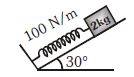
A block of mass $2\,\,kg$ is placed on a rough inclined plane as shown in the figure $(\mu  = 0.2)$ so that it just touches the spring. The block is allowed to move downwards. The spring will be compressed to a maximum of
Given below are two statements:

Statement $I:$ Acceleration due to earth's gravity decreases as you go 'up' or 'down' from earth's surface.

Statement $II:$ Acceleration due to earth's gravity is same at a height ' $h$ ' and depth ' $d$ ' from earth's surface, if $h = d$.

In the light of above statements, choose the most appropriate answer form the options given below
A planet moves around the sun. At a given point $P$, it is closest from the sun at a distance ${d_1}$ and has a speed ${v_1}$. At another point $ Q$, when it is farthest from the sun at a distance ${d_2}$, its speed will be
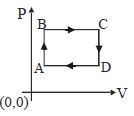
The figure shows $P-V$ diagram of a thermodynamic cycle. Which corresponding curve is correct?
In a simple harmonic oscillator, at the mean position
If the diameter of a capillary tube is doubled, then the height of the liquid that will rise is