Which of the following statement is true
Easy
Download our app for free and get started
(d) When charged particle enters perpendicularly in a magnetic field, it moves on a circular path with a constant speed. Hence it’s kinetic energy also remains constant.

Download our appand get started for free
Experience the future of education. Simply download our apps or reach out to us for more information. Let's shape the future of learning together!No signup needed.*
Similar Questions
- 1A milli voltmeter of $25$ $milli$ $volt$ range is to be converted into an ammeter of $25$ $ampere$ range. The value (in $ohm$) of necessary shunt will beView Solution
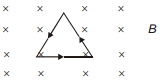
- 2A wire is bent in the form of an equilateral triangle of side $100 \,cm$ and carries a current of $2 \,A$. It is placed in a magnetic field of induction $2.0 \,T$ directed perpendicular into the plane of paper. The direction and magnitude of magnetic force acting on each side of the triangle will beView Solution
- 3A galvanometer has $30$ divisions and a sensitivity $16\,\mu A/{\rm{div}}{\rm{.}}$ It can be converted into a voltmeter to read $3\, V$ by connectingView Solution
- 4The magnetic field due to a current carrying circular loop of radius $3\, cm$ at a point on the axis at a distance of $4\, cm$ from the centre is $54\, \mu T$. What will be its value at the centre of the loop.......$\mu T$View Solution
- 5A thin, straight conductor lies along the axis of a hollow conductor of radius $R$. The two carry equal currents in the same direction. The magnetic field $B$ is plotted against the distance $r$ from the axis. Which of the following best represents the resulting curve?View Solution
- 6Two very long, straight, parallel wires carry steady currents $I$ and $-I$ respectively. The distance etween the wires is $d$. At a certain instant of time, a point charge $q$ is at a point equidistant from the two wires, in the plane of the wires. Its instantaneous velocity $v$ is perpendicular to the plane of wires. The magnitude of the force due to the magnetic field acting on the charge at this instant isView Solution
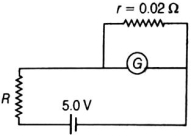
- 7In the circuit, shown the galvanometer $G$ of resistance $60\, \Omega$ is shunted by a resistance $r=0.02\, \Omega$. The current through $R$ (in $ohm$) is nearly $1\, A$. The value of resistance $R$ (in $ohm$) is nearly (in $\Omega$)View Solution
- 8A circular loop of radius $0.0157\,m$ carries a current of $2.0\, amp$. The magnetic field at the centre of the loop is$({\mu _0} = 4\pi \times {10^{ - 7}}\,weber/amp - m)$View Solution
- 9A homogeneous electric field $E$ and a uniform magnetic field $\mathop B\limits^ \to $ are pointing in the same direction. A proton is projected with its velocity parallel to $\mathop E\limits^ \to $. It willView Solution
- 10A small circular loop of conducting wire has radius $a$ and carries current $I$. It is placed in a uniform magnetic field $\mathrm{B}$ perpendicular to its plane such that when rotated slightly about its diameter and released, it starts performing simple harmonic motion of time period $T$. If the mass of the loop is $m$ thenView Solution