MCQ
Which of the following subatomic particle is lightest?
  • A
    Neutron
  • B
    Alpha particle
  • Electron
  • D
    Deuterium

Answer

Correct option: C.
Electron

Alpha particle has highest mass of the given option which is he rest mass of the alpha particle amounts to $6.64424 \times 10^{-27} \mathrm{~kg}$. Mass of neutron is $1.0086654 a.m.u.$
Mass of electrons $=9.10938291 \times 10^{-31}$ kilograms.
Hence mass of alpha particle is greatest.

Need a full question paper?

Generate a complete, print-ready paper with questions like this in minutes — across 16+ boards, with answer keys.
Start Generating Free

Similar questions

Assertion : The film which appears bright in reflected system will appear dark in the transmitted light and vice-versa.
Reason : The conditions for film to appear bright or dark in reflected light are just reverse to those in the transmitted light.
Two identical metallic spheres $A$ and $B$ when placed at certain distance in air repel each other with a force of $F$. Another identical uncharged sphere $C$ is first placed in contact with $A$ and then in contact with $B$ and finally placed at midpoint between spheres $A$ and $B$. The force experienced by sphere $C$ will be.
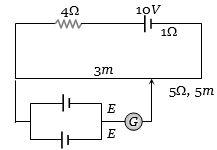
A resistance of $4\,\Omega $ and a wire of length $5\,m$ and resistance $5\,\Omega $ are joined in series and connected to a cell of $e.m.f.$ $10\, V$ and internal resistance $1\,\Omega $. A parallel combination of two identical cells is balanced across $300\, cm$ of the wire. The $e.m.f.$ $E$ of each cell is ........... $V$
Two cells of $emfs$ $E_1$ and $E_2$ and internal resistances $r_1$ and $r_2$ are connected in parallel. The $emf$ and internal resistance of the equivalent source is
An electron is accelerated from rest through a potential difference of $V$ volt. If the de Broglie wavelength of the electron is $1.227 \times 10^{-2}\, nm ,$ the potential difference is $......V$
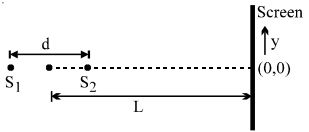
The figure shows two points source which emit light of wavelength $\lambda$ in phase with each other and are at a distance $d = 5.5 \lambda$ apart along a line which is perpendicular to a large screen at a distance $L$ from the centre of the source. Assume that $d$ is much less than $L$. Which of the following statement is (are) correct?
$f_v$ and $f_r$ are the focal lengths of a convex lens for violet and red light respectively and $F_v$ and $F_r$ are the focal lengths of a concave lens for violet and red light respectively, then
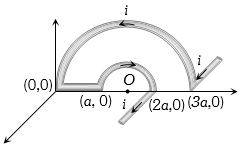
In the given figure net magnetic field at $O$ will be
For comparing the e.m.f.'s of two cells with a potentiometer, a standard cell is used to develop a potential gradient along the wires. Which of the following possibilities would make the experiment unsuccessful
Image of an object approaching a convex mirror of radius of curvature $20 \mathrm{~m}$ along its optical axis is observed to move from $\frac{25}{3} \mathrm{~m}$ to $\frac{50}{7} \mathrm{~m}$ in 30 seconds. What is the speed of the object in $\mathrm{km}$ per hour?