Question
Which of the species have same bond order and paramagnetic? Give reason.$\text{N}_2,\text{F}^+_2,\text{N}^-_2,\text{O}^-_2$

Answer

$\text{F}^+_2$ and $\text{O}^-_2$ have same bond order, i.e. $\frac32$ because these are isoelectronic $\text{F}^+_2$ and $\text{O}^-_2$ are paramagnetic due to presence of unpaired electrons.

Need a full question paper?

Generate a complete, print-ready paper with questions like this in minutes — across 16+ boards, with answer keys.

Start Generating Free

Similar questions

Lithium resembles magnesium in some of its properties. Mention two such properties and give reasons for this resemblance.
Why does fluorine not show disporportionation reaction?
Determine the molecular formula of an oxide of iron, in which the mass per cent of iron and oxygen are 69.9 and 30.1, respectively.
Note: Given that the molar mass of the oxide is $159.69 \mathrm{~g} \mathrm{~mol}^{-1}$
For the reaction : $\text{N}_2\text{(g)}+\text{3H}_2\text{(g)}\rightleftharpoons\text{2NH}_3\text{(g)}$ Equilibrium constant $\text{K}_\text{c}=\frac{[\text{NH}_3]^2}{[\text{N}_2][\text{H}_2]^3}$ Some reactions are written below in Column I and their equilibrium constants in terms of $\text{K}_\text{c}$ are written in Column II. Match the following reactions with the corresponding equilibrium constant.
Column I (Reaction) Column II (Equilibrium constant)
i. $2\text{N}_2\text{(g)}+\text{6H}_2\text{(g)}\rightleftharpoons\text{4NH}_3\text{(g)}$ a. $2\text{K}_\text{c}$
ii. $2\text{NH}_3\text{(g)}\rightleftharpoons\text{N}_2\text{(g)}+\text{3H}_2\text{(g)}$ b. $\text{K}_\text{c}^\frac{1}{2}$
iii. $\frac{1}{2}\text{N}_2\text{(g)}+\frac{3}{2}\text{H}_2\text{(g)}\rightleftharpoons\text{NH}_3\text{(g)}$ c. $\frac{1}{\text{K}_\text{c}}$
    d. $\text{K}_\text{c}^2$
1. The fact that the enthalpy is a state function forms the basis of a very useful law. Name the law.
2. Two liters of an ideal gas at a pressure of 10 atm expands isothermally at $25^{\circ} C$ into a vacuum until its total volume is 10 liters. How much heat is absorbed and how much work is done in the expansion?
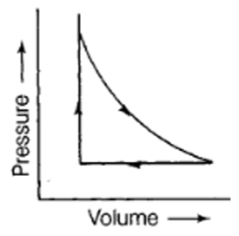
3. A sample of 1.0 mole of a monoatomic ideal gas is taken through a cyclic process of expansion and compression as shown in the figure. What will be the value of $\Delta H$ for the cycle as a whole?
Image
Calculate the mass of sodium acetate $\left(\mathrm{CH}_3 \mathrm{COONa}\right)$ required to make 500 mL of 0.375 molar aqueous solution. Molar mass of sodium acetate is $82.0245 \mathrm{~g} \mathrm{~mol}^{-1}$.
Why do beryllium and magnesium not impart colour to the flame in the flame test?
What happens when:
  1. Magnesium is burnt in air.
  2. Quick lime is heated with silica?
Explain the following:
$Pb^{4+}$ acts as an oxidising agent but $Sn^{2+}$ acts as a reducing agent.
Justify the following statements.
  1. Reactions with $\Delta\text{G}<0$ always have an equilibrium constant greater than 1.
  2. Many thermodynamically feasible reactions do not occur under ordinary conditions.
  3. At low temperatures, enthalpy change dominates the $\Delta\text{G}$ expression and at high temperatures, it is the entropy which dominates the value of $\Delta\text{G}.$