Question
Why does fluorine not show disporportionation reaction?

Answer

In a disproportionation reaction, the same species is simultaneously oxidised as well as reduced. Therefore, for such a redox reaction to occur, the reacting species must contain an element which has adeast three oxidation states.
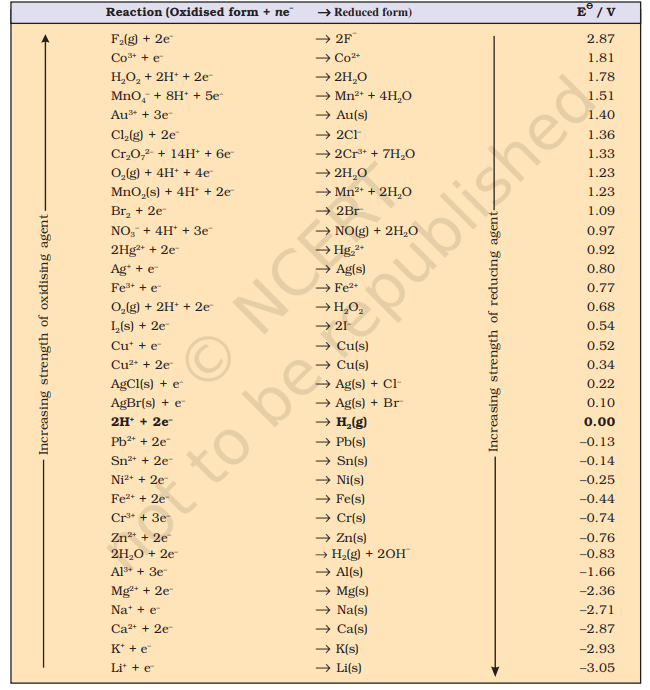
The element, in reacting species, is present in an intermediate state while lower and higher oxidation states are available for reduction and oxidation to occur (respectively). Fluorine is the strongest oxidising agent. It does not show positive oxidation state. That’s why fluorine does not show disproportionation reaction.
Need a full question paper?

Generate a complete, print-ready paper with questions like this in minutes — across 16+ boards, with answer keys.

Start Generating Free

Similar questions

A bulb emits light of wavelength $4500\mathring{\text{A}}.$ The bulb is rated as 150 watt and 8% energy is emitted as light. How many photons are emitted by the bulb per second?
$\left[\mathrm{h}=6.626 \times 10^{-34} \mathrm{J} \mathrm{s}\right]$
Among the elements of second period Li to Ne, pick out element:
  1. With the highest first ionisation energy.
  2. With highest electronegativity.
  3. With largest atomic radius.
  4. That is most reactive non-metal.
  5. That is most reactive metal.
  6. With valency equal to 4.
Calculate
  1. Dissociation constant of conjugate base of HF, $K_a = 6.8 \times 10^{-4}$.
  2. Dissociation constant of conjugate acid of $\text{CO}^{2-}_3,\text{K}_{\text{b}}=2.1\times10^{-4}$
0.5 mole each of $\mathrm{H}_2 \mathrm{~S}$ and $\mathrm{SO}_2$ mixed together in a reaction Flask, react according to equation:
$2 \mathrm{H}_2 \mathrm{~S}+\mathrm{SO}_2 \rightarrow 2 \mathrm{H}_2+3 \mathrm{~S}$
Calculate the number of moles of 'S' formed.
Find:
  1. The total number and.
  2. The total mass of neutrons in 7 mg of 14C.
(Assume that mass of a neutron = 1.675 × 10⁻²⁷kg).
Explain the following terms:
  1. Photochemical smog.
  2. Acid rain.
  3. Eutrophication.
Predict the products of electrolysis in the following:
An aqueous solution of $AgNO_3$ with silver electrodes.
a. Which out of the following can be used to those sodium metal and why $C _2 H _5 OH , C _6 H _6, H _2 O$
b. Why does tendency to form hydrates of halides of group decreases down the group.
c. A compound 'A' is used for recover ammonia from $NH _4 Cl$ in Solvay's process. Identify 'A' and write chemical equation for the reaction.
Find the temperature at which liquid water and water vapour will be in equilibrium.
$
\left(\Delta H_{\text {vap }}=40.73 kJ mol^{-1}=40.73 \times 1000 J mol^{-1}\right)
$
Using the standard electrode potentials given in the Table, predict if the reaction between the following is feasible:
$\mathrm{Ag}^{+}(\mathrm{aq})$ and $\mathrm{Cu}(\mathrm{s})$.