MCQ
Which one of the following cannot function as an oxidising agent ?
  • $I^-$
  • B
    $S(s)$
  • C
    $NO_3^ - \left( {aq} \right)$
  • D
    $Cr_2O_7^{2 - }$

Answer

Correct option: A.
$I^-$
a
If an electronegative element is in its lowest possible oxidation state in a compound or in free state. It can function as a powerful reducing agent.
e.g. $I^-$

Need a full question paper?

Generate a complete, print-ready paper with questions like this in minutes — across 16+ boards, with answer keys.

Start Generating Free

Similar questions

Match the colum
Column $-I$ Column $-II$
(Atomic number) (Position of element
in Periodic table)
$(A)$   $Z = 37$ $(P)$   $p-$ block
$(B)$   $Z = 42$ $(Q)$   $f-$ block
$(C)$   $Z = 34$ $(R)$   $d-$ block
$(D)$   $Z = 92$ $(S)$   $s-$ block
Consider the molecules $CH_4, NH_3$ and $H_2O.$ Which of the given statements is false?
A mixture of $0.3$ mole of ${H_2}$ and $0.3$ mole of ${I_2}$ is allowed to react in a $10$ litre evacuated flask at ${500\,^o}C$. The reaction is ${H_2} + {I_2}$ $\rightleftharpoons$ $2HI$, the $K$ is found to be $64$. The amount of unreacted ${I_2}$ at equilibrium is ......mole
A compound contains $69.5\%$ oxygen and $30.5\%$ nitrogen and its molecular weight  is $92.$ The molecular formula of the compound is
Which of the following compound give diastereomers when treated with $Br_2$ in  $CCl_4$ ?
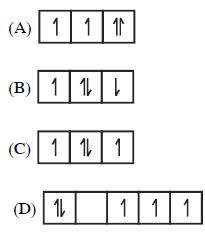
The portion of orbital diagrams representing the electronic configuration of certain elements shown below. Which of them violet Pauli’s Exclusion principle?
$IUPAC$ name of $C{H_3} - \mathop {\mathop {CH}\limits_{|\,\,\,\,\,\,\,} }\limits_{C{H_3}} - C{H_2} - \mathop {\mathop {CH}\limits_{|\,\,\,\,\,\,} }\limits_{CN\,} - C{H_3}$
Which is incorrect from the following ?
In $1 L$ saturated solution of $AgCl \left[ K _{ sp }( AgCl )=1.6 \times 10^{-10}\right]$, $0.1$ mol of CuCl $\left[ K _{ sp }( CuCl )=1.0 \times 10^{-6}\right]$ is added. The resultant concentration of $Ag ^{+}$in the solution is $1.6 \times 10^{-x}$. The value of " $x$ " is
$\sigma_{\text{C}-\text{C}} :4 ;\ \sigma_{\text{C}-\text{H}}:6;\ \pi_{\text{C}=\text{C}}:1; \ \pi_{\text{C}\equiv\text{C}}:2$ These number of $\sigma$ and $\pi$-bonds are present in which of the following molecule?