Question
A violin player riding on a slow train plays a $440\ Hz$ note. Another violin player standing near the track plays the same note. When the two are close by and the train approaches the person on the ground, he hears $4.0$ beats per second. The speed of sound in air $= 340m/s.$
  1. Calculate the speed of the train.
  2. What beat frequency is heard by the player in the train?
Answer

Given, Frequency of violins $f_{0 }= 440\ Hz$ Speed of sound in air $v = 340ms^{-1}$
Let the velocity of the train $($sources$)$ be $v_{s.}​​​​​​​$
  1. Beat heard by the standing man $= 4$
$\therefore\ \text{Frequency (f}_1)=440+4$
$\text{f}_1=444\text{Hz or 436 Hz}$
Now,
$\text{f}_1=\Big(\frac{340}{340-\text{v}_\text{s}}\Big)\times\text{f}_0$
On substituting the values,
We have,
$444=\Big(\frac{340+0}{340-\text{v}_\text{s}}\Big)\times440$
$\Rightarrow444(340-\text{v}_\text{s})=440\times340$
$\Rightarrow340\times(444-440)=440\times\text{v}_\text{s}$
$\Rightarrow340\times4=440\times\text{v}_\text{s}$
$\Rightarrow\text{v}_\text{s}=3.09\text{m/ s}=11\text{km/ h}$
  1. The sitting man will listen to fewer than $4$ beats/$-s. $

Need a full question paper?

Generate a complete, print-ready paper with questions like this in minutes — across 16+ boards, with answer keys.

Start Generating Free

Similar questions

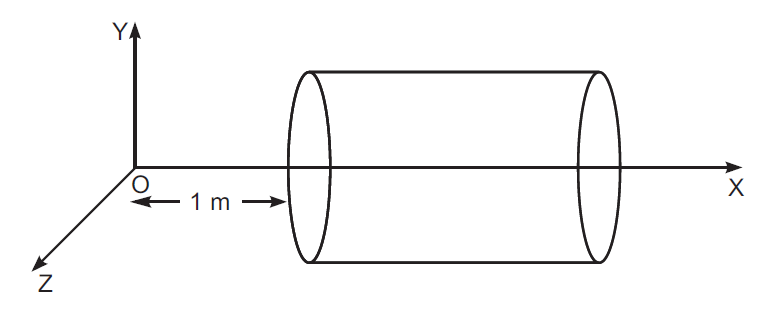
A hollow cylindrical box of length $1 m$ and area of cross$-$section $25 \ cm^2$ is placed in a three dimensional coordinate system as shown in the figure. The electric field in the region is given by$\overrightarrow{\text{E}} = 50\text{x}\hat{\text{i}},$ where $E$ is in $NC^{–1}$ and $x$ is in metres. Find
  1. Net flux through the cylinder.
  2. Charge enclosed by the cylinder.
What are the utilities of moderator, coolant and controlling rods with reference to nuclear reactor.
In Bohr’s theory of hydrogen atom, calculate the energy of the photon emitted during a transition of the electron from the first excited state to the ground state. Write in which region of the electromagnetic spectrum this transition lies.
What happens to the intensity of light from a bulb if the distance from the bulb is doubled? As a laser beam travels across the length of a room, its intensity essentially remains constant. What geomatrical characteristic of LASER beam is responsible for the constant intensity which is missing in the case of light from the bulb?
$2g$ of hydrogen is sealed in a vessel of volume $0.02m^3$ and is maintained at $300K$. Calculate the pressure in the vessel.
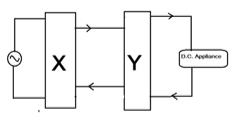
(I) Identify the circuit elements X and Y as shown in the given block diagram and draw the output waveforms of X and Y.

Image

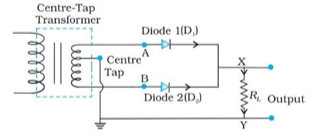
(II) If the centre tapping is shifted towards Diode D1 as shown in the diagram, draw the output waveform of the given circuit.

Image
Find the ratio of the lengths of an iron rod and an aluminium rod for which the difference in the lengths is independent of temperature. Coefficients of linear expansion of iron and aluminium are $12 \times 10^{-6}{ }^{\circ} \mathrm{C}^{-1}$ and $23 \times 10^{-6}{ }^{\circ} \mathrm{C}^{-1}$ respectively.
A parallel$-$plate capacitor with plate area $20\ cm^2$ and plate separation $1.0\ mm$ is connected to a battery. The resistance of the circuit is $10\text{k}\Omega.$ Find the time constant of the circuit.
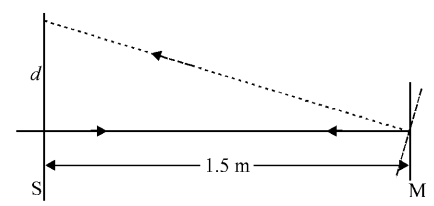
Light incident normally on a plane mirror attached to a galvanometer coil retrace backwards (as shown in Fig.). A current in the coil produces a deflection of 3.5° of the mirror. What is the displacement of the reflected spot of light on a screen placed 1.5 m away? Image
A long charged cylinder of linear charge density $+\lambda_1$ is surrounded by a hollow coaxial conducting cylinder of linear charge density $-\lambda_2$. Use Gauss’s law to obtain expressions for the electric field at a point (i) in the space between the cylinders, and (ii) outside the larger cylinder.