Given $n$ resistors each of resistance $$R, how will you combine them to get the $(i)$ maximum $(ii)$ minimum effective resistance? What is the ratio of the maximum to minimum resistance?
Exercise
Download our app for free and get started
Total number of resistors $= n$ Resistance of each resistor $= R$
- When n resistors are connected in series, effective resistance $R_1$ is the maximum, given by the product nR.
- When n resistors are connected in parallel, the effective resistance $(R_2)$ is the minimum, given by the ratio $\frac{\text{R}}{\text{n}}.$
- The ratio of the maximum to the minimum resistance is,

Download our appand get started for free
Experience the future of education. Simply download our apps or reach out to us for more information. Let's shape the future of learning together!No signup needed.*
Similar Questions
- 1What length of a copper wire of cross$-$sectional area $0.01\ mm^2$ will be needed to prepare a resistance of $1\text{k}\Omega?$ Resistivity of copper $=1.7\times10^{-8}\Omega\text{-m}.$View Solution
- 2A heating element using nichrome connected to a $230 V$ supply draws an initial current of $ 3.2 A$ which settles after a few seconds to a steady value of $2.8 A$. What is the steady temperature of the heating element if the room temperature is $27.0^\circ C?$ Temperature coefficient of resistance of nichrome averaged over the temperature range involved is $1.70\times10^{-4}{^\circ\text{C}}^{-1}.$View Solution
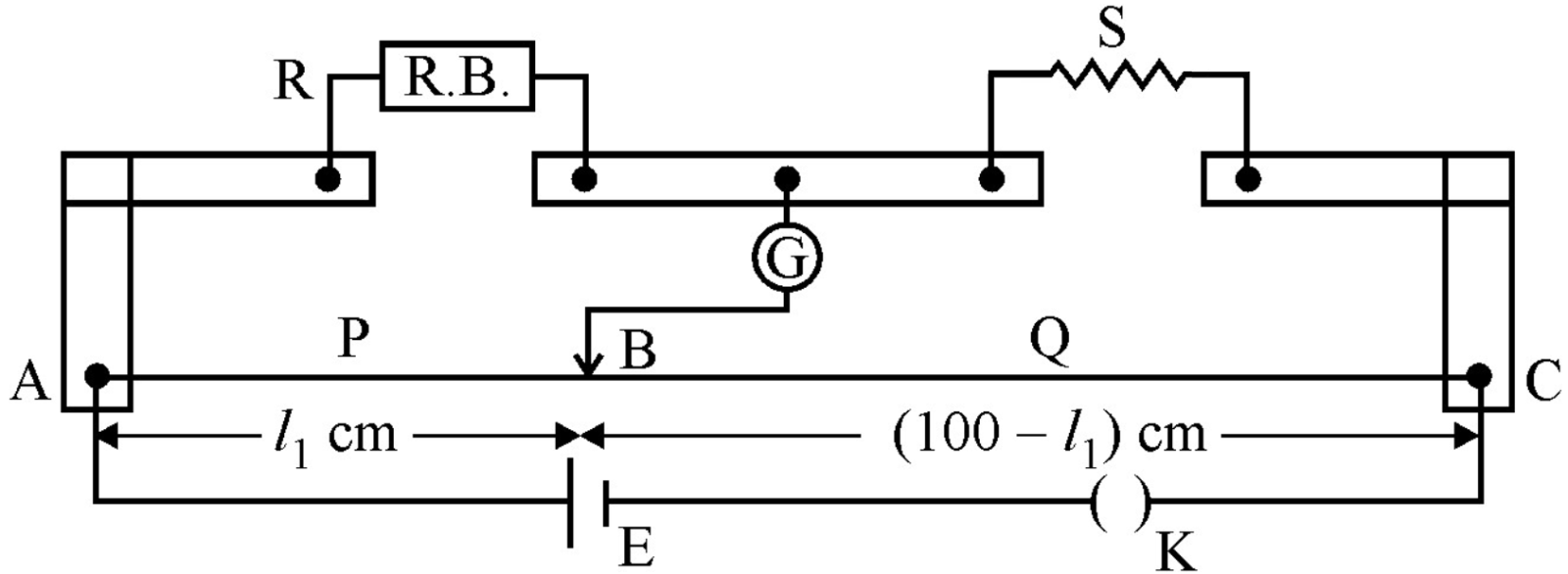
- 3What is end error in a metre bridge? How is it overcome? The resistances in the two arms of the metre bridge are $\text{R}=5\Omega$ and $S$ respectively. When the resistance $S$ is shunted with an equal resistance, the new balance length found to be $1.5 l_1 ,$ where $l_1$ is the initial balancing length. Calculate the value of $S.$View Solution
- 4View SolutionTwo wires A and B of the same material and having same length, have their cross sectional areas in the ratio 1 : 6. What would be the ratio of heat produced in these wires when same voltage is applied across each?
- 5View SolutionName the charge carriers of electric current in:
- Silver foil.
- Hydrogen discharge tube.
- Germanium semiconductor.
- Wire made of alloy nichrome.
- Superconductor.
- 6View SolutionA cylindrical metallic wire is stretched to increase its length by 10%. Calculate the percentage increase in its resistance.
- 7Three resistors $1\ \Omega,\ 2\ \Omega$ and $3\ \Omega$ are combined in series. What is the total resistance of the combination?View Solution
If the combination is connected to a battery of emf $12 V$ and negligible internal resistance, obtain the potential drop across each resistor. - 8View SolutionA voltage of 30V is applied across a carbon resistor with first, second and third rings of blue, black and yellow colours respectively. Calculate the value of current in mA, through the resistor.
- 9View SolutionA number of identical cells, n, each of emf E, internal resistance r connected in series are charged by a d.c. source of emf E', using a resistor R.
- Draw the circuit arrangement.
- Deduce the expressions for (a) the charging current and (b) the potential difference across the combination of the cells.
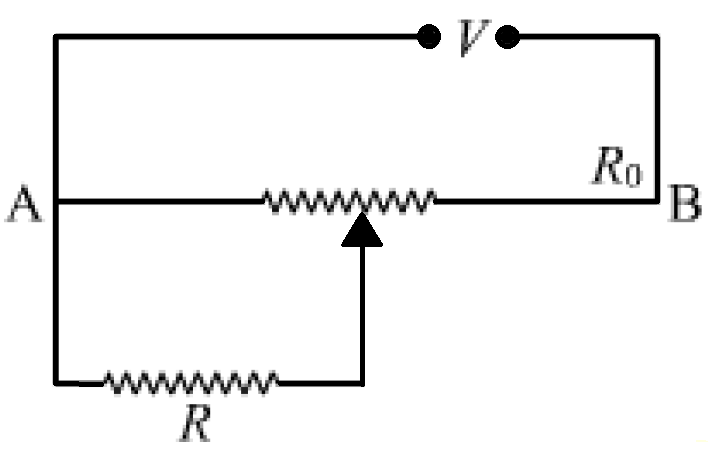
- 10A resistance of $R$ draws current from a potentiometer. The potentiometer wire, $AB,$ has a total resistance of $R_o$. A voltage $V$ is supplied to the potentiometer. Derive an expression for the voltage across $R$ when the sliding contact is in the middle of potentiometer wire.View Solution