If $l_1, l_2, l_3$ are the lengths of the emitter, base and collector of a transistor then
[KCET 2002]


Download our appand get started for free
Experience the future of education. Simply download our apps or reach out to us for more information. Let's shape the future of learning together!No signup needed.*
Similar Questions
- 1View SolutionThe electrical resistance of depletion layer is large because
- 2In a semiconducting material the mobilities of electrons and holes are $\mu$ and $\mu$ respectively. Which of the following is trueView Solution
- 3View SolutionWhich of the following energy band diagram shows the N-type semiconductor
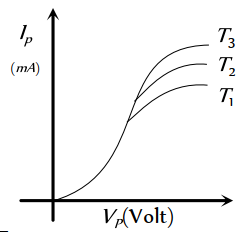
- 4View SolutionFor the diode, the characteristic curves are given at different temperature. The relation between the temperatures is
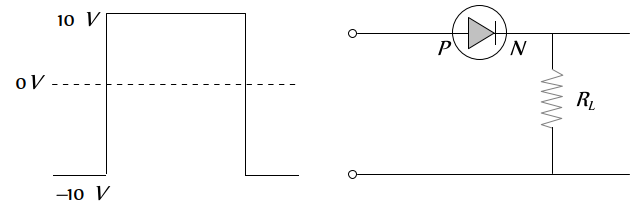
- 5If the following input signal is sent through a $P N$-junction diode, then the output signal across $R$ will beView Solution
- 6View SolutionThe transistors provide good power amplification when they are used in
- 7The width of forbidden gap in silicon crystal is $1.1\ eV$. When the crystal is converted in to a $N$-type semiconductor the distance of Fermi level from conduction band isView Solution
- 8Plate resistance of two triode valves is $2 k \Omega$ and $4 k \Omega$, amplification factor of each of the valves is $40.$ The ratio of voltage amplification, when used with $4 k \Omega$ load resistance, will beView Solution
- 9In a transistor in $CE$ configuration, the ratio of power gain to voltage gain isView Solution
- 10View SolutionA N-type semiconductor is