With the help of a labelled diagram, explain how a concave lens diverges a beam of parallel light rays.
Download our app for free and get started
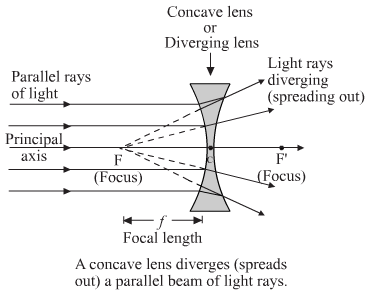 When a beam of light rays parallel to one another and also to the principal axis of the concave lens fall on the lens, the incident rays pass through the lens and get refracted according to the laws of refraction. All the rays spread out after passing through the lens. These diverging rays when produced backwards appear to meet at a point F (focus) on the left side of the lens.
Download our appand get started for free
Experience the future of education. Simply download our apps or reach out to us for more information. Let's shape the future of learning together!No signup needed.*
Similar Questions
- 1View SolutionName the type of mirrors used in the design of solar furnaces. Explain how high temperature is achieved by this device.
- 2View SolutionAn object is placed at a distance of 30 cm from a concave lens of focal length 15 cm. List four characteristics (nature, position, etc.) of the image formed by the lens.
- 3View SolutionWhat type of lens is shown in the diagram on the right? What will happen to the parallel rays of light? Show by completing the ray diagram.
- 4View SolutionWith the help of a ray diagram, determine the position, nature and size of the image formed of an object placed at the centre of curvature of a concave mirror.
- 5View SolutionA lens has a focal length of, -10cm. What is the power of the lens and what is its nature?
- 6View SolutionWhy can you not use a concave mirror as a rear-view mirror in vehicles?
- 7View SolutionState two factors on which the lateral displacement of the emergent ray depends.
- 8View SolutionYou are provided with two lenses of focal lengths 10cm and 20cm. Which of the two lenses would you suggest to obtain greater convergence on refracted light? Justify your choice.
- 9The speed of light in water is $2.25 \times 10^8 m / s$. If the speed of light in vacuum be $3 \times 10^8 m / s$, calculate the refractive index of water.View Solution
- 10View SolutionAn object is placed at the following distance from a convex lens of focal length 15cm:
- 35cm
- 30cm
- 20cm
- 10cm
- A magnified real image?
- A magnified virtual image?
- A diminished real image?
- An image of same size as the object?