Question
With the help of a suitable example, explain how ionic compounds are formed State any three general properties of ionic compounds.

Answer

Ionic compounds are formed when a metal and a non metal react with each other.ie, positive and negative charges. eg: Na(metal) + Cl(non memtal) - NaCl
Properties: Ionic compounds have a strong electrostatic force of attraction. They have high melting and boiling points. They can dissolve in other ionic compunds like water.

Need a full question paper?

Generate a complete, print-ready paper with questions like this in minutes — across 16+ boards, with answer keys.
Start Generating Free

Similar questions

When a person puts food in his mouth, then teeth cut it into small pieces, chew and grind it. The glands A in the mouth secrete a substance B which is mixed with the food by tongue. The substance B contains an enzyme C which starts the digestion of food in the mouth. The slightly digested food from the mouth goes down a tube D. The special type of movements E in the walls of tube D push the food into stomach for further digestion. The stomach wall secretes gastric juice containing three substance F, G and H. One of the functions of F is to kill bacteria which may enter the stomach with food. The substance G protects the inside layer of stomach from the damaging effect of substance F whereas substance H is and enzyme for digestion. The partially digested food then enters into small intestine for further digestion.
  1. What is Gland A, Substance B and Enzyme C?
  2. Name the tube D.
  3. What is the movement E known as?
  4. What are F, G and H?
  1. If the image formed by a mirror for all positions of the object placed in front of it is always diminished, erect and virtual, state the type of the mirror and also draw a ray diagram to justify your answer. Write one use such mirrors are put to and why.
  2. Define the radius of curvature of spherical mirrors. Find the nature and focal length of a spherical mirror whose radius of curvature is + 24 cm.
  1. Define focal length of a divergent lens.
  2. A divergent lens of focal length 30 cm forms the image of an object of size 6 cm on the same side as the object at a distance of 15 cm from its optical centre. Use lens formula to determine the distance of the object from the lens and the size of the image formed.
  3. Draw a ray diagram to show the formation of image in the above situation.
At what distance from a concave mirror of focal length 10cm should an object be placed so that:
  1. Its real image is formed 20cm from the mirror?
  2. Its virtual image is formed 20cm from the mirror?
How are evolutionary relations between organisms traced?
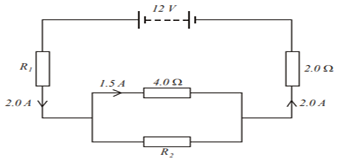
Image
The above circuit is a part of an electrical device. Use the information given in the question to calculate the following.
$(i)$ Potential Difference across $R_2.$
$(ii)$ Value of the resistance $R_2.$
$(iii)$ Value of resistance $R_1$​​​​​​​
When a high resistance voltmeter is connected directly across a resister its reading is 2V. An electric cell is sending the current of 0.4 A, (measured by an ammeter) in the electric circuit
in which a rheostat is also connected to vary the current.
  1. Draw an equivalent labelled circuit for the given data.
  2. Find the resistance of the resister.
  3. Name and state the law applicable in the given case. A graph is drawn between a set of values of potential difference (v) across the resister and current (I) flowing through it.
Show nature of graph thus obtained.
Why does a magnetic compass needle pointing North and South in the absence of a nearby magnet get deflected when a bar magnet or a current carrying loop is brought near it. Describe some salient features of magnetic lines of field concept.
i. Name the mode of reproduction of the following organisms and state the important feature of each mode :
a. Planaria
b. Hydra
c. Rhizopus
ii. We can develop new plants from the leaves of Bryophyllum. Comment.
iii. List two advantages of vegetative propagation over other modes of reproduction.
  1. What is scattering of light? Explain how the colour of the scattered light depends on the size of the scattering particles.
  2. Explain the reddish appearance of the Sun at sunrise or sunset. Why does it not appear red at noon?