MCQ
With the propagation of a longitudinal wave through a material medium, the quantities transmitted in the propagation direction are
  • A
    Energy, momentum and mass
  • B
    Energy
  • C
    Energy and mass
  • Energy and linear momentum

Answer

Correct option: D.
Energy and linear momentum
d
(d)

Need a full question paper?

Generate a complete, print-ready paper with questions like this in minutes — across 16+ boards, with answer keys.
Start Generating Free

Similar questions

Which of the following is not thermodynamical function
A particle executes simple harmonic motion between $x =- A$ and $x =+ A$. If time taken by particle to go from $x=0$ to $\frac{A}{2}$ is $2 s$; then time taken by particle in going from $x =\frac{ A }{2}$ to $A$ is $.........\,s$
The relation between two specific heats of a gas is
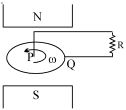
$A$ metal disc rotates freely, between the poles of a magnet in the direction indicated. Brushes $P$ and $Q$ make contact with the edge of the disc and the metal axle.What current, if any, flows through $R$?
A steady current $I$ is set up in a wire whose cross-sectional area decreases in the direction of the flow of the current. Then, as we examine the narrowing region,
A long solenoid with $20$ $turns$ per $cm$ is made. To produce a magnetic field of $20$ $millitesla$ inside the solenoid, the necessary current will nearly be......$ampere$
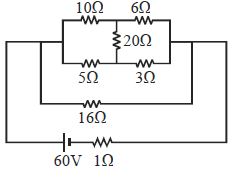
The current from the cell for the given circuit is ................ $\mathrm{A}$
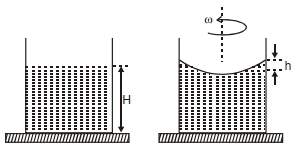
A beaker of radius $r$ is filled with water (refractive index $\frac{4}{3}$ ) up to a height $H$ as shown in the figure on the left. The beaker is kept on a horizontal table rotating with angular speed $\omega$. This makes the water surface curved so that the difference in the height of water level at the center and at the circumference of the beaker is $h(h \ll H, h \ll r)$, as shown in the figure on the right. Take this surface to be approximately spherical with a radius of curvature $R$. Which of the following is/are correct? ( $g$ is the acceleration due to gravity)

$(A)$ $R=\frac{h^2+r^2}{2 h}$

$(B)$ $R=\frac{3 r^2}{2 h}$

$(C)$ Apparent depth of the bottom of the beaker is close to $\frac{3 H }{2}\left(1+\frac{\omega^2 H }{2 g }\right)^{-1}$

$(D)$ Apparent depth of the bottom of the beaker is close to $\frac{3 H }{4}\left(1+\frac{\omega^2 H}{4 g }\right)^{-1}$
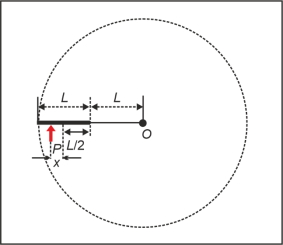
A thin uniform rod of length $L$ and certain mass is kept on a frictionless horizontal table with a massless string of length $L$ fixed to one end (top view is shown in the figure). The other end of the string is pivoted to a point $O$. If a horizontal impulse $P$ is imparted to the rod at a distance $x=L / n$ from the mid-point of the rod (see figure), then the rod and string revolve together around the point $O$, with the rod remaining aligned with the string. In such a case, the value of $n$ is. . . . . . 
A block is moving on an inclined plane making an angle $45^{\circ}$ with the horizontal and the coefficient of friction is $\mu$. The force required to just push it up the inclined plane is $3$ times the force required to just prevent it from sliding down. If we define $N=10 \ \mu$, then $N$ is