A long solenoid with $20$ $turns$ per $cm$ is made. To produce a magnetic field of $20$ $millitesla$ inside the solenoid, the necessary current will nearly be......$ampere$
Medium
Download our app for free and get started
$B=\mu_{0} n i ;$ where $n=\frac{20}{10} \frac{t u r n}{c m}$
$=2000 \frac{t u r n}{m} \cdot$ So, $20 \times 10^{-5}$
$=4 \pi \times 2000 \times i$
$\Rightarrow i=8 A$

Download our appand get started for free
Experience the future of education. Simply download our apps or reach out to us for more information. Let's shape the future of learning together!No signup needed.*
Similar Questions
- 1Two identical charged particles enter a uniform magnetic field with same speed but at angles $30^o$ and $60^o$ with field. Let $a, b$ and $c$ be the ratio of their time periods, radii and pitches of the helical paths thanView Solution
- 2Two very long, straight, parallel conductors $A$ and $B$ carry current of $5\,A$ and $10\,A$ respectively and are at a distance of $10\,cm$ from each other. The direction of current in two conductors is same. The force acting per unit length between two conductors is: $\left(\mu_0=4 \pi \times 10^{-7}\right.$ SI unit)View Solution
- 3Suppose an isolated north pole is kept at the centre of a circular loop carrying a electric current $i$. The magnetic field due to the north pole at a point on the periphery of the wire is $B$. The radius of the loop is $a$. The force on the wire isView Solution
- 4Given below are two statements: One is labelled as Assertion $(A)$ and the other is labelled as Reason $(R).$View Solution
Assertion $(A)$ : In an uniform magnetic field, speed and energy remains the same for a moving charged particle.
Reason $(R)$ : Moving charged particle experiences magnetic force perpendicular to its direction of motion.
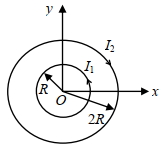
- 5Two concentric circular loops, one of radius $R$ and the other of radius $2 R$, lie in the $x y$-plane with the origin as their common center, as shown in the figure. The smaller loop carries current $I_1$ in the anti-clockwise direction and the larger loop carries current $I_2$ in the clockwise direction, with $I_2>2 I_1 . \vec{B}(x, y)$ denotes the magnetic field at a point $(x, y)$ in the $x y$-plane. Which of the following statement($s$) is(are) current?View Solution
$(A)$ $\vec{B}(x, y)$ is perpendicular to the $x y$-plane at any point in the plane
$(B)$ $|\vec{B}(x, y)|$ depends on $x$ and $y$ only through the radial distance $r=\sqrt{x^2+y^2}$
$(C)$ $|\vec{B}(x, y)|$ is non-zero at all points for $r$
$(D)$ $\vec{B}(x, y)$ points normally outward from the $x y$-plane for all the points between the two loops
- 6Given below are two statements: One is labelled as Assertion $A$ and the other is labelled as Reason $R$.View Solution
Assertion $A:$ For measuring the potential difference across a resistance of $600\,\Omega$, the voltmeter with resistance $1000\,\Omega$ will be preferred over voltmeter with resistance $4000\,\Omega$.
Reason $R:$ Voltmeter with higher resistance will draw smaller current than voltmeter with lower resistance.
In the light of the above statements, choose the most appropriate answer from the options given below.
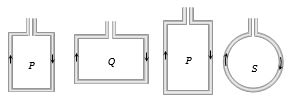
- 7Four wires each of length $2.0\, metres$ are bent into four loops $P$, $Q$, $R$ and $S$ and then suspended into uniform magnetic field. Same current is passed in each loop. Which statement is correctView Solution
- 8A moving coil galvanometer is converted into an ammeter reading upto $0.03\,A$ by connecting a shunt of resistance $4r$ across it and into an ammeter reading upto $0.06\,A$ when a shunt of resistance $r$ is connected across it. What is the maximum current which can be sent through this galvanometer if no shunt is used ............... $A$View Solution
- 9Consider two thin identical conducting wires covered with very thin insulating material. One of the wires is bent into a loop and produces magnetic field $B_1,$ at its centre when a current $I$ passes through it.The second wire is bent into a coil with three identical loops adjacent to each other and produces magnetic field $B_2$ at the centre of the loops when current $I/3$ passes through it. The ratio $B_1 : B_2$ isView Solution
- 10The region between $y = 0$ and $y = d$ contains a magnetic field $\vec B = B\hat z$ A particle of mass $m$ and charge $q$ enters the region with a velocity $\vec v = v\hat i$. If $d = \frac{{mv}}{{2qB}}$ , the acceleration of the charged particle at the point of its emergence at the other side isView Solution