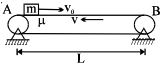
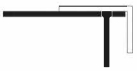
With what minimum velocity should block be projected from left end $A$ towards end $B$ such that it reaches the other end $B$ of conveyer belt moving with constant velocity $v$. Friction coefficient between block and belt is $\mu$ .
Medium


Download our appand get started for free
Experience the future of education. Simply download our apps or reach out to us for more information. Let's shape the future of learning together!No signup needed.*
Similar Questions
- 1A particle moves in a circular orbit under the action of a central attractive force inversely proportional to the distance $'r'$. The speed of the particle isView Solution
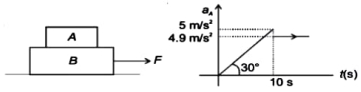
- 2Acceleration of block $A$ varies with time as shown in figure the value of coefficient of kinetic friction between block $A$ and $B$ is the value of coefficient of kinetic friction between block $A$ and $B$ is ..............View Solution
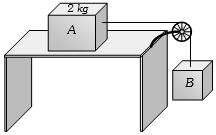
- 3The coefficient of static friction, ${\mu _s},$ between block $A$ of mass $2\, kg$ and the table as shown in the figure is $0.2$. ........ $kg$ would be the maximum mass value of block $B$ so that the two blocks do not move. The string and the pulley are assumed to be smooth and massless. $(g = 10\,m/{s^2})$View Solution
- 4A block slides down an inclined plane of slope of angle $\theta $ with a constant velocity. It is then projected up the plane with an initial velocity $u$. The distance upto which it will rise before coming to rest isView Solution
- 5A uniform rope of total length $l$ is at rest on a table with fraction $f$ of its length hanging (see figure). If the coefficient of friction between the table and the chain is $\mu$, thenView Solution
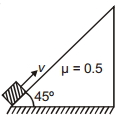
- 6A block of mass $1 \,kg$ is projected from the lowest point up along the inclined plane. If $g=10 \,ms ^{-2}$, the retardation experienced by the block is ............. $ms ^ {-2}$View Solution
- 7$A$ block of mass $M$ is placed on $a$ horizontal surface and it is tied with an inextensible string to $a$ block of mass, as shown in figure. A block of mass $m_0$ is also placed on $M$ If there is no friction between any two surfaces, thenView Solution

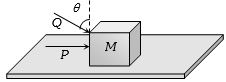
- 8A block of mass $m$ lying on a rough horizontal plane is acted upon by a horizontal force $P$ and another force $Q$ inclined at an angle $\theta $ to the vertical. The block will remain in equilibrium, if the coefficient of friction between it and the surface isView Solution
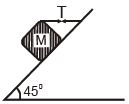
- 9A block of mass $15 \,kg $ is resting on a rough inclined plane as shown in figure. The block is tied up by a horizontal string which has tension of $50\,N$. The minimum coefficient of friction between the surfaces of contact is $(g = 10\,m/s^2)$View Solution
- 10When $F = 2N$, the frictional force between $5 kg$ block and ground is ...... $N$View Solution