A block slides down an inclined plane of slope of angle $\theta $ with a constant velocity. It is then projected up the plane with an initial velocity $u$. The distance upto which it will rise before coming to rest is
Difficult
Download our app for free and get started
Case $I\, :$ As the block slides down with constant
velocity, the acceleration is zero. In this case:
$\mathrm{f}=\mathrm{mg} \sin \theta$ and $\mathrm{f}=\mu \mathrm{R}=\mu \mathrm{mg} \cos \theta$
$\therefore \quad \mu m g \cos \theta=m g \sin \theta$ or $\mu=\tan \theta \quad \ldots$ $(i)$
Case $II\, :$ The block is projected upward with initial velocity $u$ and hence it experiences downward acceleration a. In this case,
$\mathrm{mg} \sin \theta+\mu \mathrm{mg} \cos \theta=\mathrm{ma}$
or $\operatorname{mg} \sin \theta+\operatorname{mg} \tan \theta \cos \theta=\operatorname{ma}$
or $\operatorname{mg}(\sin \theta+\sin \theta)=\operatorname{ma}$ or $a=2 g \sin \theta \ldots$ $(ii)$
Let $x$ be the distance moved up the plane before the block comes to rest. Now,
${v^{2}-u^{2}=2 a s \text { or } 0-u^{2}=2(-2 g \sin \theta) x} $
$\therefore$ ${x=\frac{u^{2}}{4 g \sin \theta}}$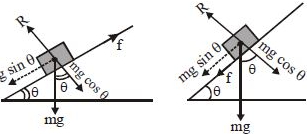

Download our appand get started for free
Experience the future of education. Simply download our apps or reach out to us for more information. Let's shape the future of learning together!No signup needed.*
Similar Questions
- 1A particle is moving in a circle of radius $R$ with constant speed $v$, if radius is double then its centripetal force to keep the same speed should beView Solution
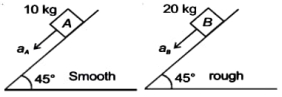
- 2The ratio of acceleration of blocks $A$ placed on smooth incline with block $B$ placed on rough incline is $2: 1$. The coefficient of kinetic friction between block $B$ and incline is .........View Solution
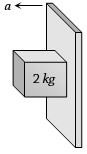
- 3A rough vertical board has an acceleration $‘a’$ so that a $2$ kg block pressing against it does not fall. The coefficient of friction between the block and the board should beView Solution
- 4View SolutionThe maximum static frictional force is
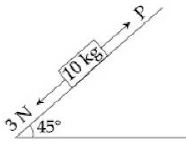
- 5A block of mass $10\, kg$ is kept on a rough inclined plane as shown in the figure. A force of $3\, N$ is applied on the block. The coefficient of static friction between the plane and the block is $0.6$. What should be the minimum value of force $P$, such that the block does not move downward? (take $g = 10\, ms^{-2}$) ........ $N$View Solution
- 6A train is running at $20 \,m / s$ on a railway line with radius of curvature $40,000$ metres. The distance between the two rails is $1.5$ metres. For safe running of train the elevation of outer rail over the inner rail is ......$mm$ $\left( g =10 \,m / s ^2\right)$View Solution
- 7A car having a mass of $1000\, kg$ is moving at a speed of $30\, metres/sec$. Brakes are applied to bring the car to rest. If the frictional force between the tyres and the road surface is $5000$ newtons, the car will come to rest in ........ $\sec$View Solution
- 8A car has to move on a level turn of radius $450\,m.$ If the coefficient of static friction between tyre and the road is $\mu = 0.2.$ Find the maximum speed the car can take without skidding is given by ........ $m/s$View Solution
- 9View SolutionWhich one of the following is not used to reduce friction
- 10A block weighs $W$ is held against a vertical wall by applying a horizontal force $F$. The minimum value of $F$ needed to hold the block is $[\mu < 1]$View Solution