MCQ
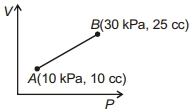
Work done for the process shown in the figure is ............ $J$
  • A
    $1$
  • B
    $1.5$
  • C
    $4.5$
  • $0.3$

Answer

Correct option: D.
$0.3$
d
(d)

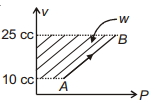
Area under graph and $V$ axis $=$ work done

$=\frac{1}{2} \times(30+10) \times 10^3 \times(25-10) \times 10^{-6}$

$=0.3 \,J$
Need a full question paper?

Generate a complete, print-ready paper with questions like this in minutes — across 16+ boards, with answer keys.
Start Generating Free

Similar questions

The length, tension, diameter and density of a wire $B$ are double than the corresponding quantities for another stretched wire $A$. Then.
When a torque acting upon a system is zero, which of the following will be constant?
A force of $19.6\, N$ when applied parallel to the surface just moves a body of mass $10 \,kg$ kept on a horizontal surface. If a $5\, kg$ mass is kept on the first mass, the force applied parallel to the surface to just move the combined body is........ $N.$ 
A ball of mass $m$ moves with speed $v$ and strikes a wall having infinite mass and it returns with same speed then the work done by the ball on the wall is
Two stars emit maximum radiation at wavelength $3600Å$ and $4800Å$ respectively. The ratio of their temperatures is
Two sinusoidal waves with same wavelengths and amplitudes travel in opposite directions along a string with a speed $10 ms^{-1}$. If the minimum time interval between two instants when the string is flat is $0.5\, s$, the wavelength of the waves is .... $m$
An $8\,m$ long copper wire and $4\,m$ long steel wire, each of cross section $0.5\,cm^2$ are fastened end to end and stretched by $500\,N$ force. The elastic potential energy of the system is (Youngs mod $: Y_{cu}= 1\times 10^{11}\,N/m^2,$ $Y_{steel} = 2\times 10^{11}\,N/m^2$ ) :
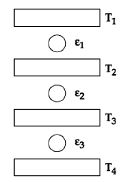
Three Carnot engines operate in series between a heat source at a temperature $T_1$ and a heat sink at temperature $T_4$ (see figure). There are two other reservoirs at temperature $T_2$ and $T_3$, as shown, with $T_1 > T_2 > T_3 > T_4$. The three engines are equally efficient if
An ideal gas is expanded adiabatically at an initial temperature of $300 K$ so that its volume is doubled. The final temperature of the hydrogen gas is $(\gamma = 1.40)$
At what point of a projectile motion acceleration and velocity are perpendicular to each other