Question
Would you prefer a material with a high work-function or a low work-function to be used as a cathode in a diode?

Answer

We will prefer a material with low work-function to be used as a cathode in a diode, so that electron emission can occur using a small amount of energy.

Need a full question paper?

Generate a complete, print-ready paper with questions like this in minutes — across 16+ boards, with answer keys.

Start Generating Free

Similar questions

Read the passage given below and answer the following questions from (i) to (v). There are no physical examples of absolutely pure simple harmonic motion. In practice we come across systems that execute simple harmonic motion approximately under certain conditions. Oscillations due to a spring: The simplest observable example of simple harmonic motion is the small oscillations of a block of mass m fixed to a spring, which in turn is fixed to a rigid wall. The block is placed on a frictionless horizontal surface. If the block is pulled on one side and is released, it then executes a to and fro motion about the mean position. Let x = 0, indicate the position of the centre of the block when the spring is in equilibrium. The positions marked as –A and +A indicate the maximum displacements to the left and the right of the mean position. We have already learnt that springs have special properties, which were first discovered by the English physicist Robert Hooke. He had shown that such a system when deformed is subject to a restoring force, the magnitude of which is proportional to the deformation or the displacement and acts in opposite direction. This is known as Hooke’s law. It holds good for displacements small in comparison to the length of the spring. At any time t, if the displacement of the block from its mean position is x, the restoring force F acting on the block is, F(x) = –k x The constant of proportionality, k, is called the spring constant, its value is governed by the elastic properties of the spring. A stiff spring has large k and a soft spring has small k. Equation is same as the force law for SHM and therefore the system executes a simple harmonic motion.Damped oscillations
We know that the motion of a simple pendulum, swinging in air, dies out eventually. Why does it happen? This is because the air drag and the friction at the support oppose the motion of the pendulum and dissipate its energy gradually. The pendulum is said to execute damped oscillations. In damped oscillations, the energy of the system is dissipated continuously; but, for small damping, the oscillations remain approximately periodic. The dissipating forces are generally the frictional forces. The damping force is generally proportional to velocity of the bob and acts opposite to the direction of velocity. If the damping force is denoted by $F_d$, we have $F_d = –b_v$ where the positive constant b depends on characteristics of the medium (viscosity, for example) and the size and shape of the block, is usually valid only for small velocity.
  1. Damping force is directly proportional to:
  1. Velocity
  2. Area
  3. Acceleration
  4. None of these
  1. Oscillations due to spring performs SHM for:
  1. Only small oscillations of spring
  2. Only for large oscillations of spring
  3. Both large as well as small oscillations of spring
  4. None of these
  1. Give expression for restoring force in spring while performing small SHM oscillations.
  2. Explain damped oscillations.
  3. Explain oscillations due to spring.
Read the passage given below and answer the following questions from 1 to 5. Every measurement involves errors. Thus, the result of measurement should be reported in a way that indicates the precision of measurement. Normally, the reported result of measurement is a number that includes all digits in the number that are known reliably plus the first digit that is uncertain. The reliable digits plus the first uncertain digit are known as significant digits or significant figures. If we say the period of oscillation of a simple pendulum is 1.62 s, the digits 1 and 6 are reliable and certain, while the digit 2 is uncertain. Thus, the measured value has three significant figures.A choice of change of different units does not change the number of significant digits or figures in a measurement. This important remark makes most of the following observations clear,
  • All the non-zero digits are significant.
  • All the zeros between two non-zero digits are significant, no matter where the decimal point is, if at all.
  • If the number is less than 1, the zero(s) on the right of decimal point but to the left of the first non-zero digit are not significant.
  • The terminal or trailing zero(s) in a number without a decimal point are not significant.[Thus 123 m = 12300 cm = 123000 mm has three significant figures, the trailing zero(s) being not significant.
  • The trailing zero(s) in a number with a decimal point are significant. [The numbers 3.500 or 0.06900 have four significant figures each]
  • For a number greater than 1, without any decimal, the trailing zero(s) are not significant.
  • For a number with a decimal, the trailing zero(s) are significant
(b) The digit 0 conventionally put on the left of a decimal for a number less than 1 (like 0.1250) is never significant. However, the zeroes at the end of such number are significant in a measurement. (c) The multiplying or dividing factors which are neither rounded numbers nor numbers representing measured values are exact and have infinite number of significant digits. (d) In multiplication or division, the final result should retain as many significant figures as are there in the original number with the least significant figures.In addition or subtraction, the final result should retain as many decimal places as are there in the number with the least decimal places. For example, the sum of the numbers 436.32 g, 227.2 g and 0.301 g by mere arithmetic addition, is 663.821 g. But the least precise measurement (227.2 g) is correct to only one decimal place. The final result should, therefore, be rounded off to 663.8 g.
  1. Significant figures in 12300 cm are:
  1. 5
  2. 4
  3. 3
  4. None of these
  1. All the non-zero digits are:
  1. Significant
  2. Non significant
  3. None of these
  1. Give rules for significant figures
  1. Give rules for addition and subtraction operations with significant figure
  1. Give rules for multiplication and division operations with significant figure
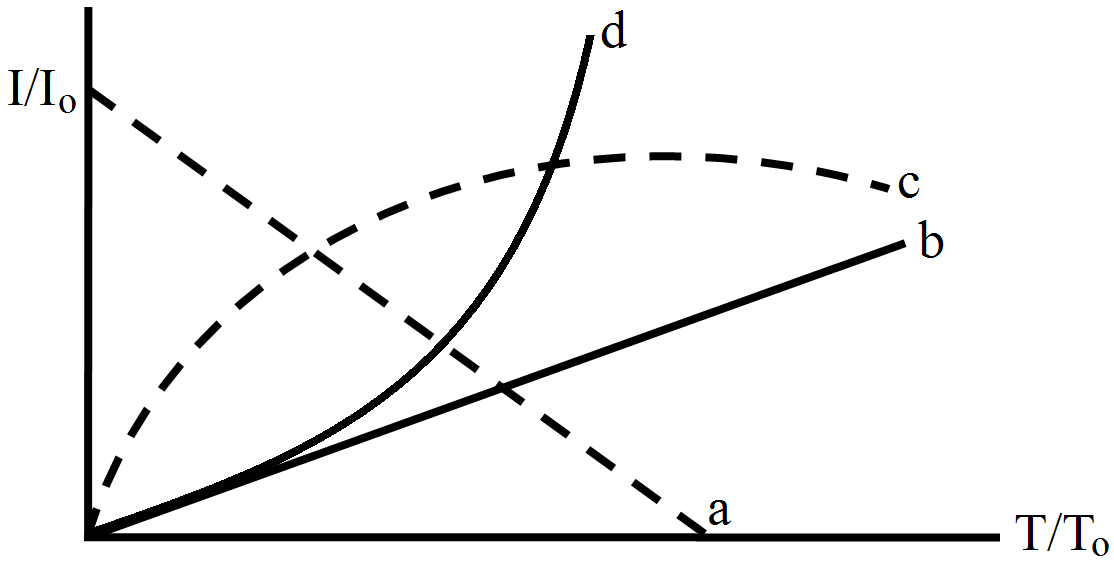
Let $\text{i}_0$ be the thermionic current from a metal surface when the absolute temperature of the surface is $\text{T}_0$. The temperature is slowly increased and the thermionic current is measured as a function of temperature. Which of the following plots may represent the variation in $\Big(\frac{\text{i}}{\text{i}_0}\Big)$ against $\Big(\frac{\text{T}}{\text{T}_0}\Big)?$
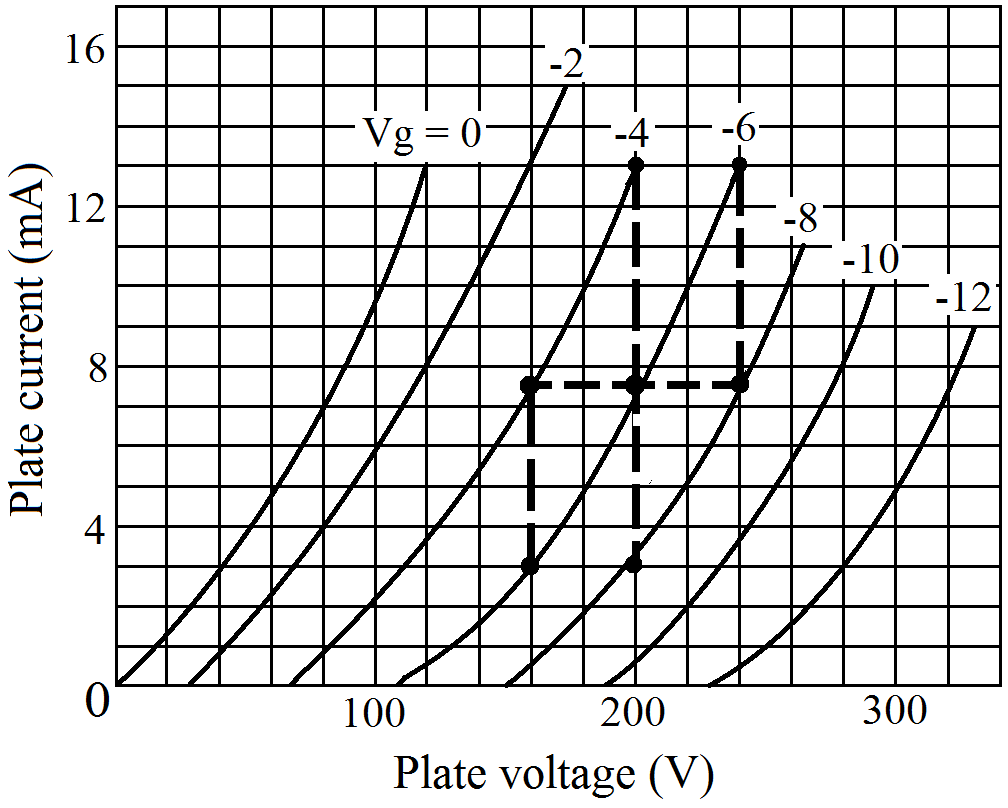
Find the values of $\text{r}_\text{p},\ \mu$ and $\text{g}_\text{m}$ of a triode operating at plate voltage 200V and grid voltage -6. The plate characteristics are shown in the figure.
The cathode of a diode valve is replaced by another cathode of double the surface area. Keeping the voltage and temperature conditions the same, will the place current decrease, increase or remain the same?
When white radiation is passed through a sample of hydrogen gas at room temperature, absorption lines are observed in Lyman series only. Explain.
A uniform magnetic field of $0.20 \times 10^{-3} \mathrm{~T}$ exists in the space. Find the change in the magnetic scalar potential as one moves through 50 cm along the field.
Read the passage given below and answer the following questions from 1 to 5. The impact and deformation during collision may generate heat and sound. Part of the initial kinetic energy is transformed into other forms of energy. A useful way to visualize the deformation during collision is in terms of a ‘compressed spring’. If the ‘spring’ connecting the two masses regains its original shape without loss in energy, then the initial kinetic energy is equal to the final kinetic energy but the kinetic energy during the collision time Δt is not constant. Such a collision is called an elastic collision. On the other hand the deformation may not be relieved and the two bodies could move together after the collision. A collision in which the two particles move together after the collision is called a completely inelastic collision. The intermediate case where the deformation is partly relieved and some of the initial kinetic energy is lost is more common and is appropriately called an inelastic collision. If the initial velocities and final velocities of both the bodies are along the same straight line, then it is called a one-dimensional collision, or head-on collision. When two equal masses undergo a glancing elastic collision with one of them at rest, after the collision, they will move at right angles to each other.
  1. After collision when two particles moves together then collision is:
  1. Elastic collision
  2. Completely inelastic collision
  3. Both a and b
  4. None of these
  1. In elastic collision, loss in kinetic energy is:
  1. Zero
  2. Positive
  3. Negative
  4. None of these
  1. What is head on collision?
  1. What is elastic collision?
  1. What is inelastic collision?
In motor vehicles, a convex mirror is attached near the driver's seat to give him the view of the traffic behind. What is the special function of this convex mirror which a plane mirror can not do?