Rajasthan BoardEnglish MediumSTD 12 SciencePhysicsSEMICONDUCTOR ELECTRONICS: MATERIALS, DEVICES AND SIMPLE CIRCUITS3 Marks
Question
Write a short note on $n$-type semi-conductors.
✓
Answer
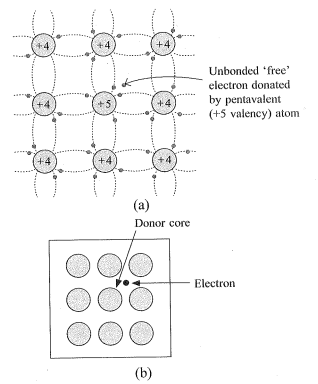
→As shown in the Fig., to make this type of semi-conductor pure $S i$ or $G e$ is doped with a pentavalent element. (In the outer most orbit, there are 5 electrons in such atoms, So they are called pentavalent.) Example : Arsenic (As), Antimony (S $b$ ), Phosphorous (P) etc. →When an atom of +5 Valency element occupies the position of an atom in the crystal lattice of $S i$, four of its electrons bond with the four silicon neighbours while the fifth remains very weakly bound to its parent atom. →As a result the ionisation energy required to set this electron free is very small and even at room temperature the electron gains energy sufficient to be free and to move in the lattice of the semiconductor. →For example : →the energy required to free this fifth electron is $\sim 0.01 eV$ for germanium and 0.05 eV for silicon, to separate the electron from its atom. →Thus the pentavalent dopant is donating one extra electron for conduction and hence it is known as donor impurity. →The number of electrons made available for conduction by dopant atoms depends strongly upon the doping level and it's is independent of any increase in ambient temperature. →In a doped semiconductor the total number of conduction electrons $n_e$ is due to the electrons contributed by donors and those generated intrinsically, while the total number of holes $n_h$ is only due to the holes from the intrinsic source. →Thus, with proper level of doping the number of conduction electrons can be made much larger than the number of holes. →Hence in an extrinsic semiconductor doped with pentavalent impurity, electrons become the majority carriers and the holes the minority carriers. →Charge of electron is negative. Hence from the first letter of the word 'negative', ' $n$ ', such semiconductors are known as $n$-type semiconductors. →For $n$-type semiconductors. $n_e \gg n_h$
Need a full question paper?
Generate a complete, print-ready paper with questions like this in minutes — across 16+ boards, with answer keys.