Question
Write balanced chemical equation for the following reactions:
Dichlorine heptaoxide ($Cl_2O_7$) in gaseous state combines with an aqueous solution of hydrogen peroxide in acidic medium to give chlorite ion ($ClO^–_2$​​​​​​​) and oxygen gas.
(Balance by ion electron method)
Answer

$\text{Cl}_2\text{O}_7(\text{g})+4\text{H}_2\text{O}_2(\text{aq})\xrightarrow{ \ \ \ \ \ \ \ }2\text{ClO}^-_2(\text{aq})+3\text{H}_2\text{O(l)}+4\text{O}_2(\text{g})+2\text{H}^+(\text{aq})$
Balancing by ion-electron method:
Oxidation half:
$\text{H}_2\text{O}_2\xrightarrow{ \ \ \ \ \ \ \ }\text{O}_2+2\text{e}^-$
Adding $2H^+$​​​​​​​ on right side to balance H atoms and charge.
$\text{H}_2\text{O}_2\xrightarrow{ \ \ \ \ \ \ \ }\text{O}_2+2\text{H}^++2\text{e}^-$
Reduction half:
$\text{Cl}_2\text{O}_7+8\text{e}^-\xrightarrow{ \ \ \ \ \ \ \ }2\text{ClO}^-_2$
Adding $H_2O$ and $H^+$​​​​​​​ to balance H and O atoms
$\text{Cl}_2\text{O}_7+8\text{e}^-+6\text{H}^+\xrightarrow{ \ \ \ \ \ \ \ \ }2\text{ClO}^-_2+3\text{H}_2\text{O}$
Adding oxidation and reduction half
$[\text{H}_2\text{O}_2\xrightarrow{ \ \ \ \ \ \ }\text{O}_2+2\text{e}^-+2\text{H}^+]\times4 \\ \text{Cl}_2\text{O}_7+8\text{e}^-+6\text{H}^+\xrightarrow{ \ \ \ \ \ \ \ }2\text{ClO}^-_2+3\text{H}_2\text{O} \\ \underline{ \ \ \ \ \ \ \ \ \ \ \ \ \ \ \ \ \ \ \ \ \ \ \ \ \ \ \ \ \ \ \ \ \ \ \ \ \ \ \ \ \ \ \ \ \ \ \ \ \ \ \ \ \ \ \ \ \ \ \ \ \ \ \ \ \ \ \ \ \ \ \ \ \ \ \ \ \ \ \ \ \ \ \ \ \ } \\ \text{Cl}_2\text{O}_7+4\text{H}_2\text{O}_2\xrightarrow{ \ \ \ \ \ \ \ }2\text{ClO}^-_2+3\text{H}_2\text{O}+4\text{O}_2+2\text{H}^+$

Need a full question paper?

Generate a complete, print-ready paper with questions like this in minutes — across 16+ boards, with answer keys.

Start Generating Free

Similar questions

Which of the following reactions involve homogeneous equilibrium and which involve heterogeneous equilibrium?
  1. $\text{Ag}_2\text{O}(\text{s})+2\text{HNO}_3(\text{aq})\rightleftharpoons2\text{AgNO}_3(\text{aq})+\text{H}_2\text{O}(\text{l})$
  2. $\text{C(s)}+\text{CO(}_2(\text{g})\rightleftharpoons2\text{CO(g)}$
  3. $\text{CH}_3\text{COOC}_2\text{H}_5(\text{aq})+\text{H}_2\text{O}(\text{l})\\\rightleftharpoons\text{CH}_3\text{COOH}(\text{aq})+\text{C}_2\text{H}_5\text{OH}(\text{aq})$
  4. $2\text{SO}_2(\text{g})+\text{O}_2(\text{g})\rightleftharpoons2\text{SO}_3(\text{g})$
The bromine atom possesses 35 electrons. It contains 6 electrons in 2p orbital, 6 electrons in 3p orbital and 5 electron in 4p orbital. Which of these electron experiences the lowest effective nuclear charge?
Explain the term 'standard molar free energy of formation' of a compound. Calculate the equilibrium constant for the reaction: $2 SO _2(g)+ O _2(g) \rightleftharpoons 2 SO _3(g)$ at $25^{\circ} C$.
Given: $\Delta_{ f } G ^{\circ} SO _3(g)=-371.1 kJ mol { }^{-1}, \Delta_{ f } G ^{\circ} SO _2(g)=-300.2 kJ mol { }^{-1}, R =8.31 JK ^{-1} mol^{-1}$.
Calculate the mass of ferric oxide that will be obtained by complete oxidation of 2g of Fe. [Atomic weights of Fe = 56u, 0 = 16u]
1. The fact that the enthalpy is a state function forms the basis of a very useful law. Name the law.
2. Two liters of an ideal gas at a pressure of 10 atm expands isothermally at $25^{\circ} C$ into a vacuum until its total volume is 10 liters. How much heat is absorbed and how much work is done in the expansion?
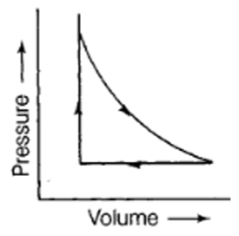
3. A sample of 1.0 mole of a monoatomic ideal gas is taken through a cyclic process of expansion and compression as shown in the figure. What will be the value of $\Delta H$ for the cycle as a whole?
Image
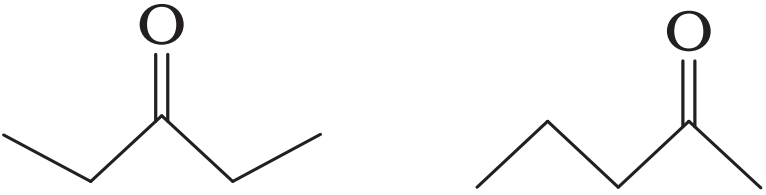
What is the relationship between the members of following pairs of structures? Are they structural or geometrical isomers or resonance contributors?
Arrange the elements N, P, O and S in the order of:
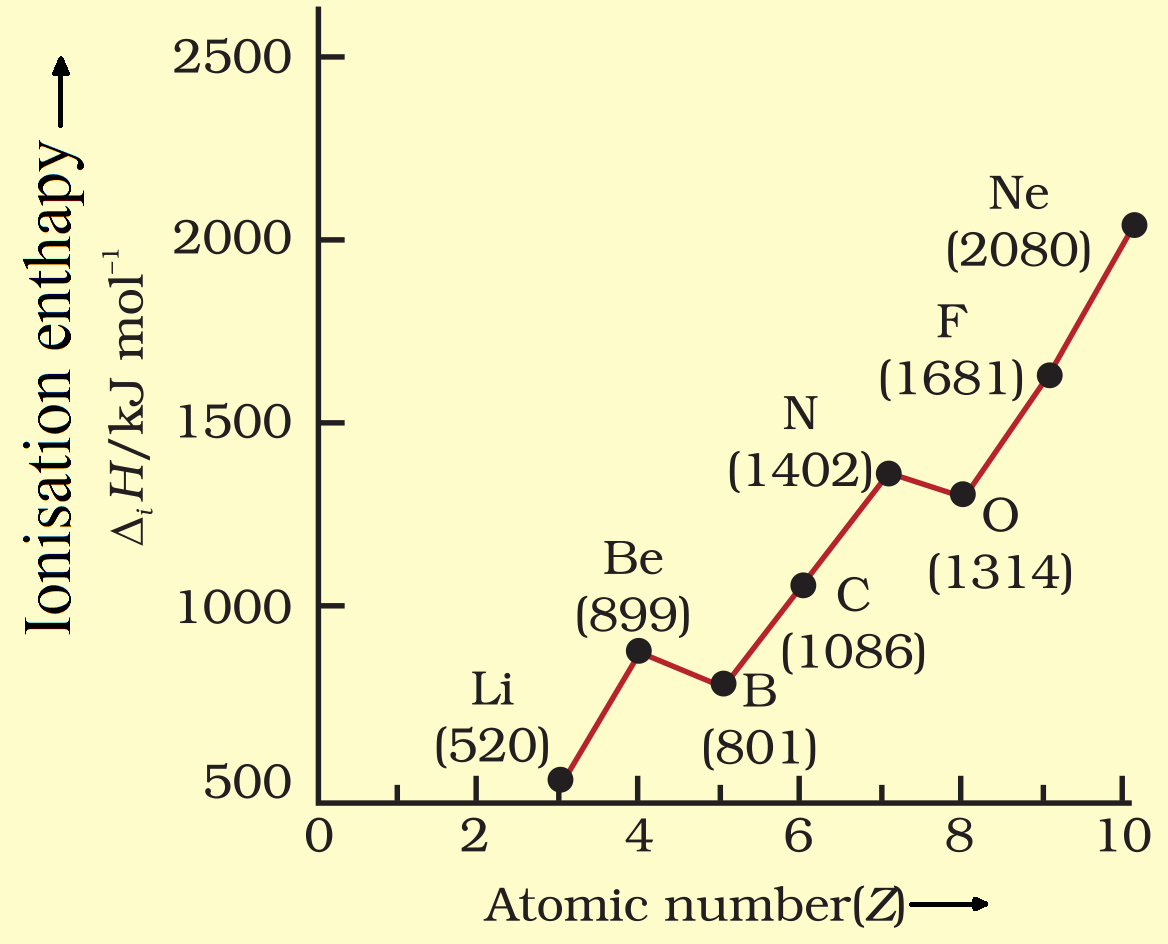
  1. Increasing first ionisation enthalpy.
  2. Increasing non metallic character. Give reason for the arrangement assigned.
  1. Which pair of element show similar properties with following atomic number?
$[13, 31], [11, 21]$
  1. Which of the following elements has most positive electron gain enthalpy?
$F, N and Ne$​​​​​​​
  1. Lithium shows diagonal relationship with which element and why?
For the following bond cleavages, use curved-arrows to show the electron flow and classify each as homolysis or heterolysis. Identify reactive intermediate produced as free radical, carbocation and carbanion.
Write Lewis symbols for the following atoms and ions: S and $S ^{2-} ; Al$ and $Al ^{3+} ; H$ and $H ^{-}$