Question
Write detailed note on: Starch

Answer

$\rightarrow$ Starch is the main storage polysaccharide of plants.
$\rightarrow$ It is the most important dietary source for human beings.
$\rightarrow$ High content of starch is found in cereals, roots, tubers and some vegetables.
$\rightarrow$ It is a polymer of $a-$glucose and consists of two components amylose and amylopectin.
$\rightarrow$ Amylose is water soluble component which constitutes about $15-20\%$ of starch.
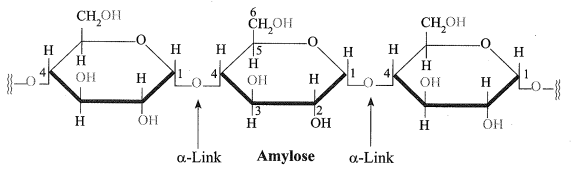
$\rightarrow$ Chemically amylose is along unbranched chain with $200-1000 \alpha-D-(+)-$glucose units held together by $C_1-C_4$ glycosidic linkage.
Image
$\rightarrow$ Amylopectin is insoluble in water and constituents about $80-85\%$ of starch.
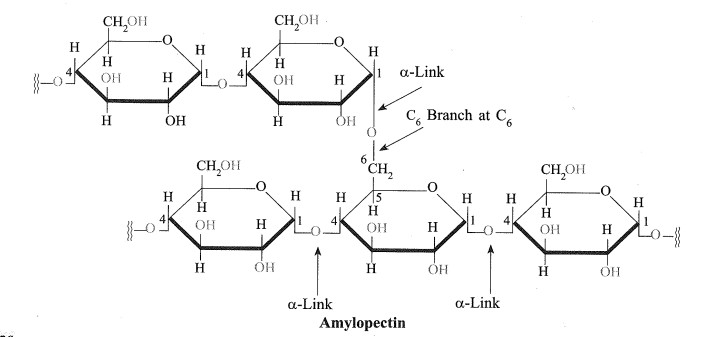
$\rightarrow$ It is a branched chain polymer of $\alpha-D-$ glucose units in which chain is formed by $C_1-C_4$ glycosidic linkage where as branching occurs by $C_1-C_6$ glycosidic linkage.
Image

Need a full question paper?

Generate a complete, print-ready paper with questions like this in minutes — across 16+ boards, with answer keys.
Start Generating Free

Similar questions

Read the passage given below and answer the following questions:
At $298 K,$ the vapour pressure of pure benzene $, C_6, H_6$ is $0.256$ bar and the vapour pressure of pure toluene $\ce{C_6 H_5 CH_3}$ is $0.0925$ bar. Two mixtures were prepared as follows:
  1. $7.8g$ of $\ce{C_6 H_6 + 9.2g}$ of toluene
  2. $3.9g$ of $\ce{C_6 H_6 + 13.8g}$ of toluene
The following questions are multiple choice questions. Choose the most appropriate answer:
  1. The total vapour pressure $($bar$)$ of solution I is.
  1. $0.128$
  2. $0.174$
  3. $0.198$
  4. $0.258$
  1. Which of the given solutions have higher vapour pressure?
  1. $I$
  2. $II$
  3. Both have equal vapour pressure
  4. Cannot be predicted
  1. Mole fraction of benzene in vapour phase in solution I is.
  1. $0.128$
  2. $0.174$
  3. $0.734$
  4. $0.266$
  1. Which of the following statements is/are correct?
  1. Mole fraction of toluene in vapour phase is more in solution $ I$.
  2. Mole fraction of toluene in vapour phase is less in solution $I.$
  3. Mole fraction of benzene in vapour phase is less in solution $I.$
  1. Only $II$
  2. Only $I$
  3. $I$ and $III$
  4. $II$ and $III$
  1. Solution I is an example of a/an.
  1. Ideal solution.
  2. Non $-$ ideal solution with positive deviation.
  3. Non $-$ ideal solution with negative deviation.
  4. Can't be predicted.
Read the passage given below and answer the following questions:
The aryl halides are relatively less reactive towards nucleophilic substitution reactions as compared to alkyl halides. This low reactivity can be attributed to the following factors:
  • The $C - X$ bond in halobenzene has a partial double bond character due to involvement of halogen electrons in resonance with benzene ring.
  • The $C - X$ bond in aryl halides is less polar as compared to that in alkyl halides as $sp^2$ hyridised carbon is more electronegative than $sp^3$ hybridised carbon.
In these questions $(Q. No. i-Iv),$ a statement of assertion followed by a statement of reason is given. Choose the correct answer out of the following choices.
  1. Assertion and reason both are correct statements and reason is correct explanation for assertion.
  2. Assertion and reason both are correct statements but reason is not correct explanation for assertion.
  3. Assertion is correct statement but reason is wrong statement.
  4. Assertion is wrong statement but reason is correct statement.
  1. Assertion: Primary benzylic halides are more reactive than primary alkyl halides towards $S_N1$ reactions.
Reason: Reactivity depends upon the nature of the nucleophile and the solvent.
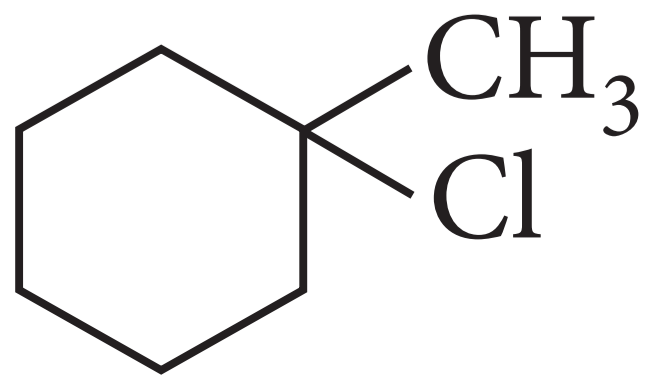
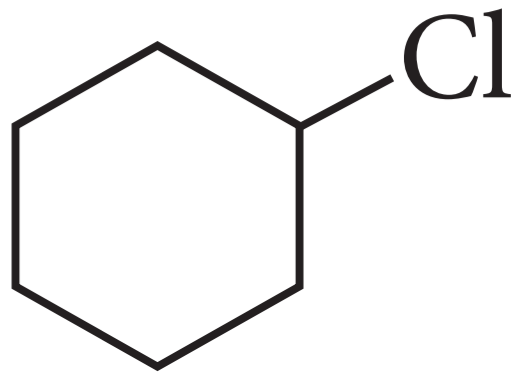
  1. Assertion: is more reactive than towards nucleophilic substitution reactions.

Reason: Tertiary alkyl halides react predominantly by $S_N1$ mechanism.
  1. Assertion: Chlorobenzene is more reactive than $p-$chloroanisole to nucleophilic substitution reactions.
Reason: Greater the stability of carbanion, greater is its ease of formation and hence, more reactive is the aryl halide.
  1. Assertion: $4-$Nitrochlorobenzene undergoes nucleophilic substitution more readily than chlorobenzene.
Reason: Chlorobenzene undergoes nucleophilic substitution by elimination-addition mechanism while $4-$nitrochlorobenzene undergoes nucleophilic substitution by addition$-$elimination mechanism.
  1. Assertion: Chlorobenzene is less reactive than benzene towards the electrophilic substitution reaction.
Reason: Resonance destabilises the carbocation.
Read the passage given below and answer the following questions:
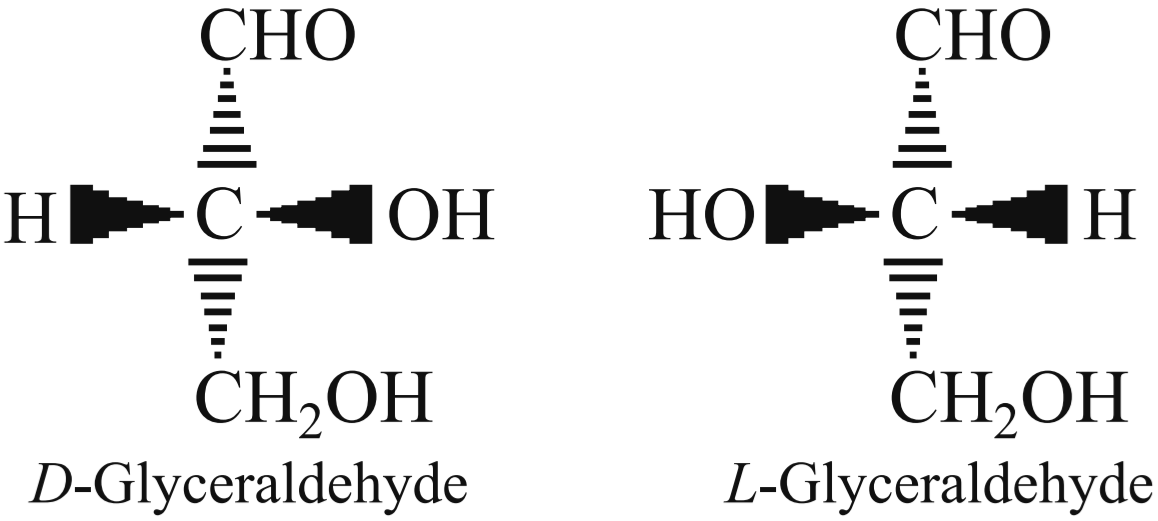
Carbohydrates can exist in either of two conformations, as determined by the orientation of the hydroxyl group about the asymmetric carbon farthest from the carbonyl.

By convention, a monosaccharide is said to have $D-$configuration if the hydroxyl group attached to the asymmetric carbon atom adjacent to the $-\ce{CH_2OH}$ group is on the right hand side irrespective of the positions of the other hydroxyl groups. On the other hand, the molecule is assigned $L-$configuration if the $-OH$ group attached to the carbon adjacent to the $- \ce{CH_2OH}$ group is on the left hand side.
The following questions are multiple choice questions. Choose the most appropriate answer:
  1. $D-$Glyceraldehyde and $L-$Glyceraldehyde are:
  1. Epimers.
  2. Enantiomers.
  3. Anomers.
  4. Conformational diasteriomers.
  1. Which of the following monosaccharides, is the majority found in the human body?
  1. $D-$type.
  2. $L-$type.
  3. Both of these.
  4. None of these.
  1. The two functional groups present in a typical carbohydrate are:
  1. $-\ce{OH}$ and $-\ce{COOH}$
  2. $-\ce{CHO}$ and $-\ce{COOH}$
  3. $ > \ce{C= O}$ and $-\ce{OH}$
  4. $-\ce{OH}$ and $-\ce{CHO}$
  1. Monosaccharides contain:
  1. Always six carbon atoms.
  2. Always five carbon atoms.
  3. Always four carbon atoms.
  4. May contain $3$ to $7$ carbon atoms.
  1. The correct corresponding order of names of four aldoses with configuration given below respectively, is:
  1. $L-$erythrose, $L-$threose, $L-$erythrose, $D-$threose.
  2. $D-$threose, $D-$erythrose, $L-$threose, $L-$erythrose.
  3. $L-$erythrose, $L-$threose, $D-$erythrose, $D-$threose.
  4. $D-$erythrose, $D-$threose, $L-$erythrose, $L-$threose.
The following reaction, $\text{A}_{(\text{g})}\xrightarrow{\ \ \triangle\ \ \ }\text{P}_{(\text{g})}+\text{Q}_{(\text{g})}+\text{R}_{(\text{g})},$ follows first order kinetics. The half$-$life period of this reaction is $69.3s$ at $500^\circ C$. The gas $A$ is enclosed in a container at $500^\circ C$ and at a pressure of $0.4$ atm.
The following questions are multiple choice questions. Choose the most appropriate answer :
  1. The rate constant for the reaction is :
  1. $0.4s^{-1}$
  2. $0.02s^{-1}$
  3. $0.01s^{-1}$
  4. $0.3s^{-1}$
  1. The pressure of the gas $A$ after $230$ s will be :
  1. $0.04$ atm
  2. $0.36$ atm
  3. $0.4$ atm
  4. $0.036$ atm
  1. The total pressure of the system after $230$ swill be:
  1. $2.15$ atm
  2. $1.12$ atm
  3. $0.4$ atm
  4. $3.08$ atm
  1. The plot ofln$[A]$ vs twill be:
  1. Linear with slope $= k$
  2. Linear with intercept $= In[A]_0$
  3. Linear with slope $= In[A]_0$
  4. Linear with intercept $= [A]_0$
  1. Which of the following is not an example of first order reaction?
  1. $\text{C}_2\text{H}_{4(\text{g})}+\text{H}_{2(\text{g})}\rightarrow\text{C}_2\text{H}_{6(\text{g})}$
  2. $2\text{N}_2\text{O}_{5(\text{g})}\rightarrow4\text{NO}_{2(\text{g})}+\text{O}_{2(\text{g})}$
  3. $2\text{N}\text{H}_{3(\text{g})}\xrightarrow[\triangle]{\text{pt}}\text{N}_{2(\text{g})}+3\text{H}_{2(\text{g})}$
  4. $2\text{N}_2\text{O}_{(\text{g})}\xrightarrow{\ \ \triangle\ \ }2\text{N}_{2(\text{g})}+\text{O}_{2(\text{g})}$
What change in the concentration of H₂ will triple the rate of reaction?
(c). Suppose a reaction between A and B, was experimentally found to be first order with respect to both A and B. So the rate equation is:
Rate = k[A][B]
Which of these two mechanisms is consistent with this experimental finding? Why?
Mechanism 1
A → C + D (slow)
B+C → E (fast)
Mechanism 2
A+B →C + D (slow)
C → E (fast)
Read the passage given below and answer the following questions: Aniline activates the benzene ring by increasing electron density at ortho$-$and para$-$positions. Hence, it is $o-, p-$directing. $-NH-2$ group strongly activates the ring therefore it is difficult to stop the reaction at monosubstitution stage. Among electrophilic substitution reaction, direct nitration of aniline is not done to get $o-$ and $p-$nitroaniline because lone pair of electrons present at nitrogen atom will accept proton from nitrating mixture to give anilinium ion which is meta$-$directing. Aniline with $NaNO_2$ and $\text{HCI}$ forms benzene diazonium chloride at very low temperature. Aromatic amines react with nitrous acid to form a yellow oily liquid known as $N-$nitrosoamines. A statement of assertion followed by a statement of reason is given. Choose the correct answer out of the following choices.
  1. Assertion and reason both are correct statements and reason is correct explanation for assertion.
  2. Assertion and reason both are correct statements but reason is not correct explanation for assertion.
  3. Assertion is correct statement but reason is wrong statement.
  4. Assertion is wrong statement but reason is correct statement.
  1. Assertion: Nitrating mixture used for carrying out nitration of benzene consists of cone. $HNO_3 +$ cone. $H_2SO_4.$
Reason: In presence of $\ce{H_2SO_4, HNO_3}$ acts as a base and produces $\text{NO}^+_2$ ions.
  1. Assertion: Anilinium chloride is more acidic than ammonium chloride.
Reason: Anilinium ion is not resonance$-$stabilised.
  1. Assertion: Nitrobenzene can be prepared from benzene by using mixture of cone. $HNO_3$ and cone. $H_2SO_4.$
Reason: In the mixture, $H_2SO_4$ act as a acid.
  1. Assertion: In strongly acidic solution, aniline becomes less reactive towards electrophilic reagents.
Reason: The amino group being completely protonated in strongly acidic solution, the lone pair of electrons on the nitrogen is no longer available for resonance.
  1. Assertion: Nitration of aniline can be done conveniently by protecting $-NH_2$ group through acetylation.
Reason: Acetylation of aniline results in the increase of electron density in the benzene ring.
Read the passage given below and answer the following questions:
A primary alkyl halide $(A) C_4H_9Br$ reacted with akoholic $\text{KOH}$ to give compound $(B).$ Compound $(B)$ is reacted with $\text{HBr}$ to give compound $(C)$ which is an isomer of $(A).$ When $(A)$ reacted with sodium metal, it gave a compound $(D) C_8H_{18}$ that is different than the compound obtained when n-butyl bromide reacted with sodium metal.
The following questions are multiple choice questions. Choose the most appropriate answer:
  1. Compound $(A)$ is:
  1. $\ce{CH_3CH_2CH_2CH_2Br}$
  2. $\text{CH}_3\text{CH}-\text{CH}_2\text{Br}\\\ \ \ \ \ \ \ \ \ |\\\ \ \ \ \ \ \ \ \text{CH}_3$
  3. $\ \ \ \ \ \ \ \ \ \ \ \ \ \ \text{CH}_3\\\ \ \ \ \ \ \ \ \ \ \ \ \ \ \ |\\\text{CH}_3-\text{C}-\text{Br} \\\ \ \ \ \ \ \ \ \ \ \ \ \ \ \ \ |\\\ \ \ \ \ \ \ \ \ \ \ \ \ \ \ \text{CH}_3$
  4. $\ce{CH_3CH_2CH_2Br}$
  1. Which type of isomerism is present in compound $(A)$ and $(C)$?
  1. Positional
  2. Functional
  3. Chain
  4. Both $(a)$ and $(c)$
  1. Identify compound $(B).$
  1. $\text{CH}_3-\text{C}=\text{CH}_2 \ \ \\ \ \ \ \ \ \ \ \ \ \ \ \ \ \mid \\ \ \ \ \ \ \ \ \ \ \ \ \text{CH}_3$
  2. $\ce{CH_3– CH = CH – CH_3}$
  3. $\ce{CH_3– CH_2 – CH = CH_2}$
  4. None of these.
  1. IUPAC name of compound $(D)$ is:
  1. $N -$ octane
  2. $2, 5 -$ dimethylhexane
  3. $2 -$ methylheptane
  4. $3, 4 -$ dimethyl hexane.
  1. When compoound $(C)$ is treated with ale. $\text{KOH}$ and then treated with presence of peroxide, the compound obtained is:
  1. $\ \ \ \ \ \ \ \ \ \ \ \ \ \ \text{CH}_3\\\ \ \ \ \ \ \ \ \ \ \ \ \ \ \ |\\\text{CH}_3-\text{C}-\text{Br} \\\ \ \ \ \ \ \ \ \ \ \ \ \ \ \ \ |\\\ \ \ \ \ \ \ \ \ \ \ \ \ \ \ \text{CH}_3$
  2. $\ \ \ \ \ \ \ \ \ \ \ \ \ \ \text{CH}_3\\\ \ \ \ \ \ \ \ \ \ \ \ \ \ \ |\\\text{CH}_3-\text{CH}-\text{CH}_2-\text{Br}$
  3. $\text{CH}_3\text{CH}_2\text{CH}_2\text{CH}_2\text{Br}$
  4. $\text{CH}_3\text{CH}_2\text{CH}_2\text{CH}-\text{Br}\\\ \ \ \ \ \ \ \ \ \ \ \ \ \ \ \ \ \ \ \ \ \ \ \ \ |\\\ \ \ \ \ \ \ \ \ \ \ \ \ \ \ \ \ \ \ \ \ \ \ \ \text{CH}_3$
Read the passage given below and answer the following questions:
Both alcohols and phenols are acidic in nature, but phenols are more acidic than alcohols. Acidic strength of alcohols mainly depends upon the inductive effect. Acidic strength of phenols depends upon a combination of both inductive effect and resonance effects of the substituent and its position on the benzene ring. Electron withdrawing groups increases the acidic strength of phenols whereas electron donating groups decreases the acidic strength of phenols. Phenol is a weaker acid than carboxylic acid.
The following questions are multiple choice questions. Choose the most appropriate answer:
  1. Phenols are highly acidic as compare to alcohols due to:
  1. The higher molecular mass of phenols.
  2. The stronger hydrogen bonds in phenols.
  3. Alkoxide ion is a strong conjugate base.
  4. Phenoxide ion is resonance stabilised.
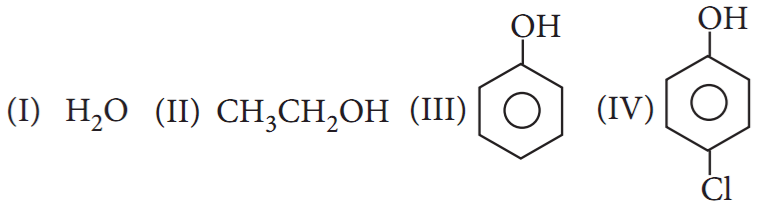
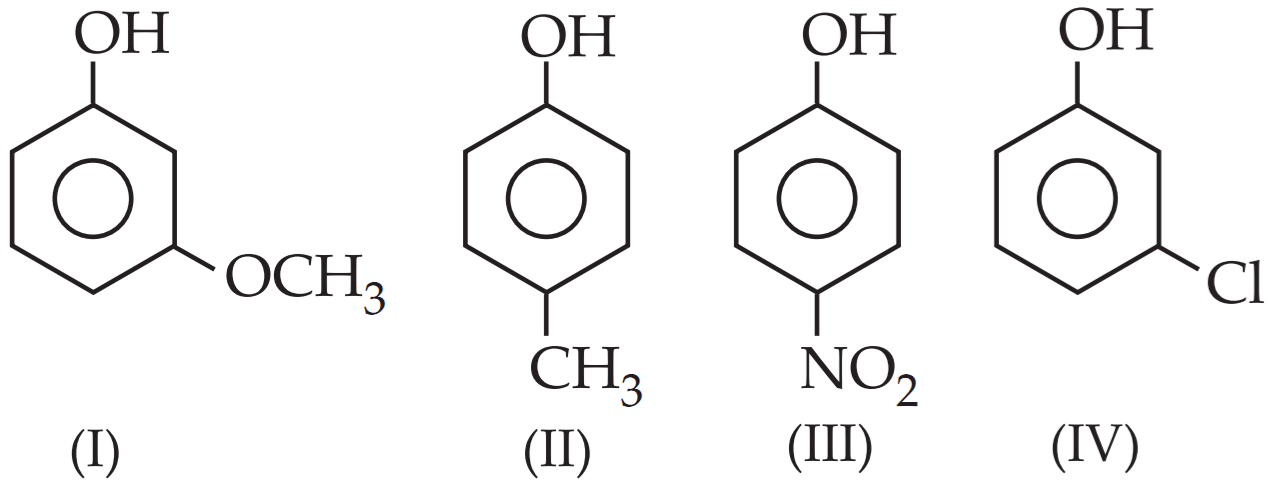
  1. The correct order of acidic strength among the following is:
  1. $(III) > (IV) > (II) > (I)$
  2. $(IV) > (III) > (I) > (II)$
  3. $(IV) > (III) > (II) > (I)$
  4. $(I) > (II) > (IV) > (III)$
  1. The correct decreasing order of $pK_a$ value is:
  1. $II > IV > I > III$
  2. $IV > II > III > I$
  3. $II I> II > IV > I$
  4. $IV > I > II > III$
  1. The compound that does not liberate $CO_2,$ on treatment with aqueous sodium bicarbonate solution is:
  1. Benzoic acid.
  2. Benzenesulphonic acid.
  3. Salicylic acid.
  4. Carbolic acid.
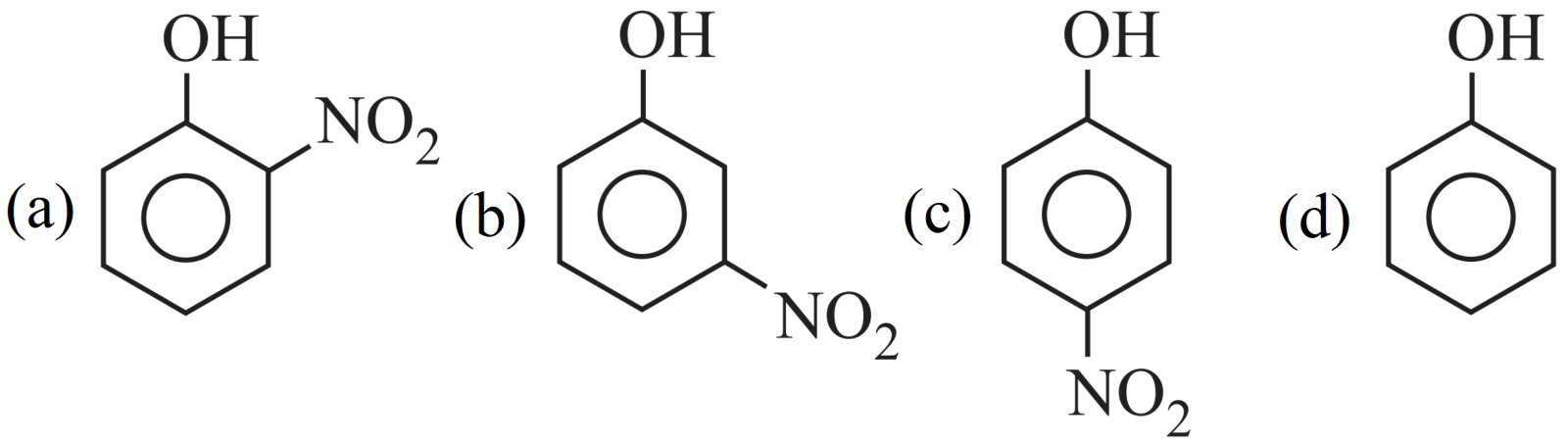
  1. Most acidic amongst the following is:
Read the passage given below and answer the following questions:
A mixture of two aromatic compounds $(A)$ and $(B)$ was separated by dissolving in chloroform followed by extraction with aqueous $\ce{KOH}$ solution. The organic layer containing compound $(A),$ when heated with alcoholic solution of $\ce{KOH}$ produce $\ce{C_7H_5N (C)}$ associated with unpleasant odour.
The following questions are multiple choice questions. Choose the most appropriate answer:
  1. What is $A?$
  1. $\ce{C_6H_5NH_2}$
  2. $\ce{C_6H_5CH_3}$
  3. $\ce{C_6H_5CH_3}$
  4. None of these.
  1. The reaction of $(A)$ with alcoholic solution of $\ce{KOH}$ to produce $(C)$ of unpleasant odour is called:
  1. Sandmeyer reaction.
  2. Carbylamine reaction.
  3. Ullmann reaction.
  4. Reimer$-$Tiemann reaction..
  1. The alkaline aqueous layer $(B)$ when heated with chloroform and then acidified give a mixture of isomeric compounds of molecular formula $\ce{C_7H_6O_2. (B)}$ is:
  1. $\ce{C_6H_5CHO}$
  2. $\ce{C_6H_5COOH}$
  3. $\ce{C_6H_5CH_3}$
  4. $\ce{C_6H_5OH}$
  1. In the chemical reaction,
  2. $\ce{CH_3CH_2NH_2 + CHCl_3 + 3KOH \rightarrow (A)+ (B) + 3H_2O,}$
  1. $\ce{C_2H_5NC}$ and $\ce{KCl}$
  2. $\ce{C_2H_5CN}$ and $\ce{KCl}$
  3. $\ce{CH_3CH_2CONH_2}$ and $\ce{KCl}$
  4. $\ce{C_2H_5NC}$ and $\ce{K_2CO_3}$
  1. Direct nitration of an aromatic compound $(A)$ is not feasible because:
  1. The reaction cannot be stopped at the mononitration stage.
  2. A mixture of $o, m$ and $p-$nitroaniline is always obtained.
  3. Nitric acid oxidises most of the aromatic compound to give oxidation products along with only a small amount of nitrated products.
  4. All of the above.
A reaction is said to be of the first order if the rate of the reaction depends upon one concentration term only. For a first order reaction of the type $A \rightarrow$ Products, the rate of the reaction is given as: rate $= k[A]$. The differential rate law is given as : $\frac{\text{dA}}{\text{dt}}=-\text{k}[\text{A}].$ The integrated rate law is : In $\frac{[\text{A}]}{[\text{A}]_0}=-\text{kt}, [A]$ is the concentration of reactant left at time $t$ and $[A]_0$ is the initial concentration of the reactant$, k$ is the rate constant.
The following questions are multiple choice questions. Choose the most appropriate answer :
  1. The unit of rate constant for a first order reaction is:
  1. $S^{-1}$
  2. $mol\ L^{-1} s^{-1}$
  3. $L\ mol^{-1} s^{-1}$
  4. $L^2\ mol^{-2} s^{-1}$
  1. Half$-$life period of a first order reaction is $10$ min. Starting with initial concentration $12M,$ the rate after $20$ min is:
  1. $0.693 \times 3M\ min^{-1}$
  2. $0.0693 \times 4M\ min^{-1}$
  3. $0.0693 \times M\ min^{-1}$
  4. $0.0693 \times 3M\ min^{-1}$
  1. $50\%$ of a first order reaction is complete in $23$ minutes. Calculate the ti me required to complete $90\%$ of the reaction.
  1. $70.4$ minutes.
  2. $76.4$ minutes.
  3. $38.7$ minutes.
  4. $35.2$ minutes.
  1. For a first order reaction$, (A) \rightarrow$ products, the concentration of $A$ changes from $0.1M$ to $0.025M$ in $40$ minutes. The rate of reaction when the concentration of $A$ is $0.01M,$ is:
  1. $3.47 \times 10^{-4} M/ min$
  2. $3.47 \times 10^{-5} M/ min$
  3. $1.73 \times 10^{-4} M/ min$
  4. $1.73 \times 10^{-5} M/ min$
  1. The half$-$life period ofa $1^{st}$ order reaction is $60$ minutes. What percentage will be left over after $240$ minutes?
  1. $6.25\%$
  2. $4.25\%$
  3. $5\%$
  4. $6\%$