(a) Unit: An arbitrarily chosen standard of measurement of a quantity, which is accepted internationally is called unit of the quantity.
The units in which the fundamental quantities are measured are called fundamental or base units and the units of measurement of all other physical quantities, which can be obtained by a suitable multiplication or division of powers of fundamental units, are called derived units.
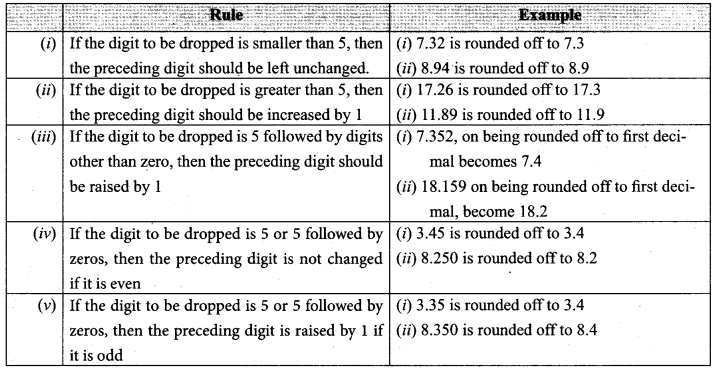
(b) Rounding – off: In no case should the result have more significant figures than die figures involved in the data used for calculation. The result of calculation with numbers containing more than one uncertain digit should be rounded off. The rules for rounding off are given below.
(c) Dimensionless quantities: On the basis of dimension, dimensionless quantities are classified into two categories.
(i) Dimensionless variables:
Physical quantities which have no dimensions, but have variable values are called dimensionless variables. Examples are specific gravity, strain, refractive index etc.
(ii) Dimensionless Constant:
Quantities which have constant values and also have no dimensions are called dimensionless constants. Examples are π, e, numbers etc.