Question
write the classification of amino acids and give examples of each.

Answer

self

Need a full question paper?

Generate a complete, print-ready paper with questions like this in minutes — across 16+ boards, with answer keys.
Start Generating Free

Similar questions

(i) Define the order of a reaction.
(ii) Explain the effect of concentration of reactant on the rate constant.
(iii) For a first order reaction, if the rate constant at 500 K and 600 K are $0.03 s^{-1}$ and $0.06 s^{-1}$ respectively, then calculate the activation energy.
$
\left[R=8.314 JK^{-1} mol^{-1}, \log 2=0.3010\right]
$
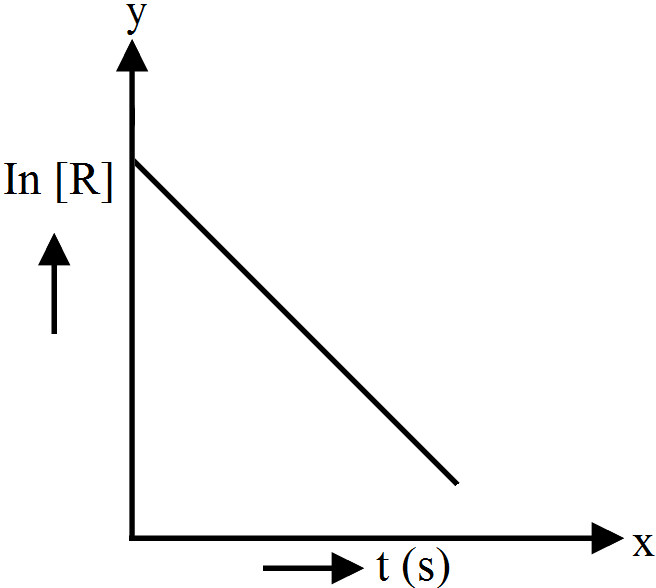
For a certain chemical reaction variation in the concentration ln $[R]$ vs. time plot is given alongside.For this reaction:
  1. What is the order of the reaction?
  2. What are the units of rate constant $k$?
  3. Give the relationship between $k$ and $t1/2$ (half-life period).
  4. What is the slope of the curve?
  5. Draw the plot log $[R]0 /[R]$ vs time $t(s)$.
Using Valence bond theory, explain the following in relation to the paramagnetic complex $[Mn(CN)_6]^{3-}$
$a.$ type of hybridisation
$b.$ magnetic moment value
$c.$ type of complex $-$ inner, outer orbital complex
(a) Draw the structure of a galvanic cell and also describe the reaction taking place in it.
(b) What happens when opposite external potential is applied in the galvanic cell system? Explain.
  1. With reference to structural variability and chemical reactivity, write the differences between lanthanoids and actinoids.
  2. Name a member of the lanthanoid series which is well known to exhibit $+4$ oxidation state.
  3. Complete the following equation:
$\text{MnO}_{4}^{-}+\text{8H}^{+}+\text{5e}^{-}\rightarrow$
  1. Out of $Mn^{3+}$ and $Cr^{3+}$, which is more paramagnetic and why?
(Atomic nos: $Mn = 25, Cr = 24).$
Assign reasons for the following:
i. The enthalpies of atomisation of transition elements are high.
ii. The transition metals and many of their compounds act as good catalyst.
iii. From element to element the actinoid contraction is greater than the lanthanoid contraction.
iv. The $E ^0$ value for the $Mn ^{3+} / Mn ^{2+}$ couple is much more positive than that for $Cr ^{3+} / Cr ^{2+}$.
v. Scandium $(Z=21)$ does not exhibit variable oxidation states and yet it is regarded as a transition element.
Match the property given in Column I with the element given in Column II.
 
Column I (Property)
 
Column II (Element)
(i)
Lanthanoid which shows $+4$ oxidation state
$(a)$
$Pm$
(ii)
Lanthanoid which can show $+2$ oxidation state
$(b)$
$Ce$
(iii)
Radioactive lanthanoid
$(c)$
$Lu$
(iv)
Lanthanoid which has $4f^7$ electronic configuration in +3 oxidation state
$(d)$
$Eu$
(v)
Lanthanoid which has $4f^{14}$ electronic configuration in +3 oxidation state
$(e)$
$Gd$
 
 
$(f)$
$Dy$
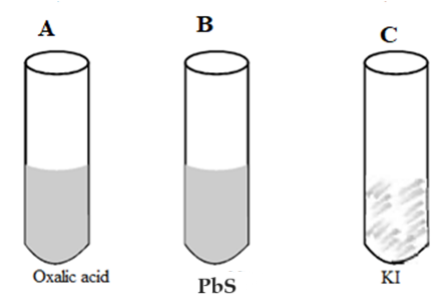
$(a).$ A purple colour compound $A,$ which is a strong oxidising agent and used for bleaching of wool, cotton, silk and other textile fibres was added to each of the three test tubes along with $H_2SO_4.$ It was followed by strong heating.
Image
In which of the above test tubes; $A, B$ or $C:$
$(i)$ Violet vapours will be formed
$(ii)$ The bubbles of gas evolved will extinguish a burning matchstick. Write an equation for each of the above observations.
$b.$ A metal ion $M^{n+}$ of the first transition series having $d^5$ configuration combines with three didentate ligands. Assuming $\Delta_0< P:$
$(i)$ Draw the crystal field energy level diagram for the $3d$ orbital of this complex.
$(ii)$ What is the hybridisation of $Mnt$ in this complex and why?
$(iii)$ Name the type of isomerism exhibited by this complex.
  1. Explain the following:
  1. Henry's law about dissolution of a gas in a liquid.
  2. Boiling point elevation constant for a solvent.
  1. A solution of glycerol $(C_3H_8O_3)$ in water was prepared by dissolving some glycerol in $500\ g$ of water. This solution has a boiling point of $100.42^\circ\ C$. What mass of glycerol was dissolved to make this solution? $(K_b$ for water = $0.512\ K\ kg\ mol^{–1})$.
i. Name the element of 3d transition series which shows maximum number of oxidation states. Why does it show so?
ii. which transition metal of 3 d series has positive $E ^{\circ}\left( M ^{2+} / M \right)$ value and why?
iii. Out of $Cr ^{3+}$ and $Mn ^{3+}$, which is a stronger oxidizing agent and why?
iv. Name a member of the lanthanoid series which is well known to exhibit +2 oxidation state.
v. Complete the following equation:
$MnO_4^{-}+8 H^{+}+5 e^{-} \rightarrow$