Question
  1. Write the conjugate acid for $\text{NH}_2^-\text{ and }\text{NH}_3.$
  2. What is the relationship between $p K_a$ and $p K_b$ values?

Answer

  1. The conjugate acid of $\text{NH}_2^-\text{ is }\text{NH}_3.$ whereas conjugate acid of $\text{NH}_3\text{ and }\text{NH}_4^+.$
[Add $\mathrm{H}^{-}$to get conjugate acid]
  1. $\text{pK}_{\text{a}}+\text{pK}_{\text{b}}=14,\text{pK}_{\text{a}}=14-\text{pK}_{\text{b}}$

Need a full question paper?

Generate a complete, print-ready paper with questions like this in minutes — across 16+ boards, with answer keys.
Start Generating Free

Similar questions

The equilibrium constant for a reaction is 10. What will be the value of $\Delta\text{G}^\ominus$? $\mathrm{R}=8.314 \mathrm{JK}^{-1} \mathrm{~mol}^{-1}, \mathrm{~T}=300 \mathrm{~K}$.
In 250 ml solution, 12.6 gm crystalline oxalic acid is dissolved and density of solution is $1 . 1$ $gm / ml$ then calculate (a) molarity (b) normality (c) molality.
Write the structures of products (A and B) of the following reactions:
  1. $\text{HC}\equiv\text{CH}\xrightarrow{\text{Na}}\text{A}\xrightarrow{\text{CH}_3\text{Br}}\text{B}$
  2. $\text{BrH}_2\text{C}-\text{CH}_2\text{Br}\xrightarrow[\text{KOH}]{\text{Alcoholic}}\text{A}\xrightarrow{\text{NaNH}_2}\text{B}$
Account for the following:
  1. BF, molecule has a zero dipole moment although $\text{B}-\text{F}$ bonds are polar.
  2. The structure of $\mathrm{NH}_3$ molecule is pyramidal.
Compound with carbon-carbon double bond, such as ethylene ($\text{C}_2\text{H}_4$) and hydrogen in a reaction is called hydrogenation.$\text{C}_2\text{H}_4(\text{g})+\text{H}_2(\text{g})\overrightarrow{\ \ \ \ \ \ }\ \text{C}_2\text{H}_6(\text{g})$
Calculate enthalpy change for the reaction using the following combustion data:$\text{C}_2\text{H}_4(\text{g})+3\text{O}_2(\text{g})\overrightarrow{\ \ \ \ \ }\ 2\text{CO}_2(\text{g})+2\text{H}_2\text{O(g)};$ $\Delta\text{H}=-1401\text{kJ/ mol}$
$\text{C}_2\text{H}_6(\text{g})+\frac{7}{2}\text{O}_2(\text{g})\overrightarrow{\ \ \ \ \ \ }\ 2\text{CO}_2(\text{g})+3\text{H}_2\text{O(l)};$ $\Delta\text{H}=-1550\text{kJ/ mol}$
$\text{H}_2(\text{g})+\frac{1}{2}\text{O}_2(\text{g})\overrightarrow{\ \ \ \ \ \ }\ \text{H}_2\text{O(l)};$ $\Delta\text{H}=-286.0\text{kJ/ mol}$
$\Delta\text{H}$ and $\Delta\text{S}$ for a reaction are found to be $-10000 \mathrm{~J} \mathrm{~mol}^{-1}$ and $-33.3 \mathrm{JK}^{-1}$. Under what conditions reaction will proceed in reverse direction.
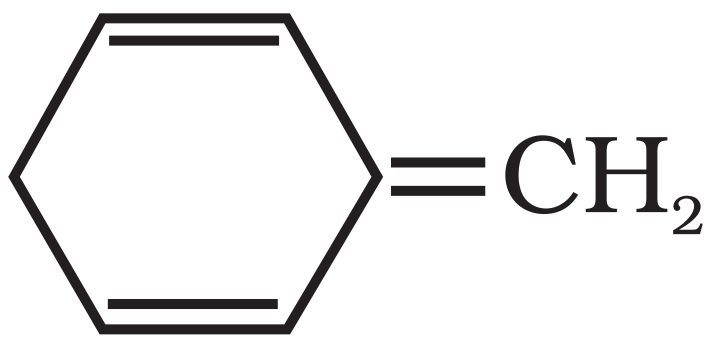
Explain why the following systems are not aromatic?
Discuss the similarities and differences between $1s$ and $2s-$orbitals.
What will be the mass of one ${ }^{12} C$ atom in g ?
Two half cells are $\mathrm{Al}^{3+}(\mathrm{aq}) / \mathrm{Al}$ and $\mathrm{Mg}^{+}(\mathrm{aq}) / \mathrm{Mg}$. The reduction potentials of these half cells are -1.66 V and -2.36 V respectively. Calculate the cell potential. Write the cell reaction also.