Question
Write the properties of diamagnetic, paramagnetic and ferromagnetic materials.

Answer

Properties of Diamagnetic Materials :
(i) When a bar of diamagnetic material is suspended freely between two magnetic poles of a magnet then it turns to become perpendicular to the magnetic field and the poles produced on the two sides of the bar are similar to the nearer magnetic poles.
(ii) When a diamagnetic material is placed in a strong uniform external magnetising field, the field lines prefer to pass through the surrounding air than to pass through the material itself i.e. field lines get repelled or expelled. Consequently, the magnetic induction 'B' inside material becomes less than magnetising field H. Thus permeability for diamagnetic substance is less but never negative.
(iii) In a non-uniform field a diamagnetic substance moves from stronger to the weaker parts of the field. For instance, if a diamagnetic liquid is placed in a watch glass resting on the pole pieces not more than 2 mm apart, the liquid accumulates on the sides where the field is weaker and creates depression in the middle. The reverse is the effect when the poles are far apart because now the field is stronger near the poles.
(iv) If a diamagnetic solution is poured into a U-tube and one arm of this U-tube is placed between the poles of a strong magnet, the level of the solution in that arm is depressed.
(v) A diamagnetic gas when allowed to ascend in between the poles of a magnet spreads across the field.
(vi) The susceptibility of a diamagnetic substance is independent of temperature and has a negative value e.g. for lead it is $-1.7 \times 10^5$.
Properties of Paramagnetic Materials :
(i) When a rod of a paramagnetic materials is suspen-ded freely between two magnetic poles of a magnet then it rotates until its axis becomes parallel to the magnetising field. The poles produced at the ends of the rod are opposite to the nearer magnetic poles of the magnet.
(ii) When a rod of paramagnetic substance is placed in a strong external magnetising field, the field lines prefer to pass through it than through the surrounding air, i.e. these field lines get slightly more concentrated inside the material. Consequently, the magnetic induction B inside the paramagnetic substance becomes slightly greater than the magnetising field H. Thus permeability for paramagnetic substance is greater than 1, but increase is very small, about I part in $10^5$. For Al and platinum the value of $\chi$ is 1.76 x $10^{-6}$ and 2.88 × $10^{6}$ respectively.
(iii) In a non-uniform field they experience an attractive force towards the stronger part of the field. For example, if a paramagnetic liquid be placed in a watch glass resting on the pole pieces not more than 2 mm apart, the liquid accumulates in the middle where the field is strongest. If the pole-pieces are far apart say, 2 cm or so, the field is strongest near the poles, then the liquid moves away from the centre producing a depression in the middle.
(iv) If the solution of paramagnetic substance is poured in a U-tube and one-arm of the U-tube is placed between two strong poles the level of the solution in that arm rises.
(v) When paramagnetic gases (like traces of ammonia and hydrogen chloride) are allowed to ascend between the poles of a magnet they spread along the field.
(vi) The susceptibility $\chi$ for paramagnetic susbtances is positive and mall e.g. for A l it is $1.76 \times 10^{-6}$ and for platnium it is 2.88 × 10⁻⁶.
(vii) $\chi$ and $\mu$ for paramagnetic substances do not change with variation in magnetising field H. $\chi$ varies inversely with the absolute temperature. At some high temperature becomes negative and substance become diamagnetic.
(viii) A paramagnetic substance acts like a diamagnetic substance if it is surrounded by a medium which is more paramagnetic than itself.
Properties of Ferromagnetic Materials
(i) The dipole moment of atoms is permanent and exists in domains.
(ii) The alignment of atomic dipoles and external magnetic fields are in the same direction.
(iii) There is a significant strength of magnetic dipole moment.
(iv) The magnetisation intensity varies linearly with the magnetising field. Moreover, the magnetisation intensity is quite high and positive.
(v) Magnetic susceptibility is relatively high and positive.
(vi) The magnetic flux density is also high and positive. The magnetic field lines inside ferromagnetic materials are dense.
(vii) The relative permeability is also relatively high. It varies linearly with the magnetic field. The magnetic field inside the material is substantially more vital than outside the material. They tend to pull in many force lines from the material.
(viii) The field aggressively attracts ferromagnetic materials. They tend to adhere to the poles where the field is more potent in a non-uniform field.
(ix) Because the field is more vital at poles, if the ferromagnetic powder is placed in a watch glass between two properly faraway poles, powder accumulates on the sides, and the centre is depressed.
(x) At high temperatures, a ferromagnetic substance loses its ferromagnetic characteristics.

Need a full question paper?

Generate a complete, print-ready paper with questions like this in minutes — across 16+ boards, with answer keys.
Start Generating Free

Similar questions

An LR circuit has L = 1.0H and $\text{R}=20\Omega.$ It is connected across an emf of 2.0V at t = 0. Find $\frac{\text{di}}{\text{dt}}$ at:
  1. t = 100ms
  2. t = 200ms
  3. t = 1.0s
Figure shows a smooth track which consists of a straight inclined part of length $1$ joining smoothly with the circular part. $A$ particle of mass m is projected up the incline from its bottom.
  1. Find the minimum projection $-$ speed $v_0,$ for which the particle reaches the top of the track.
  2. Assuming that the projection $-$ speed is $2v_0$ and that the block does not lose contact with the track before reaching its top, find the force acting on it when it reaches the top.
  3. Assuming that the projection $-$ speed is only slightly greater than $v_0,$ where will the block lose contact with the track?
Asha’s mother read an article in the newspaper about a disaster that took place at Chernobyl. She could not understand much from the article and asked a few questions from Asha regarding the article. Asha tried to answer her mother’s questions based on what she learnt in Class XII Physics.
  1. What was the installation at Chernobyl where the disaster took place? What, according to you, was the cause of this disaster?
  2. Explain the process of release of energy in the installation at Chernobyl.
  3. What, according to you, were the values displayed by Asha and her mother?
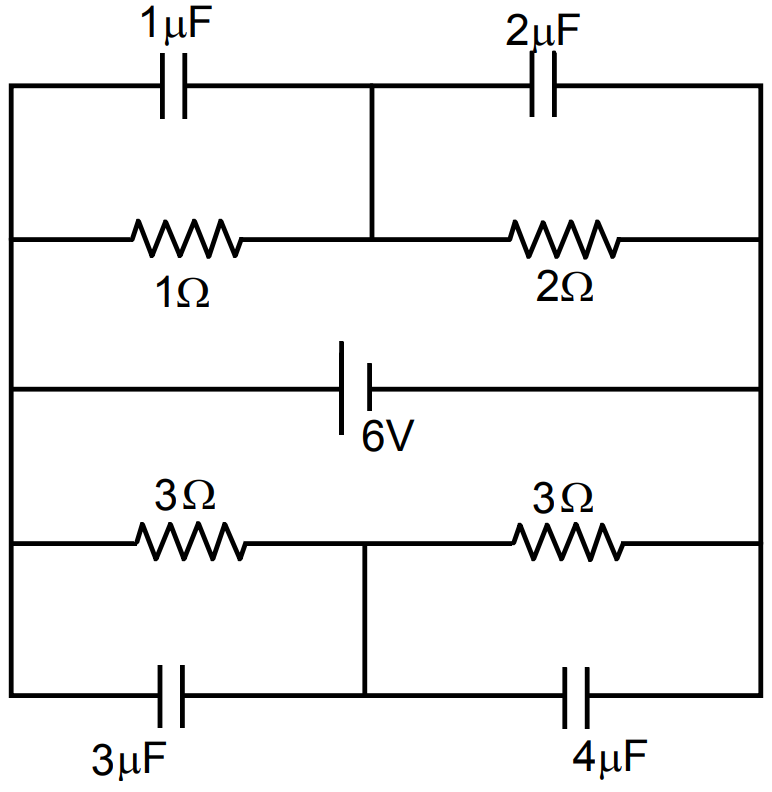
Find the charges on the four capacitors of capacitances $1\mu\text{F},2\mu\text{F},3\mu\text{F}$ and $4\mu\text{F}$ shown in the figure.
Suppose we want to verify the analogy between electrostatic and magnetostatic by an explicit experiment. Consider the motion of (i) electric dipole p in an electrostatic field E and (ii) magnetic dipole m in a magnetic field B. Write down a set of conditions on E, B, p, m so that the two motions are verified to be identical. (Assume identical initial conditions.)
A uniform chain of length L and mass M overhangs a horizontal table with its two third part on the table. The friction coefficient between the table and the chain is $\mu.$ Find the work done by the friction during the period the chain slips off the table.
Write the nature, properties and difference among $\alpha$-, $\beta$- and $\gamma$-rays.
A group of hydrogen atoms are prepared in n = 4 states. List the wavelength that are emitted as the atoms make transitions and return to n = 2 states.
Establish the formula for the capacitance of a parallel plate capacitor in the presence of dielectric material completely and partially.
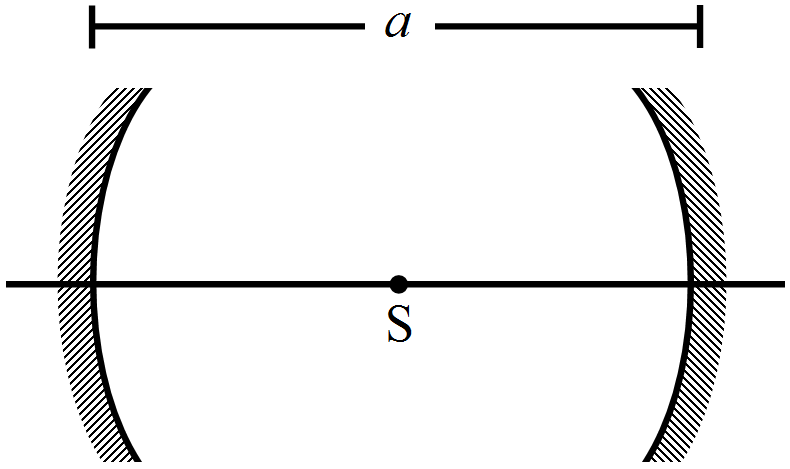
A point source S is placed midway between two converging mirrors having equal focal length f. Find the values of d for which only one image is formed.