Question
Write the rate law for a first order reaction. Justify the statement that half life for a first order reaction is independent of the initial concentration of the reactant.

Answer

Consider the first order reaction,

R → P

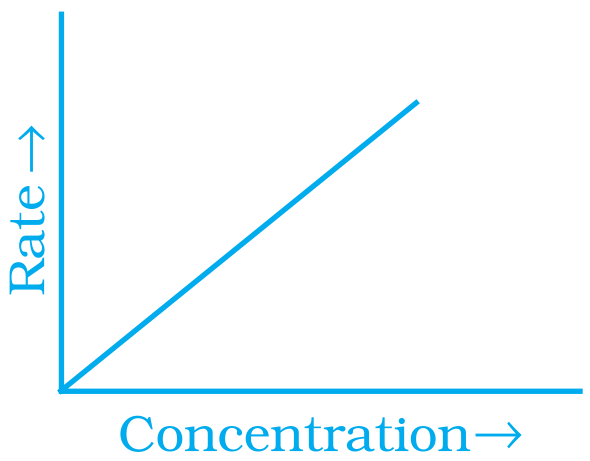
For this reaction, rate law which relates the rate of reaction to the concentration of reactants can be given as:

$\text{Rate}=\frac{\text{d|R|}}{\text{dt}}=\text{k|R|}$

For a first order reaction,

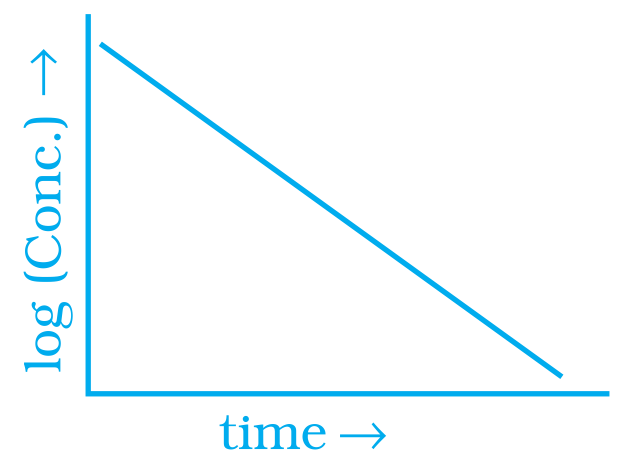
$\text{t}=\frac{2.303}{\text{k}} \log\frac{\text{|R|}_0}{\text{|R|}}$, Where [R]0 = initial concentration,[R] = concentration at time t.

At t1/2, [R] = [R]0/2

So, the above equation becomes:

$\text{t}_{1/2}=\frac{2.303}{\text{k}}\log\frac{\text{|R|}_0}{\text{|R|}_0/2}$

$\text{t}_{1/2}=\frac{2.303}{\text{k}}\log2 \text{ or}\text{ t}_{1/2}=\frac{2.303}{\text{k}}\times0.3010$

$\text{t}_{1/2}=\frac{0.693}{\text{k}}$

Need a full question paper?

Generate a complete, print-ready paper with questions like this in minutes — across 16+ boards, with answer keys.

Start Generating Free

Similar questions

What is meant by stability of a coordination compound in solution? State the factors which govern stability of complexes.
Write the applications of d- and f-block elements.
Explain the following phenomena with the help of Henry’s law.
  1. Painful condition known as bends.
  2. Feeling of weakness and discomfort in breathing at high altitude.
  1. Name the three major classes of carbohydrates and give an example of each of these classes.
  2. Answer the following:
  1. What type of linkage is responsible for the primary structure of proteins?
  2. Name the location where protein synthesis occurs in our bod.
  1.  
  1. How is the variability in oxidation states of transition metals different from that of the p-block elements?
  2. Out of Cu+ and Cu2+, which ion is unstable in aqueous solution and why?
  3. Orange colour of Cr2O72– ion changes to yellow when treated with an alkali. Why?
  1. Chemistry of actinoids is complicated as compared to lanthanoids. Give two reasons.
Assign reasons for the following:
  1. The enthalpies of atomisation of transition elements are high.
  2. The transition metals and many of their compounds act as good catalyst.
  3. From element to element the actinoid contraction is greater than the lanthanoid contraction.
  4. The E0 value for the Mn3+/Mn2+ couple is much more positive than that for Cr3+/Cr2+.
  5. Scandium (Z = 21) does not exhibit variable oxidation states and yet it is regarded as a transition element.
The decomposition of a hydrocarbon follows the equation.

$\text{k}=(4.5\times10^{11}\text{s}^{-1})\text{e}^{-28000}\text{ K/T}$

Calculate Ea.

The experimental data for decomposition of N2O5
[2N2O5 → 4NO2 + O2]
in gas phase at 318K are given below:
t/s 0 400 800 1200 1600 2000 2400 2800 3200
102 × [N2O5]/mol L-1 1.63 1.36 1.14 0.93 0.78 0.64 0.53 0.43 0.35
  1. Plot [N2O5] against t.
  2. Find the half-life period for the reaction.
  3. Draw a graph between log[N2O5] and t.
  4. What is the rate law?
  5. Calculate the rate constant.
  6. Calculate the half-life period from k and compare it with (ii).
Classify carbohydrates and also give examples of each.