Question
Write the three laws of thermodynamics (i.e. zeroth law, first law and second law) then explain their importance.
Answer

SELF

Need a full question paper?

Generate a complete, print-ready paper with questions like this in minutes — across 16+ boards, with answer keys.

Start Generating Free

Similar questions

Given below are some functions of x and t to represent the displacement of an elastic wave.$​​​​\text{y}=100\cos(100\pi\text{t+0.5x})$
The separation between the objective and the eyepiece of a compound microscope can be adjusted between $9.8cm$ to $11.8cm$. If the focal lengths of the objective and the eyepiece are $1.0cm$ and 6cm respectively, find the range of the magnifying power if the image is always needed at $24cm$ from the eye.
What is scalar product? Explain by giving examples. Explain the scalar product of perpendicular and parallel vectors with an example.
A $14.5kg$ mass, fastened to the end of a steel wire of unstretched length $1.0m$, is whirled in a vertical circle with an angular velocity of $2rev/s$ at the bottom of the circle. The cross-sectional area of the wire is $0.065cm^2$. Calculate the elongation of the wire when the mass is at the lowest point of its path.
Define 1st law of thermodynamics. By using this law, derive relationship between $C_p$ and $C_v.$
Obtain a relation between the distance travelled by a body in time t, if its initial velocity be u and acceleration:
Can $\text{L}_\alpha$ X-ray of one material have shorter wavelength than $\text{K}_\alpha$ X-ray of another?
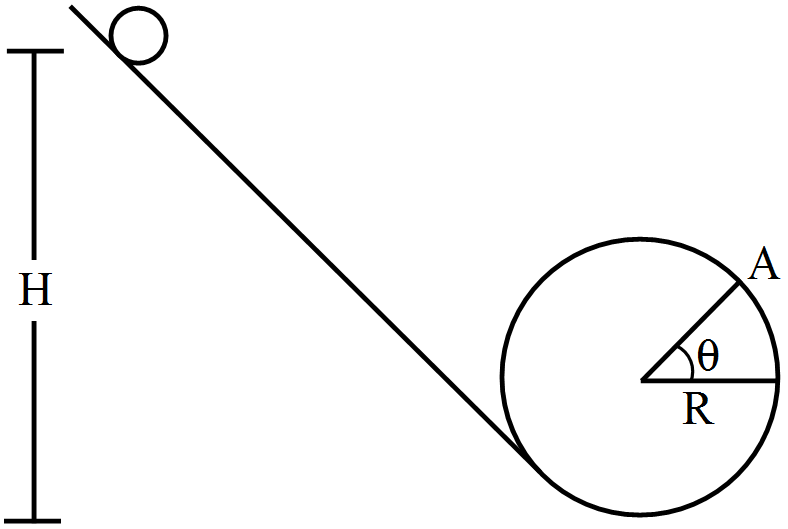
Figure shows a small spherical ball of mass m rolling down the loop track. The ball is released on the linear portion at a vertical height H from the lowest point. The circular part shown has a radius R.
  1. Find the kinetic energy of the ball when it is at a point A where the radius makes an angle $\theta$ with the horizontal.
  2. Find the radial and the tangential accelerations of the centre when the ball is at A.
  3. Find the normal force and the frictional force acting on the ball if H = 60cm, R = 10cm, $\theta=0 $ and m = 70g.
Prove that the total speed of a particle in simple harmonic motion energy is directly proportional to the square of the particle's amplitude and the square of its frequency.
Estimate the average mass density of a sodium atom assuming its size to be about $2.5 \mathring{\text{A}}.$ (Use the known values of Avogadro’s number and the atomic mass of sodium). Compare it with the mass density of sodium in its crystalline phase: $970kg ~m^{–3}$. Are the two densities of the same order of magnitude? If so, why?