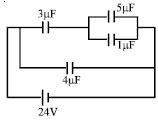
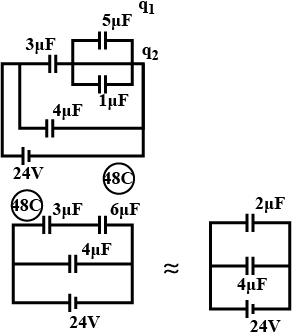
In the circuit shown, the energy stored in $1$ $ \mu F$ capacitor is......$\mu J$
Medium


Download our appand get started for free
Experience the future of education. Simply download our apps or reach out to us for more information. Let's shape the future of learning together!No signup needed.*
Similar Questions
- 1A capacitor of capacity $C$ has charge $Q$ and stored energy is $W$. If the charge is increased to $2Q$, the stored energy will beView Solution
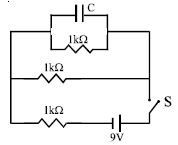
- 2A capacitor $C = 100$ $ \mu F$ is connected to three resistor each of resistance $1$ $k\Omega$ and a battery of $emf$ $9\,V$. The switch $S$ has been closed for long time so as to charge the capacitor. When switch $S$ is opened, the capacitor discharges with time constant......$ms$View Solution
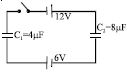
- 3In the circuit shown initially $C_1, C_2$ are uncharged. After closing the switchView Solution
- 4The electric field near a conducting surface having a uniform surface charge density $\sigma $ is given byView Solution
- 5View SolutionA non uniformly shaped conductor is charged then at it's sharpest point
- 6Three infinitely long linear charges of charge density $\lambda $ , $\lambda $ and $-2\lambda $ are placed in space. A point in space is specified by its perpendicular distance $r_1 , r_2 $ and $ r_3$ respectively from the linear charges. For the points which are equipotentialView Solution
- 7A dielectric slab of thickness $d$ is inserted in a parallel plate capacitor whose negative plate is at $x = 0$ and positive plate is at $x = 3d$. The slab is equidistant from the plates. The capacitor is given some charge. As one goes from $0$ to $3d$View Solution
- 8View SolutionA parallel plate capacitor is charged. Then battery is removed now If the plates are pulled apart
- 9Consider a sphere of radius $R$ with uniform charge density and total charge $Q$. The electrostatic potential distribution inside the sphere is given by $\theta_{(r)}=\frac{Q}{4 \pi \varepsilon_{0} R}\left(a+b(r / R)^{C}\right)$. Note that the zero of potential is at infinity. The values of $(a, b, c)$ areView Solution
- 10A condenser having a capacity of $6\,\mu F$ is charged to $100\, V$ and is then joined to an uncharged condenser of $14\,\mu F$ and then removed. The ratio of the charges on $6\,\mu F$ and $14\,\mu F$ and the potential of $6\,\mu F$ will beView Solution