Question
What is the kinetic theory of gases? Explain the hypothesis of this theory and point out its limitations.
Answer

SELF

Need a full question paper?

Generate a complete, print-ready paper with questions like this in minutes — across 16+ boards, with answer keys.

Start Generating Free

Similar questions

A meter stick held vertically, with one end on the ground, is then allowed to fall. What is the value of the radial and tangential acceleration of the top end of the stick when the stick has turned through on angle $\theta?$ What is the speed with which the top end of the stick hits the ground? Assume that the end of the stick in. contact with the ground does not slip.
Solve the previous problem if the friction coefficient between the $2.0kg$ block and the plane below it is $0.5$ and the plane below the $4.0kg$ block is frictionless.
A uniform ladder of length 10.0m and mass 16.0kg is resting against a vertical wall making an angle of 37° with it. The vertical wall is frictionless but the ground is rough. An electrician weighing 60.0kg climbs up the ladder. If he stays on the ladder at a point 8.00m from the lower end, what will be the normal force and the force of friction on the ladder by the ground? What should be the minimum coefficient of friction for the elctrician to work safely?
One day in the morning, Ramesh filled up 1/ 3 bucket of hot water from geyser, to take bath. Remaining 2/ 3 was to be filled by cold water (at room temperature) to bring mixture to a comfortable temperature. Suddenly Ramesh had to attend to something which would take some times, say 5-10 minutes before he could take bath. Now he had two options:
  1. Fill the remaining bucket completely by cold water and then attend to the work.
  2. First attend to the work and fill the remaining bucket just before taking bath. Which option do you think would have kept water warmer? Explain.
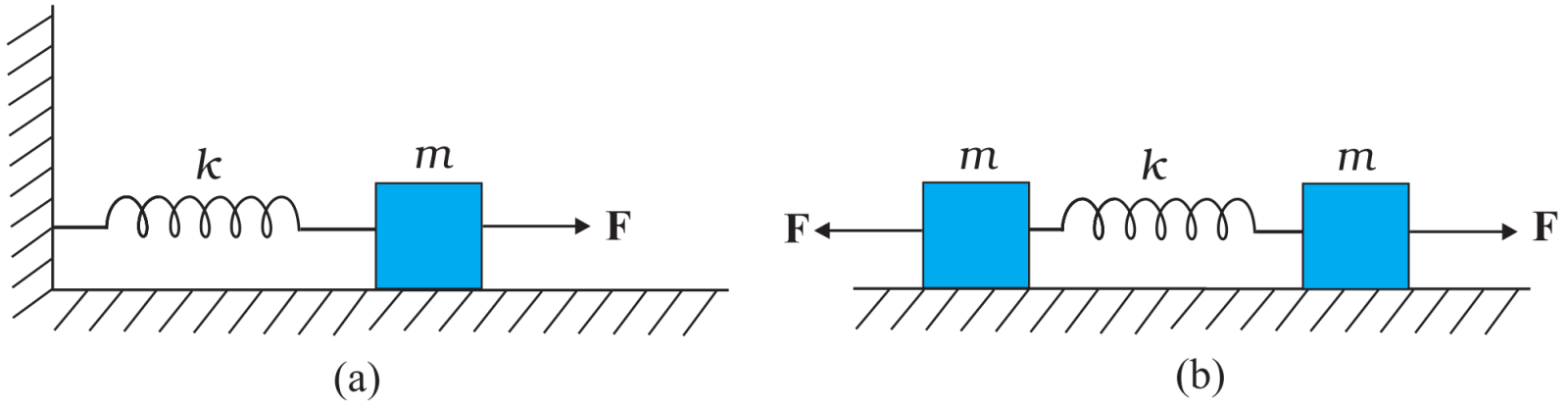
Figure (a) shows a spring of force constant k clamped rigidly at one end and a mass m attached to its free end. A force F applied at the free end stretches the spring. Figure (b) shows the same spring with both ends free and attached to a mass m at either end. Each end of the spring in Fig. (b) is stretched by the same force F.
If the mass in Fig. (a) and the two masses in Fig. (b) are released, what is the period of oscillation in each case?
  1. State Pascal's law. Explain the working of hydraulic lift.
  2. Find out the height of atmosphere if the density of the atmosphere at sec level is $1.29km/ m^3$. Assume that it does not change with altitude.
Give the postulates of kinetic theory of gases. Derive the expression for pressure exerted by gas molecules in a container. Use it to relate kinetic energy with pressure.
Do permeability and relative permeability have the same dimensions?
The bob of a pendulum is released from a horizontal position. If the length of the pendulum is $1.5m$, what is the speed with which the bob arrives at the lowermost point, given that it dissipated $5\%$ of its initial energy against air resistance?
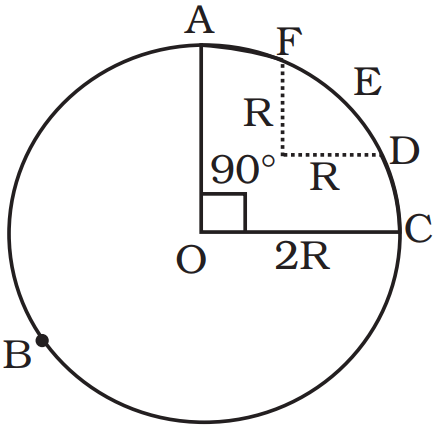
A racing car travels on a track (without banking) ABCDEFA ABC is a circular arc of radius 2 R. CD and FA are straight paths of length R and DEF is a circular arc of radius $R = 100 m$. The co-effecient of friction on the road is $\mu = 0.1.$ The maximum speed of the car is $50m s^{–1}$. Find the minimum time for completing one round.