Questions · Page 2 of 5

M.C.Q (1 Marks)

MCQ 511 Mark
Calculate the current through a lamp of $25w$ operating at $220v.$
  • A
    $2A$
  • B
    $25A$
  • $0.114A$
  • D
    $6A$
Answer
Correct option: C.
$0.114A$

Given: $P = 25W$
$V = 220$ volts
$\therefore$ Current through the lamp $\text{I}=\frac{\text{P}}{\text{V}}=\frac{25}{220}=0.114\text{A}$

View full question & answer
MCQ 521 Mark
Which color band in the color coding of a resistor has the tolerance $\pm2\%$?
  • A
    Orange
  • B
    Black
  • C
    Silver
  • Red
Answer
Correct option: D.
Red

Red color band in the color coding of a resistor has the tolerance of $\pm2\%$

View full question & answer
MCQ 531 Mark
An experiment to verify ohm's law, a conductor of resistance $R$ is taken. During the experiment, temperature of the conductor increases with the flow of current. Resistance of the conductor will:
  • A
    Remains same.
  • B
    Decrease.
  • Increase.
  • D
    First increases then decreases.
Answer
Correct option: C.
Increase.

Resistance of conductor $\text{RT}​=\text{R}\text{o}​(1+αΔ\text{T})$ where $α > 0$
Thus resistance of the conductor increases with increase in temperature.

View full question & answer
MCQ 541 Mark
Identify the type of conductors in which both positive and negative charges can move.
  • A
    Thermosets
  • B
    Metallic conductors
  • Electrolytic solutions
  • D
    Polymers
Answer
Correct option: C.
Electrolytic solutions

Electrolytic solutions are those that are capable of conducting an electrical current. They are generally ions, in which both positive and negative charges can move. Polymers and thermosets do not conduct electric charge. Electrons are the charge carriers in metallic conductors.

View full question & answer
MCQ 551 Mark
The speed at which the current travels, in conductor, is nearly equal to:
  • A
    $3 \times 10^4 m / s$
  • B
    $3 \times 10^5 m / s$
  • C
    $4 \times 10^6 m / s$
  • $3 \times 10^8 m / s$
Answer
Correct option: D.
$3 \times 10^8 m / s$
d. $3 \times 10^8 m / s$.
View full question & answer
MCQ 561 Mark
As the temperature of a metallic resistor is increased, the product of its resistivity and conductivity:
  • A
    Increases.
  • B
    Decreases.
  • C
    Remains constant.
  • May increase or decrease.
Answer
Correct option: D.
May increase or decrease.
The product of resistivity and conductivity is independent of temperature. As the temperature of a metallic resistor is increased, the resistivity increases and conductivity decreases. Hence, both the conductivity and resistivity of the metallic resistor nullify the effect of the change in temperature.
View full question & answer
MCQ 571 Mark
Choose the correct statement:
  • A
    The potential difference between the terminals of a cell in closed circuit is called $\text{EMF}$ of the cell.
  • B
    Electromotive force and accelerating force have the same dimensions.
  • C
    The internal resistance of an ideal cell is infinity.
  • The difference between the emf of a cell and potential difference across the ends of the cell is called lost volts.
Answer
Correct option: D.
The difference between the emf of a cell and potential difference across the ends of the cell is called lost volts.

When the battery is discharging, the terminals voltage of the battery is always $≤$ Emf of cell $[∵\text{r}>0]$
$\therefore$ There will always be a difference which is defined to be lost volt.

View full question & answer
MCQ 581 Mark
A hank of uninsulated wire consisting of seven and a half turns is stretched between two nails hammered into a board to which the ends of the wire are fixed. The resistance of the circuit between the nails is determined with the help of electrical measuring instruments. Determine the proportion in which the resistance will change if the wire is unwound so that the ends remain to be fixed to the nails.
  • $225.$
  • B
    $15.$
  • C
    $240.$
  • D
    $250.$
Answer
Correct option: A.
$225.$
View full question & answer
MCQ 591 Mark
Which of the following is not the disadvantage of wire wound resistor?
  • A
    It has a big size which is not suitable for many of the applications.
  • B
    It has high power rating with a low tolerance value.
  • Resistance value gets changed by a change in temperature, humidity etc.
  • D
    It is not suitable for high$-$frequency circuits.
Answer
Correct option: C.
Resistance value gets changed by a change in temperature, humidity etc.

In wired resistors are mainly produced with alloys, since pure metal has a high temperature co$-$efficient.
Due to alloy temperature co$-$efficient of wire wound resistor is very low.
Therefore it is very less effected by temperature change.

View full question & answer
MCQ 601 Mark
Kirchoffs law of junctions is also called the law of conservation of:
  • A
    Energy
  • Charge
  • C
    Momentum
  • D
    Angular momentum
Answer
Correct option: B.
Charge

Kirchoff's second law:- According to the law, at a particular junction the charge entering the junction is equal to charge exiting that junction.
$\Rightarrow $ There is no charge accumulated at junction. This is also called as law of conservation of charge.

View full question & answer
MCQ 611 Mark
Which type of current is flowing through a circuit?
  • A
    Static current
  • B
    Conventional current
  • Electronic current
  • D
    Potential current
Answer
Correct option: C.
Electronic current

The carriers of electric current are electrons. The current in a circuit is due to the flow of electrons. Therefore, the direction of the conventional current is opposite to the direction of flow of electrons.

View full question & answer
MCQ 621 Mark
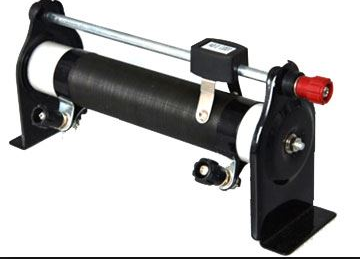
The wire wound resistor is also known as:
  • A
    Variable resistor
  • B
    Rheostat
  • C
    Circular coil
  • Both $a$ and $b$
Answer
Correct option: D.
Both $a$ and $b$

It is rheostat

View full question & answer
MCQ 631 Mark
The $\text{EMF}$ of a cell can be defined as:
  • A
    Work done in taking a unit positive charge once round the circuit.
  • B
    The open circuit voltage of the cell.
  • C
    The terminal voltage when the current is zero.
  • All the above.
Answer
Correct option: D.
All the above.

$\text{EMF}$ of cell can be defined as:
$\rightarrow $ Workdone in taking unit positive charge once round the circuit.
$\rightarrow $ The open circuit voltage of cell.
$\rightarrow $ The terminal voltage when current is zero.

View full question & answer
MCQ 641 Mark
The length of a conductor is doubled and its radius is halved, its specific resistance is:
  • A
    Halved
  • B
    Doubled
  • C
    Quadrupled
  • Unchanged
Answer
Correct option: D.
Unchanged

Specific resistance $($ or resistivity $)$ is an intrinsic property of a material i.e. it depends only on the nature of material but not on the dimensions of the conductor. Thus specific resistance remains the same even if the length of the conductor is doubled and its radius is halved.

View full question & answer
MCQ 651 Mark
The electric field intensity $E$, current density $J$ and specific resistance k are related to each other through the relation:
  • A
    $E = J/k$
  • $E = J k.$
  • C
    $E = k/J.$
  • D
    $k = J E.$
Answer
Correct option: B.
$E = J k.$
View full question & answer
MCQ 661 Mark
Two or more resistors are said to be in $...A...$ if one end of all resistors is joined together and similarly the other ends joined together, Here, A refers to:
  • A
    Series.
  • Parallel.
  • C
    Either $(a)$ or $(b).$
  • D
    None of these.
Answer
Correct option: B.
Parallel.
View full question & answer
MCQ 671 Mark
Consider a current carrying wire $($current $I)$ in the shape of a circle.
  • A
    Source of emf.
  • Electric field produced by charges accumulated on the surface of wire.
  • C
    The charges just behind a given segment of wire which push them just the right way by repulsion.
  • D
    The charges ahead.
Answer
Correct option: B.
Electric field produced by charges accumulated on the surface of wire.
View full question & answer
MCQ 681 Mark
The current which is assumed to be flowing in a circuit from positive terminal to negative, is called:
  • A
    Direct current.
  • B
    Pulsating current
  • Conventional current.
  • D
    Alternating current.
Answer
Correct option: C.
Conventional current.
View full question & answer
MCQ 691 Mark
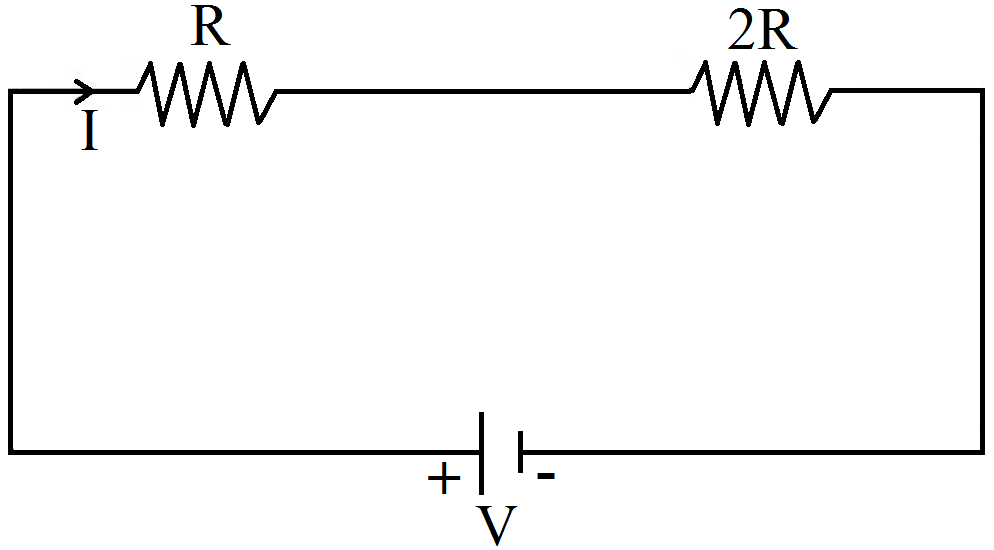
Two resistors $R$ and $2R$ are connected in series in an electric circuit. The thermal energy developed in $R$ and $2R$ are in the ratio:
  • $1 : 2.$
  • B
    $2 : 1.$
  • C
    $1 : 4.$
  • D
    $4 : 1.$
Answer
Correct option: A.
$1 : 2.$

Thermal Energy developed $=1^2 Rt ($Because in series, current is same$)$

$\frac{\text{Thermal Energy developedin "R"}}{\text{Thermal Energy developedin "2R"}}=\frac{\text{I}^2\text{Rt}}{\text{I}^2(2\text{R})\text{t}}=\frac{1}{2}$

View full question & answer
MCQ 701 Mark
Which type of a physical quantity is electric current?
  • Scalar quantity
  • B
    Vector quantity
  • C
    Bipolar quantity
  • D
    Thermodynamic quantity
Answer
Correct option: A.
Scalar quantity

The electric current is a scalar quantity. Laws of ordinary algebra are used to add electric currents and the law of vector algebra are not applicable.

View full question & answer
MCQ 711 Mark
What happens when negative terminal of cell is connected to other negative terminal of cell in a particular circuit?
  • Current will not flow in circuit.
  • B
    Current will flow in circuit.
  • C
    Temperature of cell will increase.
  • D
    Cell gets damaged.
Answer
Correct option: A.
Current will not flow in circuit.
Current means flow of electrons and electrons are negative charged and so are attracted to the positive end of the battery and repelled by the negative end.
When battery is connected in a circuit that lets the electron flow through it, they flow from negative to positive.
When negative terminal of cell is connected to other negative terminal of the cell in a particular circuit then, current will not flow in circuit as electrons cannot flow from negative to negative terminal.
View full question & answer
MCQ 721 Mark
The resistance of a metal increases with increasing temperature because:
  • The collisions of the conducting electrons with the electrons increase.
  • B
    The collisions of the conducting electrons with the lattice consisting of the ions of the metal increase.
  • C
    The number of conduction electrons decreases.
  • D
    The number of conduction electrons increases.
Answer
Correct option: A.
The collisions of the conducting electrons with the electrons increase.
View full question & answer
MCQ 731 Mark
$‘X’$ is a type of commercial resistor made from a mixture of clay, carbon black, and resin binder which are pressed and then molded into cylindrical rods by heating. Identify $X$.
  • A
    Wire$-$bound resistors
  • Carbon resistors
  • C
    Metal film resistors
  • D
    Surface$-$mount resistors
Answer
Correct option: B.
Carbon resistors

Carbon resistors are made from a mixture of carbon black, clay and resin binder which are pressed and then molded into cylindrical rods by heating. The rods are enclosed in a ceramic or plastic jacket. They are used in circuits of radio receivers, amplifiers, etc.

View full question & answer
MCQ 741 Mark
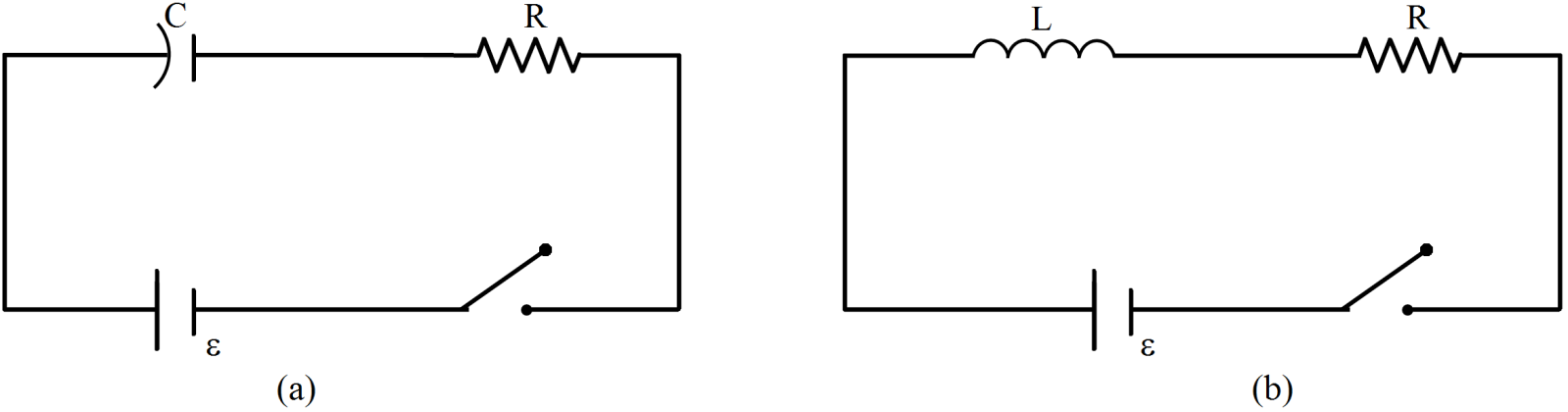
The switches in figure are closed at $t=0$ and reopened after a long time at $t=t_0$ :
  • A
    The charge on $C$ just after $t = 0$ is $\in\text{C}.$
  • B
    The charge on $C$ long after $t = 0$ is $\in\text{C}.$
  • A and B both
  • D
    The current in $L$ long after $t = t_o$ is $\frac{\in}{\text{R}}.$
Answer
Correct option: C.
A and B both
Explanation:

þ A long time after capacitor is fully charged is equal to
$\text{Q}=\text{CV}=\text{C}\hat{\text{I}}$
$\text{Q}=\text{C}\hat{\text{I}}\Big(1-\text{e}^{-\frac{\text{t}}{\text{t}}}\Big)$
þ The current in $'L'$ just before t $t = t_o$ is
$\text{i}=\frac{\hat{\text{I}}}{\text{R}}\Big(1-\text{e}^{-\frac{\text{t}}{\text{t}}}=\frac{\hat{\text{I}}}{\text{R}}\Big)$
View full question & answer
MCQ 751 Mark
Which of the following is non-ohmic resistance?
  • A
    Lamp filament
  • B
    Copper wire
  • C
    Carbon resistor
  • Diode
Answer
Correct option: D.
Diode

A non$-$ohmic resistance is a resistance that does not obey $ohm’s$ law. Among the given options, a diode is a non$-$ohmic resistance.

View full question & answer
MCQ 761 Mark
Which resistor is difficult to make of having a value less than about $2 \ Ohms?$
  • A
    Iron Resistor
  • Carbon Resistor
  • C
    Wire wound Resistor
  • D
    Both $b$ and $c$
Answer
Correct option: B.
Carbon Resistor

Carbon resistor is difficult to make of having a value less than about $20 \ Ohms$ because they have ability to withstand high energy pulses, when current flow through the carbon composition body conducts the energy. So carbon resistor can be made with a higher resistance.

View full question & answer
MCQ 771 Mark
When no current is passed through a conductor:
  • A
    The free electrons do not move.
  • B
    The average of the velocities of all the free electrons at an instant is zero.
  • C
    The average velocity of a free electron over a large period of time is zero.
  • B and C both
Answer
Correct option: D.
B and C both
Explanation:
No current is passed through a conductor means. That the average velocity of a free elecron over a large period of time is zero or the average of the velocity of all the free electrons at an instant is zero.
View full question & answer
MCQ 781 Mark
Which error is removed when the known and unknown resistances are interchanged in a Meter Bridge?
  • A
    Percentage error
  • B
    Measurement error
  • End error
  • D
    Index error
Answer
Correct option: C.
End error

End error is removed when the known and unknown resistances are interchanged in a Meter Bridge. This additional length has a resistance known as end resistance. So, when an end error arises, it can be removed by interchanging the known and unknown resistances and taking the mean of the resistances determined.

View full question & answer
MCQ 791 Mark
The amount of work done by the cell on a unit positive charge carrier to force it to go to the point of higher potential is called:
  • A
    Power.
  • B
    Voltage.
  • Emf.
  • D
    Energy.
Answer
Correct option: C.
Emf.

The rate at which energy is drawn from a source of energy when unit current flows through the circuit or device is called $e.m.f.$ It is measured in volts.

View full question & answer
MCQ 801 Mark
The product of resistivity and conductivity of a cylindrical conductor depends on:
  • A
    Temperature.
  • B
    Material.
  • C
    Area of cross section.
  • None of these.
Answer
Correct option: D.
None of these.

Conductivity $\sigma=\frac{1}{\rho }$ Where r is resistivily.
Product of conductity and resistivity $= 1.$

View full question & answer
MCQ 811 Mark
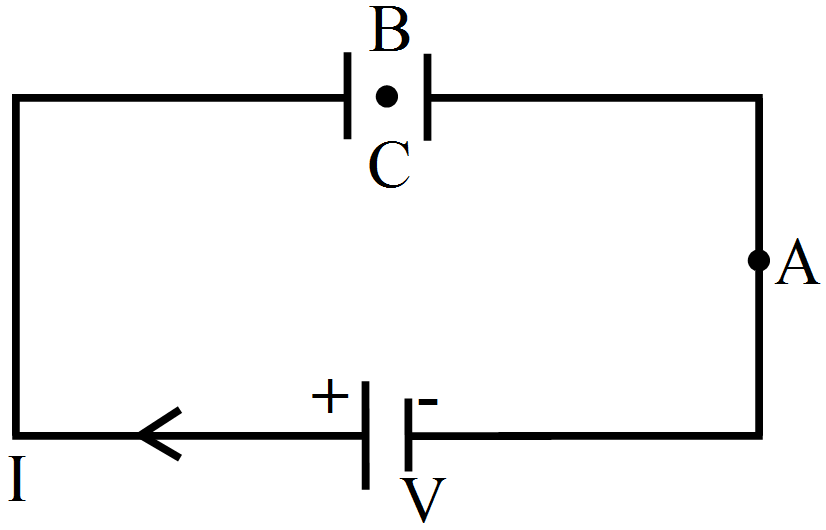
A capacitor with no dielectric is connected to a battery at $t = 0$. Consider a point A in the connecting wires and a point $B$ in between the plates.
  • A
    There is no current through $A.$
  • B
    There is no current through $B.$
  • C
    There is a current through $A$ as long as the charging is not complete.
  • $B$ and $C$ both
Answer
Correct option: D.
$B$ and $C$ both


$Þ$ There is no current through $B.$
$Þ$ There is a current through $A$ as long as the charging is not complete.

View full question & answer
MCQ 821 Mark
Constantan wire is used for making standard resistance, because it has:
  • A
    High melting point.
  • B
    Low specific resistance.
  • C
    High specific resistance.
  • Negligible temperature coefficient of resistance.
Answer
Correct option: D.
Negligible temperature coefficient of resistance.

Constantan is a copper-nickel alloy. Its main feature is its resistivity, which is constant over a wide range of temperatures. Thus it has low temperature coefficient of resistance.that's why it is used for making of standard resistances.

View full question & answer
MCQ 831 Mark
To maintain a steady current through the conductor, some external device must do work. What does the external device provide?
  • A
    Inductance
  • B
    Capacitance
  • C
    Potential difference
  • Electromotive force
Answer
Correct option: D.
Electromotive force

To maintain steady current through the conductor, electromotive force must be provided by the external device to take positive charge from lower potential to higher potential i.e. in the direction opposite to that of the electric field.

View full question & answer
MCQ 841 Mark
The color coding of earth, live and neutral wire respectively is:
  • Green, Red, black.
  • B
    Red, Green, Black.
  • C
    Red, Black, Green.
  • D
    None of the above.
Answer
Correct option: A.
Green, Red, black.

The electric power line enters our house through three wires$-$ namely the live wire, the neutral wire and the earth wire. To avoid confusion we follow a colour code for insulating these wires. The red wire is the live wire, and the black wire is neutral. The earth wire is given green plastic insulation. The colour coding of wires is green for earth red for live and black for neutral.

View full question & answer
MCQ 851 Mark
Which of the following is used for the formation of thermistor?
  • A
    Copper oxide.
  • B
    Nickel oxide.
  • C
    Iron oxide.
  • All of the above.
Answer
Correct option: D.
All of the above.
View full question & answer
MCQ 861 Mark
Identify the correct statement from the following.
  • A
    While traversing in a closed loop, if negative pole of cell is encountered first, then the emf is negative.
  • B
    The product of resistance and current in an arm is taken to be positive if the direction of current is opposite to the direction in which one moves along the closed loop.
  • C
    Current flowing away from a junction is taken as positive.
  • While traversing in a closed loop, if positive pole of cell is encountered first, then the emf is positive.
Answer
Correct option: D.
While traversing in a closed loop, if positive pole of cell is encountered first, then the emf is positive.
According to sign convention while traversing a closed loop $($in clockwise or anti$-$clockwise direction$)$, if positive pole of the cell is encountered first then its emf is negative or else, it will be positive.
View full question & answer
MCQ 871 Mark
Which of the following devices is the more accurate one for the measurement of emf?
  • A
    Meter Bridge
  • B
    Voltmeter
  • C
    Multimeter
  • Potentiometer
Answer
Correct option: D.
Potentiometer

Potentiometer is the more accurate device to measure emf than the other ones such as multimeter or voltmeter. Potentiometer is highly sensitive and thus, even small emfs can be measured using this device. Moreover, potentiometers do not draw current from the circuit during measurements, like voltmeters.

View full question & answer
MCQ 881 Mark
In an electric circuit containing a battery, the charge $($assumed positive$)$ inside the battery:
  • A
    Always goes from the positive terminal to the negative terminal.
  • May go from the positive terminal to the negative terminal.
  • C
    Always goes from the negative terminal to the positive terminal
  • D
    Does not move.
Answer
Correct option: B.
May go from the positive terminal to the negative terminal.

The charge $($Positive$)$ inside the bottery my go from the positive terminal to the negative terminal.

View full question & answer
MCQ 891 Mark
Which of these is a correct definition of electronic current?
  • Current that flows from lower potential to higher potential.
  • B
    The current which remains static.
  • C
    Current constituted by the flow of ions.
  • D
    Current that flows from higher potential to lower potential.
Answer
Correct option: A.
Current that flows from lower potential to higher potential.

The current that flows from a point at the lower $($negative$)$ potential to a point at higher $($positive$)$ potential is called electronic current. Electronic current is produced by the movement of negatively charged electrons.

View full question & answer
MCQ 901 Mark
In a potentiometer of ten wires, the balance point is obtained on the sixth wire. To shift the balance point to eighth wire, we should:
  • Increase resistance in the primary circuit.
  • B
    Decrease resistance in the primary circuit.
  • C
    Decrease resistance in series with the cell whose $e.m.f.$ has to be measured.
  • D
    Increase resistance in series with the cell whose $e.m.f.$ has to be measure.
Answer
Correct option: A.
Increase resistance in the primary circuit.

By increasing resistance in the primary circuit the $P.G$ of the wire decreases thereby it requires more length to measure the emf of secondary cell.
By increasing the resistance in series circuit we can move balancing point from sixth to eight wire.

View full question & answer
MCQ 911 Mark
Identify the type of materials which develop electric currents in them, when an electric field is applied.
  • A
    Elastomers
  • Conductors
  • C
    Insulators
  • D
    Polymers
Answer
Correct option: B.
Conductors
When an electric field is applied across the ends of conductors, the electrons begin to move under the action of the electric field. The flow of electrons constitutes electric current through the conductor.
View full question & answer
MCQ 921 Mark
Identify the material which is suitable for making standard resistors.
  • A
    Silver
  • B
    Copper
  • Constantan
  • D
    Germanium
Answer
Correct option: C.
Constantan

Alloys like constantan or manganin are used for making standard resistance coils due to their high resistivity values and very small temperature coefficient.

View full question & answer
MCQ 931 Mark
Which among the following is true?
  • A
    According to Kirchhoff’s law, the current flowing towards a junction is equal to the voltage drop.
  • B
    According to Kirchhoff’s law, the current flowing towards a junction is equal to the resistance across the junction.
  • According to Kirchhoff’s law, the current flowing towards a junction is equal to the current leaving the junction.
  • D
    According to Kirchhoff’s law, the current flowing towards a junction is equal to all the currents in the circuit.
Answer
Correct option: C.
According to Kirchhoff’s law, the current flowing towards a junction is equal to the current leaving the junction.
c. According to Kirchhoff's law, the current flowing towards a junction is equal to the current leaving the junction.
Explanation:
According to Kirchhoff's first law, the current flowing towards the junction is equal to the current leaving the junction. Mathematically, this law can be expressed as $\sum^n{ }_{K-1} I_K=0$ (where n is the number of branches carrying current towards or away from the junction)
View full question & answer
MCQ 941 Mark
Kirchhoff ’s junction rule is a reflection of:
  • A
    Conservation of current density vector.
  • B
    Conservation of charge.
  • C
    The fact that there is no accumulation of charges at a junction.
  • B and C both.
Answer
Correct option: D.
B and C both.
Solution:
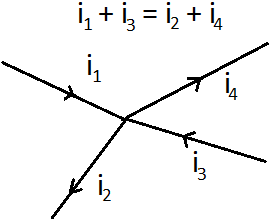
Key concept: Junction rule: At any junction, the sum of the currents entering the junction is equal to the sum of currents leaving the junction.
Or
Algebraic sum of the currents flowing towards any point in an electric network is zero, i.e., charges are conserved in an electric network.
The proof of this rule follows from the fact that when currents are steady, there is no accumulation of charges at any junction or at any point in a line.
Thus, the total current flowing in, (which is the rate at which charge flows into the junction), must equal the total current flowing out.
Kirchhoffs junction rule is also known as Kirchhoff’s current law.
So, Kirchhoffs junction rule is the reflection of conservation of charge
Important point: Sign convention of current from a junction: We are taking outgoing current from a junction as negative. And we are taking incoming current towards a junction as positive.
View full question & answer
MCQ 951 Mark
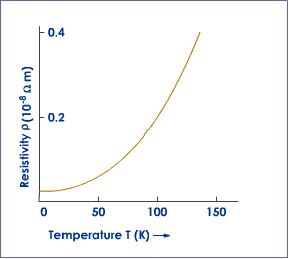
Identify the type of material based on the $T-ρ$ graph given below.
Image
  • A
    Silicon
  • B
    Polymer
  • C
    Nichrome
  • Copper
Answer
Correct option: D.
Copper

For metals, the temperature coefficient of resistivity is positive. At lower temperatures, the resistivity of a pure metal increases as a higher power of temperature. So, the answer is copper, which is a metal.

View full question & answer
MCQ 961 Mark
Electromotive Force $\text{(EMF)}$ may be defined as:
  • Work done per coulomb on the charge.
  • B
    Drift velocity of electrons.
  • C
    Flow of electron.
  • D
    The number of coulombs of charge per second.
Answer
Correct option: A.
Work done per coulomb on the charge.

Electromotive Force $\text{(EMF)}$ may be defined as work done per coulomb on the charge.

View full question & answer
MCQ 971 Mark
The Kirchhoff's second law $\Big(\sum\text{iR}=\sum\text{E}\Big)$ where the symbols have their usual meanings, is based on:
  • A
    Conservation of momentum.
  • B
    Conservation of charge.
  • C
    Conservation of potential.
  • Conservation of energy.
Answer
Correct option: D.
Conservation of energy.
View full question & answer
MCQ 981 Mark
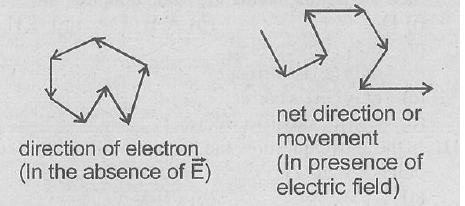
In the absence of an electric field, the mean velocity of free electrons in a conductor at absolute temperature $(T)$ is:
  • Zero
  • B
    Independent of $T$
  • C
    Proportional to $T$
  • D
    Proportional to $t^2$
Answer
Correct option: A.
Zero
In the absence of electric field, the electron moves in zig$-$zag direction as shown in figure. So net displacement is zero, hence mean velocity of free electrons in a conductor at absolute temperature is zero.
View full question & answer
MCQ 991 Mark
The resistance of carbon $......$ with rise in the temperature.
  • A
    Increases
  • Decreases
  • C
    Remains the same
  • D
    First increases then decreases
Answer
Correct option: B.
Decreases

The resistance of the conductor increases with the rise in temperature. However, substances classified as insulator tends to show opposite behaviour. Carbon is an insulator.

View full question & answer
MCQ 1001 Mark
Which one of the following is the practical unit of power?
  • A
    Watt $(W)$
  • B
    Kilowatt hour $(kWh)$
  • Horse power $(hp)$
  • D
    Kilojoule $(kJ)$
Answer
Correct option: C.
Horse power $(hp)$

The practical unit of power is horse power $(hp)$. Kilo watt is also another practical unit of power. $1$ kilowatt $= 1000$ watt; $1 hp = 746$ watt. It is usually used in reference to the output of engines or motors.

View full question & answer