Questions · Page 5 of 5

M.C.Q (1 Marks)

MCQ 2011 Mark
What will be the grouping of cells when the current in the circuit is $\frac{\text{ne}}{(\text{R+nr})}$?
  • A
    Parallel grouping.
  • Series grouping.
  • C
    Mixed grouping.
  • D
    When there is no grouping.
Answer
Correct option: B.
Series grouping.

When n identical cells, each of emf $' e\ '$ and internal resistance $' r\ '$ are connected to the external resistance $' R\ '$ in series, its called series grouping. In series grouping $e _{ eq }= ne$ and $r _{ eq }= nr$ Therefore, current in the circuit $( l )=\frac{ ne }{( R + nr )}$
View full question & answer
MCQ 2021 Mark
Which of the following is a widely used variety of commercial resistor?
  • A
    Bio amplification resistor
  • Wire$-$bound resistor
  • C
    Ultrasonic resistor
  • D
    Copper resistor
Answer
Correct option: B.
Wire$-$bound resistor

A wire bound resistor is an electrical passive component that limits current. Wire$-$bound resistors are made by winding the wires of an alloy like manganin on an insulating base. They are relatively insensitive to temperature.

View full question & answer
MCQ 2031 Mark
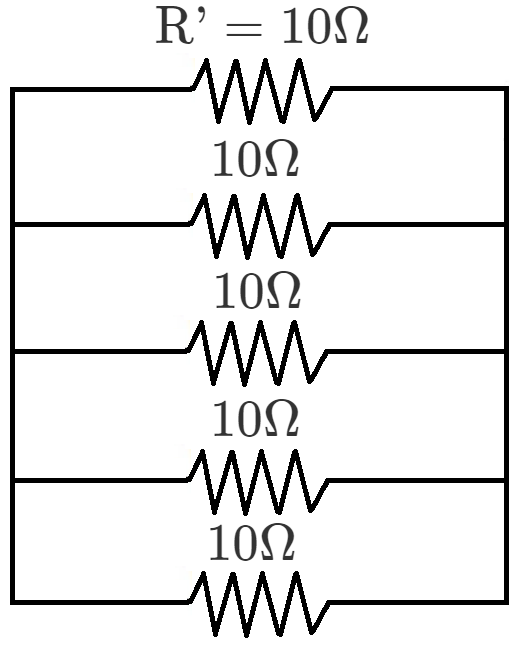
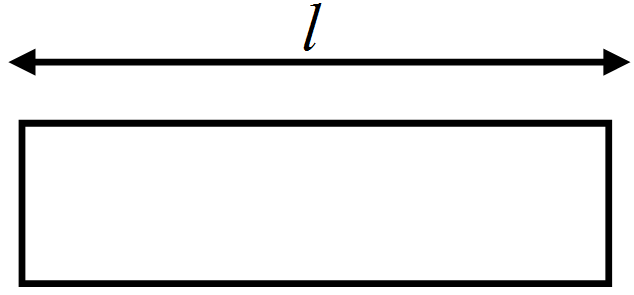
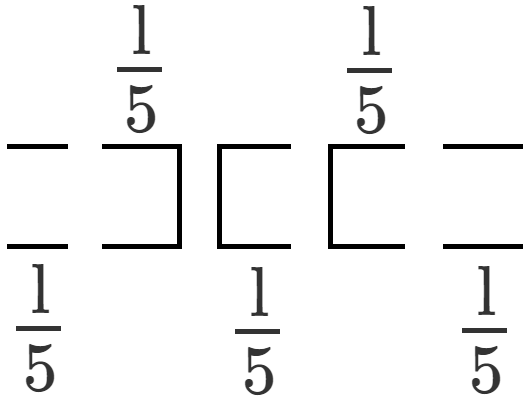
A uniform wire of resistance $50\Omega$ is cut into $5$ equal parts. These parts are now connected in parallel. The equivalent resistance of the combination is:
  • $2\Omega$
  • B
    $10\Omega$
  • C
    $250\Omega$
  • D
    $6250\Omega$
Answer
Correct option: A.
$2\Omega$

$\text{R}=\frac{\rho}{\text{A}}=50$


resistance of $'5\ '$ equal parts are same.
$\text{R}'=\frac{\frac{\rho}{5}}{\text{A}}=\frac{50}{5}=10\Omega$
All '5' equal parts connect in parallel,

$\frac{1}{\text{R}_\text{eq}}=\frac{1}{10}+\frac{1}{10}+\frac{1}{10}+\frac{1}{10}+\frac{1}{10}=\frac{5}{10}$
$\text{R}_\text{eq}=2\Omega$

View full question & answer
MCQ 2041 Mark
The resistivity of $‘X’$ decreases with temperature and its coefficient of resistivity is negative. Identify $X.$
  • A
    Silver
  • Silicon
  • C
    Copper
  • D
    Nichrome
Answer
Correct option: B.
Silicon
The coefficient of resistivity is negative for semiconductors and their resistivity decreases with temperature. The relaxation time does not change with temperature but the number density of free electrons increases exponentially with the increase in temperature. Consequently, the resistivity decreases exponentially with the increase in temperature.
View full question & answer
MCQ 2051 Mark
Electromotive force of a battery represents:
  • A
    Force.
  • B
    Energy.
  • Electric potential energy per unit charge.
  • D
    Current.
Answer
Correct option: C.
Electric potential energy per unit charge.
When a voltage is generated by a battery, this generated voltage has been traditionally called an electromotive force or emf. The emf represents electric potential energy per unit charge $($voltage$)$ which has been made available to free electrons by the generating mechanism and is not a force.
The term emf is useful to distinguish voltage generated by the battery from those which occur in a circuit as a result of energy dissipation $($ Like Voltage drop across a resistor$).$
View full question & answer
MCQ 2061 Mark
Predict the effect of temperature of the conductor on the drift velocity of electrons.
  • A
    Drift velocity varies linearly with temperature.
  • B
    Drift velocity does not depend on the temperature.
  • C
    Drift velocity increases with increasing temperature.
  • Drift velocity decreases with increasing temperature.
Answer
Correct option: D.
Drift velocity decreases with increasing temperature.

On increasing the temperature of a conductor, the value of resistivity of its material increases. Resistivity is indirectly proportional to drift velocity. Therefore, the drift velocity of electrons decreases with the increasing temperature of the conductor.

View full question & answer
MCQ 2071 Mark
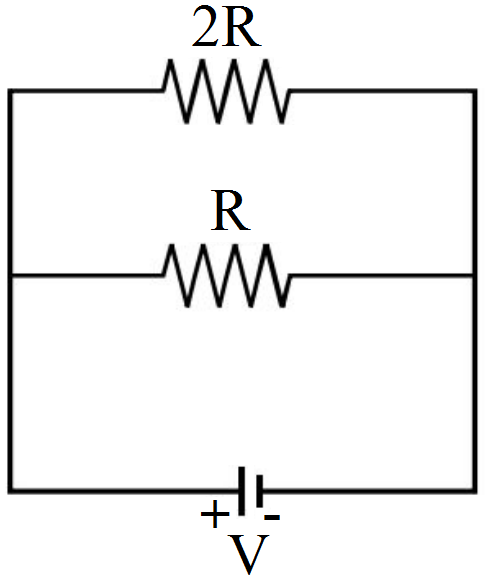
Two resistances $R$ and $2R$ are connected in parallel in an electric circuit. The thermal energy developed in $R$ and $2R$ are in the ratio:
  • A
    $1 : 2$
  • $2 : 1$
  • C
    $1 : 4$
  • D
    $4 : 1$
Answer
Correct option: B.
$2 : 1$

Thermal Energy developed $=\frac{\text{v}_2}{\text{R}}\text{t} ($Because in Parallel, voltage is same$)$

$\frac{\text{Thermal Energy developedin "R"}}{\text{Thermal Energy developedin "2R"}}=\frac{\frac{\text{v}^2}{\text{R}}\text{t}}{\frac{\text{v}^2}{2\text{R}}\text{t}}=2:1$

View full question & answer
MCQ 2081 Mark
A current passes through a wire of nonuniform crosssection. Which of the following quantities are independent of the cross$-$section?
  • A
    The charge crossing.
  • B
    Drift velocity
  • C
    Current density.
  • Free$-$electron density.
Answer
Correct option: D.
Free$-$electron density.
View full question & answer
MCQ 2091 Mark
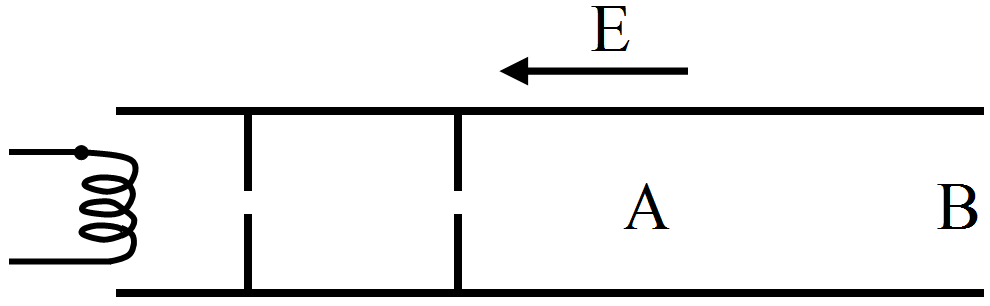
Electrons are emitted by a hot filament and are accelerated by an electric field, as shown in the figure. The two stops at the left ensure that the electron beam has a uniform cross-section.
  • The speed of the electrons is more at $B$ than at $A.$
  • B
    The electric current is from left to right.
  • C
    The magnitude of the current is larger at $B$ than at $A.$
  • D
    The current density is more at $B$ than at $A.$
Answer
Correct option: A.
The speed of the electrons is more at $B$ than at $A.$
Electric field goes higher potential to Lower potential. The drift velocity of the electron at higher potentail is greater than the lower potential.
So the speed of the electron is more at $B$ that at $A.$
View full question & answer
MCQ 2101 Mark
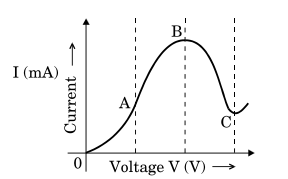
Identify the type of conductor represented by the $V-I$ characteristic curve given below.
Image
  • A
    Metallic conductor
  • B
    Water voltameter
  • C
    Thyristor
  • Semiconductor
Answer
Correct option: D.
Semiconductor

The $V-I$ graph gives the characteristic of a semiconductor. It exhibits non$-$linear behaviour. After a certain voltage, the current decreases as the voltage increases. Gallium arsenide shows this type of behaviour.

View full question & answer
MCQ 2111 Mark
The resistivity of a wire varies with:
  • A
    length
  • B
    cross$-$section
  • C
    mass
  • material
Answer
Correct option: D.
material

Resistivity of the wire is an intrinsic property of the material with which the wire is made and thus depends only on the material of the wire, not on the dimensions of the wire.

View full question & answer
MCQ 2121 Mark
Which is the factor that internal resistance does not depend on?
  • A
    Distance between the electrodes.
  • Temperature of the electrolyte.
  • C
    Nature of electrode and electrolyte.
  • D
    Area of the electrode, immersed in the electrolyte.
Answer
Correct option: B.
Temperature of the electrolyte.

Internal resistance is defined as the resistance offered by the electrolyte and electrodes of a cell when the current flows through it. Internal resistance depends on distance between the electrodes, the nature of electrodes and electrolyte, and area of the electrode immersed in the electrolyte. So, that leaves temperature of the electrolyte out, which is the answer.

View full question & answer
MCQ 2131 Mark
Identify the type of materials which have resistivities in the range of $10^{-8} \Omega m$ to $10^{-6} \Omega m$.
  • A
    Semiconductors
  • B
    Insulators
  • Conductors
  • D
    Thyristors
Answer
Correct option: C.
Conductors

Conductors have low resistivities in the range of $10^{-8} \Omega m$ to $10^{-6} \Omega m$.. Metals are good conductors. Conductors are objects or types of material that allows the flow of charge in one or more directions, and a result, the resistance offered against the flow of charge will be less.

View full question & answer
MCQ 2141 Mark
One watt is equal to $.......$?
  • A
    One kilowatt per second.
  • B
    One kilo joule per second.
  • One joule per second.
  • D
    One joule per minute.
Answer
Correct option: C.
One joule per second.

Watt is the $SI$ unit of power.
$\text{Power}=\frac{\text{Work done}}{\text{time}}$.
The $SI$ unit of work done is the same as energy, that is, joule and that of time is seconds. Therefore, one watt is equal to one joule per second.

View full question & answer
MCQ 2151 Mark
When potential difference is applied across an electrolyte, then $Ohm's$ law is obeyed at:
  • A
    Zero potential.
  • B
    Very low potential.
  • C
    Negative potential.
  • High potential.
Answer
Correct option: D.
High potential.

When voltage is applied to an electrolyte, dissociation of ions starts.
At low voltages as the voltage increases the number of ions conducting also increases making a non linear increase of current.
After a certain voltage when the ions are dissociated and no more dissociation, the electrolyte behaves as a conductor and obeys ohm's law.
Thus at high voltages, an electrolyte obeys ohm's law.

View full question & answer
MCQ 2161 Mark
A current passes through a resistor. Let $K _1$ and $K _2$ represent the average kinetic energy of the conduction electrons and the metal ions, respectively:
  • A
    $K _2 < K _2$
  • B
    $K _1= K _2$
  • $K _1> K _2$
  • D
    Any of these three may occur.
Answer
Correct option: C.
$K _1> K _2$

vd drift velocity $=\frac{1}{2}\Big(\frac{\text{eE}}{\text{m}}\Big)\text{t}$
$\text{K.E}.=\frac{1}{2}\text{mv}^2_\text{d}=\frac{1}{2}\text{m}\Big(\frac{1}{4}\frac{\text{e}^2\text{E}^2\text{t}^2}{\text{m}^2}\Big)$
$\text{K.E}.=\frac{1}{8}\frac{\text{e}^2\text{E}^2\text{t}^2}{\text{m}}$
$\text{p}=\text{K.E}.\propto\frac{1}{\text{m}}$
Mass of electron $<$ mass of metalions.
$K.E.$ of electron $> K.E.$ of metalions.

View full question & answer
MCQ 2171 Mark
The net resistance of an ammeter should be small to ensure that:
  • A
    It does not get overheated.
  • B
    It does not draw excessive current.
  • C
    It can measure large currents.
  • It does not appreciably change the current to be measured.
Answer
Correct option: D.
It does not appreciably change the current to be measured.
The net resistance of an ammeter should be small to ensure that it does not oppreciably change the current to be measured.
View full question & answer
MCQ 2181 Mark
L, C and R represent the physical quantities inductance, capacitance and resistance respectively. Which of the following combinations have dimensions of frequency?
  • A
    $\frac{1}{\text{RC}}$
  • B
    $\frac{\text{R}}{\text{L}}$
  • C
    $\frac{1}{\sqrt{\text{LC}}}$
  • All of the above.
Answer
Correct option: D.
All of the above.
Explanation:
þ Time constant t = RC in RC circuit
frequency $=\frac{1}{\tau}=\frac{1}{\text{RC}} \ ...(\text{i})$
þ Time constant in LR circuit is $\tau=\frac{\text{L}}{\text{RC}}$
frequency $\frac{1}{\tau}=\frac{\text{R}}{\text{L}} \ ...(\text{ii})$
þ eq. (i) & (ii) multiply
frequency $=\frac{1}{\text{LC}}$
frequency $=\frac{1}{\sqrt{2\text{C}}}$
View full question & answer
MCQ 2191 Mark
A steady current is passing through a linear conductor of non uniform cross$-$section. The net quantity of charge crossing any cross section per second is:
  • Independent of area of cross-section.
  • B
    Directly proportional to the length of the conductor.
  • C
    Directly proportional to the area of cross section.
  • D
    Inversely proportional to the length of the conductor.
Answer
Correct option: A.
Independent of area of cross-section.

The quantity of charge passing through any cross$-$section per second is nothing but current flowing in the conductor.
As given, the current is steady current, means current is uniform throughout the cross$-$section. Hence it is independent of Area of cross section.

View full question & answer
MCQ 2201 Mark
The rate of flow of electric charge through any cross-section of a conductor is known as $.......$
  • A
    Electric flux
  • B
    Electric potential
  • Electric current
  • D
    Electric field
Answer
Correct option: C.
Electric current

The rate of flow of electric charge through any cross$-$section of a conductor is known as electric current.

View full question & answer
MCQ 2211 Mark
What is the suitable material for electric fuse?
  • A
    Cu.
  • B
    Constantan.
  • Tin$-$lead alloy.
  • D
    Nichrome.
Answer
Correct option: C.
Tin$-$lead alloy.
View full question & answer
MCQ 2221 Mark
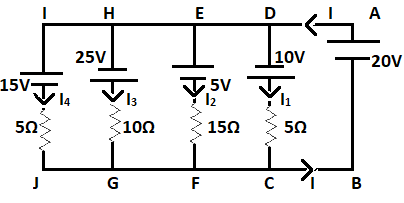
In the circuit shown below, calculate the current flowing through $20V$ cell.
Image
  • A
    $12A$
  • B
    $15A$
  • $12.5A$
  • D
    $12.3A$
Answer
Correct option: C.
$12.5A$
Here, we can apply Kirchhoff's loop rule in closed loops $\text{ADCBA, AEFBA, AHGBA,}$ and $\text{AIJBA.}$Thus, we get
$20+10-5 I_1=0 \rightarrow I_1=6 A$
$-5+20-15 I_2=0 \rightarrow I_2=1 A$
$25+20-10 I _3=0 \rightarrow I _3=4.5 A$
$-15+20-5 I _4=0 \rightarrow I _4=1 A$
Therefore, the current flowing through the $20 V$ cell $=6+1+4.5+1=12.5 A$
View full question & answer
MCQ 2231 Mark
A metal wire is subjected to a constant potential difference. When the temperature of the metal wire increases, the drift velocity of the electron in it:
  • A
    Increases, thermal velocity of the electron increases.
  • Decreases, thermal velocity of the electron increases.
  • C
    Increases, thermal velocity of the electron decreases.
  • D
    Decreases, thermal velocity of the electron decreases.
Answer
Correct option: B.
Decreases, thermal velocity of the electron increases.
View full question & answer
MCQ 2241 Mark
In series combination of resistances:
  • A
    $p.d.$ is same across each resistance.
  • B
    total resistance is reduced.
  • current is same in each resistance.
  • D
    all above are true.
Answer
Correct option: C.
current is same in each resistance.

Components connected in series are connected along a single path, so the same current flows through all of the components. The current through each of the components is the same, and the voltage across the circuit is the sum of the voltages across each component. In a series circuit, every device must function for the circuit to be complete. One bulb burning out in a series circuit breaks the circuit. A circuit composed solely of components connected in series is known as a series circuit.
The total resistance of resistors in series is equal to the sum of their individual resistances. Hence, the Equivalent resistance is more than the individual resistances because a sum is taken of all the individual resistances. That is, $R_{\text {total }}=R_1+R_2$. The current is given as $I=I_1=I_2$.
Below is the diagrammatic representation of $2$ resistors $R_1$ and $R_2$ connected in series.

View full question & answer