- A6m.
- B12m.
- C16m.
- D24m.
- 6m.
Explanation:
Electric potential may be defined as the amount of work done in moving a unit positive charge from infinity to a given point.
$\text{V}=\frac{\text{W}}{\text{q}}$
Explanation:
When the capacitor is kept at a voltage, it gains charge.
Now when the system is isolated, the charge present on capacitor cannot change because of law of conservation of charge.
$\therefore$ Charge always remains constant in isolated systems.
Explanation:
Any point on the perpendicular bisector is equidistant from both the charges of the dipole. Therefore, the electric potential at that point is equal and opposite due to the two different charges. Therefore, the total electric potential at that point is zero.
Explanation:
Unit of electric potential difference is volt(V).
Explanation:
Since the voltage gets added up when the capacitors are connected in series, the voltage of the combination is 2V.
Also, the capacitance of a series combination is given by
$\frac{1}{\text{C}_{\text{net}}}=\frac{1}{\text{C}_1}+\frac{1}{\text{C}_2}$
Here,
Cnet = Net capacitance of the combination
$\text{C}_1=\text{C}_2=\text{C}$
$\therefore\text{C}_{\text{net}}=\frac{\text{C}}{2}$
Explanation:
Energy density U is given by
$\text{U}=\frac{1}{2}\in_0\text{E}^2\ \dots(1)$
The electric field created by a point charge at a distance r is given by
$\text{E}=\frac{\text{q}}{4\pi\in_0\text{r}^2}$
On putting the above form of E in eq. 1, we get
$\text{U}=\frac{1}{2}\in_0\Big(\frac{\text{q}}{4\pi\in_0\text{r}^2}\Big)^2$
Thus, U is directly proportional to $\frac{1}{\text{r}^4}.$

Explanation:
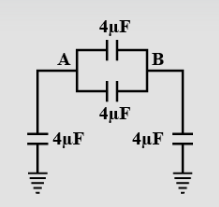
In the given figure,
Equivalent capcitance between A and B.
Ceg = C1 + C2
$=4μ\text{F}+4μ\text{F}$
Explanation:
When the spheres are connected, charges flow between them until they both acquire the same common potential V.
The final charges on the spheres are given by:
Q1 = C1V and Q2 = C2V
$\therefore\frac{\text{Q}_1}{\text{Q}_2}=\frac{\text{C}_1\text{V}}{\text{C}_2\text{V}}=\frac{\text{C}_1}{\text{C}_2}$
Explanation:

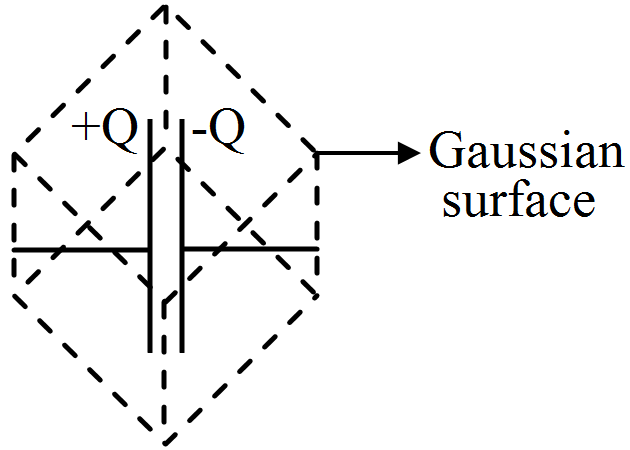
Since the net charge enclosed by the Gaussian surface is zero, the total flux of the electric field through the closed Gaussian surface enclosing the capacitor is zero.
$\phi=\oint\text{E.ds}=\frac{\text{q}}{\in_0}=0$
Here,
$\phi=$ Electric flux
q = Total charge enclosed by the Gaussian surface.
Explantion:
Electric field is negative gradient of electric potential.
$\text{E}=-\text{grad}(\text{V})$
$\text{E}=-\frac{\text{dV}}{\text{dr}}$
If $\text{E}=0$
$-\frac{\text{dV}}{\text{dr}}=0$
This implies
V = constant.
A constant can be zero or a quantifiable number.
Explanation:
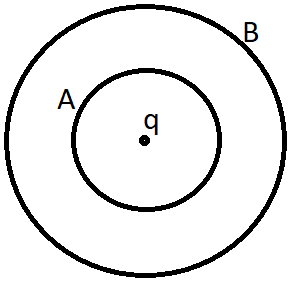
A charge always tries to move from a point of higher potential to a point of lower potential. The potential at A is greater than the potential at B because of electric potential decreases with distance from the charge. It can also be explained by the fact that a positive charge is always repelled by another positive charge.
Explanation:
Since we know that capacitance$=\frac{\text{charge}}{\text{voltage}}$
Therefore capacitance$=\frac{9}{5}=1.8\text{f.}$
Explanation:
We say electrostatic forces are conservative in nature since the work done in moving a unit positive test charge over a closed path in an electric field is zero.
Explanation:
Van de Graff generator is used to create a large amount of static electricity. A Van de Graff generator uses static electricity and a moving belt to charge a large metal sphere to a very high voltage. As the belt moves, electrons move from the rubber belt to the silicon roller, causing the belt to become positively charged and the roller to become negatively charged. As a result, it builds up positive charge.
Explanation:
Electric potential of every point lying on the YZ plane is zero as every point is at equal distance from negative and positive charge of dipole. So, the plane will be equipotential.
Explanation:
A molecule in which the centre of mass of positive and negative charges collide with each other is called a non-polar molecule. They normally have zero dipole moment. They have symmetrical shapes.
Explanation:
The simplest and the most widely used capacitor is the parallel plate capacitor. It consists of two large plane parallel conducting plates, separated by a small distance.
Explanation:
Dipole moment = charge × length of the dipole. The electric charge has dimensions [I T] and length has dimensions [L]. Therefore, the dipole moment has the dimension [I T L] and has unit C × m of C × m.
Explanation:
Van de Graff generator was invented by Robert Jemison Van de Graff on November 28, 1933. Robert Jemison invented the Van de Graff generator, which is a kind of high-voltage electrostatic generator that accelerates particles, while he was doing his PhD in Princeton University.
Explanation:
The induced dipole moment developed per unit volume of a dielectric when placed in an external electric field is called polarization density. It may be defined as the charge induced per unit surface area.

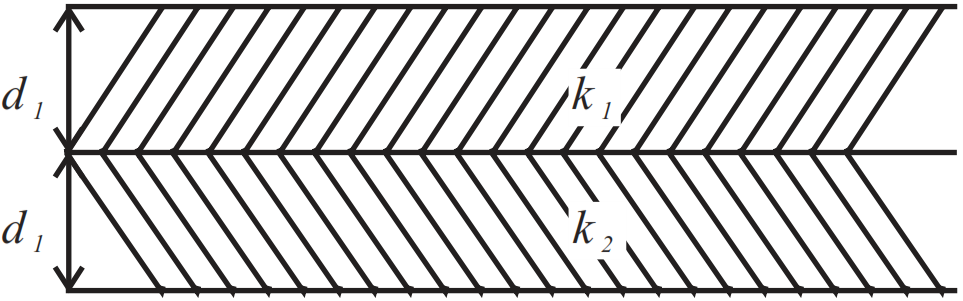
Here the system can be considered as two capacitors C1 and C2 connected in series as shown in figure.
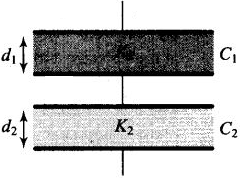
The capacitance of parallel plate capacitor filled with dielectric block has thickness d1 and dielectric constant K2 is given by
$\frac{1}{\text{C}_\text{eq}}=\frac{1}{\text{C}_1}+\frac{1}{\text{C}_2}\Rightarrow\ \text{C}_\text{eq}=\frac{\text{C}_1\text{C}_2}{\text{C}_1+\text{C}_2}$
$\text{C}_\text{eq}=\frac{\frac{\text{K}_1\in_0\text{A}}{\text{d}_1}}{\frac{\text{K}_1\in_0\text{A}}{\text{d}_1}}\frac{\frac{\text{K}_2\in_0\text{A}}{\text{d}_2}}{\frac{\text{K}_2\in_0\text{A}}{\text{d}_2}}=\frac{\text{K}_1\text{K}_2\in_0\text{A}}{\text{K}_1\text{d}_2+\text{K}_2\text{d}_1}\ ...(\text{i})$
We can write the equivalent capacitance as
$\text{C}=\frac{\text{K}\in_0\text{A}}{\text{d}_1+\text{d}_2}\ ...(\text{ii})$
On comparing (i) and (ii) we have
$\text{K}=\frac{\text{k}_1\text{k}_2(\text{d}_1+\text{d}_2)}{(\text{k}_1\text{d}_2+\text{k}_2\text{d}_1)}$.
Explanation:
The capacitance of the capacitor in which a dielectric slab of dielectric constant K, area A and thickness t is inserted between the plates of the capacitor of area A and separated by a distance d is given by:
$\text{C}=\frac{\in_0\text{A}}{(\text{d}-\text{t})+\big(\frac{\text{t}}{\text{K}}\big)}$
Since it is given that the thickness of the sheet is negligible, the above formula reduces to $\text{C}=\frac{\in_0\text{A}}{\text{d}}.$ In other words, there will not be any change in the electric field, potential or charge.
Only, equal and opposite charges will appear on the two faces of the metal plate because of induction due to the presence of the charges on the plates of the capacitor.