Questions · Page 6 of 6

M.C.Q [1M]

MCQ 2511 Mark
The electrostatic potential on the surface of a charged conducting sphere is 100V. Two statments are made in this regard:
S1 : At any point inside the sphere, electric intensity is zero.
S2 : At any point inside the sphere, the electrostatic potential is 100V.
Which of the following is a correct statement?
  • A
    S1 is true but S2 is false.
  • B
    Both S1 & S2 are false.
  • C
    S1 is true, S2 is also true and S1 is the cause of S2.
  • D
    S1 is true, S2 is also true but the statements are independant.
Answer
  1. S1 is true, S2 is also true and S1 is the cause of S2.

We know, the electric field intensity E and electric potential V are related $\text{E}=\frac{\text{dV}}{\text{dr}}$.
If electric field intensity  E= 0, then $\frac{\text{dV}}{\text{dr}}=0$.  It means, E = 0 inside the charged conducting sphere causes uniform potential inside the sphere. Hence uniform electrostatic potential 100 V will be at any point inside the sphere.

Important points:

  1. The electric field zero does not necessary imply that electric potential is zero. E.g., the electric field intensity at any point inside the charged spherical shell is zero but there may exist non-zero electric potential.
  2. If two charged particles of same magnitude but opposite sign are placed, the electric potential at the midpoint will be zero but electric field is not equal to zero.
View full question & answer
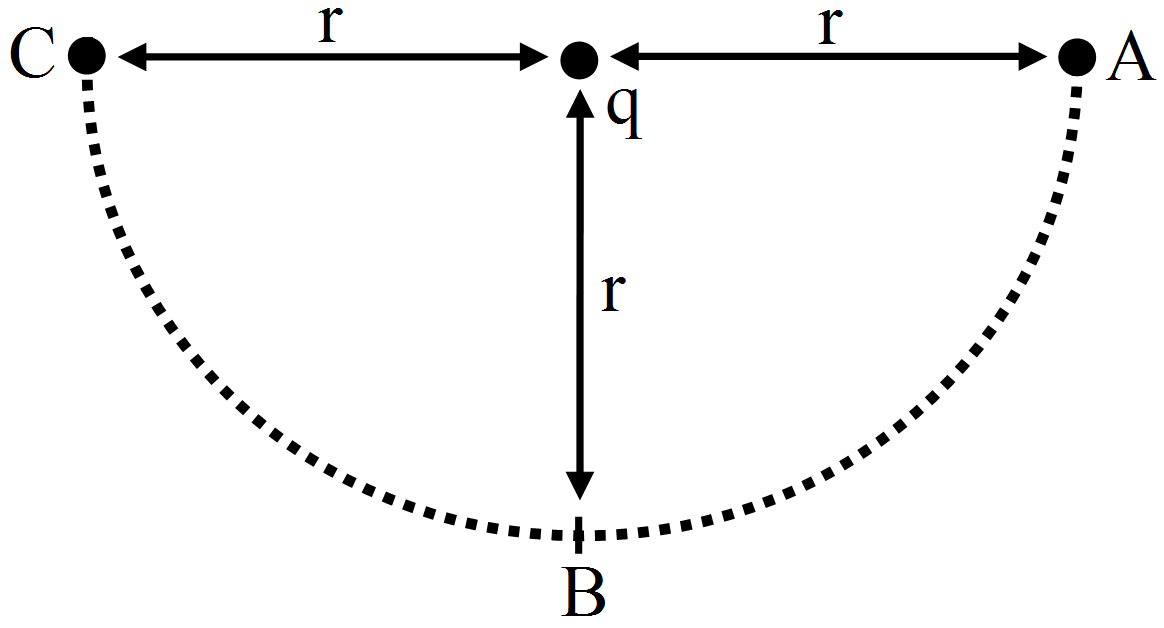
MCQ 2521 Mark
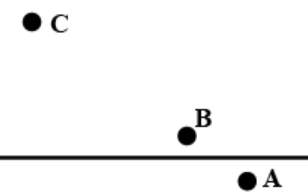
Answer
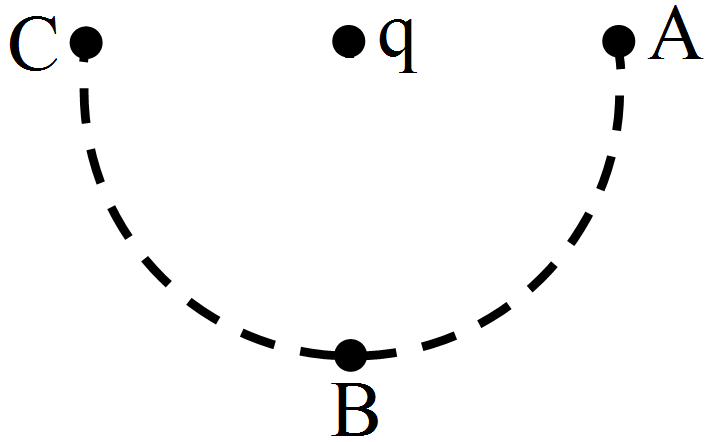
  1. WA = WB = WC

Explanation:

Electric Potential at A 'due to q' þ $\text{V}_\text{A}=\frac{\text{Kq}}{\text{r}}$

Electric Potetial at B 'due to q' þ $\text{V}_\text{B}=\frac{\text{Kq}}{\text{r}}$

& Electric potential at c 'due to q' þ $\text{V}_\text{C}=\frac{\text{Kq}}{\text{r}}$

Work done $=-\text{D}_\text{u}=-\text{q}\text{DV}$ {Let at 'P', Vp = 0}

Here $\text{V}_\text{A}=\text{V}_\text{B}=\text{V}_\text{C}$

The work done is taking a point charge from P to A, B & C is same.

So, $\text{W}_\text{A}=\text{W}_\text{B}=\text{W}_\text{C}$

View full question & answer
MCQ 2531 Mark
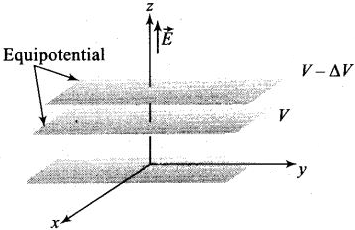
Consider a uniform electric field in the $\hat{\text{Z}}$ direction. The potential is a constant:
  • A
    In all space.
  • B
    For any x for a given z.
  • C
    For any y for a given z.
  • D
    On the x-y plane for a given z.
Answer
  1. For any x for a given z.
  2. For any y for a given z.
  3. On the x-y plane for a given z.

We know, the electric field intensity E and electric potential V are

$\text{E}=-\frac{\text{dV}}{\text{dr}}$

Electric potential decreases inf the direction of electric field. The direction of electric field is always perpendicular to one equipotential surface maintained at high electrostatic potential to other equipotential surface maintained at low electrostatic potential.

The electric field in z-direction suggest that equipotential surfaces are in x-y plane. Therefore the potential is a constant for any x for a given z, for any y for a given z and on the x-y plane for a given z.

View full question & answer
MCQ 2541 Mark
A parallel plate capacitor is charged. If the plates are pulled apart:
  • A
    The capacitance increases.
  • B
    The potential difference increases.
  • C
    The total charge increases.
  • D
    The charge and potential difference remain the same.
Answer
  1. The potential difference increases.

Explanation:

Capacitance of a parallel plate capacitor.

$\text{C}=ε0\text{AdC}=ε0\text{Ad}$

A parallel plate capacitor is charged (battery is disconnected) then the plates are pulled apart, the capacitance decreases while the charge remains the same.

$\because$ Potentialdifference = ChargeCapacitance∵Potentialdifference = ChargeCapacitance.

$\therefore$ potential difference increases.

View full question & answer
MCQ 2551 Mark
When the separation between two charges is increased the electric potential energy of the charges.
  • A
    Increases.
  • B
    Decreases.
  • C
    Remains the same.
  • D
    May increase or decrease.
Answer
  1. May increase or decrease.

Explanation:

When the separation between two charges is increased, the electric potential Energy of charge may incease or decrease.

If Both charge are like charge then electric potential energy of charge decreases.

$\text{U}=\frac{\text{k}\text{q}_1\text{q}_2}{\text{r}}$

If Both charge are unlike charge then electric potential energy of charge increases.

$\text{U}=\frac{-\text{kq}_1\text{q}_2}{\text{r}}$

View full question & answer
MCQ 2561 Mark
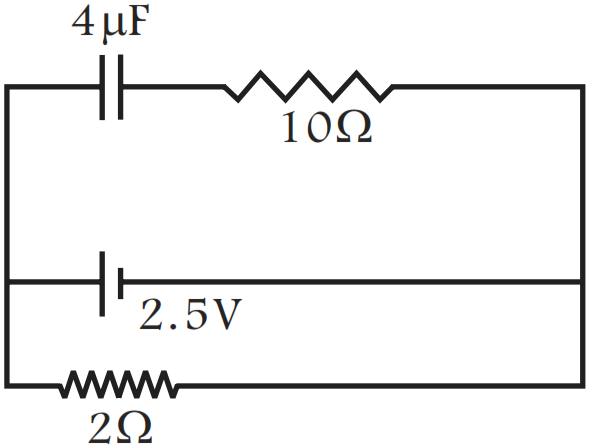
A capacitor of 4μ F is connected as shown in the circuit (Fig.). The internal resistance of the battery is 0.5Ω. The amount of charge on the capacitor plates will be:

  • A
    0.
  • B
    4μ C.
  • C
    16μ C.
  • D
    8μ C.
Answer
  1. 8μ C.

The capacitor offers infinite resistance in a DC circuit. Here, no current will flow through the capacitor and 10Ω resistance after the capacitor is full charged. 

The potential difference across 10Ω resistance will be zero. It will act like a plain wire.

Current flowing through 2Ω resistance is given by

$\text{I}=\frac{\text{V}}{(\text{R}+\text{r})}=\frac{2.5}{(2+0.5)}=1\text{A}$

Potential difference across 2Ω resistance V = IR = 1 × 2 = 2V

Here, capacitor is connected in parallel with 2 Ω resistance, so it will also have 2V potential difference across it.

The charge on capacitor, q = CV = (2 mF) × 2V = 8 mC.

View full question & answer
MCQ 2571 Mark
The capacity of a parallel plate air condenser is 2 μF. If a dielectric of dielectric constant 4 is introduced between the plates, its new capacity is:
  • A
    1.5 μF
  • B
    0.5 μF
  • C
    8 μF
  • D
    6 μF
Answer
  1. 8 μF

Explanation:

We know $\text{C}=\frac{\in_0\text{A}}{\text{d}}$

When dielectric is added:

$\text{C'}=\frac{\text{K}\in_0\text{A}}{\text{d}}=4\times2\mu\text{F}=8\mu\text{F}$

View full question & answer
MCQ 2581 Mark
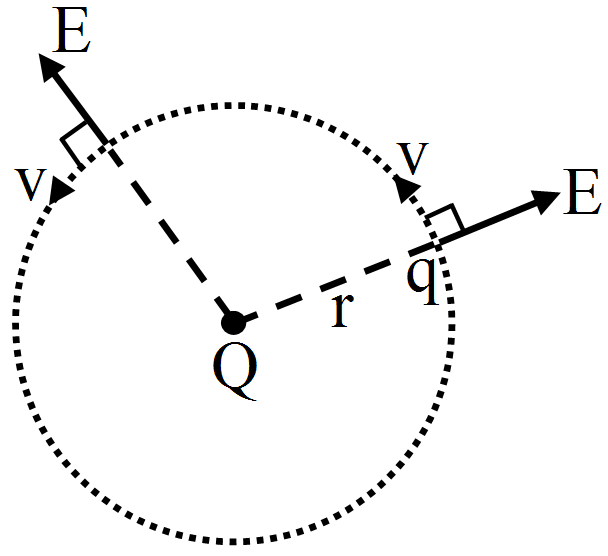
A point charge q is rotated along a circle in the electric field generated by another point charge Q. The work done by the electric field on the roatating charge in one complete revolution is:
  • A
    Zero.
  • B
    Positive.
  • C
    Negative.
  • D
    Zero if the charge Q is at the centre and nonzero otherwise.
Answer
  1. Zero.

Explanation:

In a circle Electric field due tot 'Q' is always perpendicular to the displacement oifthe charge 'q'.

Workdone $=\vec{\text{F}}.\vec{\text{d}}$

$=\big(\text{q}\vec{\text{E}}\big).\vec{\text{d}}=\text{q}\big(\vec{\text{E}}.\vec{\text{d}}\big)=0$

$\therefore\vec{\text{E}}\ \bot\ \vec{\text{d}}$

Workdoen by the Electric field on the rotating charge in one complete revolution is zero.

View full question & answer
MCQ 2591 Mark
(1): The dielectric medium between the plates of a parallel plate capacitor lowers the potential difference between the plates without a battery.
(2): The maximum electric field that a dielectric can withstand without causing it to break down is dielectric strength.
  • A
    Both 1 and 2 are true, 2 is not correct explanation of 1
  • B
    Both 1 and 2 are true, 2 is correct explanation of 1.
  • C
    1 is false, 2 is true
  • D
    1 is true, 2 is false
Answer
  1. Both 1 and 2 are true, 2 is not correct explanation of 1

Explanation:

Consider a capacitor with charge density $σ.$

The potential between its two plates is given by $\frac{\sigma\text{d}}{\in_0}$

When a dielectric is inserted, the electric field inside the capacitor decrease decreasing the potential between the two plates of capacitor.

However, this is nothing to the dielectric strength of the dielectric.

View full question & answer
MCQ 2601 Mark
"The work per unit of charge required to move a charge from a reference point to a specified point, measured in joules per coulomb or volts. The static electric field is the negative of the gradient of the electric potential." comments are given below, select the correct one:
  • A
    Statement is correct
  • B
    Statement is incorrect
  • C
    Comment on electric field is not correct
  • D
    Only comment on electric potential is not correct
Answer
  1. Statement is correct

Explanation:

The given statement is correct. Volt or Joules per Coulomb are SI unit of Potential (V) i.e, work done per unit charge to move a charge from a reference point to a certain point.

And electric field E is negative of the gradient of electric potential (V) i.e,$\text{E}=\frac{\text{-dv}}{\text{dr}}$

View full question & answer
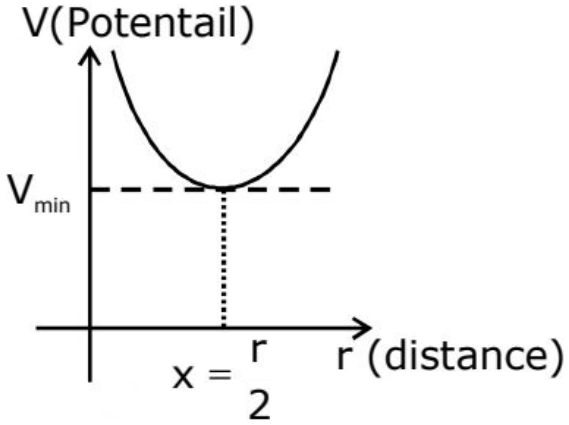
MCQ 2611 Mark
Two equal positive charges are kept at points A and B. The electric potential at the points between A and B (excluding these points) is studied while moving from A to B. The potential.
  • A
    Continuously increases.
  • B
    Continuously decreases.
  • C
    Increases then decreases.
  • D
    Decreases then increases.
Answer
  1. Continuously increases.

Explanation:

$\text{V}=\frac{\text{KQ}}{\text{r}}$

V → Electric Potential

$\text{V}_\text{p}=\frac{\text{KQ}}{\text{x}}+\frac{\text{KQ}}{\text{r}-\text{x}}=\frac{\text{KQ}\text{r}}{\text{x}(\text{r}-\text{x})}$

$\frac{\text{dvp}}{\text{dx}}=\frac{-\text{kQr}(\text{r}-2\text{x})}{\big(\text{r}(\text{r}-\text{x})\big)^2}=0$

$\text{r}=2\text{x},\ \text{x}=\frac{\text{r}}{2}$

$\text{V}_\text{Pmin}=\frac{\text{KQ}}{\frac{\text{r}}{2}}+\frac{\text{KQ}}{\frac{\text{r}}{2}}=\frac{4\text{KQ}}{\text{r}}$ at $\Big(\text{x}=\frac{\text{r}}{2}\Big)$

View full question & answer
MCQ 2621 Mark
Three capacitors of capacitances $6\mu\text{F}$ each are available. The minimum and maximum capacitances, which may be obtained are:
  • A
    $6\mu\text{F},\ 18\mu\text{F}$
  • B
    $3\mu\text{F},\ 12\mu\text{F}$
  • C
    $2\mu\text{F},\ 12\mu\text{F}$
  • D
    $2\mu\text{F},\ 18\mu\text{F}$
Answer
  1. $2\mu\text{F},\ 18\mu\text{F}$

Explanation:

The minimum capacitance can be obtained by connecting all capacitors in series. It can be calculated as follows:

$\frac{1}{\text{C}}=\frac{1}{6}+\frac{1}{6}+\frac{1}{6}=\frac{1}{2}$

$\Rightarrow\text{C}=2\mu\text{F}$

The maximum capacitance can be obtained by connecting all capacitors in parallel. It can be calculated as follows:

$\text{C}=6+6+6=18\mu\text{F}$

View full question & answer
MCQ 2631 Mark
How many $6μ\text{F},$ 200V condensers are needed to make a condenser of $18μ\text{F},$ 600V?
  • A
    9
  • B
    18
  • C
    3
  • D
    27
Answer
  1. 27

Explanation:

Place three 200V, $6μ\text{F},$ capacitors in series to get 1 equivalent 600V, $2μ\text{F},$ capacitor. Now place 9 of these equivalent 600V, $2μ\text{F},$capacitors in parallel to obtain an equivalence of 18μF at 600 Volts. All this requires a total of 27 $6μ\text{F},$ capacitors. Nine rows connected in parallel with 3 capacitors connected in series in each row.

View full question & answer
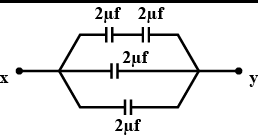
MCQ 2641 Mark
The minimum number of condensers each of capacitance of $2μ\text{F},$ in order to obtain resultant capacitance of $5μ\text{F},$ will be:
  • A
    4
  • B
    10
  • C
    5
  • D
    6
Answer
  1. 4

Explanation:

We can obtain an equivalence capacitance of $5μ\text{F},$ by connecting minimum  4 capacitance of each $2μ\text{F},$only in the way as shown in the figure.

View full question & answer
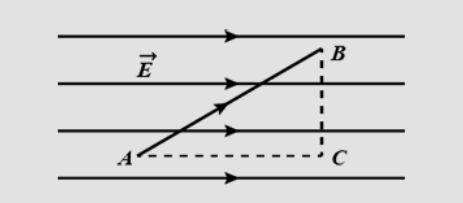
MCQ 2651 Mark
An electron is taken from point A to point B along the path AB in a uniform electric field of intensity E = 10Vm−1. Side AB = 5m, and side BC = 3m. Then, the amount of work done on the electron by us is:

  • A
    50 eV
  • B
    40 eV
  • C
    -50 eV
  • D
    -40 eV
Answer
  1. 40 eV

Explanation:

WAB ​= WAC ​+ WCB​

WCB​ should be zero, because in moving from C to B, we always move perpendicular to field. Hence, force applied by field and displacement will be at 90.

So work done in BC will be 0

WAC ​= −e(VC​ - VA​)

VC​ - V​= -E × AC = -10 × 4 = -40

$\therefore$ WAB​ = 40eJ = 40eV

View full question & answer
MCQ 2661 Mark
A capacitor is charged by using a battery which is then disconnected. A dielectric slab is introduced between the plates which results in:
  • A
    Increase in the potential difference across  the plates and reduction in stored energy but no change in the charge on the plates.
  • B
    Decrease in the potential difference across the plates and reduction in the stored energy but no change in the charge on the plates.
  • C
    Reduction of charge on the plates and Increase of potential difference across the plates.
  • D
    Increase in stored energy but no change in potential difference across the plates.
Answer
  1. Decrease in the potential difference across the plates and reduction in the stored energy but no change in the charge on the plates.

Explanation:

If a dielectric slab of dielectric constant K is filled in between the plates of a capacitor after charging the capacitor (i.e., after removing the connection of battery with the plates of capacitor) the potential difference between the plates reduces to $\frac{1}{\text{K}}$​ times and the potential energy of capacitor reduces to$\frac{1}{\text{K}}$times but there is no change in the charge on the plates.

View full question & answer
MCQ 2671 Mark
The work done to move a charge along an equipotential from A to B:
  • A
    Cannot be defined as $-\int\limits_\text{A}^\text{B}\text{E}.\text{dl}$.
  • B
    Must be defined as $-\int\limits_\text{A}^\text{B}\text{E}.\text{dl}$.
  • C
    Is zero.
  • D
    Can have a non-zero value.
Answer
  1. Must be defined as $-\int\limits_\text{A}^\text{B}\text{E}.\text{dl}$.
  2. Is zero.
Work done in moving a charge particle from point A to point B is given by WAB = q(VB - VA) and the line integral of electrical field from point A to B gives potential difference i.e., $\text{V}_\text{B}-\text{V}_\text{A}=-\int\limits_\text{A}^\text{B}\text{E}.\text{dl}$
Now, work done to move a charge aling an equipotential from A to B is zero when potentials at point A and B are some.
View full question & answer
MCQ 2691 Mark
The energy stored per unit volume of a space is called as:
  • A
    Energy efficiency.
  • B
    Energy density.
  • C
    Electric field.
  • D
    Polarisation.
Answer
  1. Energy density.
View full question & answer
MCQ 2701 Mark
The capacity of the parallel plate capacitor increases when:
  • A
    Area of the plate is decreased.
  • B
    Area of the plate is increased.
  • C
    Distance between the plates increases.
  • D
    None of the option.
Answer
  1. Area of the plate is increased.
View full question & answer
MCQ 2711 Mark
The separation between the plates of a charged parallel-plate capacitor is increased. Which of the following quantities will change?
  • A
    Charge on the capacitor.
  • B
    Potential difference across the capacitor.
  • C
    Energy of the capacitor.
  • D
    Energy density between the plates.
Answer
  1. Potential difference across the capacitor.
  2. Energy of the capacitor.

Explanation:

Because the charge always remains conserved in an isolated system, it will remain the same.

Now,

$\text{V}=\frac{\text{Qd}}{\in_0\text{A}}$

Here, Q, A and d are the charge, area and distance between the plates, respectively.

Thus, as d increases, V increases.

Energy is given by:

$\text{E}=\frac{\text{qV}}{2}$ 

So, it will also increase.

Energy density u, that is, energy stored per unit volume in the electric field is given by:

$\text{u}=\frac{1}{2}\in_0\text{E}^2$

So, u will remain constant with increase in distance between the plates.

View full question & answer
MCQ 2721 Mark
Three capacitors, $ 3μ\text{F}, 6μ\text{F}$ and 6μF are connected in series to a source of 120V. The potential difference, in volts, across the $3μ\text{F}$ capacitor will be:
  • A
    24
  • B
    30
  • C
    40
  • D
    60
Answer
  1. 60

Explanation:

The equivalent capacitance of the two $6μ\text{F} $ and $6μ\text{F} $ capacitors in series is $3μ\text{F} $.

Hence the potential across the two capacitors, original $3μ\text{F} $ capacitor and the equivalent $3μ\text{F} $ capacitor is divided equally.

View full question & answer
MCQ 2731 Mark
Following operations can be performed on a capacitor:
X - connect the capacitor to a battery of emf $\in.$
Y - disconnect the battery.
Z - reconnect the battery with polarity reversed.
W - insert a dielectric slab in the capacitor.
  • A
    In XYZ (perform X, then Y, then Z) the stored electric energy remains unchanged and no thermal energy is developed.
  • B
    The charge appearing on the capacitor is greater after the action XWY than after the action XYW.
  • C
    The electric energy stored in the capacitor is greater after the action WXY than after the action XYW.
  • D
    The electric field in the capacitor after the action XW is the same as that after WX.
Answer
  1. The charge appearing on the capacitor is greater after the action XWY than after the action XYW.
  2. The electric energy stored in the capacitor is greater after the action WXY than after the action XYW.
  3. The electric field in the capacitor after the action XW is the same as that after WX.

Explanation:

Justification of option (b):

If the potential is held constant, that is, the battery remains attached to the circuit, then the charge on the capacitor increases by a factor of K on inserting a dielectric of a dielectric constant K between the plates of the capacitor. 

Mathematically,

q = Kq

Here, q0 and q are the charges without dielectric and with dielectric, respectively.

The amount of charge stored does not depend upon the polarity of the plates.

Thus, the charge appearing on the capacitor is greater after the action XWY than after the action XYZ.

Justification of option (c):

Since the battery is disconnected before inserting a dielectric, the amount of charge remains constant, that is, q = q​0, because after the battery is disconnected, the capacitor gets no source to store charge from. In other words, the capacitor is now an isolated system where the amount of charge is conserved and so is the energy U as $\frac{1}{2}\text{q}\in.$ Hence, inserting a dielectric after disconnecting the battery will not bring any change in the amount of charge stored in the capacitor. So, the energy stored in the capacitor will also not change after the action XYW.

However, during the action WXY, the amount of charge that will get stored in the capacitor will get increased by a factor of K, as the battery is disconnected after inserting a dielectric between the plates of the capacitor and the energy stored will also get multiplied by a factor of K.

Thus, the electric energy stored in the capacitor is greater after the action WXY than after the action XYW.

Justification of option (d):

The electric field between the plates E depends on the potential across the capacitor and the distanced between the plates of the capacitor.

Mathematically, 

$\text{E}=\frac{\in}{\text{d}}$

In either case, that is, during actions XW and WX, the potential remains the same, that is, $\in.$ Thus, the electric field E remains the same.

Denial of option (a):

During the action XYZ, the battery has to do extra work equivalent to $\frac{1}{2}\text{CV}^2$ to change the polarity of the plates of the capacitor. In other words, the total work to be done by the battery will be $\frac{1}{2}\text{CV}^2+\frac{1}{2}\text{CV}^2.$

This extra work done will be dissipated as heat energy. Thus, thermal energy is developed. However, the stored electric energy remains unchanged, that is, $\frac{1}{2}\text{CV}^2.$

View full question & answer
MCQ 2741 Mark
The electric potential inside a conducting sphere:
  • A
    Increases from centre to surface.
  • B
    Decreases from centre to surface.
  • C
    Remains constant from centre to surface.
  • D
    Is zero at every point inside.
Answer
  1. Remains constant from centre to surface.
View full question & answer
MCQ 2751 Mark
Which of the following about potential difference between any two points is true?
  1. It depends only on the initial and final position.
  2. It is the work done per unit positive charge in moving from one point to other.
  3. It is more for a positive charge of two units as compared to a positive charge of one unit.
    • A
      I only.
    • B
      II only.
    • C
      I and II.
    • D
      I, II and III.
    Answer
    1. I and II.
    View full question & answer
    MCQ 2761 Mark
    Consider the following statements and select the correct statement(s).
    1. Electric field lines are always perpendicular to equipotential surface.
    2. No two equipotential surfaces can intersect each other.
    3. Electric field lines are in the direction of tangent to an equipotential surface.
      • A
        I only.
      • B
        II only.
      • C
        I and II.
      • D
        I, II and III.
      Answer
      1. I only.
      View full question & answer