- A1 joule.
- B1 joule per coulomb.
- C1 coulomb per metre.
- D1 newton per coulomb.
- 1 joule per coulomb.
Explanation:
Using: $\text{V}=\frac{\text{W}}{\text{q}}$
⟹ 1 volt is equal to 1 joule per coulomb
Explanation:
Using: $\text{V}=\frac{\text{W}}{\text{q}}$
⟹ 1 volt is equal to 1 joule per coulomb
Explanation:
A dielectric is a substance which does not allow the flow of charges through it but permits them to exert electrostatic forces on one another through it. A dielectric is essentially an insulator which can be polarized through small localized displacements of its charges.
Explanation:
The direction of the electric field is from the positive to the negative plate. In the inner region, between the two capacitor plates, the electric fields due to the two charged plates add up. Hence, the field is uniform throughout.

Explanation:
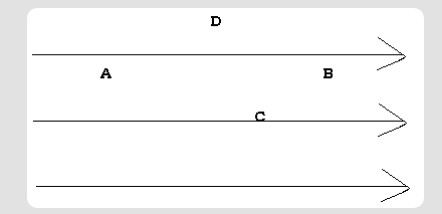
A charged species tends to move from place of higher potential energy to that of lower potential energy.
The direction of electric field is from left to right. This means that there is a positively charged plate on the left side, closest to A and farthest from B.
An electron being negatively charged plate always moves towards left here.
Explanation:
We consider earth as the storage of infinite positive as well as a negative charge. Therefore, the potential of the earth is always considered to be zero and the potential of every body is measured with respect to earth. That’s why if we connect any charged body to the earth, its potential instantaneously becomes zero.

Explanation:
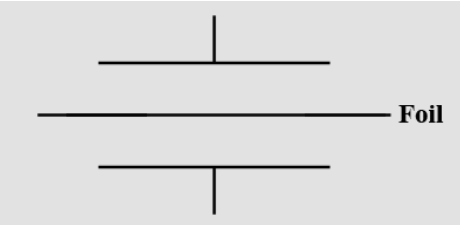
The capacity of condenser before inserting foil is $\text{C}=\frac{\text{A}\in0}{\text{d}}$ where A be the area of plate and d be the separation between plates.
After inserting foil the there will be two capacitors in series with capacitance 2C as distance is halved and the series combination of the two will give equivalent capacitance of C, hence, capacity will remain same.
Explanation:
Here copper, tin, iron all are conductor so they will decrease the capacitance. The mica sheet is a dielectric or insulator so it will increase the capacitance k times. Where k is the dielectric constant.
Explanation:
If the empty Condensor has capacity C, then its capacity with dielectric is given by C′ = kC, where k is the dielectric constant of the dielectric material. k can never be less than 1.
Explanation:
The electrostatic potential on the perpendicular bisector due to an electric dipole is zero.
Explanation:
A parallel- plate capacitor with a dielectric. The electric field is reduced between the plates because the dielectric material is polarized, producing an opposing field. When there is a dielectric, the potential is also reduced because potential is inversely proportional to dielectric
Explanation:
A capacitor becomes a perfect insulator for direct current as the regular supply of current charges capacitor and the it behaves as open circuit, where as in A.C. the current being variable in sign and magnitude does not charge capacitor ever it goes through a repetitive process of charging and discharging and hence it never behaves as open circuit.
Explanation:
Hint:- Check the dependence of capacitance on certain quantities.
In a parallel plate capacitor, the capacitance is $\text{C}=\frac{\text{k}\in_0\text{A}}{\text{d}};$
Where, k is the dielectric constant, $\in_0$ is the permittivity constant, A is the area of the conduction and d is the distance between plates.
From here we can see C is directly proportional to k, $\in_0$,A and inversely proportional to d.

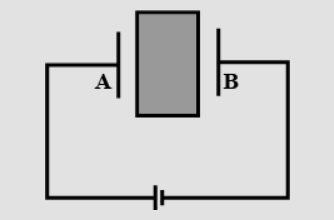
In case A, key K is kept closed and plates of capacitors are moved apart using insulating handle (i.e. distance between plates is increasing). As capacitance $\text{C}=\Big[\frac{(\text{K}\in_0\text{A})}{\text{d}}\Big]=\text{C}\propto\text{d}$ (separation between plates) so, capacitance will decrease & amount of charge stored will also decrease (as Q = CV). Here, there will be no change in potential difference.
In case B, key K is opened and plates of capacitors are moved apart using insulating handle, by conservation of charge, charge stored by the capacitor remains same. Plates of capacitance are moving apart so capacitance will decrease and with the decreases of capacitance, potential difference V increases $\Big(\text{as V}=\frac{\text{Q}}{\text{C}}\Big)$.
Explanation:
If a dielectric medium of dielectric constant K is filled completely between the plates then capacitance increases by K times
$\text{C}=\frac{\text{K}\in_0\text{A}}{\text{d}}$
$⇒\text{C}′=\text{KC.}$
Explanation:
In general capacitance of parallel plate capacitor is given by:
$\text{C}=\frac{\text{K}\in_0\text{A}}{\text{d}}$
Where C is capacitance, k is relative permittivity of dielectric material, ϵ0 is permittivity of free space constant, A is area of plates and d is distance between them. Therefore, the capacitance of parallel plates is increased by the insertion of a dielectric material. Further, the capacitance is inversely proportional to the electric field between the plates, and hence the presence of the dielectric decreases the effective electric field.

Explanation:
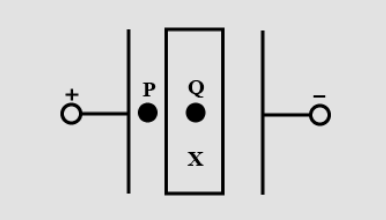
There is no effect of the metal on the external electric field(thus A is incorrect) while the dielectric reduces the net electric field outside. The dielectric produces an electric field inside it due to the induced charges which is opposite to the external field. Thus EQ is reduced and B and C are also incorrect.(Note that EP is not the external field). Now as the electric field inside the conductor is zero, the field Ep is zero if X is a metallic.

Explanation:
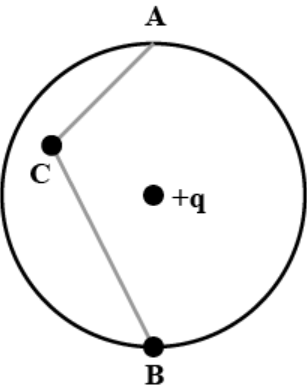
As the charge q is situated at the center of the circle ABCDE, therefore the circle is an equipotential surface. That means all the points on the circle i.e. A, B, C, D, and E have the same potential. Therefore, work done to bring the charge from A to any point on the circle is zero always.
Explanation:
There is no potential gradient along any direction parallel to the surface, and no electric field is parallel with the surface, This means electric field are always at right angle to the equipotential surface.
Explanation:
An electric potential can be calculated in either a static (or time invariant) or a dynamic (varying with time) electric field at a specific time in units of Joules per Coulomb or Volts.
Explanation:
The formula for electrostatic potential is Electrostatic potential = Work done/ charge.
Explanation:
The capacitance of a parallel plate capacitor is directly proportional to the area of the plates and permittivity of the medium between the plates. It is indirectly proportional to the distance between the plates.
Explanation:
We know that for a conducting sphere, the charge is always distributed on its outer surface. We also know that charge flows from higher potential to lower potential. But if we put the smaller sphere inside the larger sphere and connect them with a conductor, they will act as a single conductor and charge will be distributed to its outer surface, i.e. charge will flow to the larger sphere.
Explanation:
By Gauss’s theorem, the charge enclosed by the gaussian surface is zero. Consequently, the electric field must be zero at every point inside the cavity. Then, the entire excess charge lies on its surface.
We know, the electric field intensity E and electric potential V are dV related as $\text{E}=-\frac{\text{dV}}{\text{dr}}$
or we can write $|\text{E}|=-\frac{\Delta\text{V}}{\Delta\text{r}}$
The electric field intensity E and electric potential V are related as E = 0 and for V = constant, $\frac{\text{dV}}{\text{dr}}=0$ this imply that electric field intensity E = 0.
If some charge is present inside the region then electric field cannot be zero at that region, for this V = constant is not valid.
Explanation:
Dynamic resistance (rP) is given by,
$\text{r}_\text{P}=\frac{\Delta\text{V}_\text{P}}{\Delta\text{i}_\text{P}}$
The triode is operating in the linear region. Therefore,
Change in the value of voltage = Change in the value of current
So, (rP) will remain almost the same.
Explanation:
B and C points are situated on the circle, so they are on the equipotential surface. To bring a point charge from A to B and from A to C requires the same amount of work done as the initial and final points have the same potential energy in both the cases.
Explanation:
Electric potential is defined as the amount of work done to bring a unit positive charge from an infinite distance to a particular point of an electric field. The total energy of that point charge means the sum of kinetic energy and potential energy which is not the same as the potential energy if the particle is in motion.
Explanation:
Total charged is conserved in the condenser. Here the potential difference on the condenser is equal to the emf of battery. When dielectric is inserted between the plates the charge will maintain the constant potential in the capacitor. Thus, the potential difference on the condenser is 4V
Explanation:
The ratio of the polarization to εo times the electric field is called the electric susceptibility of the dielectric. It describes the electrical behaviour of a dielectric.
Explanation:
The work done against electrostatic force gets stored in the form of potential energy.
Explanation:
Electric field at any point is equal to the negative of the potential gradient. But inside a conductor, the electric field is zero. Hence, the electric potential is constant throughout the volume of a conductor and has the same value on its surface.
Explanation:
Equipotential surface is a surface formed by the locus of all the points which are at the same potential. Equipotential surfaces do not intersect with each other and are closely spaced in the region of strong electric fields and vice-versa.
The facing surfaces of the capacitor have equal and opposite charges.
The two plates of the capacitor have equal and opposite charges.
Explanation:
In H.C Verma the answer is (a), (c), (d). But according to us the answer should be (a), (b), (d) all these options are the properties of a capacitor and the option (c) is incorrect because the battery is a source of energy not charge. Moreover if a capacitor plates have equal charge on outside and equal charge on inside then one can think that the charge on the plates must be also equal so option (b) cant be incorrect.
Explanation:
The number of current pulses is equal to the frequency of the AC source because one current pulse passes through the diode for one oscillation of the AC source.

Explanation:
Electric potential is a scalar quantity and its value is solely dependent on the charge near it and the distance from that charge. In this case, the point is equidistant from the two point charges and the point charges have the same value but opposite nature. Therefore equal but opposite potentials are generated due to the charges and hence the net potential at midpoint becomes zero.