Questions · Page 2 of 3

3 Marks Question

Question 513 Marks
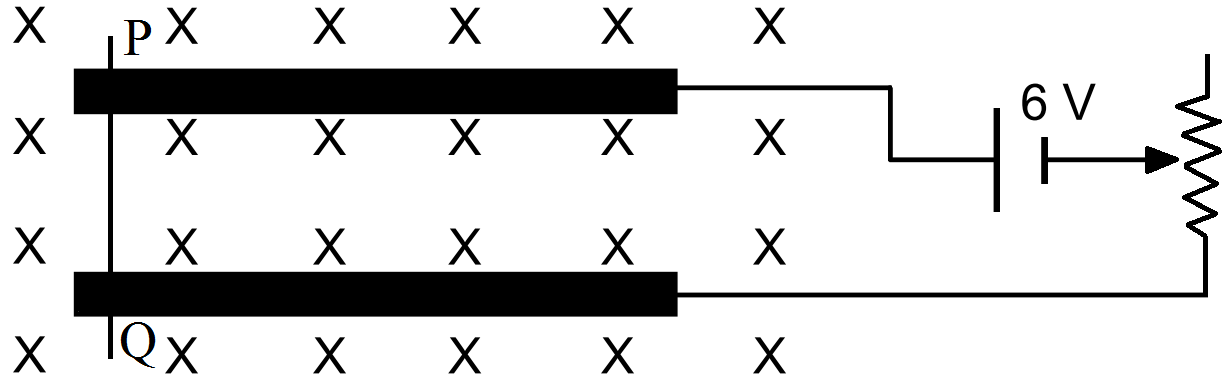
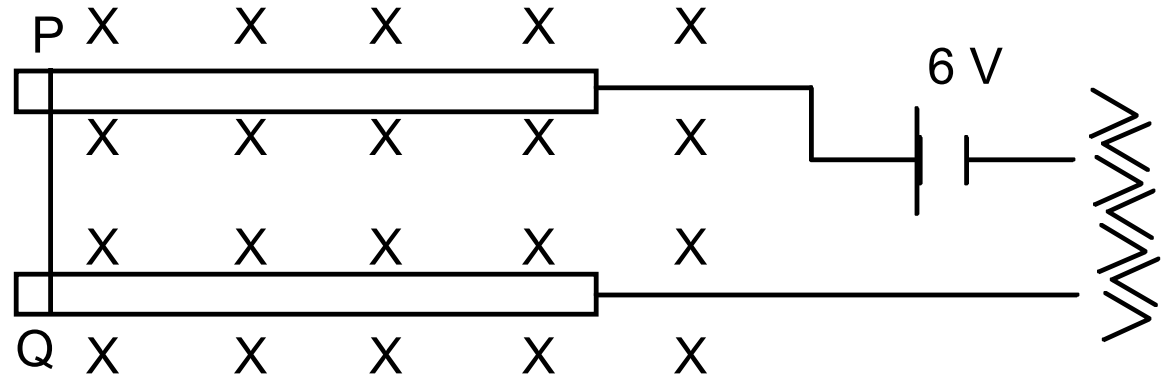
A metal wire PQ of mass 10g lies at rest on two horizontal metal rails separated by 4.90cm A vertically-downward magnetic field of magnitude 0.800T exists in the space. The resistance of the circuit is slowly decreased and it is found that when the resistance goes below 20.0Ω, the wire PQ starts sliding on the rails. Find the coefficient of friction.
Answer
$\mu\text{R}=\text{F}$
$\Rightarrow\mu\times\text{m}\times\text{g}=\text{ilB}$
$\Rightarrow\mu\times10\times10^{-3}\times9.8$
$=\frac{6}{20}\times4.9\times10^{-2}\times0.8$
$\Rightarrow\mu=\frac{0.3\times0.8\times10^{-2}}{2\times10^{-2}}=0.12$
View full question & answer
Question 523 Marks
You are given a low resistance $ R_1$ a high resistance $R_2$ and a moving coil galvanometer. Suggest how would you use these to have an instrument that will be able to measure?
  1. Current.
  2. Potential difference.
Answer
  1. To measure current we shall connect low resistance $R_1$ in parallel with the coil of moving coil galvanometer. This arrangement is called ammeter.
  2. To measure the potential difference we shall connect high resistance $R_2$ in series with the coil of galvanometer. This arrangement is called voltmeter.
View full question & answer
Question 533 Marks
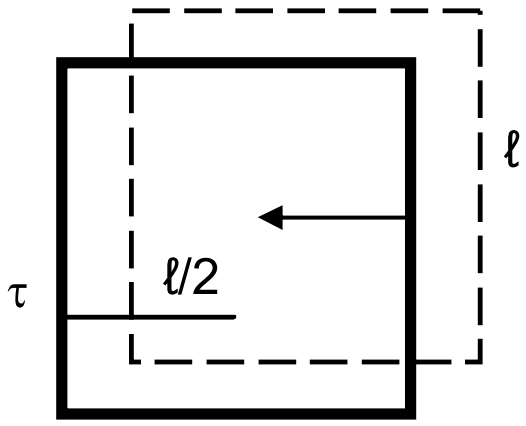
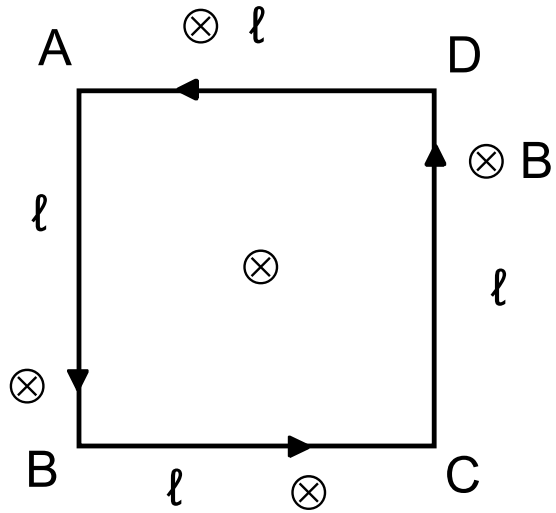
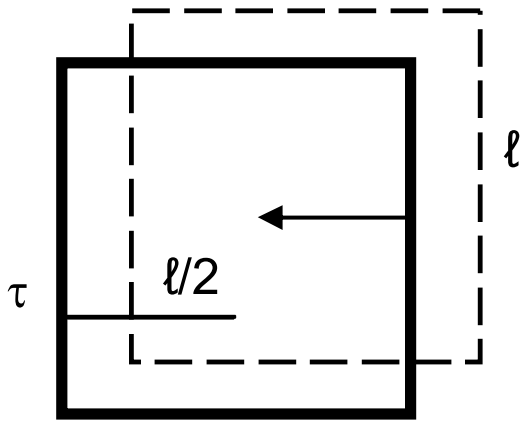
A square coil of edge l and with n turns carries a current i. It is kept on a smooth horizontal plate. A uniform magnetic field B exists parallel to an edge. The total mass of the coil is M. What should be the minimum value of B for which the coil will start tipping over?
Answer

Edge = l
Current = i
Turns= n
mass = M
Magnetic filed = B
Min Torque produced must be able to balance the torque produced due to weight Now, $\tau\text{B}=\tau$ Weight.
$\mu\text{B}=\mu\text{g}\Big(\frac{1}{2}\Big)$
$\Rightarrow\text{n}\times\text{i}\times\text{l}^2\text{B}=\mu\text{g}\Big(\frac{1}{2}\Big)$
$\Rightarrow\text{B}=\frac{\mu}{2\text{nil}}$
View full question & answer
Question 543 Marks
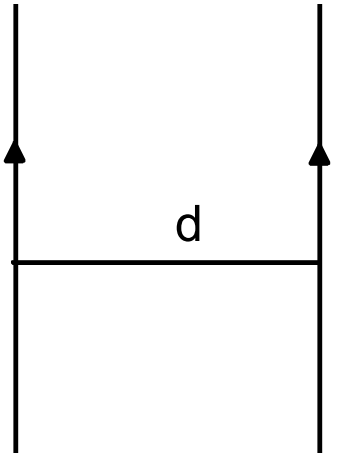
A straight, long wire carries a current of 20A. Another wire carrying equal current is placed parallel to it. If the. force acting on a length of 10cm of the second wire is $2 \times 10^{-5}N,$ what is the separation between them?
Answer


Force acting on 10cm of wire is $2 \times 10^{-5}N$
$\frac{\text{dF}}{\text{dl}}=\frac{\mu_0\text{i}_1\text{i}_2}{2\pi\text{d}}$
$\Rightarrow\frac{2\times10^{-5}}{10\times10^{-2}}=\frac{\mu_0\times20\times20}{2\pi\text{d}}$
$\Rightarrow\text{d}=\frac{4\pi\times10^{-7}\times20\times20\times10\times10^{-2}}{2\pi\times2\times10^{-5}}$
$=400\times10^{-3}=0.4\text{m}=40\text{cm}$
View full question & answer
Question 553 Marks
A solenoid of length 1.0m, radius 1cm and total turns 1000 wound on it, carries a current of 5A. Calculate the magnitude of the axial magnetic field inside the solenoid. If an electron was to move with a speed of $104ms^{–1}$ along the axis of this current carrying solenoid, what would be the force experienced by this electron?
Answer
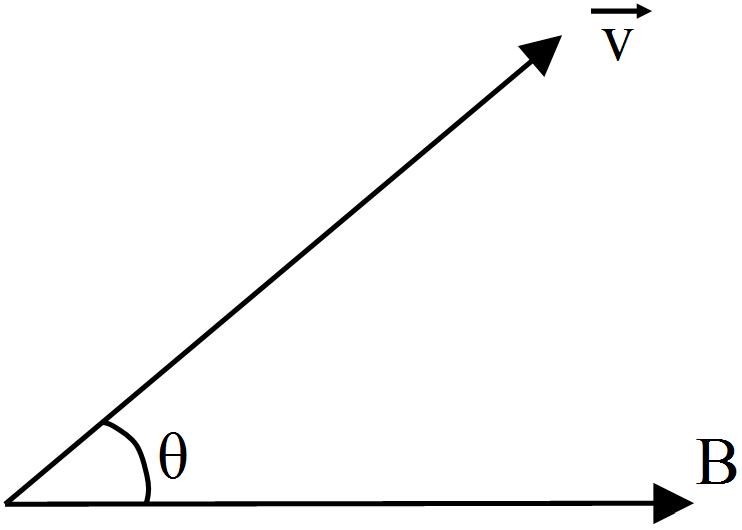
Magnetic field inside a solenoid, $\text{B}=\mu_0\text{nI}$ $\text{n}=\frac{\text{N}}{1}=\frac{1000\ \text{turns}}{1.0\ \text{m}}=1000\ \text{turns/ m}$ $\text{I}=5\text{A}$ $\therefore\text{B}=(4\pi\times10^{-7})\times1000\times5$ $=20\times3.14\times10^{-4}\text{J}=6.28\times10^{-3}\text{T},$ along the axis Force experience by electron $\text{F}_\text{m}=\text{qvB}\sin\theta$ Here,$ q = -e,v =10^4m/ s, \theta=$ angle between $\overrightarrow{\text{v}}\text{and}\overrightarrow{\text{B}}=0$$\therefore\text{F}_\text{m}=-\text{evB}\sin0^\circ=0(\text{zero})$
View full question & answer
Question 563 Marks
Consider the situation of the previous problem. A particle having charge q and mass m is projected from the point Q in a direction going into the plane of the diagram. It is found to describe a circle of radius r between the two plates. Find the speed of the charged particle.
Answer
Charge = q,
mass = m
We know radius described by a charged particle in a magnetic field B.
$\text{r}=\frac{\text{mv}}{\text{qB}}$
$\text{Bit}\ \text{B}=\mu_0\text{K}$ [according to Ampere’s circuital law, where K is a constant]
$\text{r}=\frac{\text{mv}}{\text{q}\mu_0\text{K}}\Rightarrow\text{v}=\frac{\text{rq}\mu_0\text{K}}{\text{m}}$
View full question & answer
Question 573 Marks
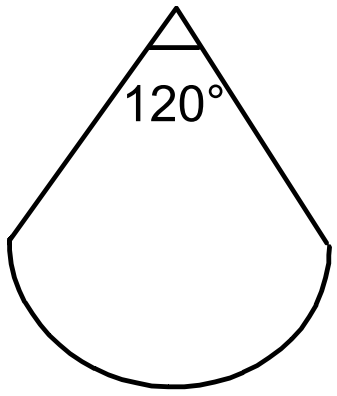
A piece of wire carrying a current of 6.00A is bent in the form of a circular arc of radius 10.0cm, and it subtends an angle of 120° at the centre. Find the magnetic field B due to this piece of wire at the centre.
Answer

$\text{B}=\frac{\mu_0\text{i}}{2\text{R}}\frac{\theta}{2\pi}=\frac{2\pi}{3\times2\pi}\times\frac{\mu_0\text{i}}{2\text{R}}$
$=\frac{4\pi\times10^{-7}\times6}{6\times10^{-2}}=4\pi\times10^{-6}$
$=4\times3.14\times10^{-6}=12.56\times10^{-6}$
$=1.26\times10^{-5}\text{T}$
View full question & answer
Question 583 Marks
A semi-circular arc of radius 20cm carries a current of 10A. Calculate the magnitude of magnetic field at the centre of the arc.
Answer
The magnetic field due to a semi-circular arc of radius ‘r’ carrying current (I) at centre is given by, $\Delta\text{B}=\frac{\mu_0}{4\pi}\frac{\text{I}\Delta\text{l}\sin90^\circ}{\text{r}^2}=\frac{\mu_0}{4\pi}\frac{\text{I}\Delta}{\text{r}^2}$The net magnetic field due to whole length of arc l will be
$\text{B}=\frac{\mu_0}{4\pi}\frac{\text{I}}{\text{r}^2}\sum\Delta\text{l}$ For semi-circular arc $\sum\Delta\text{l}=\pi\text{r}$ $\therefore\text{B}=\frac{\mu_0}{4\pi}\frac{\text{I}}{\text{r}^2}(\pi\text{r})=\frac{\mu_0\text{I}}{4\text{r}}$ Given I = 10A, r = 20m = 0.20m $\therefore\text{B}=\frac{4\pi\times10^{-7}\times10}{4\times0.20}$ $=\frac{4\times3.14\times10^{-7}\times10}{4\times0.20}$ $=1.57\times10^{-5}\text{T}$
View full question & answer
Question 593 Marks
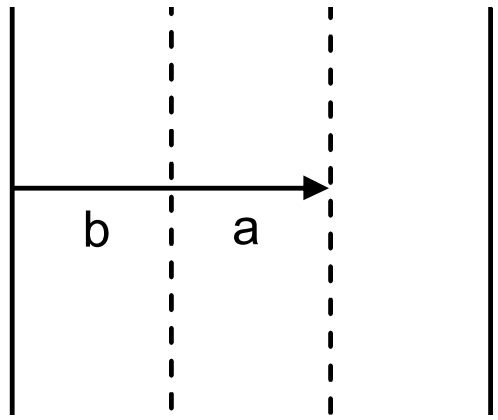
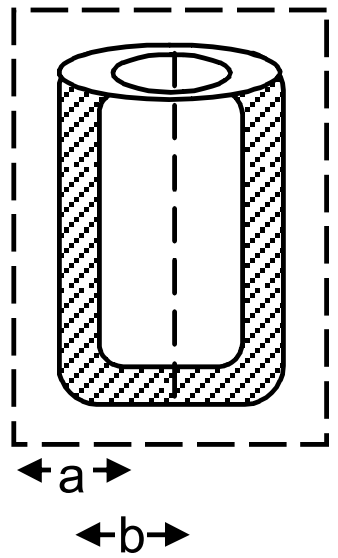
A long, cylindrical tube of inner and outer radii a and b carries a current i distributed uniformly over its cross section. Find the magnitude of the magnetic field at a point (a) just inside the tube (b) just outside the tube.
Answer
  1. At a point just inside the tube the current enclosed in the closed surface = 0.
Thus $\text{B}=\frac{\mu_0\text{o}}{\text{A}}=0$
  1. Taking a cylindrical surface just out side the tube, from ampere’s law
$\mu_0\text{i}=\text{B}\times2\pi\text{b}$

$\Rightarrow\text{B}=\frac{\mu_0\text{i}}{2\pi\text{b}}$
View full question & answer
Question 603 Marks
Describe the motion of a charged particle in a cyclotron if the frequency of the radio frequency (rf) field were doubled.
Answer
The frequency $v_a$ of the applied voltage (radio frequency) is adjusted so that the polarity of the dees is reversed in the same time that it takes the ions to complete one half of the revolution. The requirement $v_a = v_c$ is called the resonance condition.
When the frequency of the radio frequency (rf) field were doubled, then the resonance condition are violated and the time period of the radio frequency (rf) field were halved. Therefore, the duration in which particle completes half revolution inside the dees, radio frequency completes the cycle.
So, particle will accelerate and decelerate alternatively. So, the radius of path in the dees will remain same.
View full question & answer
Question 613 Marks
A straight wire carrying an electric current is placed along the axis of a uniformly charged ring. Will there be a magnetic force on the wire if the ring starts rotating about the wire? If yes, in which direction?
Answer
The magnetic force on a wire carrying an electric current i is $\overrightarrow{\text{F}}=\text{i}.\big(\overrightarrow{\text{l}}\times\overrightarrow{\text{B}}\big),$ where l is the length of the wire and B is the magnetic field acting on it. If a uniformly charged ring starts rotating around a straight wire, then according to the right-hand thumb rule, the magnetic field due to the ring on the current carrying straight wire placed at its axis will be parallel to it. So, the cross product will be:
$\big(\overrightarrow{\text{l}}\times\overrightarrow{\text{B}}\big)=0$
$\Rightarrow\overrightarrow{\text{F}}=0$
Therefore, no magnetic force will act on the wire.
View full question & answer
Question 623 Marks
A long, straight wire carries a current. Is Ampere's law valid for a loop that does not enclose the wire? That encloses the wire but is not circular?
Answer
Ampere's law is valid for a loop that is not circular. However, it should have some charge distribution in the area enclosed so as to have a constant electric field in the region and a non-zero magnetic field. Even if the loop defined does not have its own charge distribution but has electric influence of some other charge distribution, it can have some constant magnetic field $\big(\oint\overrightarrow{\text{B}}.\text{d}\overrightarrow{\text{l}}=\mu_0\text{i}\ \text{enclosed}\big).$
View full question & answer
Question 633 Marks
A long, straight wire of radius r carries a current i and is placed horizontally in a uniform magnetic field B pointing vertically upward. The current is uniformly distributed over its cross-section.
  1. At what points will the resultant magnetic field have maximum magnitude? What will be the maximum magnitude?
  2. What will be the minimum magnitude of the resultant magnetic field?
Answer

  1. The maximum magnetic field is $\text{B}+\frac{\mu_0\text{I}}{2\pi\text{r}}$ which are along the left keeping the sense along the direction of traveling current.
  1. The minimum $\text{B}-\frac{\mu_0\text{I}}{2\pi\text{r}}$
If $\text{r}=\frac{\mu_0\text{I}}{2\pi\text{B}}\ \text{B}\ \text{net}=0$

$\text{r}<\frac{\mu_0\text{I}}{2\pi\text{B}}\ \text{B}\ \text{net}=0$

$\text{r}>\frac{\mu_0\text{I}}{2\pi\text{B}}\ \text{B}\ \text{net}=\text{B}-\frac{\mu_0\text{I}}{2\pi\text{r}}$
View full question & answer
Question 643 Marks
Answer the following questions.
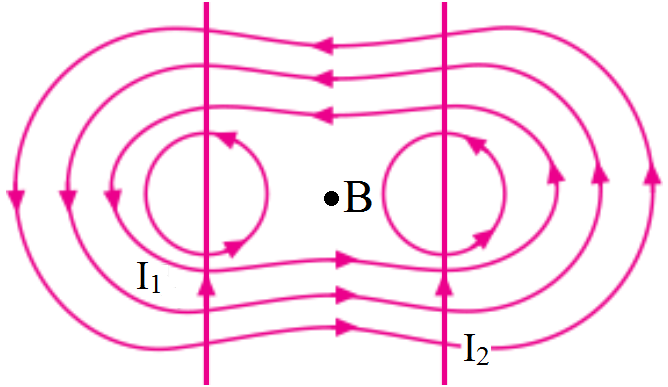
  1. Draw the magnetic field lines due to two straight, long, parallel conductors carrying currents $I_1$ and $I_2$ in the same direction. Write an expression for the force acting per unit length on one conductor due to other. Is this force attractive or repulsive?
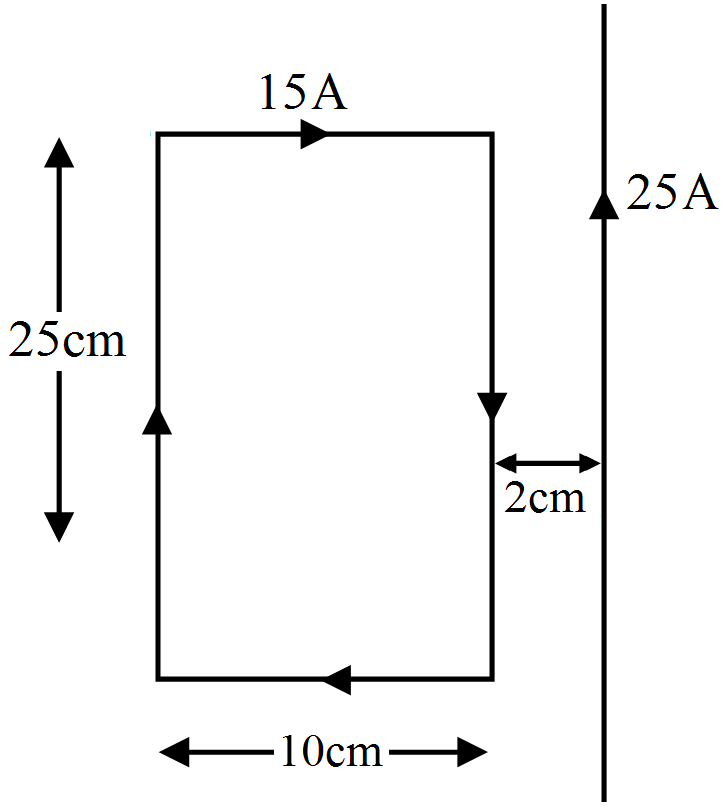
  1. Figure shows a rectangular current-carrying loop placed 2cm away from a long, straight, current-carrying conductor. What is the direction and magnitude of the net force acting on the loop?
Answer
  1. The magnetic field lies due to two current carrying parallel wires are shown in figure. The force between parallel wires $\frac{\text{F}}{\text{l}}=\frac{\mu_0\text{I}_1\text{I}_2}{2\pi\text{r}}\text{N}/\text {m}$.
  2. We know that parallel currents attract and opposite currents repel and $\text{F}\propto\frac{1}{\text{r}}$. As wire of loop carrying opposite current is nearer, so the net force acting on the loop is repulsive.
View full question & answer
Question 653 Marks
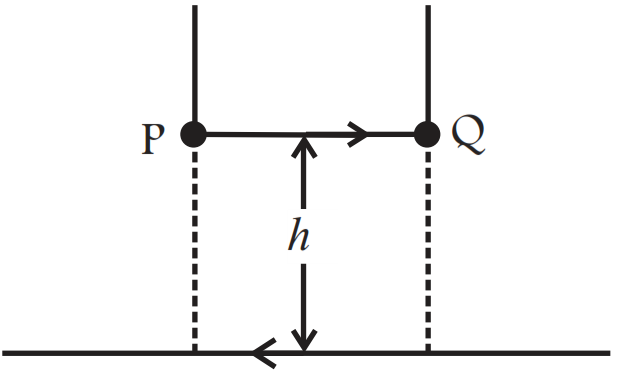
A long straight wire carrying current of 25A rests on a table as shown in Fig. Another wire PQ of length 1m, mass 2.5g carries the same current but in the opposite direction. The wire PQ is free to slide up and down. To what height will PQ rise?
Answer
In equilibrium state,
$\text{mg}=\frac{\mu_0}{4\pi}\frac{2\text{I}_1\text{I}_2}{\text{h}}\text{l}$
According to the question,
$\text{h}=\frac{\mu_0}{4\pi}\frac{2\text{I}_1\text{I}_2\text{l}}{\text{mg}}$
$\text{h}=\frac{\mu_0}{4\pi}\frac{10^{-7}\times2\times25\times25\times1}{(2.5\times10^{-3})\times9.8}$
$=51\times10^{-4}=0.51\text{cm}.$
View full question & answer
Question 663 Marks
An ammeter and a milliammeter are converted from the same galvanometer. Out of the two, which current measuring instrument has a higher resistance?
Answer
$\text{Shunt resistance},\ \text{S}=\frac{\text{I}_\text{g}}{\text{I-I}_\text{g}}\text{G}\approx\frac{\text{I}_\text{g}}{\text{I}}\text{G}$
Clearly, smaller the value of range, larger is the shunt resistance. Obviously, milliammeter will have a larger shunt resistance and hence it will have a higher resistance.
$\frac{1}{\text{R}_\text {A}}=\frac{1}{\text{G}}+\frac{1}{\text{S}}$
Higher the S, higher the $R_A$ for given G.
View full question & answer
Question 673 Marks
A charge of $3.14 \times 10^{-6}C$ is distributed uniformly over a circular ring of radius 20.0cm. The ring rotates about its axis with an angular velocity of 60.0 rad/s. Find the ratio of the electric field to the magnetic field at a point on the axis at a distance of 5.00cm from the centre.
Answer


Given:
Magnitude of charges, $q = 3.14 \times 10^{−6}C$
Radius of the ring,$ r = 20cm = 20 \times 10^{-2}mr = 20cm = 20 \times 10^{-2}m$
Angular velocity of the ring, $\omega=60\ \text{rad/s}$
Time for 1 revolution $=\frac{2\pi}{60}$
$\therefore\ \text{Current},\ \text{i}=\frac{\text{q}}{\text{t}}=\frac{3.14\times10^{-6}\times60}{2\pi}$
$=30\times10^{-6}\text{A}$
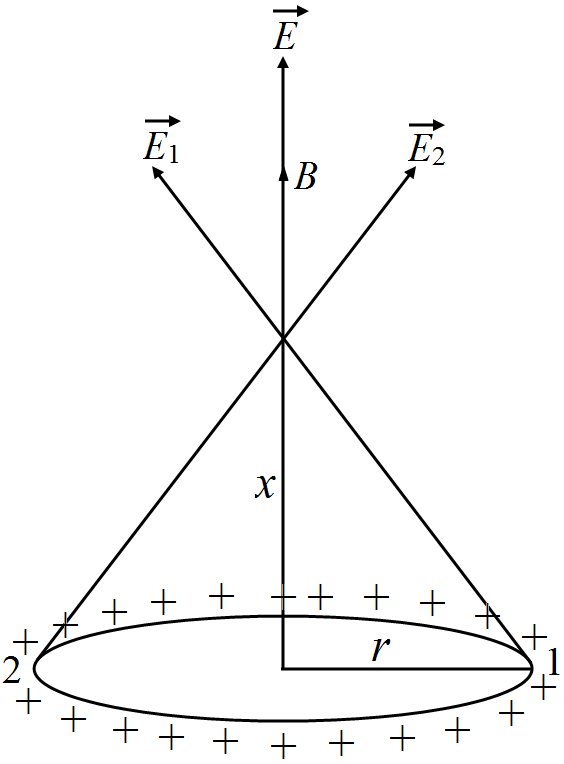
In the figure, $E_1$ and $E_2$ denotes the electric field at a point on the axis at a distance of 5.00 cm from the centre due to small element 1 and 2 of the ring respectively.
E is the resultant electric field due to the entire ring at a point on the axis at a distance of 5.00 cm from the centre.
The electric field at a point on the axis at a distance x from the centre is given by
$\text{E}=\frac{\text{xq}}{4\pi\in_0(\text{x}^2+\text{r}^2)^\frac{3}{2}}$
The magnetic field at a point on the axis at a distance x from the centre is given by
$\text{B}=\frac{\mu_0}{2}\frac{\text{ir}^2}{(\text{x}^2+\text{r}^2)^\frac{3}{2}}$
$\frac{\text{E}}{\text{B}}=\frac{\frac{\text{xq}}{4\pi\in_0(\text{x}^2+\text{r}^2)^\frac{3}{2}}}{\frac{\mu_0}{2}\frac{\text{ir}^2}{(\text{x}^2+\text{r}^2)^\frac{3}{2}}}$
$=\frac{9\times10^9\times3.14\times10^{-6}\times2\times(20.6)^3\times10^{-6}}{25\times10^{-4}\times4\pi\times12}$
$=\frac{9\times3.14\times2\times(20.6)^3}{25\times4\pi\times12}$
$=1.88\times10^{15}\text{m/s}$
View full question & answer
Question 683 Marks
A particle of mass ‘m’, with charge ‘q’ moving with a uniform speed ‘v’, normal to a uniform magnetic field ‘B’, describes a circular path of radius ‘r’. Derive expressions for the:
  1. Time period of revolution.
  2. Kinetic energy of the particle.
Answer
  1. Motion of charged particle in perpendicular magnetic field:The magnetic force on charged particle $\text{qvB}\sin90^\circ$ provides the necessary centripetal force for a circular path, so
​​​​​​​$\text{qvB}=\frac{\text{mv}^2}{\text{r}}\Rightarrow\upsilon=\frac{\text{qBr}}{\text{m}}$

But $\upsilon=\frac{2\pi\text{r}}{\text{T}}$ where T is time period

$\frac{2\pi\text{r}}{\text{T}}=\frac{\text{qBr}}{\text{m}}\Rightarrow\text{T}=\frac{2\pi\text{r}}{\text{qB}}$
  1. Kinetic energy of charged paricle:​​​​​​​
$\text{KE}=\frac{1}{2}\text{mv}^2\ \ \ \ \ \ \ \Rightarrow\ \ \ \ \ \ \ \frac{1}{2}\text{m}\frac{\text{q}^2\text{B}^2\text{r}^2}{\text{m}^2}=\frac{\text{q}^2\text{B}^2\text{r}^2}{2\text{m}}$​​​​​​​​​​​​​​
View full question & answer
Question 693 Marks
A particle moves in a circle of diameter 1.0cm under the action of a magnetic field of 0.40T. An electric field of $200\ Vm^{-1}$ makes the path straight. Find the charge/ mass ratio of the particle.
Answer
$r = 0.5cm = 0.5 \times 10^{-2}m$
$B = 0.4T,$
$\text{E}=200\frac{\text{V}}{\text{m}}$
The path will straighten, if $\text{qE}=\text{quB}$
$\Rightarrow\text{E}=\frac{\text{rqB}\times\text{B}}{\text{m}}$
$\Rightarrow\text{E}=\frac{\text{rqB}^2}{\text{m}}$
$\Rightarrow\frac{\text{q}}{\text{m}}=\frac{\text{E}}{\text{B}^2\text{r}}=\frac{200}{0.4\times0.4\times0.5\times10^{-2}}$
$=2.5\times10^5\text{c/kg}$
View full question & answer
Question 703 Marks
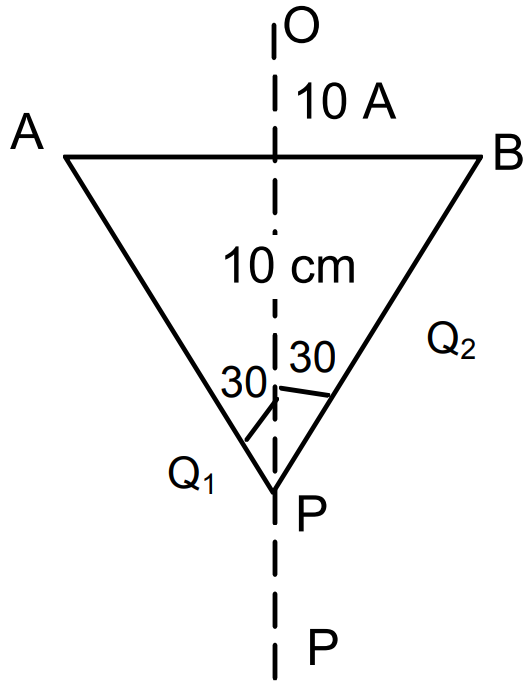
Consider a 10cm long piece of a wire which carries a current of 10A. Find the magnitude of the magnetic field due to the piece at a point which makes an equilateral triangle with the ends of the piece.
Answer

$\text{I} = 10 \text{A},\ \text{a} = 10\text{cm} = 0.1\text{m}$
$\text{r}=\text{OP}=\frac{\sqrt3}{2}\times0.1\text{m}$
$\text{B}=\frac{\mu_0\text{I}}{4\pi\text{r}}(\sin\phi_1+\sin\phi_2)$
$=\frac{10^{-7}\times10\times1}{\sqrt{\frac{\sqrt{3}}{2}}\times0.1}=\frac{2\times10^{-5}}{1.732}$
$= 1.154\times10^{-5}\text{T} = 11.54\mu\text{T}$
View full question & answer
Question 713 Marks
A long cylindrical wire of radius b carries a current i distributed uniformly over its cross-section. Find the magnitude of the magnetic field at a point inside the wire at a distance a from the axis.
Answer
i is uniformly distributed throughout So, ‘i’ for the part of radius $\text{a}=\frac{\text{i}}{\pi\text{b}^2}\times\pi\text{a}^2=\frac{\text{ia}^2}{\text{b}^2}=\text{I}$
Now according to Ampere’s circuital law, $\phi\text{B}\times\text{d}\ell=\text{B}\times2\times\pi\times\text{a}=\mu_0\text{I}$ $\Rightarrow\text{B}=\mu_0\frac{\text{ia}^2}{\text{b}^2}\times\frac{1}{2\pi\text{a}}=\frac{\mu_0\text{ia}}{2\pi\text{b}^2}$
View full question & answer
Question 723 Marks
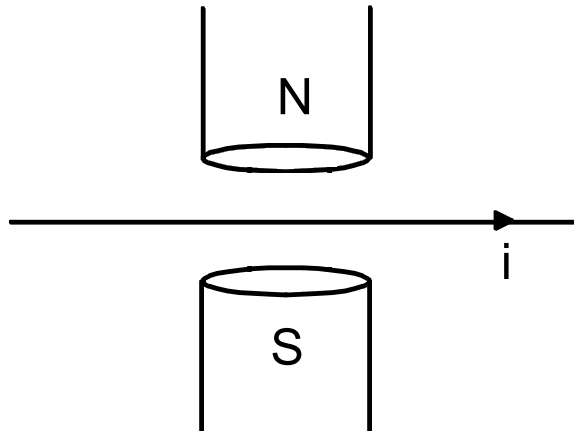
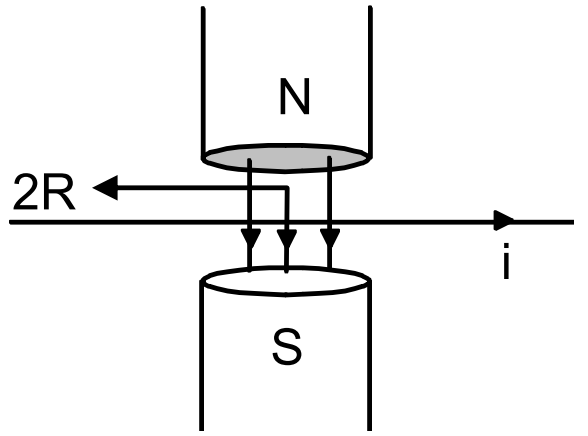
A magnetic field of strength 1.0T is produced by a strong electromagnet in a cylindrical region of radius 4.0cm, as shown in the figure. A wire, carrying a current of 2.0A, is placed perpendicular to and intersecting the axis of the cylindrical region. Find the magnitude of the force acting on the wire.
Answer

$\text{F}=\text{ilB}\sin\theta$
$=\text{ilB}\sin90^\circ$
$=\text{i}\ 2\text{RB}$
$=2\times(8\times10^{-2})\times1$
$=16\times10^{-2}$
$=0.16\text{N}.$
View full question & answer
Question 733 Marks
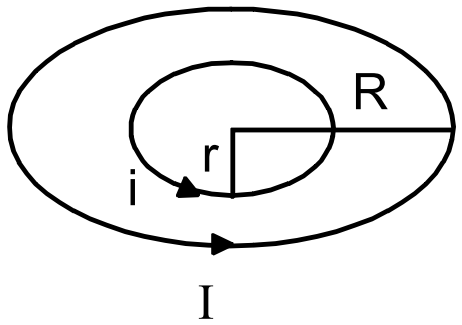
A circular loop of radius r carrying a current i is held at the centre of another circular loop of radius R(>> r) carrying a current I. The plane of the smaller loop makes an angle of 30° with that of the larger loop. If the smaller loop is held fixed in this position by applying a single force at a point on its periphery, what would be the minimum magnitude of this force?
Answer

The force acting on the smaller loop
$\text{F}=\text{ilB}\sin\theta$
$=\frac{\text{i}2\pi\text{r}\mu_0\text{I}1}{2\text{R}\times2}=\frac{\mu_0\text{iI}\pi\text{r}}{2\text{R}}$
View full question & answer
Question 743 Marks
A current loop of arbitrary shape lies in a uniform magnetic field B. Show that the net magnetic force acting on the loop is zero.
Answer


$\mathrm{F}_1=$ Force on $\mathrm{AD}=\mathrm{i} \ell \mathrm{B}$ inwards
$\mathrm{F}_2=$ Force on $\mathrm{BC}=\mathrm{i} \ell \mathrm{B}$ inwards
They cancel each other
$\mathrm{F}_3=$ Force on $\mathrm{CD}=\mathrm{i} \ell \mathrm{B}$ inwards
$F_4=$ Force on $A B=i \ell B$ inwards
They also cancel each other.
So the net force on the body is 0.
View full question & answer
Question 753 Marks
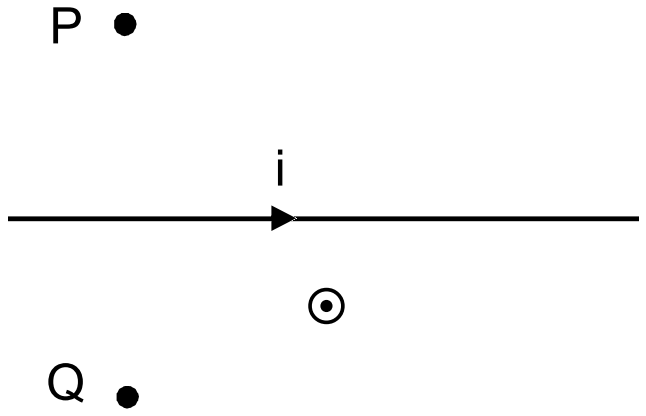
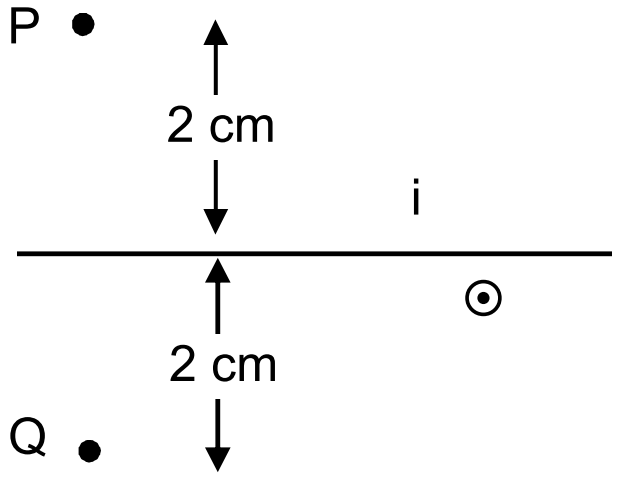
A long, straight wire carrying a current of 1.0A is placed horizontally in a uniform magnetic field $B = 1.0 \times 10^{-5}T$ pointing vertically upward figure. Find the magnitude of the resultant magnetic field at the points Pand Q, both situated at a distance of 2.0cm from the wire in the same horizontal plane.
Answer
$\mu_0=4\pi\times10^{-7}\text{T-m/A}$ $\text{r}2\text{cm}=0.02\text{m},$ $\text{I}=1\text{A}$ $\overrightarrow{\text{B}}=1\times10^{-5}\text{T}$

We know: Magnetic field due to a long straight wire carrying current $=\frac{\mu_0\text{I}}{2\pi\text{r}}$ $\overrightarrow{\text{B}}\ \text{at}\ \text{P}=\frac{4\pi\times10^{-7}\times1}{2\pi\times0.02}=1\times10^{-5}{\text{T}}$ upward net $ \text{B} = 2\times1\times10^{–7}\text{T} = 20\mu\text{T}$ B at $Q = 1 \times 10^{-5}$ downwards Hence net $\overrightarrow{\text{B}}=0$
View full question & answer
Question 763 Marks
A proton describes a circle of radius 1cm in a magnetic field of strength 0.10T. What would be the radius of the circle described by an α-particle moving with the same speed in the same magnetic field?
Answer
$\text{r}=\frac{\text{mv}}{\text{qB}}$
$0.01=\frac{\text{mv}}{\text{e}0.1}\ ...(1)$
$\text{r}=\frac{\text{4}\text{m}\times\text{V}}{2\text{e}\times0.1}\ ...(2)$
$(2)\div(1)$
$\Rightarrow\frac{\text{r}}{0.01}=\frac{4\text{mVe}\times0.1}{2\text{e}\times0.1\times\text{mv}}=\frac{4}{2}=2$
$\Rightarrow\text{r}=0.02\text{m}=2\text{cm}$
View full question & answer
Question 773 Marks
A long, vertical wire carrying a current of 10A in the upward direction is placed in a region where a horizontal magnetic field of magnitude $2·0 \times 10^{-3}T$ exists from south to north. Find the point where the resultant magnetic field is zero.
Answer
$\text{i}=10\text{A}.(\hat{\text{K}})$
$\text{B}=2\times10^{-3}\text{T}$ South to North $(\hat{\text{J}})$
To cancel the magnetic field the point should be choosen so that the net magnetic field is along $-\hat{\text{J}}$ direction.
$\therefore$ The point is along $-\hat{\text{i}}$ direction or along west of the wire.
$\text{B}=\frac{\mu_0\text{I}}{2\pi\text{r}}$
$\Rightarrow2\times10^{-3}=\frac{4\pi\times10^{-7}\times10}{2\pi\times\text{r}}$
$\Rightarrow\text{r}=\frac{2\times10^{-7}}{2\times10^{-3}}=10^{-3}\text{m}=1\text{mm}.$
View full question & answer
Question 783 Marks
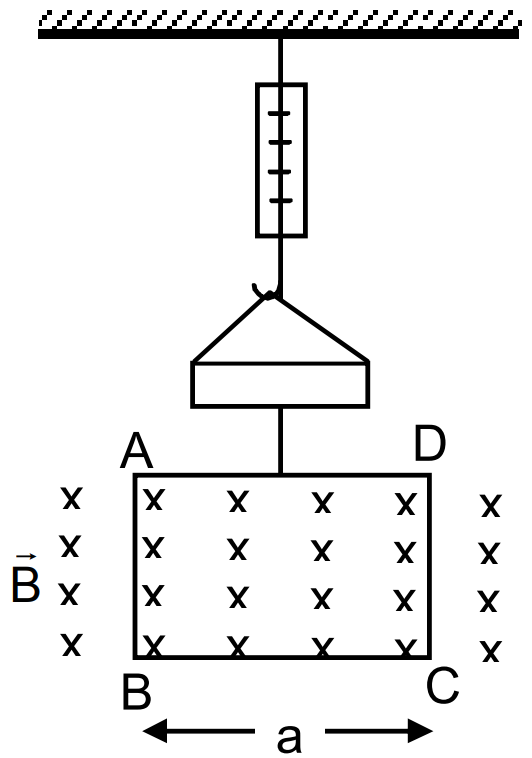
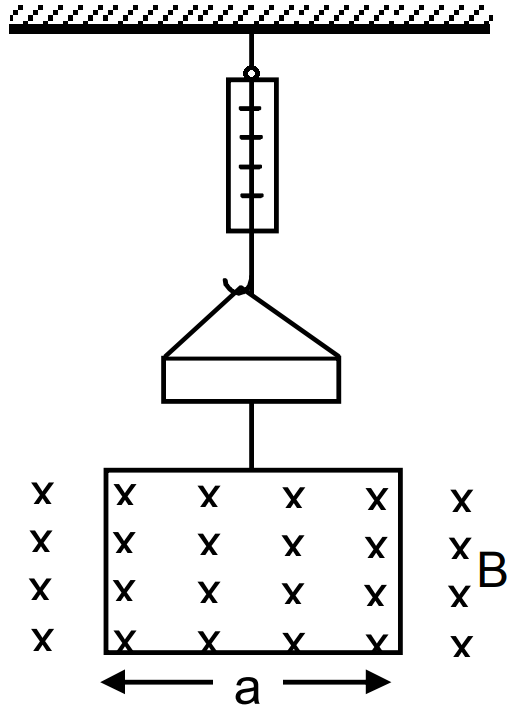
A rectangular wire loop of width a is suspended from the insulated pan of a spring balance, as shown in A current i exists in the anti-clockwise direction in the loop. A magnetic field Bexists in the lower region. Find the change in the tension of the spring if the current in the loop is reversed.
Answer

Current anticlockwise
Since the horizontal Forces have no effect.
Let us check the forces for current along AD & BC [Since there is no $\overrightarrow{\text{B}}$ ]
In AD, F = 0
For BC
F = iaB upward
Current clockwise
Similarly, F = - iaB downwards
Hence change in force = change in tension
= iaB - (-iaB) = 2 iaB
View full question & answer
Question 793 Marks
A given galvanometer is to be converted into (i) an ammeter (ii) a milliammeter (iii) a voltmeter. In which case will the required resistance be (i) least (ii) highest and why?
Answer
The required resistance has least value in the case of an ammeter and maximum value in the case of a voltmeter.
This is due to the reason that the shunt resistance required to convert a galvanometer into ammeter or milliammeter has the value.
$\text{S}=\frac{\text{I}_g}{\text{I}-\text{I}_\text{g}}\times\text{R}_\text{g}$
Thus, the shunt required in the case of milliammeter has higher value.
Similarly, since the voltmeter should have a high resistance, the value of required resistance should be highest in the case of a voltmeter. This is connected in series with the coil of the galvanometer.
View full question & answer
Question 803 Marks
A proton is projected with a velocity of $3 \times 10^6\ ms^{-1}$ perpendicular to a uniform magnetic field of 0.6T. Find the acceleration of the proton.
Answer
$\text{v}=3\times10^6\text{m/s},$
$\text{B}=0.6\text{T},$
$\text{m}=1.67\times10^{-27}\text{kg}$
$\text{F}=\text{qvB}$
$\text{q}_\text{p}=1.6\times10^{-19}\text{C}$
$\overrightarrow{\text{a}}=\frac{\text{F}}{\text{m}}=\frac{\text{quB}}{\text{m}}$
$=\frac{1.6\times10^{-19}\times3\times10^6\times10^{-1}}{1.67\times10^{27}}$
$=17.245\times10^{13}=1.724\times10^4\text{m/s}^2$
View full question & answer
Question 813 Marks
Which of the following will describe the smallest circle when projected with the same velocity perpendicular to the magnetic field B (i) $\alpha$-particle and (ii) $\beta$-particle?
Answer
Radius of circular path in transverse magnetic field, $\text{r}=\frac{\text{mv}}{\text{qB}}\propto\frac{\text{m}}{\text{q}}\ $for the same V and BFor $\alpha-$ particle$\Big(\frac{\text{m}}{\text{q}}\Big)_\alpha=\frac{4\text{mp}}{2\text{e}}=\frac{2\text{mp}}{\text{e}}$where mp is of mass proton.
For $\beta-$ particle $\Big(\frac{\text{m}}{\text{q}}\Big)_\beta=\frac{\frac{1}{1840}\text{m}_\text{p}}{\text{e}}=\frac{1}{1840}\Big(\frac{\text{m}_\text{p}}{\text{e}}\Big)$
Clearly $\beta-$ particle has smallest value of $\frac{\text{m}}{\text{q}}$; so $\beta-$ particle will describe the smalest circle.
View full question & answer
Question 823 Marks
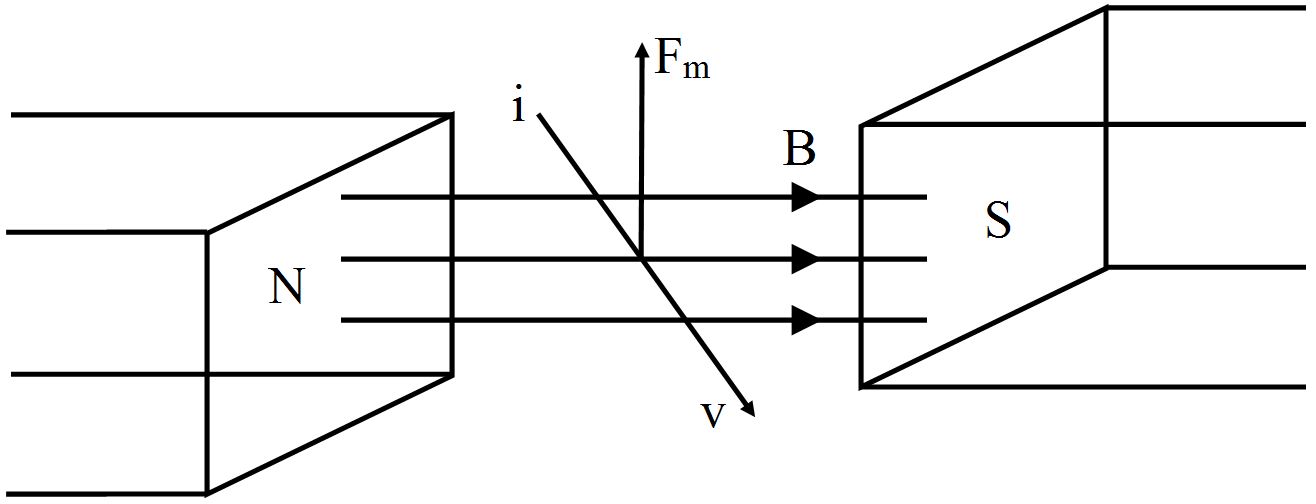
A charged particle enters into a uniform magnetic field and experiences an upward force as indicated in the figure. What is the charge sign on the particle?
Answer
Positive Charge: By Fleming left hand rule the direction of current is along positive Z-axis. By vector method $\vec{\text{F}_\text{m}}=\text{q}\vec{\upsilon}\times\vec{\text{B}}$ $\text{F}_\text{m}\hat{\text{j}}=\text{q}\upsilon\hat{\text{k}}\times\text{B}\hat{\text{i}}$ $\text{F}_\text{m}\hat{\text{j}}=\text{q}{\text{v}}\text{B}\hat{\text{j}}$ This shows that q is positive.
View full question & answer
Question 833 Marks
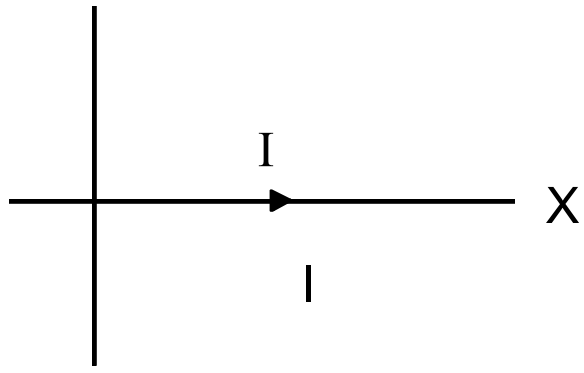
A wire of length l carries a current i long the x-axis. A magnetic field exists, which is given $\overrightarrow{\text{B}}=\text{B}_0(\overrightarrow{\text{i}}+\overrightarrow{\text{j}}+\overrightarrow{\text{k}})\text{T}.$ Find the magnitude of the magnetic force acting on the wire.
Answer

Length = l, Current $=\text{l}\hat{\text{i}}$
$\overrightarrow{\text{B}}=\text{B}_0(\hat{\text{i}}+\hat{\text{j}}+\hat{\text{k}})\text{T}$
$\text{B}_0\hat{\text{i}}+\text{B}_0\hat{\text{j}}+\text{B}_0\hat{\text{k}}\text{T}$
$\text{F}=\text{Il}\times\overrightarrow{\text{B}}=\text{Il}\hat{\text{i}}\times\text{B}_0\hat{\text{i}}+\text{B}_0\hat{\text{j}}+\text{B}_0\hat{\text{k}}$
$=\text{Il}\text{B}_0\hat{\text{i}}\times\hat{\text{i}}+\text{lB}_0\hat{\text{i}}\times\hat{\text{j}}+\text{lB}0\hat{\text{i}}\times\hat{\text{k}}=\text{Il}\text{B}_0\hat{\text{k}}-\text{IlB}\hat{\text{j}}$
or, $|\overrightarrow{\text{F}}|=\sqrt{2\text{I}^2\text{l}^2\text{B}_0^2}=\sqrt{2}\text{Il}\text{B}_0$
View full question & answer
Question 843 Marks
To increase the current sensitivity of a moving coil galvanometer by 50%, its resistance is increased so that the new resistance becomes twice its initial resistance. By what factor does its voltage sensitivity change?
Answer
Current sensitivity, $\text{S}_\text{C}=\frac{\theta}{\text{I}}=\frac{\text{NAB}}{C}$
Voltage sensitivity, $\text{S}_\text{V}=\frac{\theta}{\text{V}}=\frac{\theta}{\text{IR}}=\frac{\text{S}_\text{C}}{\text{R}}$
When current sensitivity is increased by 50%, the resistance is made twice.
$\therefore$ New current sensitivity $\text{S}_{\text{C}'}=\text{S}_\text{C}+\frac{50}{100}\text{S}_\text{C}=1.5\text{S}_\text{C}$
New resistance R' = 2R
$\therefore$ New Voltage sesitivity. $\text{S}_\text{V'}=\frac{\text{S}_\text{C'}}{\text{R'}}=\frac{1.5\text{S}_\text{C'}}{2\text{R}}=0.75\ \text{S}_\text{V}$
Clearly, $S_{V'} < S_{V'}$ i.e, voltage sensitivity $=\frac{\text{S}_\text{V}-\text{S}_\text{V'}}{\text{S}_\text{V}}\times100\%$
$=\frac{\text{S}_\text{V}-0.75\text{S}_\text{V'}}{\text{S}_\text{V}}\times100\%=25\%$
View full question & answer
Question 853 Marks
A uniform magnetic field of magnitude 0.20T exists in space from east to west. With what speed should a particle of mass 0.010g and with charge $1.0 \times 10^{-5}C$ be projected from south to north so that it moves with uniform velocity?
Answer
$B = 0.20T,$
$u = ?$
$m = 0.010g = 10^{-5}kg,$
$q = 1 \times 10^{-5}C$
Force due to magnetic field = Gravitational force of attraction
So,$quB = mg$
$\Rightarrow 1 \times 10^{-5} \times u \times 2 \times 10^{-1} = 1 \times 10–5 \times 9.8$
$\Rightarrow\text{v}=\frac{9.8\times10^{-5}}{2\times10^{-6}}=49\text{m/s}.$
View full question & answer
Question 863 Marks
What are the advantages of using soft iron as a core, instead of steel, in the coils of galvanometers?
Answer
The material used as a core in the moving coil galvanometer undergoes cycle of magnetization for long period. Therefore, low hysterisis loss is the first requirement for such material. In soft ron core, area under the hysteresis curve is small thus loss of energy is less as compared to steel. Further, it is easily magnetized by the magnetizing field, which increase the magnetic field and hence sensitivity of galvanometer.
View full question & answer
Question 873 Marks
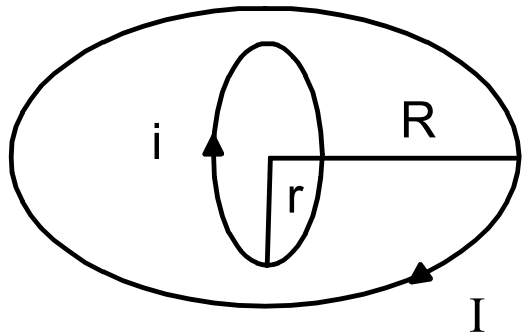
A circular loop of radius R carries a current I. Another circular loop of radius r ( << R) carries a current i and is placed at the centre of the larger loop. The planes of the two circles are at right angle to each other. Find the torque acting on the smaller loop.
Answer

$\overrightarrow{\text{B}}$ Large loop $=\frac{\mu_0\text{I}}{2\text{R}}$
'i’ due to larger loop on the smaller loop
$=\text{i}(\text{A}\times\text{B})=\text{i}\text{AB}\ \sin90^\circ=\text{i}\times\pi\text{r}^2\times\frac{\mu_0\text{I}}{2\text{r}}$
View full question & answer
Question 883 Marks
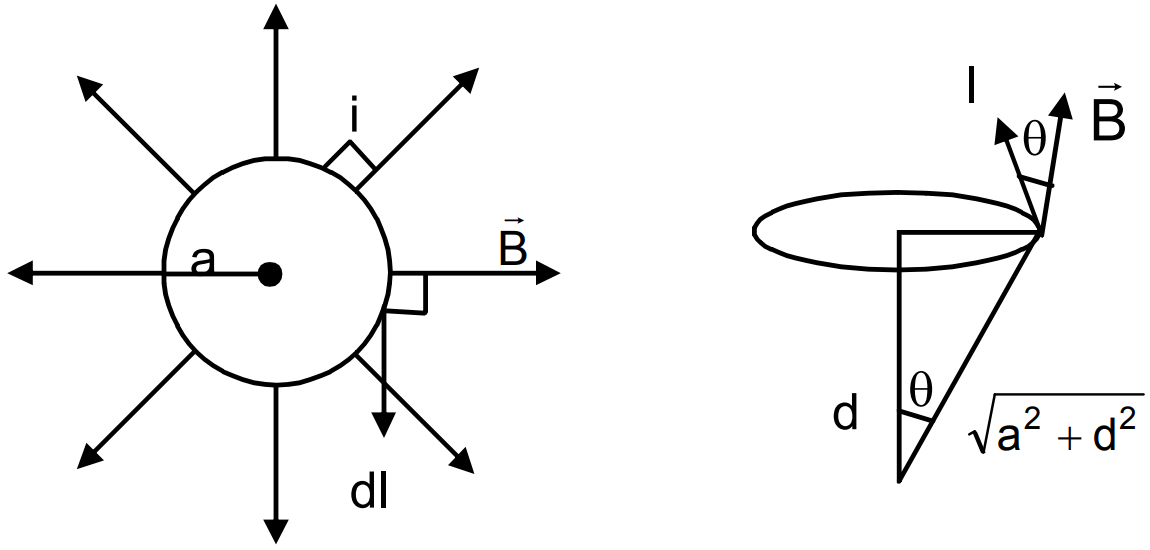
A hypothetical magnetic field existing in a region is given by $\overrightarrow{\text{B}}=\text{B}_0\overrightarrow{\text{e}}_\text{r},$ where $\overrightarrow{\text{e}}_\text{r}$ denotes the unit vector along the radial direction. A circular loop of radius a, carrying a current i, is placed with its plane parallel to the x-y plane and the centre at (0, 0, d). Find the magnitude of the magnetic force acting on the loop.
Answer

$\overrightarrow{\text{B}}=\text{B}_0\overrightarrow{\text{e}}_\text{r}$
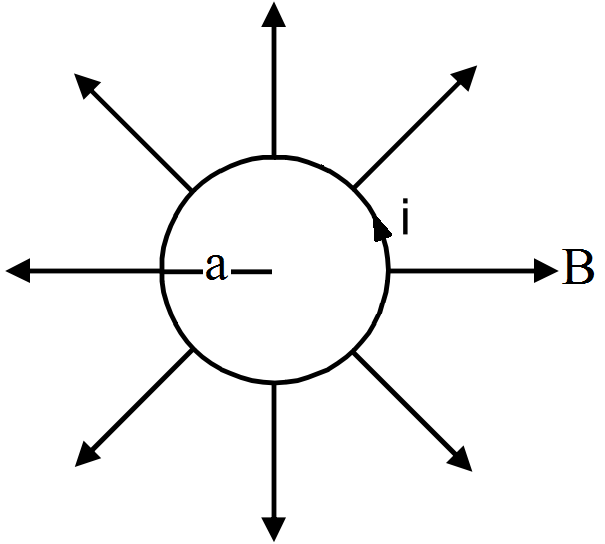
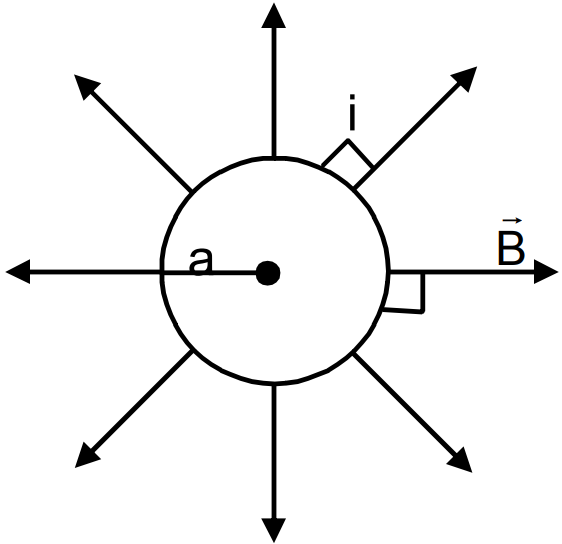
$\overrightarrow{\text{e}}_\text{r}=$ Unit vector along radial direction
$\text{F}=\text{i}(\overrightarrow{\text{l}}\times\overrightarrow{\text{B}})=\text{ilB}\sin\theta$
$=\frac{\text{i}(2\pi\text{a})\text{B}_0\text{a}}{\sqrt{\text{a}^2}+\text{d}^2}=\frac{\text{i}2\pi\text{a}^2\text{B}_0}{\sqrt{\text{a}^2+\text{d}^2}}$
View full question & answer
Question 893 Marks
A circular loop of radius a, carrying a current i, is placed in a two-dimensional magnetic field. The centre of the loop coincides with the centre of the field The strength of the magnetic field at the periphery of the loop is B. Find the magnetic force on the wire.
Answer

$\text{l}=2\pi\text{a}$
Magnetic field $=\overrightarrow{\text{B}}$ radially outwards
Current ⇒ 'i'
$\text{F}=\text{i l}\times\text{B}$
$=\text{i}\times(2\pi\text{a}\times\overrightarrow{\text{B}})$
$=2\pi\text{ai B}$ perpendicular to the plane of the figure going inside.
View full question & answer
Question 903 Marks
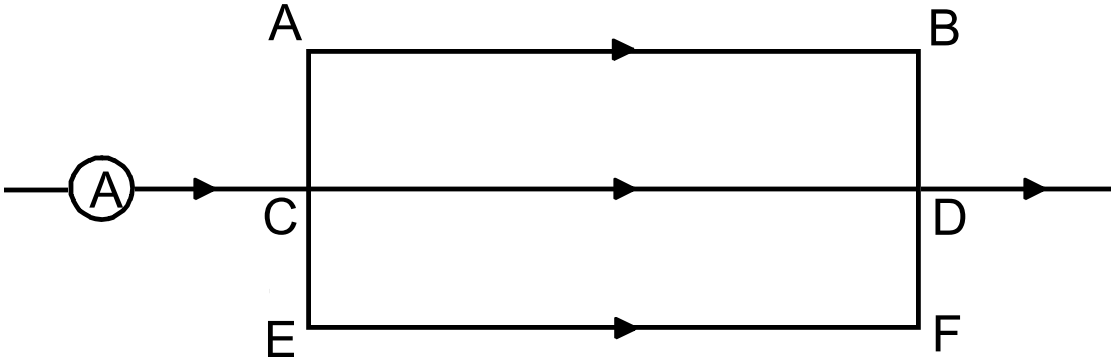
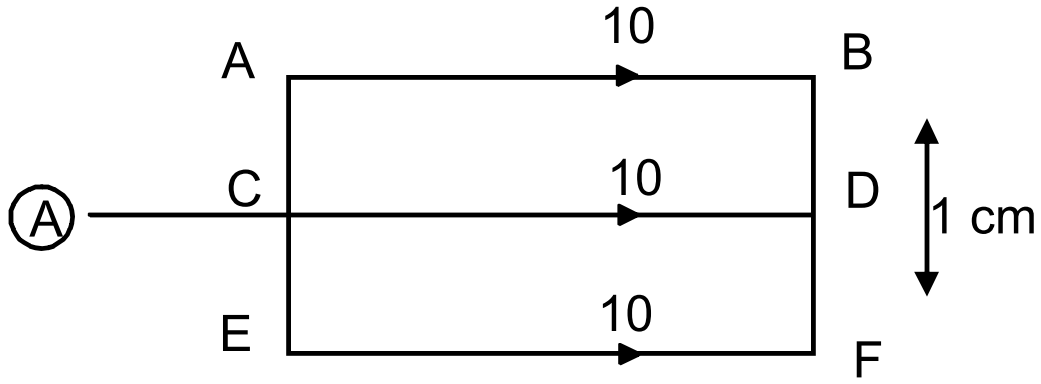
Figure shows a part of an electric circuit. The wires AB, CD and EF are long and have identical resistances. The separation between the neighbouring wires is 1.0cm. The wires AE and BF have negligible resistance and the ammeter reads 30A. Calculate the magnetic force per unit length of AB and CD.
Answer


$\text{F}_\text{AB} =\text{F}_\text{CD} +\text{F}_\text{EF}$
$=\frac{\mu_0\times10\times10}{2\pi\times10\times10}+\frac{\mu_0\times10\times10}{2\pi\times2\times10^{-2}}$
$=2\times10^{-3}+10^{-3}=3\times10^{-3}$ downward
$\text{F}_\text{CD} =\text{F}_\text{AB} +\text{F}_\text{EF}$
As $F_{AB} \& F_{EF}$ are equal and oppositely directed hence F = 0.
View full question & answer
Question 913 Marks
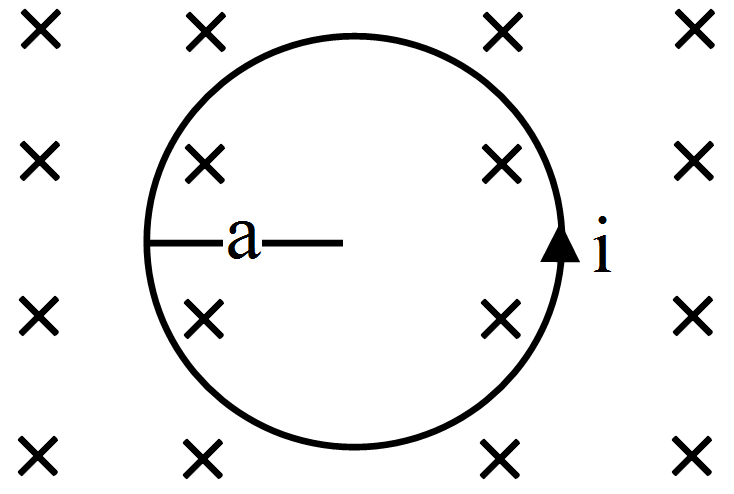
The shows a circular wire loop of radius a and carrying a current i, which is placed in a perpendicular magnetic field B.
  1. Consider a small part dl of the wire. Find the force on this part of the wire exerted by the magnetic field.
  2. Find the force of compression in the wire.
Answer

  1. Fdl = i × dl × B towards centre. (By cross product rule)
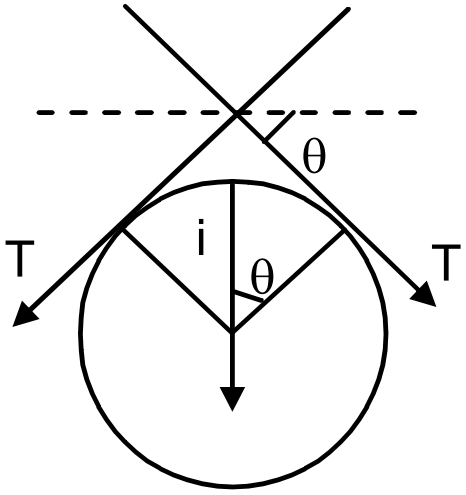
  2. Let the length of subtends an small angle of 20 at the centre.
Here, $2\text{T}\sin\theta=\text{i}\times\text{dl}\times\text{B}$

$\Rightarrow2\text{T}\theta=\text{i}\times\text{a}\times2\theta\times\text{B}$ $[\text{As}\theta\rightarrow0,\ \theta\approx0]$

$\Rightarrow\text{T}=\text{i}\times\text{a}\times\text{B}$

$\text{dl}=\text{a}\times2\theta$

Force of compression on the wire $=\text{i}\text{aB}$
View full question & answer
Question 923 Marks
Show that a force that does no work must be a velocity dependent force.
Answer
To show that a force that does no work must be a velocity dependent force, then we have to assume that work done by force is zero. As shown by the equation below:
$\text{dW}=\vec{\text{F}}.\vec{\text{dI}}=0$
We can write, $\vec{\text{dI}}=\vec{\text{v}}\text{dt But}\text{ dt}\neq0 $
$\Rightarrow\ \vec{\text{F}}.\vec{\text{v}}\text{dt}=0$
$\Rightarrow\ \vec{\text{F}}.\vec{\text{v}}=0$
So we can say that force F must be velocity dependent, this implies that angle between F and v is 90°. If the direction of velocity changes, then direction of force will also change.
View full question & answer
Question 933 Marks
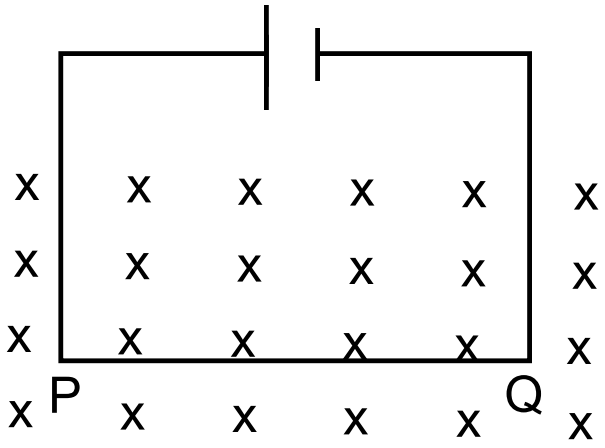
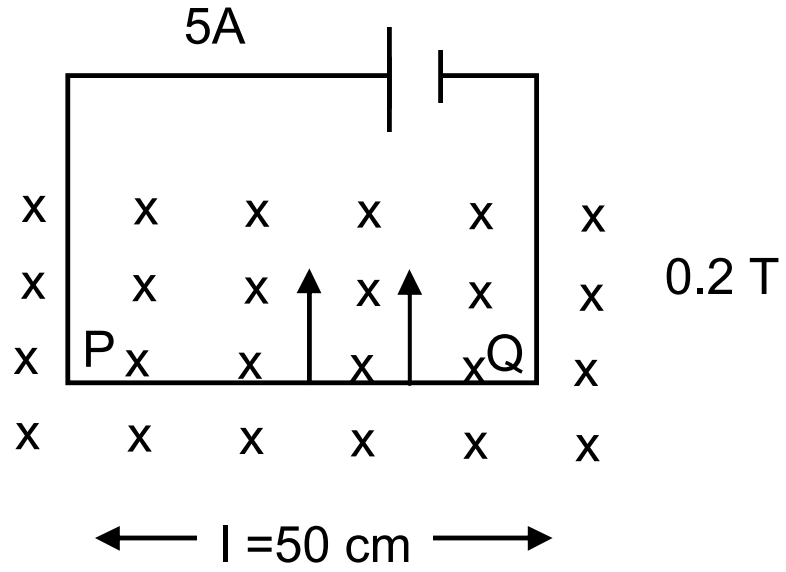
A current of 5.0A exists in the circuit shown in the figure. The wire PQ has a length of 50cm and the magnetic field in which it is immersed has a magnitude of 0.20T. Find the magnetic force acting on the wire PQ.
Answer

$\text{i}=5\text{A},\ \text{l}=50\text{cm}=0.5\text{m}$
$\text{B}=0.2\text{T},$
$\text{F}=\text{ilB}\sin\theta=\text{ilB}\sin90^\circ$
$=5\times0.5\times0.2$
$=0.05\text{N}$
View full question & answer
Question 943 Marks
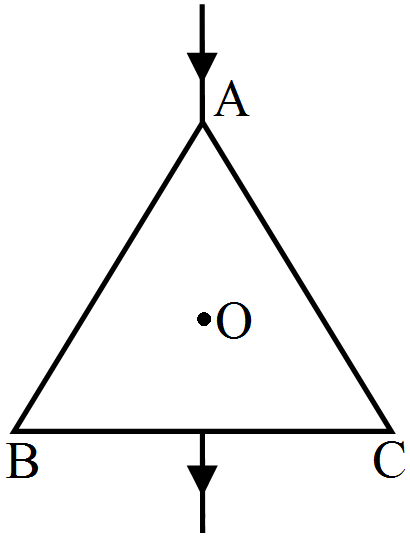
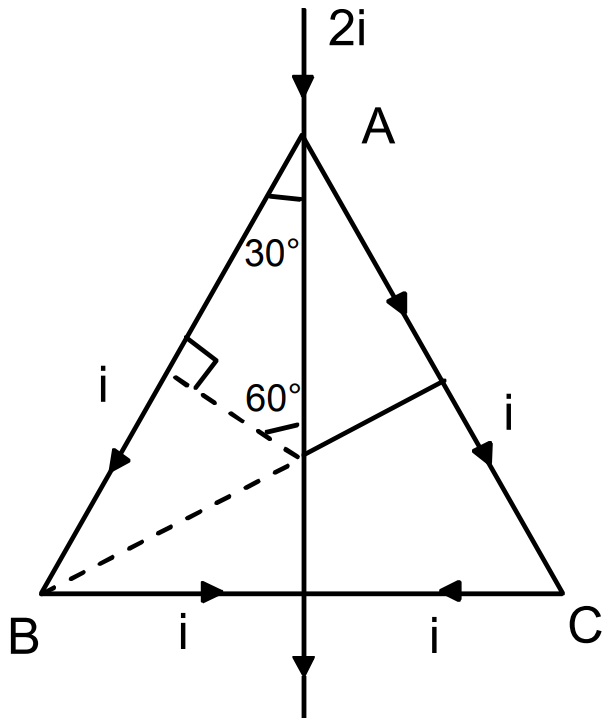
The. wire ABC shown in figure forms an equilateral triangle. Find the magnetic field B at the centre O of the triangle assuming the wire to be uniform.
Answer

For AB B is along $\odot\ \text{B}=\frac{\mu_0\text{i}}{4\pi\text{r}}(\sin60^\circ+\sin60^\circ)$
For AC B $\otimes\ \text{B}=\frac{\mu_0\text{i}}{4\pi\text{r}}(\sin60^\circ+\sin60^\circ)$
For BD B $\odot\ \text{B}=\frac{\mu_0\text{i}}{4\pi\text{r}}(\sin60^\circ)$
For DC $\otimes\ \text{B}=\frac{\mu_0\text{i}}{4\pi\text{r}}(\sin60^\circ)$
$\therefore\ \text{Net}\ \text{B}=0$
View full question & answer
Question 953 Marks
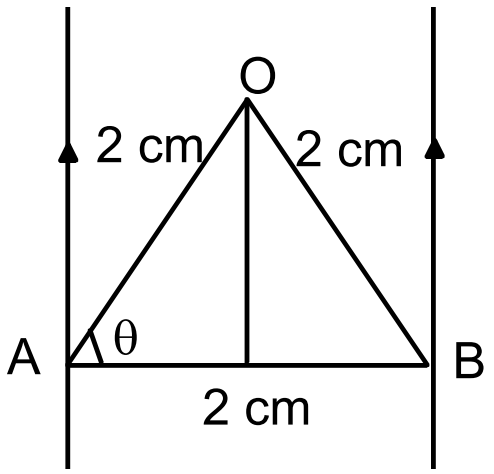
Two parallel wires carry equal currents of 10A along the same direction and are separated by a distance of 2.0cm. Find the magnetic field at a point which is 2.0cm away from each of these wires
Answer

$\cos\theta=\frac{1}{2},$
$\theta=60^\circ\ \&\ \angle\text{AOB}=60^\circ$
$\text{B}=\frac{\mu_0\text{I}}{2\pi\text{r}}=\frac{10^{-7}\times2\times10}{2\times10^{-2}}=10^{-4}\text{T}$
So net is $[(10^{-4})^2]+(10^{-4})^2+2(10^{-8})\cos60^\circ]^\frac{1}{2}$
$=10^{-4}\Big[1+1+2\times\frac{1}{2}\Big]^\frac{1}{2}$
$=10^{-4}\times\sqrt3\text{T}$
$=1.732\times10^{-4}\text{T}$
View full question & answer
Question 963 Marks
An experimenter's diary reads as follows: "A charged particle is projected in a magnetic field of $(7.0\vec{\text{i}}-3.0\vec{\text{j}})\times10^{-3}\text{T}.$ The acceleration of the particle is found to be $(\vec{\text{i}}+7.0\vec{\text{j}})\times10\text{m/s}^{2\text{n}}.$ The number to the left of $\vec{\text{i}}$ in the last expression was not readable. What can this number be?
Answer
$\vec{\text{B}}=(7.0\hat{\text{i}}+3.0 \ \vec{\text{j}})\times10^{-3}\text{T}$
$\vec{\text{a}}=$ acceleration $=(\text{i}+7\text{j})\times10^{-6}\text{m/s}^2$
Let the gap be x.
Since $\vec{\text{B}}$ and $\vec{\text{a}}$ are always perpendicular
$\vec{\text{B}}\times\vec{\text{a}}=0$
$\Rightarrow(7\text{x}\times10^{-3}\times10^{-6}-3\times10^{-3}7\times10^{-6})=0$
$\Rightarrow7\text{x}-21=0$
$\Rightarrow\text{x}=3$
View full question & answer
Question 973 Marks
A current-carrying circular coil of 100 turns and radius 5.0cm produces a magnetic field of $6.0 \times 10^{-5}T$ at its centre. Find the value of the current.
Answer
$\text{B}=\frac{\mu_0\text{i}}{2\text{r}}$
$\text{n} = 100,\ \text{r} = 5\text{cm} = 0.05\text{m}$
$\overrightarrow{\text{B}}=6\times10^{-5}\text{T}$
$\text{i}=\frac{2\text{r}\text{B}}{\text{n}\mu_0}=\frac{2\times0.05\times6\times10^{-5}}{100\times4\pi\times10^{-7}}$
$=\frac{3}{6.28}\times10^{-1}=0.0477\approx48\text{mA}$
View full question & answer
Question 983 Marks
Prove that the force acting on a current-carrying wire, joining two fixed points a and b in a uniform magnetic field, is independent of the shape of the wire.
Answer

For force on a current carrying wire in an uniform magnetic field
We need, l → length of wire
i → Current
B → Magnitude of magnetic field
Since $\overrightarrow{\text{F}}=\text{i}\ell\text{B}$
Now, since the length of the wire is fixed from A to B, so force is independent of the shape of the wire.
View full question & answer
Question 993 Marks
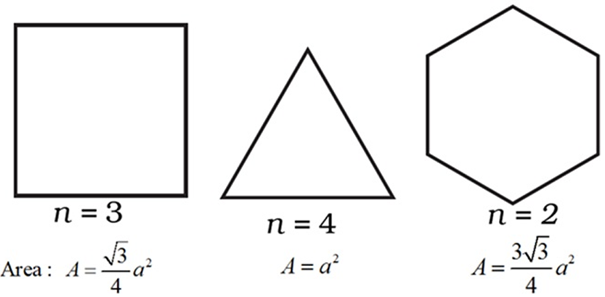
A uniform conducting wire of length 12a and resistance R is wound up as a current carrying coil in the shape of:
  1. An equilateral triangle of side a.
  2. A square of sides a.
  3. A regular hexagon of sides a. The coil is connected to a voltage source $V_0.$ Find the magnetic moment of the coils in each case.
Answer

Current I is same for all
Magnetic moment m = nIA
Here, n is number of turns.
  1. For equilateral triangle:
$\therefore\ \text{m}=\text{nIA}=4\text{I}\bigg(\frac{\sqrt{3}}{4}\text{a}^2\bigg)=\text{Ia}^2\sqrt{3}$
  1. For square of side a
$\therefore\ \text{m}=\text{nIA}=3\text{Ia}^2$
  1. For a resular hexagon of sieds a,
$\therefore\ \text{m}=\text{nIA}=2\times\text{I}\times\bigg(\frac{3\sqrt{3}}{2}\bigg)^2=3\sqrt{3}\text{a}^2\text{I}$

(Note: m is in a geometric series).
View full question & answer
Question 1003 Marks
Write the expression for the force on a charge moving in a magnetic field.Use this expression to define the SI unit of magnetic field.
Answer
Force on a charge (q) moving in a magnetic field B with velocity $\vec{\text{v}}$ making an angle $\theta$ (with the direction of magnetic field $(\vec{\text{B}})$ is given by,$\text{F}_\text{m}=\text{qvB}\sin\theta$
when $\theta=90^\circ\Rightarrow\sin\theta=1,$so

$\text{F}_\text{m}=\text{qvB}$
$\text{or}\ \text{B}=\frac{\text{F}_\text{m}}{\text{q}^\text {v}}$
$\text{If}\ \text{v}=1\ \text{m/s},\text{B}=\frac{\text{F}_\text{m}}{\text{q}}\ \text{newton/ coulomb}$
SI unit of magnetic field is telsa.
Thus, 1 tesla is the magnetic field in which a charged particle moving with velocity 1m/ s perpendicular to velocity experiences a force of 1 newton/ coulomb.
View full question & answer
3 Marks Question - Page 2 - Physics STD 12 Science Questions - Vidyadip