MCQ 11 Mark
Mark $(\checkmark)$ against the correct answer.The sum of all angles of a triangle is:
- A
$90^\circ $
- B
$100^\circ$
- C
$150^\circ$
- ✓
$180^\circ$
AnswerCorrect option: D. $180^\circ$
Sum of angles of triangle is $= 180^\circ $
View full question & answer→MCQ 21 Mark
Mark $(\checkmark)$ against the correct answer.In the given figure, it is given that $AOB$ is a straight line and $4x = 5y.$ What is the value of $x?$
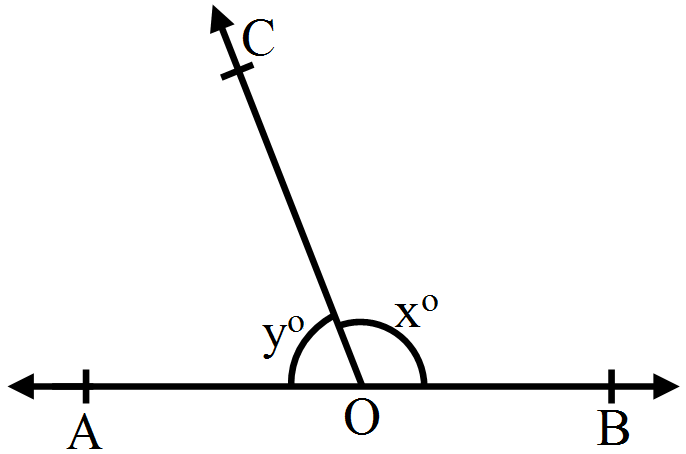
Answer$AOB$ is a straight line
$x + y = 180^\circ $
But $4x = 5y$
$\therefore\frac{5}{4}\text{y}+\text{y}=180^\circ$
$\frac{\text{5y}+\text{4y}}{4}=180^\circ$
$\Rightarrow\frac{9\text{y}}{4}=180^\circ$
$\text{y}=\frac{180^\circ\times4}{9}=80^\circ$
$\therefore\text{x}=\frac{5}{4}\text{y}=\frac{5}{4}\times80=100^\circ$
View full question & answer→MCQ 31 Mark
Mark $(\checkmark)$ against the correct answer.The sum of all angles of a quadrilateral is:
- A
$180^\circ$
- B
$270^\circ$
- ✓
$360^\circ$
- D
$480^\circ$
AnswerCorrect option: C. $360^\circ$
Sum of angles of a quadrilateral $= 360^\circ $
View full question & answer→MCQ 41 Mark
Mark $(\checkmark)$ against the correct answer.The angle of a triangle are $(3x)^\circ , (2x - 7)^\circ $ and $(4x - 11)^\circ .$ Then, $x =?$
AnswerIn $\triangle\text{ABC,}$
$\angle\text{A}+\angle\text{B}+\angle\text{C}=180^\circ$
(Sum of angles of a triangle)
But angles are $(3x)^\circ ,(2x-7)^\circ $ and $(4x-11)^\circ $
$3x + (2x - 7) + (4x - 11)^\circ = 180^\circ $
$\Rightarrow 3x + 2x - 7 + 4x - 11^\circ = 180^\circ $
$\Rightarrow 9x = 180^\circ + 18^\circ = 198^\circ $
$= 22^\circ $
View full question & answer→MCQ 51 Mark
Mark $(\checkmark)$ against the correct answer.Two poles of heights $6\ m$ and $11\ m$ stand vertically on a plane ground. If the distance between their feet is $12\ m,$ what is the distance between their tops$?$
- ✓
$13\ m.$
- B
$14\ m.$
- C
$15\ m.$
- D
$12.8\ m.$
AnswerCorrect option: A. $13\ m.$
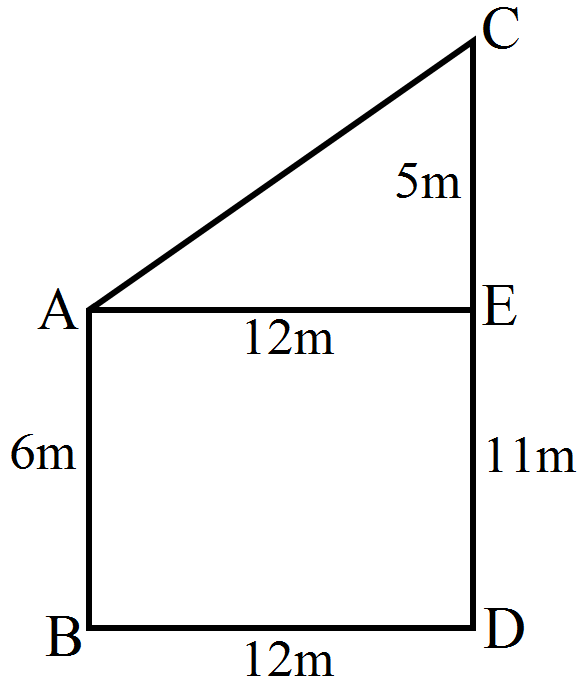
Let $A B$ and $C D$ are two poles such that
$\mathrm{AB}=6 \mathrm{~m}, \mathrm{CD}=11 \mathrm{~m}$
and distance between two poles $B D=12 \mathrm{~m}$
From A , draw $\mathrm{AE} \mid \mathrm{BD}$
$\mathrm{AE}=\mathrm{BD}=12 \mathrm{~m}$
$\mathrm{CE}=\mathrm{CD}-\mathrm{ED}=11-6=5 \mathrm{~m}$
Now in right $\triangle \mathrm{AEC}$
$\mathrm{AC}^2=\mathrm{AE}^2+\mathrm{CE}=(12)^2+(5)^2=144+25=169=(13)^2$
$\mathrm{AC}=13 \mathrm{~m}$
Distance between tops of poles $=13 \mathrm{~m}$
View full question & answer→MCQ 61 Mark
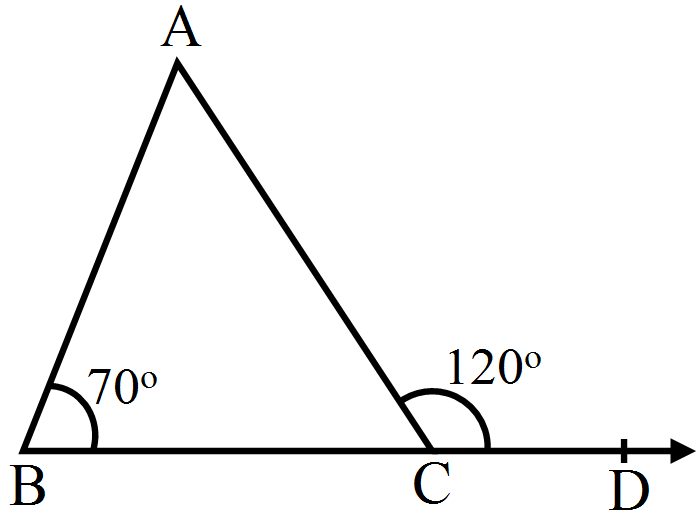
Mark $(\checkmark)$ against the correct answer.In the given figure, side $BC$ of $\triangle\text{ABC}$ is produced to $D$ such that $\angle\text{ABC}=70^\circ$ and $\angle\text{ACD}=130^\circ.$ Then, $\angle\text{BAC}={ ?}$
- A
$60^\circ$
- ✓
$50^\circ$
- C
$70^\circ$
- D
$35^\circ$
AnswerCorrect option: B. $50^\circ$
In $\triangle\text{ABC,}$ side $BC$ is produced to $D$
$\angle\text{ABC}=70^\circ$ and $\angle\text{ACD}=120^\circ$
Ext. $\angle\text{ACD}=\angle\text{BAC}+\angle\text{ABC}$
$\Rightarrow120^\circ=\angle\text{BAC}+70^\circ$
$\Rightarrow\angle\text{BAC}=120^\circ-70^\circ=50^\circ$
View full question & answer→MCQ 71 Mark
Mark $(\checkmark)$ against the correct answer: $\triangle\text{ABC},$ is an isosceles right triangle in which $\angle\text{A}=90^\circ$ and $BC = 6\ cm.$ Then $AB = ?$
- A
$2\sqrt{2}\text{cm}$
- ✓
$3\sqrt{2}\text{cm}$
- C
$4\sqrt{2}\text{cm}$
- D
$2\sqrt{3}\text{cm}$
AnswerCorrect option: B. $3\sqrt{2}\text{cm}$
Here, $A B=A C$
In right angled isoceles triangle:
$\mathrm{BC}^2=\mathrm{AB}^2+\mathrm{AC}^2$
$\Rightarrow \mathrm{BC}^2=2 \mathrm{AB}^2$
$\Rightarrow 36=2 \mathrm{AB}^2$
$\Rightarrow \mathrm{AB}=\frac{36}{2}$
$\Rightarrow \mathrm{AB}=\sqrt{18}$
$\Rightarrow \mathrm{AB}=3 \sqrt{2} \mathrm{~cm}$
View full question & answer→MCQ 81 Mark
Mark $(\checkmark)$ against the correct answer.
The supplement of $45^\circ$ is:
- A
$45^\circ$
- B
$75^\circ$
- ✓
$135^\circ$
- D
$155^\circ$
AnswerCorrect option: C. $135^\circ$
Supplement of $45^\circ $ is $135^\circ $
$135^\circ + 45^\circ = 180^\circ $
View full question & answer→MCQ 91 Mark
Mark $(\checkmark)$ against the correct answer.
An angle is $24^\circ $ more than its complement. The measure of the angle is:
- A
$47^\circ$
- ✓
$57^\circ$
- C
$53^\circ$
- D
$66^\circ$
AnswerCorrect option: B. $57^\circ$
Let angle is $x$
Then its complement angle $= x - 24^\circ $
But $x + x - 24^\circ = 90^\circ $
$\Rightarrow 2x = 90^\circ + 24^\circ = 114^\circ $
$x = 57^\circ $
The required angle is $57^\circ $
View full question & answer→MCQ 101 Mark
Mark $(\checkmark)$ against the correct answer. The complement of $80^\circ $ is:
- A
$100^\circ$
- ✓
$10^\circ$
- C
$20^\circ$
- D
$280^\circ$
AnswerCorrect option: B. $10^\circ$
Complement of $80^\circ $ is $10^\circ $
$10^\circ + 80^\circ = 90^\circ $
View full question & answer→MCQ 111 Mark
Mark $(\checkmark)$ against the correct answer: In a $\triangle\text{ABC},$ If $\angle\text{B}=40^\circ$ and $\angle\text{C}=35^\circ,$ then $\angle\text{A}=?$
- A
$50^\circ$
- B
$55^\circ$
- ✓
$105^\circ$
- D
$150^\circ$
AnswerCorrect option: C. $105^\circ$
$\angle\text{A}+\angle\text{B}+\angle\text{C}=180^\circ$
$\Rightarrow\angle\text{A}=180^\circ-(40^\circ+35^\circ)$
$\Rightarrow\angle\text{A}=105^\circ$
View full question & answer→MCQ 121 Mark
Mark $(\checkmark)$ against the correct answer:
In a $\triangle\text{ABC},$ If $2\angle\text{A}=3\angle\text{B}=6\angle\text{C}$ then $\angle\text{B}=?$
- A
$30^\circ$
- B
$45^\circ$
- ✓
$60^\circ$
- D
$90^\circ$
AnswerCorrect option: C. $60^\circ$
Given:
$2\angle\text{A}=3\angle\text{B}$
$\angle\text{A}=\frac{3}{2}\angle\text{B}\ \dots(\text{i})$
$3\angle\text{B}=6\angle\text{C}$
$=\angle\text{C}=\frac{1}{2}\angle\text{B}\ \dots(\text{ii})$
$\angle\text{A}+\angle\text{B}+\angle\text{C}=180^\circ$
$\Rightarrow\frac{3}{2}\angle\text{B}+\angle\text{B}+\frac{1}{2}\angle\text{B}=180^\circ$
$\Rightarrow(\frac{3}{2}+1+\frac{1}{2})\angle\text{B}=180^\circ$
$\Rightarrow\frac{6}{2}\angle\text{B}=180^\circ$
$\Rightarrow\angle\text{B}=\frac{180^\circ}{3}=60^\circ$
View full question & answer→MCQ 131 Mark
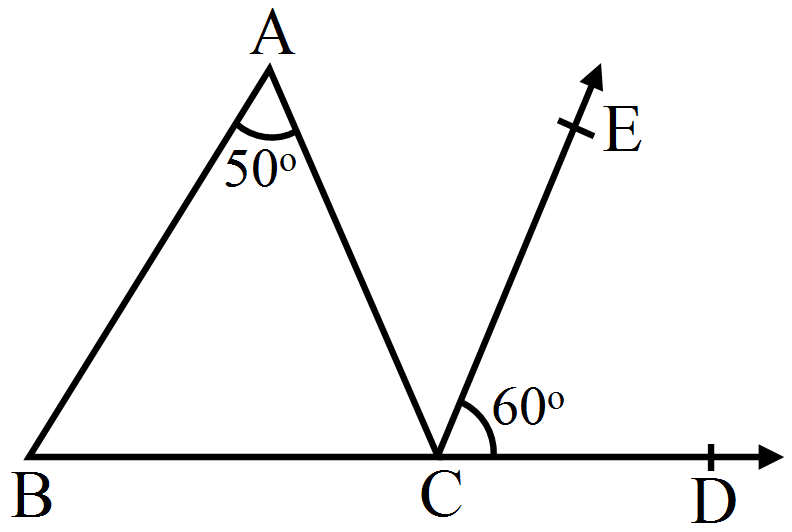
Mark $(\checkmark)$ against the correct answer.In the given figure, $\angle\text{A}=50^\circ,\text{CE}{\parallel}\text{BA}$ and $\angle\text{ECD}=60^\circ.$ Then, $\angle\text{ACB}={}?$
- A
$50^\circ$
- B
$60^\circ$
- ✓
$70^\circ$
- D
$80^\circ$
AnswerCorrect option: C. $70^\circ$
In the figure,
Side $BC$ of $\triangle\text{ABC}$ is produced to $D$
$CE||BA$ is drawn
$\angle\text{A}=50^\circ$ and $\angle\text{ECD}=60^\circ$
$\text{AB}||\text{CE}$
$\angle\text{ABC}=\angle\text{ECD}$ (corresponding angle)$=60^\circ$
But in $\triangle\text{ABC,}$
$\angle\text{A}+\angle\text{B }+\angle\text{ACB }=180^\circ$ (Angles of triangles)
$\Rightarrow50^\circ+60^\circ+\angle\text{ACB}=180^\circ$
$\Rightarrow\angle\text{ACB}=180^\circ-50^\circ-60^\circ=70^\circ$
View full question & answer→MCQ 141 Mark
Mark $(\checkmark)$ against the correct answer.
An angle is one-fifth of its supplement. The measure of the angle is:
- ✓
$30^\circ$
- B
$15^\circ$
- C
$75^\circ$
- D
$150^\circ$
AnswerCorrect option: A. $30^\circ$
The angle is one-fifth of its supplement
Let angle be $x,$ then
$\Rightarrow x + 5x = 180^\circ $
$\Rightarrow 6x = 180^\circ $
$x = 30^\circ $
Angle is $30^\circ $
View full question & answer→MCQ 151 Mark
Mark $(\checkmark)$ against the correct answer.In a $\triangle\text{ABC}$ it is given that $\angle\text{B}=37^\circ$ and $\angle\text{C}=29^\circ$ Then, $\angle\text{A}={}?$
- A
$86^\circ $
- B
$66^\circ$
- ✓
$114^\circ$
- D
$57^\circ$
AnswerCorrect option: C. $114^\circ$
In $\triangle\text{ABC},\angle\text{B}=90^\circ,\angle\text{G}=29^\circ$
But $\angle\text{A}+\angle\text{B}+\angle\text{C}=180^\circ$ (angles of a triangle)
$\Rightarrow\angle\text{A}+37^\circ+29^\circ=180^\circ$
$\Rightarrow\angle\text{A}+66^\circ=180^\circ$
$\Rightarrow\angle\text{A}=180^\circ-66^\circ=114^\circ$
View full question & answer→MCQ 161 Mark
Mark $(\checkmark)$ against the correct answer.In the given figure, $\text{AB}\parallel\text{CD}\parallel\text{EF},\angle\text{ABG}=110^\circ,$, $\angle\text{GCD}=100^\circ$ and $\text{BCG}=\text{x}^\circ$ Then, $\text{x}={}?$
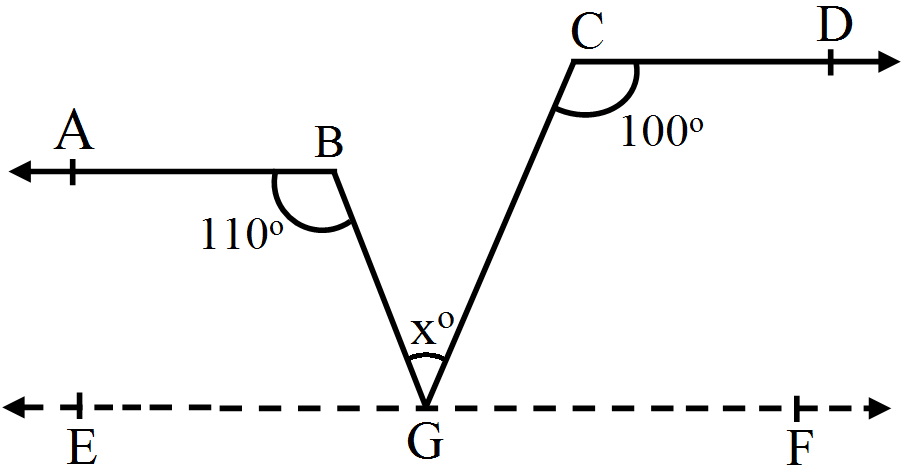
AnswerIn the figure,
$\text{PQ}\parallel\text{RS}\parallel\text{EF}$
$\angle\text{ABG}=110^\circ$ and $\angle\text{GCD}=100^\circ$
$\angle\text{BGC}=\text{x}^\circ$
$\text{AB}\parallel\text{EF}$
$\angle\text{ABG}+\angle\text{BGE}=180^\circ$
$\Rightarrow110^\circ+\angle\text{BGE}=180^\circ$
$\Rightarrow\angle\text{BGE}=180^\circ-110^\circ=70^\circ$
Similarly $\text{CD}\parallel\text{EF}$
$\angle\text{GCD}+\angle\text{CGF}=180^\circ$
$\Rightarrow100^\circ+\angle\text{CGF}=180^\circ$
But $\angle\text{BGE}+\angle\text{BGC}+\angle\text{CGF}=180^\circ$
$\Rightarrow70^\circ+\text{x}+80^\circ=180^\circ$
$\Rightarrow\text{x}=180^\circ-150^\circ=30^\circ$
View full question & answer→MCQ 171 Mark
Mark $(\checkmark)$ against the correct answer.In the given figure, $AOB$ is a straight line, $\angle\text{AOC}=\text{(3x-8)}^\circ$, $\angle\text{COD}=50^\circ$ and $\angle\text{BOD}=\text{(x+10)}^\circ$. The value of $x$ is:
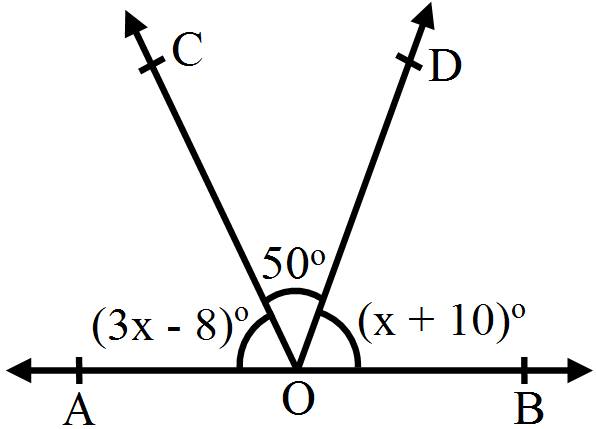
Answer$AOB$ is a straight line
$\angle\text{AOC}+\angle\text{COD+}\angle\text{DOB}=180^\circ$
$\Rightarrow 3x - 8^\circ + 50^\circ + x + 10^\circ = 180^\circ $
$\Rightarrow 4x = 180^\circ + 8^\circ - 50^\circ - 10^\circ $
$\Rightarrow 4x = 128^\circ $
$\Rightarrow x = 32^\circ $
View full question & answer→MCQ 181 Mark
Mark $(\checkmark)$ against the correct answer.In the given figure, rays $OA, OB, OC$ and $OD$ are such that $\angle\text{AOB}=50^\circ,\angle\text{BOC}=90^\circ,\angle\text{COD}=70^\circ$ and $\angle\text{AOD}=\text{x}^\circ.$
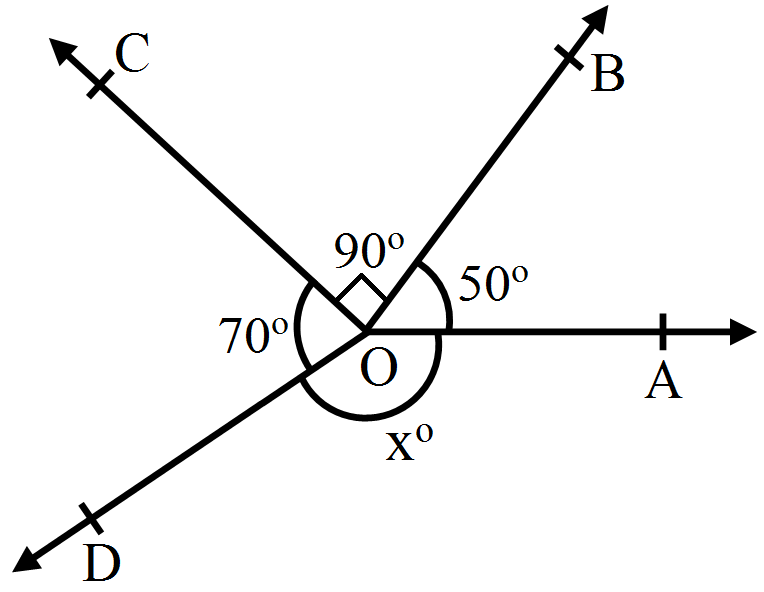
- A
$50^\circ$
- B
$70^\circ$
- ✓
$150^\circ$
- D
$90^\circ$
AnswerCorrect option: C. $150^\circ$
In the figure,
$\angle\text{AOB}=50^\circ,\angle\text{BOC}=90^\circ$
$\angle\text{COD}=70^\circ,\angle\text{AOD}=\text{x}^\circ.$
But $\angle\text{AOB}+\angle\text{BOC}+\angle\text{COD}+\angle\text{DOA}$ (Angles at point)
$\Rightarrow50^\circ+90+^\circ+70+\text{x}=360^\circ$
$\Rightarrow210+\text{x}=360^\circ$
$\Rightarrow\text{x}=360^\circ-210^\circ$
$\Rightarrow\text{x}=150^\circ$
View full question & answer→MCQ 191 Mark
Mark $(\checkmark)$ against the correct answer.
The diagonals of a rhombus:
- A
- B
- C
Always bisect each other at an acute angle.
- ✓
Always bisect each other at right angles.
AnswerCorrect option: D. Always bisect each other at right angles.
The diagonals of a rhombus always bisect each other at right angles.
View full question & answer→MCQ 201 Mark
Mark $(\checkmark)$ against the correct answer.In a $\triangle\text{ABC},$ if $\angle\text{A}+\angle\text{B}=65^\circ$ and $\angle\text{B}+\angle\text{C}=140^\circ.$ Then, $\angle\text{B}={}?$
- ✓
$25^\circ$
- B
$35^\circ$
- C
$40^\circ$
- D
$45^\circ$
AnswerCorrect option: A. $25^\circ$
In $\triangle\text{ABC,}$
$\angle\text{A}=65^\circ-\angle\text{B}$
$\angle\text{B}+\angle\text{C}=140^\circ$
$\angle\text{C}=140^\circ-\angle\text{B}$
But $\angle\text{A}+\angle\text{B}+\angle\text{C}=180^\circ$(Angles of a triangle)
$\Rightarrow65^\circ-\angle\text{B}+140^\circ-\angle\text{B}+\angle\text{B}=180^\circ$
$\Rightarrow205^\circ-\angle\text{B}=180^\circ$
$\Rightarrow\angle\text{B}=205^\circ-180^\circ=25^\circ$
View full question & answer→MCQ 211 Mark
Mark $(\checkmark)$ against the correct answer. An angle is $32^\circ $ less than its supplement. The measure of the angle is:
- A
$37^\circ$
- ✓
$74^\circ$
- C
$148^\circ$
- D
AnswerCorrect option: B. $74^\circ$
Let required angle $= x$
Then its supplement angle $= x + 32$
But $x + x + 32^\circ = 180^\circ $
$\Rightarrow 2x = 180^\circ - 32 = 148^\circ $
$x = 74^\circ $
Required angle $= 74^\circ $
View full question & answer→MCQ 221 Mark
Mark $(\checkmark)$ against the correct answer. In the given figure, $AOB$ is a straight line and the ray $OC$ stands on it. If $\angle\text{BOC}=132^\circ$, then $\angle\text{AOC}=?$
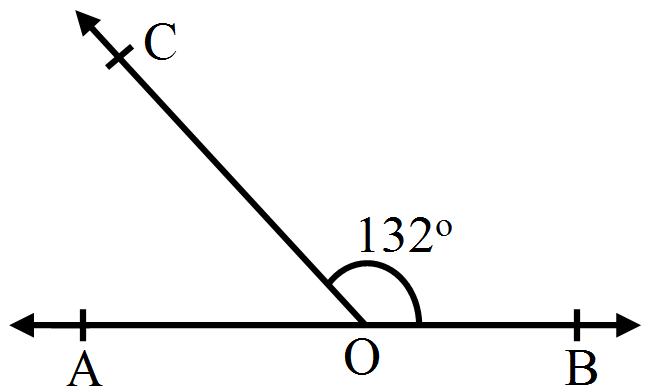
- A
$68^\circ$
- ✓
$48^\circ$
- C
$42^\circ$
- D
AnswerCorrect option: B. $48^\circ$
In the figure $\angle\text{BOC}=132^\circ$
But $\angle\text{AOC}+\angle\text{BOC}=180^\circ$ (Linear pair)
$\Rightarrow\angle\text{AOC}+132^\circ=180^\circ$
$\Rightarrow\angle\text{AOC}=180^\circ-132^\circ=48^\circ$
View full question & answer→MCQ 231 Mark
Mark $(\checkmark)$ against the correct answer.In a $\triangle\text{ABC},$ if $\angle\text{A}-\angle\text{B}=33^\circ$ and $\angle\text{B}-\angle\text{C}=18^\circ.$ Then, $\angle\text{B}={}?$
- A
$35^\circ$
- ✓
$55^\circ$
- C
$45^\circ$
- D
$57^\circ$
AnswerCorrect option: B. $55^\circ$
In $\triangle\text{ABC,}$
$\angle\text{A}-\angle\text{B}=33^\circ$ and $\angle\text{B}-\angle\text{C}=18^\circ.$
$\angle\text{A}=33^\circ+\angle\text{B}$ and $\angle\text{C}=\angle\text{B}-18^\circ$
But $\angle\text{A}+\angle\text{B}+\angle\text{C}=180^\circ$
$\Rightarrow33^\circ+\angle\text{B}+\angle\text{B}+\angle\text{B}-18^\circ=180^\circ$
$\Rightarrow3\angle\text{B}=180^\circ-33^\circ+18^\circ=165^\circ$
$\Rightarrow\angle\text{B}=55^\circ$
View full question & answer→MCQ 241 Mark
Mark $(\checkmark)$ against the correct answer. $\triangle\text{ABC}$ is an isosceles triangle with $\angle\text{C}=90^\circ$ and $AC = 5\ cm.$ then, $AB = ?$
- A
$2.5\ cm.$
- B
$5 \ cm.$
- C
$15\ m.$
- ✓
$5\sqrt2\text{cm.}$
AnswerCorrect option: D. $5\sqrt2\text{cm.}$
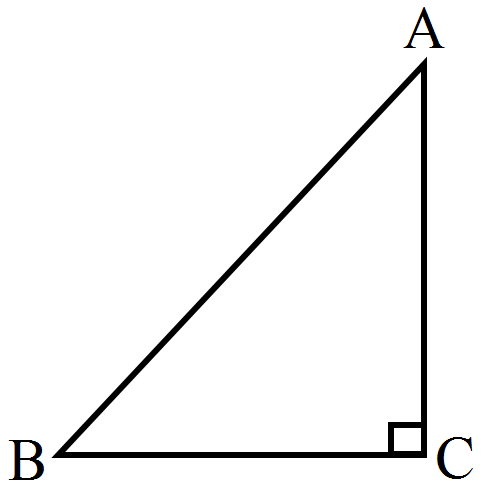
$\triangle \mathrm{ABC}$ is an isosceles triangle
$\angle \mathrm{C}=90^{\circ}$
$\mathrm{AC}=5 \mathrm{~cm}$
$\mathrm{BC}=\mathrm{AC}=5 \mathrm{~cm}$
$\text { In right } \triangle \mathrm{ABC}$
$\mathrm{AB}^2=\mathrm{AC}^2+\mathrm{BC}^2=(5)^2+(5)^2=25+25=50=2 \times 25$
$\mathrm{AB}=\sqrt{2 \times 25}=5 \sqrt{2} \mathrm{~cm}$
View full question & answer→MCQ 251 Mark
Mark $(\checkmark)$ against the correct answer.The angles of a triangle are in the ratio $2 : 3 : 7.$ The measure of the largest angle is:
- A
$84^\circ$
- B
$98^\circ$
- ✓
$105^\circ$
- D
$91^\circ$
AnswerCorrect option: C. $105^\circ$
The ratio of angles of a triangle is $2 : 3 : 7$
But sum of angles of a triangle $= 180^\circ $
$\therefore$ Measure of largest angle $=\frac{180^\circ\times7}{2+3+7}$
$=\frac{180^\circ\times7}{2+3+7}=105^\circ$
View full question & answer→MCQ 261 Mark
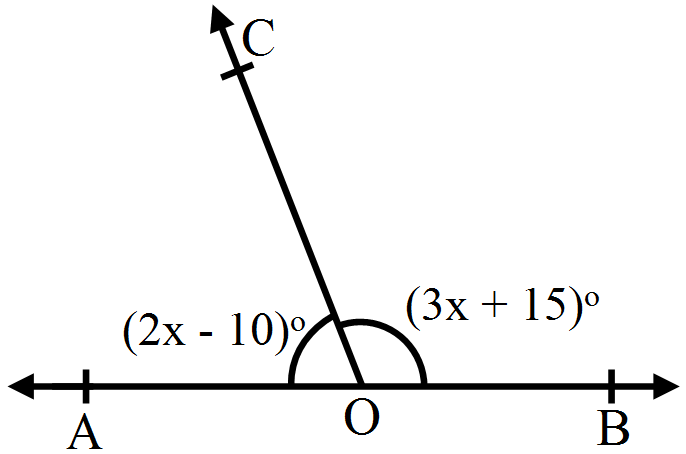
Mark $(\checkmark)$ against the correct answer.In the adjoining figure, what of $x$ will make $AOB$ a straight line$?$
- A
$x = 30$
- ✓
$x = 35$
- C
$x = 25$
- D
$x = 40$
AnswerCorrect option: B. $x = 35$
In the figure,
$AOB$ is a straight line
$\angle\text{AOC}+\angle\text{BOC}=180^\circ$ (Linear pair)
$\Rightarrow2\text{x}-10^\circ+3\text{x}+15^\circ=180^\circ$
$5\text{x}=180^\circ+10^\circ-15^\circ=175^\circ$
$\Rightarrow\text{x}=35^\circ$
$\text{x}=35$
View full question & answer→MCQ 271 Mark
Mark $(\checkmark)$ against the correct answer. Two supplementary angles are in the ratio $3 : 2.$ The smaller angle measures:
- A
$108^\circ$
- B
$81^\circ$
- ✓
$72^\circ$
- D
AnswerCorrect option: C. $72^\circ$
Two supplementary angle are in the ratio $= 3 : 2$
Let first angle $= 3x$
Second angle $= 2x$
But $3x + 2x = 180^\circ $
$\Rightarrow 5x = 180^\circ $
$\Rightarrow x = 36^\circ $
Smaller angle $= 2x = 2 \times 36^\circ = 72^\circ $
View full question & answer→MCQ 281 Mark
Mark $(\checkmark)$ against the correct answer.A ladder is placed in such a way that its foot is $15\ m$ away from the wall and its top reaches, a window $20\ m$ above the ground. The length of the ladder is:
- A
$35\ m.$
- ✓
$25\ m.$
- C
$18\ m.$
- D
$17.5\ m.$
AnswerCorrect option: B. $25\ m.$
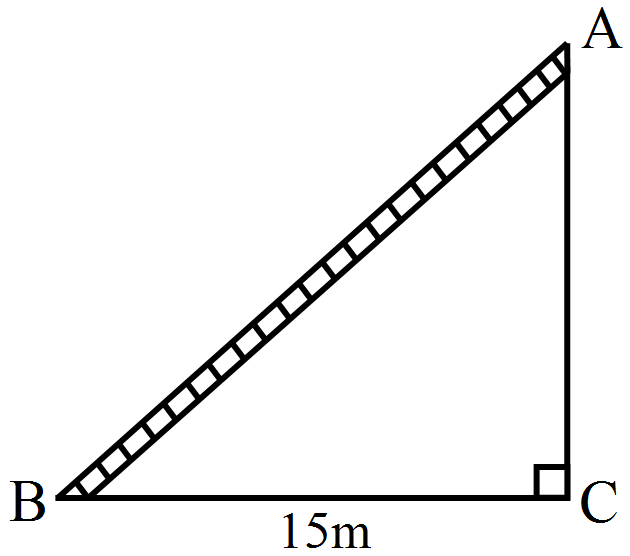
Let $A B$ is a ladder and $A$ is the window
$B C=15 \mathrm{~m}, \mathrm{AC}=20 \mathrm{~m}$
Now in right $\triangle \mathrm{ABC}$
$A B^2=B C^2+A C^2=(15)^2=(20)^2$
$=225+400=625=(25)^2$
$A B=25 m$
View full question & answer→MCQ 291 Mark
Mark $(\checkmark)$ against the correct answer. An angle is its own complement. The measure of the angle is:
- A
$30^\circ$
- ✓
$45^\circ$
- C
$90^\circ$
- D
$60^\circ$
AnswerCorrect option: B. $45^\circ$
The angle is its own complement.
The measure of the angles will be $45^\circ (45^\circ + 45^\circ = 90^\circ )$
View full question & answer→MCQ 301 Mark
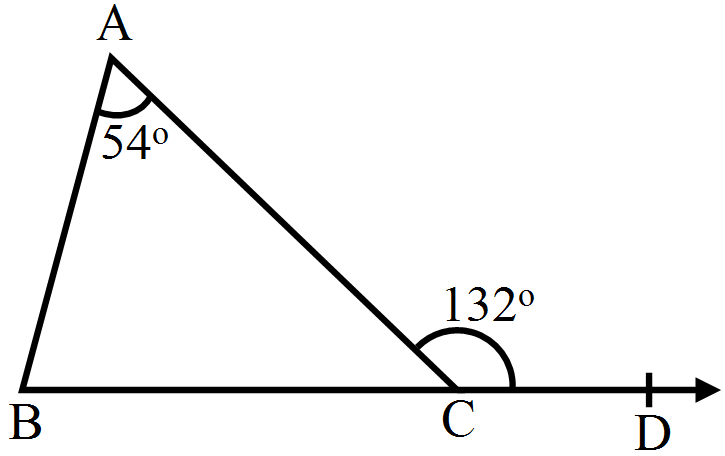
Mark $(\checkmark)$ against the correct answer.In $\triangle\text{ABC},$ side $BC$ has been produced to $D.$ If $\angle\text{ACD}=132^\circ$ and $\angle\text{A}=54^\circ$ then $\angle\text{B}={ ?}$
- A
$48^\circ$
- ✓
$78^\circ$
- C
$68^\circ$
- D
$58^\circ$
AnswerCorrect option: B. $78^\circ$
In $\triangle\text{ABC,}$ side $BC$ is produced to $D$
$\triangle\text{ACD}=132^\circ$ and $\angle\text{A}=54^\circ$
Ext. $\angle\text{ACD}=\angle\text{A}+\angle\text{B}$
$\Rightarrow132^\circ=54^\circ+\angle\text{B}$
$\Rightarrow\angle\text{B}=132^\circ-54^\circ=78^\circ$
View full question & answer→MCQ 311 Mark
Mark $(\checkmark)$ against the correct answer.In the given figure, $AOB$ is a straight line, $\angle\text{AOC}=68^\circ$ and $\angle\text{BOC}=\text{x}^\circ$. The value of $x$ is:
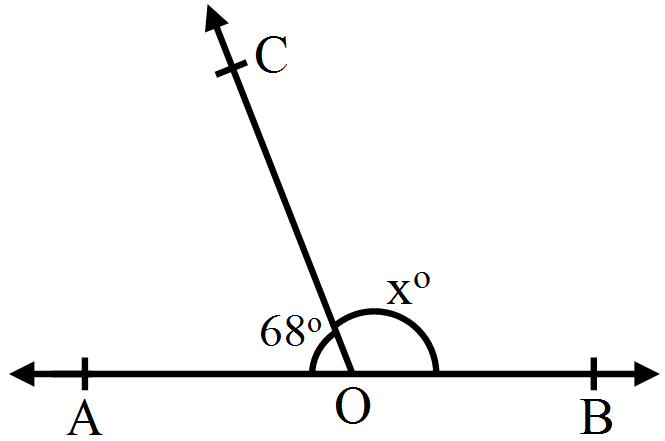
AnswerIn the figure $\angle\text{AOC}=68^\circ$
But $\angle\text{AOC}+\angle\text{BOC}=180^\circ$ (Linear pair)
$68^\circ+\text{x}=180^\circ$
$\Rightarrow\text{x}=180^\circ-68^\circ=112^\circ$
View full question & answer→MCQ 321 Mark
Mark $(\checkmark)$ against the correct answer.In the given figure, $\text{PQ}\parallel\text{RS,}\angle\text{PAB}=60^\circ$ and $\angle\text{ACS}=100^\circ.$ Then $\angle\text{BAC}={}?$
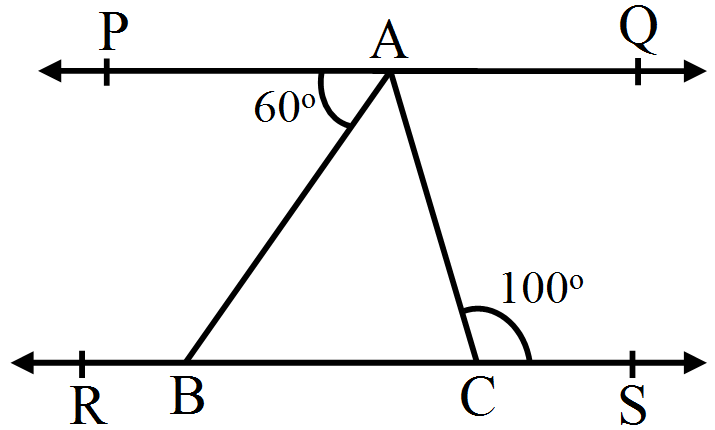
- ✓
$40^\circ$
- B
$60^\circ$
- C
$80^\circ$
- D
$50^\circ$
AnswerCorrect option: A. $40^\circ$
In the given figure,
$\text{PQ}\parallel\text{RS,}$
$\angle\text{PAB}=60^\circ$ and $\angle\text{ACS}=100^\circ$
$\text{PQ}\parallel\text{RS}$
$\angle\text{ABC}=\angle\text{PAB}$ (alternate angles) $60^\circ$
But Ext. $\angle\text{ACS}=\angle\text{BAC}+\angle\text{ABC}$
$\Rightarrow100^\circ\angle\text{BAC}+60^\circ$
$\Rightarrow\angle\text{BAC}=100^\circ-60^\circ=40^\circ$
View full question & answer→MCQ 331 Mark
Mark $(\checkmark)$ against the correct answer: In the given figure, $AOB$ is a straignt line, $\angle\text{AOC}=56^\circ$ and $\angle\text{BOC}=\text{x}^\circ$ The value of $x$ is:
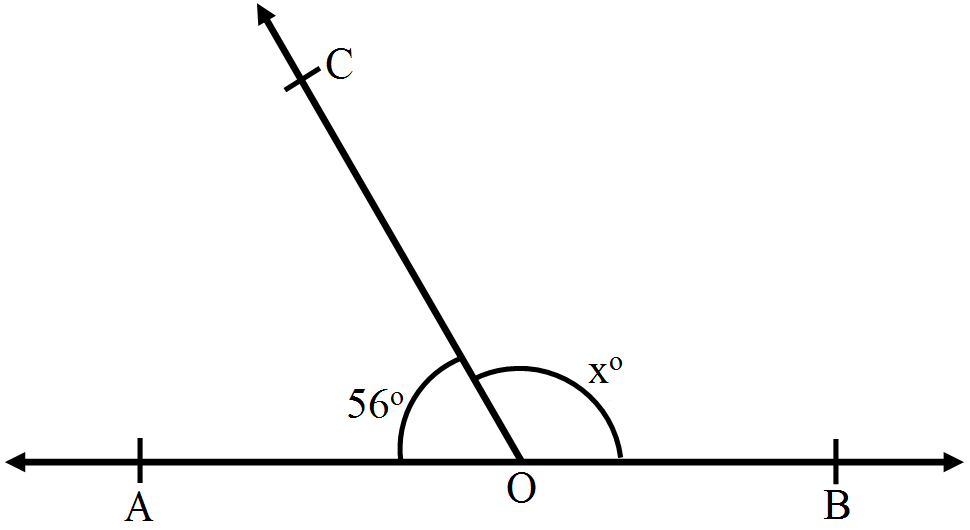
Answer$x^\circ + 56^\circ = 180^\circ ($linear pair$)$
$\Rightarrow x^\circ = 180^\circ - 56^\circ $
$\Rightarrow 124^\circ $
$\therefore x = 124$
View full question & answer→MCQ 341 Mark
Mark $(\checkmark)$ against the correct answer.In $\triangle\text{ABC}$ if $\angle\text{A}=65^\circ$ and $\angle\text{C}=85^\circ$ then $\angle\text{B}={}?$
- A
$25^\circ$
- ✓
$30^\circ$
- C
$35^\circ$
- D
$40^\circ$
AnswerCorrect option: B. $30^\circ$
In $\triangle\text{ABC}$
$\angle\text{A}=65^\circ,\angle\text{C}=85^\circ$
But $\angle\text{A}+\angle\text{B}+\angle\text{C}=180^\circ$ (Angles of a triangle)
$\Rightarrow65^\circ+\angle\text{B}+85^\circ=180^\circ$
$\Rightarrow150^\circ+\angle\text{B}=180^\circ$
$\Rightarrow\angle\text{B}=180^\circ-150^\circ=30^\circ$
View full question & answer→MCQ 351 Mark
Mark $(\checkmark)$ against the correct answer.$\triangle\text{ABC}$ is right angled at $A.$ If $AB = 24\ cm$ and $AC = 7\ cm,$ then $BC = ?$
- A
$31\ cm.$
- B
$17\ cm.$
- ✓
$25\ cm.$
- D
$28\ cm.$
AnswerCorrect option: C. $25\ cm.$
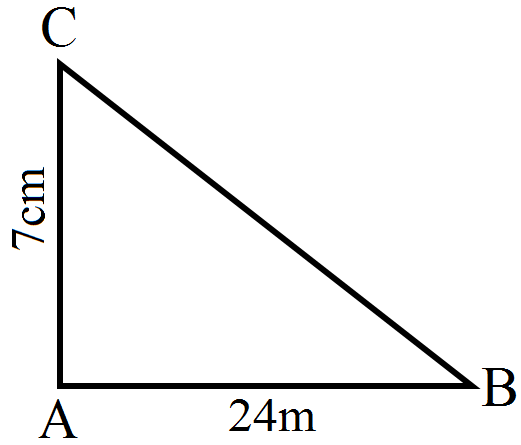
$\triangle \mathrm{ABC}$, is a right angled, $\angle \mathrm{A}=90^{\circ}$
$A B=24 \mathrm{~cm}, A C=7 \mathrm{~cm}$
$\text { but } B C^2=A B^2+A C^2$
$\Rightarrow B C=(24)^2+(7)^2=576+49=625=(25)^2$
$B C=25 \mathrm{~cm}$
View full question & answer→MCQ 361 Mark
Mark $(\checkmark)$ against the correct answer.The sum of any two sides of a triangle is always:
AnswerCorrect option: D. Greater than the $3rd$ side.
Sum of any two sides of a triangle is always greater than the third side.
View full question & answer→MCQ 371 Mark
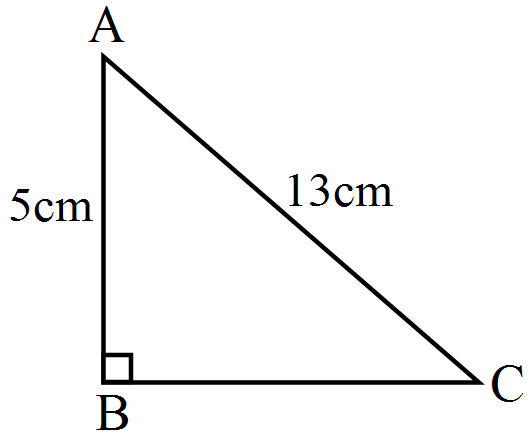
Mark $(\checkmark)$ against the correct answer. In $\triangle\text{ABC},\angle\text{B}=90^\circ, AB = 5\ cm$ and $AC = 13\ cm.$ Then, $BC =?$
- A
$8\ cm.$
- B
$18\ cm.$
- ✓
$12\ cm.$
- D
AnswerCorrect option: C. $12\ cm.$
$\text { In } \triangle \mathrm{ABC}, \angle \mathrm{B}=90^{\circ}$
$\text { But } A C^2=\mathrm{AB}^2+\mathrm{BC}^2 \text { (By Pythagoras Theoram) }$
$\Rightarrow(13)^2=(5)^2+\mathrm{BC}^2$
$\Rightarrow 169=25+\mathrm{BC}^2$
$\Rightarrow B C^2=169-25=144=(12)^2$
$\mathrm{BC}=12 \mathrm{~cm}$
View full question & answer→MCQ 381 Mark
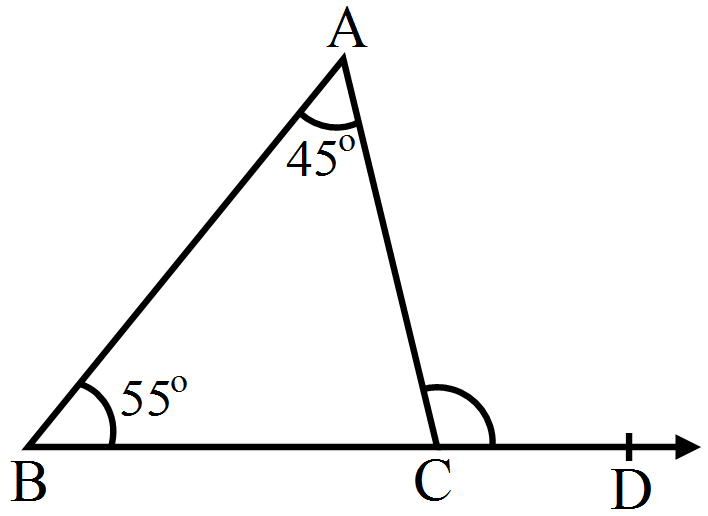
Mark $(\checkmark)$ against the correct answer.In $\triangle\text{ABC},$ side $BC$ has been produced to $D$. If $\angle\text{BAC}=45^\circ$ and $\angle\text{ABC}=55^\circ$ then $\angle\text{ACD}={ ?}$
- A
$80^\circ $
- B
- ✓
$100^\circ $
- D
$110^\circ $
AnswerCorrect option: C. $100^\circ $
In $\triangle\text{ABC,}$ side $BC$ is produced to $D$
$\angle\text{A}=45^\circ,$ $\angle\text{B}=55^\circ,$
Ext. $\angle\text{ACD}=\angle\text{A}+\angle\text{B}$
$45^\circ+55^\circ=100^\circ$
View full question & answer→MCQ 391 Mark
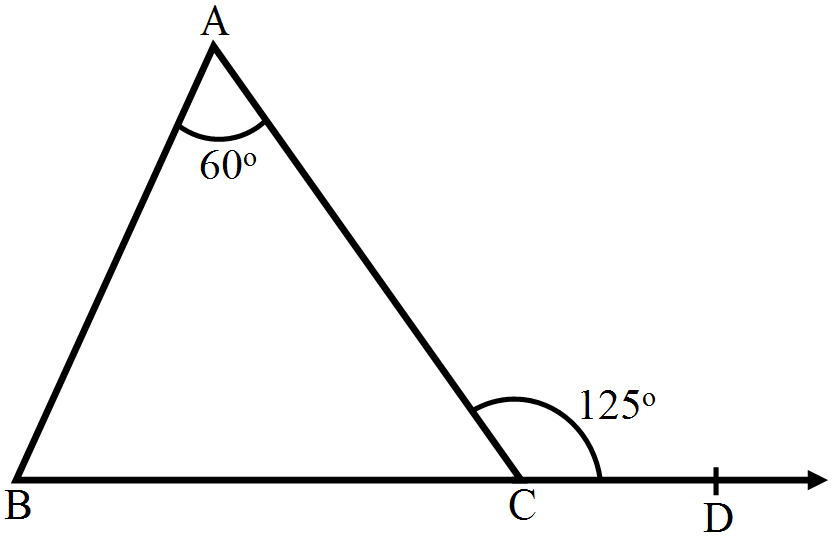
Mark $(\checkmark)$ against the correct answer: In $\triangle\text{ABC,}$ side $BC$ has been produced to $D$ such that $\angle\text{ADC}=125^\circ$ and $\angle\text{BAC}=60^\circ$ Then $\angle\text{ABC}={}?$:
- A
$55^\circ $
- B
$60^\circ$
- ✓
$65^\circ $
- D
$70^\circ $
AnswerCorrect option: C. $65^\circ $
$\angle\text{ACD}=125^\circ$
$\angle\text{ACD}=\angle\text{CAB}+\angle\text{ABC}$
($\because$ the exterior angles are equal to the sum of its interior opposite angles)
$\therefore\angle\text{ABC}=125^\circ-60^\circ=65^\circ$
View full question & answer→MCQ 401 Mark
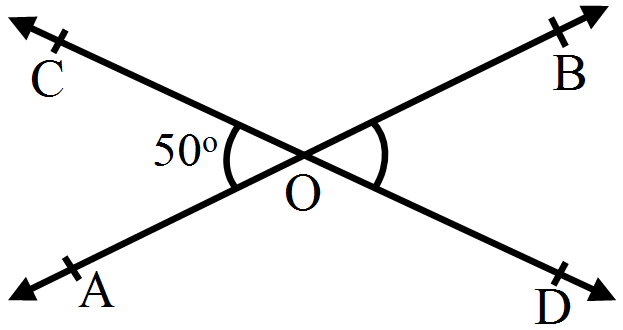
Mark $(\checkmark)$ against the correct answer.In the given figure, two straight lines $AB$ and $CD$ intersect at a point $O$ and $\angle\text{AOC}=50^\circ$. Then, $\angle\text{BOD}={ ?}$
- A
$40^\circ $
- ✓
$50^\circ $
- C
$130^\circ $
- D
$60^\circ $
AnswerCorrect option: B. $50^\circ $
$AB$ and $CD$ intersect each other at $O$ and $\angle\text{AOC}=50^\circ$
$\angle\text{BOD}=\angle\text{AOC}=50^\circ$ (Vertically opposite angles)
View full question & answer→MCQ 411 Mark
Mark $(\checkmark)$ against the correct answer: In a $\triangle\text{ABC},$ If $A - B = 33^\circ $ and $B - C = 18^\circ ,$ then $\angle\text{B}=?$
- A
$35^\circ $
- ✓
$55^\circ $
- C
$45^\circ $
- D
$57^\circ $
AnswerCorrect option: B. $55^\circ $
$\text{In}\ \triangle\text{ABC}:$
$A + B + C = 180^\circ .....(i)$
Given, $A - B = 33^\circ $
$A = 33^\circ + B .....(ii)$
$B - C = 18^\circ $
$C = B + 18^\circ .....(iii)$
Putting the values of $A$ and $B$ in equation $(i):$
$\Rightarrow B + 33^\circ + B + B - 18^\circ = 180^\circ $
$\Rightarrow 3B = 180^\circ - 15$
$\Rightarrow\text{B}=\frac{165^\circ}{3}=55^\circ$
View full question & answer→MCQ 421 Mark
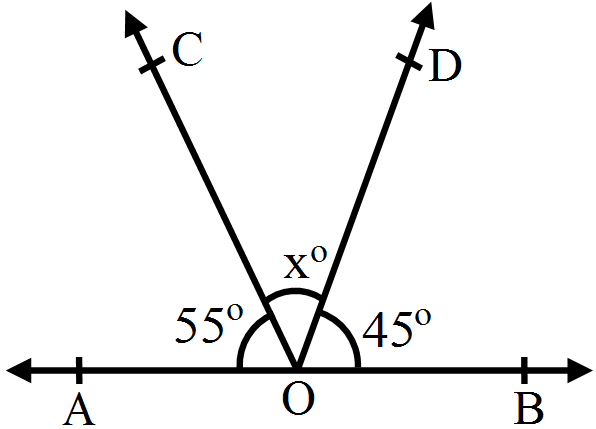
Mark $(\checkmark)$ against the correct answer.In the given figure, what value of $x$ will make $AOB$ a straight line?
- A
$x = 50$
- B
$x = 100$
- C
$x = 60$
- ✓
$x = 80$
AnswerCorrect option: D. $x = 80$
In the figure,
$AOB$ is a straight line
$\angle\text{AOC}+\angle\text{COD}+\angle\text{DOB}=180^\circ$
$\Rightarrow55^\circ+\text{x }+45^\circ=180^\circ$
$\Rightarrow\text{x}+100^\circ=180^\circ$
$\Rightarrow\text{x}=180^\circ-100^\circ=80^\circ$
View full question & answer→MCQ 431 Mark
Mark $(\checkmark)$ against the correct answer: The supplement of $35^\circ $ is:
- A
$55^\circ $
- B
$65^\circ $
- ✓
$145^\circ $
- D
$165^\circ $
AnswerCorrect option: C. $145^\circ $
Supplement of $35^\circ = 180^\circ - 35^\circ = 145^\circ $
View full question & answer→MCQ 441 Mark
$\triangle A B C$ is an isosceles triangle with $\angle C=90^{\circ}$ and $A C=5 cm$. Then, $A B=$ ?
AnswerCorrect option: D. $5 \sqrt{2} cm$
View full question & answer→MCQ 451 Mark
Two poles of heights 6 m and 11 m stand vertically on a plane ground. If the distance between their feet is 12 m, what is the distance between their tops?
MCQ 461 Mark
A ladder is placed in such a way that its foot is 15 m away from the wall and its top reaches a window 20 m above the ground. The length of the ladder is
MCQ 471 Mark
$\triangle A B C$ is right-angled at $A$. If $A B=24 cm$ and $A C=7 cm$, then $B C=$ ?
View full question & answer→MCQ 481 Mark
The angles of a triangle are $(3 x)^{\circ},(2 x-7)^{\circ}$ and $(4 x-11)^{\circ}$. Then, $x=$ ?
View full question & answer→MCQ 491 Mark
In a $\triangle A B C, \angle A-\angle B=33^{\circ}$ and $\angle B-\angle C=18^{\circ}$. Then, $\angle B=$ ?
- A
$35^{\circ}$
- ✓
$55^{\circ}$
- C
$45^{\circ}$
- D
$57^{\circ}$
AnswerCorrect option: B. $55^{\circ}$
View full question & answer→MCQ 501 Mark
In a $\triangle A B C$, if $\angle A+\angle B=65^{\circ}$ and $\angle B+\angle C=140^{\circ}$. Then, $\angle B=$ ?
- ✓
$25^{\circ}$
- B
$35^{\circ}$
- C
$40^{\circ}$
- D
$45^{\circ}$
AnswerCorrect option: A. $25^{\circ}$
View full question & answer→