Question 14 Marks
A quadrilateral $ABCD$ is inscribed in a circle such that $AB$ is a diameter and $\angle\text{ADC}=130^\circ.$ Find $\angle\text{BAC}.$
Answer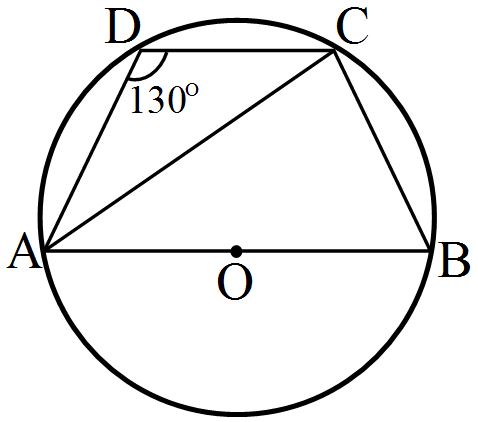
Draw a quadrilateral $ABCD$ inscribed in a circle having centre $O.$ Given,
$\angle\text{ADC}=130^\circ$ Since, ABCD is a quadrilateral. inscribed in a circle,
therefore $ABCD$ becomes a cyclic quadrilateral.
$\because$ Since, the sum of opposite angle of a cyclic quadrilateral is $180^\circ .$
$\therefore\angle\text{ADC}+\angle\text{ABC}=180^\circ$
$\Rightarrow130^\circ+\angle\text{ABC}=180^\circ$
$\Rightarrow\angle\text{ABC}=50^\circ$
Since, $AB$ is a diameter of a circle, then $AB$ subtends an angle to the circle is right angle.
$\therefore\angle\text{ACB}=90^\circ$ In $\triangle\text{ABC},\ \ \angle\text{BAC}+\angle\text{ACB}+\angle\text{ABC}=180^\circ$ [by angle sum property of a triangle]
$\Rightarrow\angle\text{BAC}+90^\circ+50^\circ=180^\circ$
$\Rightarrow\angle\text{BAC}=180^\circ-(90^\circ+50^\circ)$
$=180^\circ-140^\circ=40^\circ$ View full question & answer→Question 24 Marks
$AB$ and $AC$ are two equal chords of a circle. Prove that the bisector of the angle $BAC$ passes through the centre of the circle.
AnswerGiven: $AS$ and $AC$ are two equal chords whose centre is $O.$
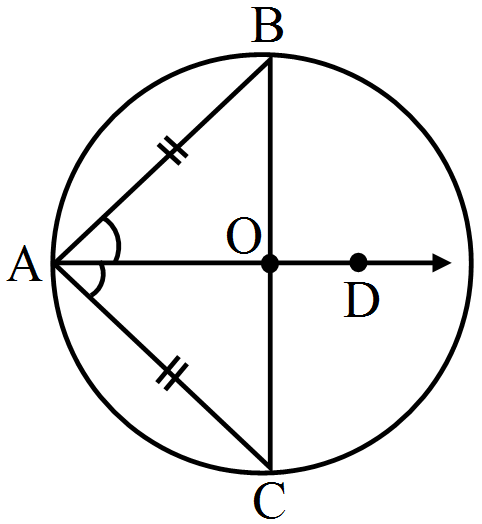
To prove: Centre $O$ lies on the bisector of $\angle\text{BAC}.$
Construction: Join $SC,$ draw bisector $AD$ of $\angle\text{BAC}.$
Proof In $\angle\text{SAM}$ and $\angle\text{CAM}, AS = AC [$given$]$
$\angle\text{BAM} = \angle\text{CAM}$ [given] and $AM = AM [$common side$]$
$\therefore\triangle\text{BAM}=\triangle\text{CAM} [$by $SAS$ congruence rule$]$
$\Rightarrow\text{BM}=\text{CM} [$by $CPCT]$ and
$\angle\text{MBA}=\angle\text{CMA} [$by $CPCT]$
So, $BM = CM$ and $\angle\text{BMA}=\angle\text{CMA}=90^\circ$
So, $AM$ is the perpendicular bisector of the chord $BC.$
Hence, bisector of $\angle\text{BAC}$
i.e., $AM$ passes through the centre $O.$ View full question & answer→Question 34 Marks
$ABCD$ is a parallelogram. $A$ circle through $A, B$ is so drawn that it intersects $AD$ at $P$ and $BC$ at $Q.$ Prove that $P, Q, C$ and $D$ are concyclic.
Answer$ABCD$ is a parallelogram. A circle through $A, B$ is so drawn that intersects $AD$ at $P$ and $BC$ at $Q.$ We have to prove that $P, Q, C$ and $D$ are concyclic. Join $PQ.$
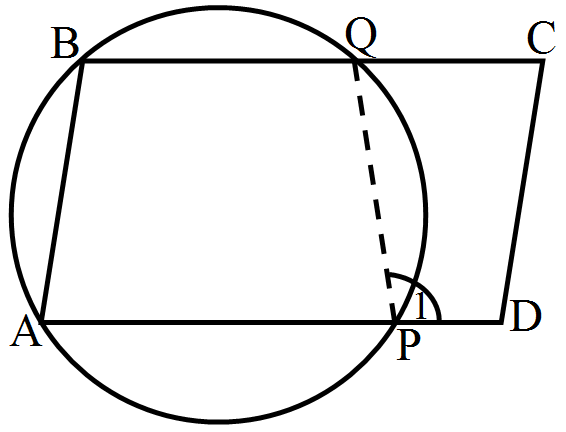
Now, side $AP$ of the cyclic quadrilateral $APQB$ produced to $D.$
$\therefore\ \text{Ext. }\angle1=\text{int.opp. }\angle\text{B}$
$\because BA || CD$ and $BC$ cuts them
$\therefore\angle\text{B}+\angle\text{C}=180^\circ$ [ $\because$ sum of int. $\angle\text{s}$ on the same side of the transversal is $180^\circ ] $ or
$\angle1+\angle\text{C}=180^\circ\ [\therefore\angle1=\angle\text{B}\ (\text{proved})]$
$\therefore PDCQ$ is cyclic quadrilateral.
Hence, the point $P, Q$, and are concyclic. View full question & answer→Question 44 Marks
On a common hypotenuse $AB,$ two right triangles $ACB$ and $ADB$ are situated on opposite sides. Prove that $\angle\text{BAC} = \angle\text{BDC.}$
AnswerIn right triangle $ACB$ and $ADB,$ we have
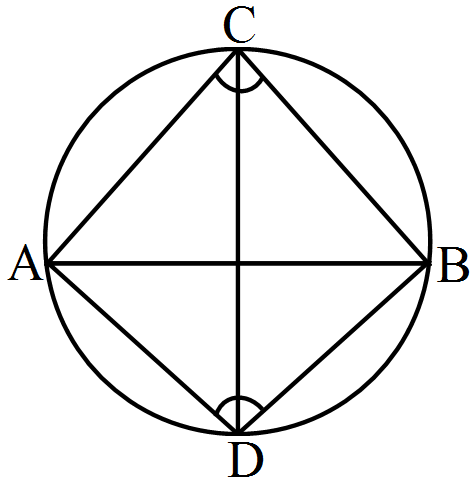
$\angle\text{ACB}=90^\circ$ and $\angle\text{ADB}=90^\circ$
$\therefore\angle\text{ACB}+\angle\text{ADB}=90^\circ+90^\circ=180^\circ$
If the sum of any pair of opposite angle of quadrilateral is $180^\circ ,$ then the quadrilateral is cyclic.
So, $ADBC$ is a cyclic quadrilateral. Join $CD$.
Angle $\angle\text{BAC}$ and $\angle\text{BDC}$ are made by $\widehat{\text{BC}}$ in the same segment $BDAC.$
Hence, $\angle\text{BAC}=\angle\text{BDC}.$
$ [\because$ Angles in the same segment of a circle are equal$]$ View full question & answer→Question 54 Marks
If a line is drawn parallel to the base of an isosceles triangle to intersect its equal sides, prove that the quadrilateral so formed is cyclic.
AnswerGiven: $\triangle\text{ABC}$ is an isosceles triangle such that $AB = AC$ and also $DE || SC.$
To prove: Quadrilateral $BCDE$ is a cyclic quadrilateral.
Construction: Draw a circle passes through the points $B, C, D$ and $E.$
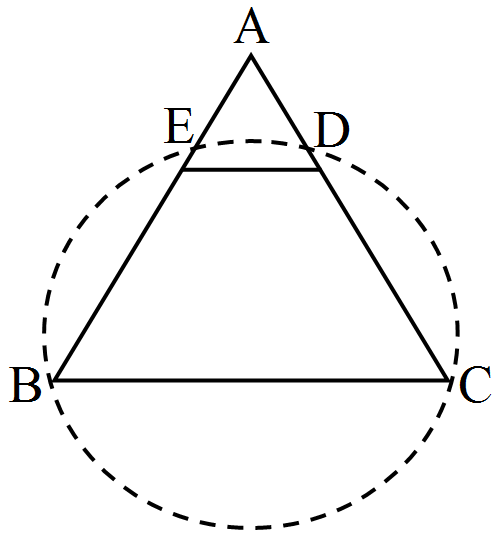
Proof: In $\triangle\text{ABC},\ \ \text{AB}=\text{AC} [$equal sides of an isosceles triangle$]$
$\Rightarrow\angle\text{ACB}=\angle\text{ABC}\ \ ...(\text{i})$ [angles opposite to the equal sides are equal]
Since, $DE || BC$
$\Rightarrow\angle\text{ADE}=\angle\text{ACB} [$corresponding angles$] ....(ii)$
On adding both sides by $\angle\text{EDC}$ in Eq. $(ii)$, we get,
$\angle\text{ADE}+\angle\text{EDC}=\angle\text{ACB}+\angle\text{EDC}$
$\Rightarrow180^\circ=\angle\text{ACB}+\angle\text{EDC}$ [$\angle\text{ADE}$ and $\angle\text{EDC}$ from linear pair aniom]
$\Rightarrow\angle\text{EDC}+\angle\text{ABC}=180^\circ$ [from Eq. (i)]
Hence, $BCDE$ is cyclic quadrilateral, because sum opposite angles is $180^\circ .$ View full question & answer→Question 64 Marks
In Fig. $O$ is the centre of the circle, $BD = OD$ and $\text{CD}\bot\text{AB}.$ Find $\angle\text{CAB}.$ 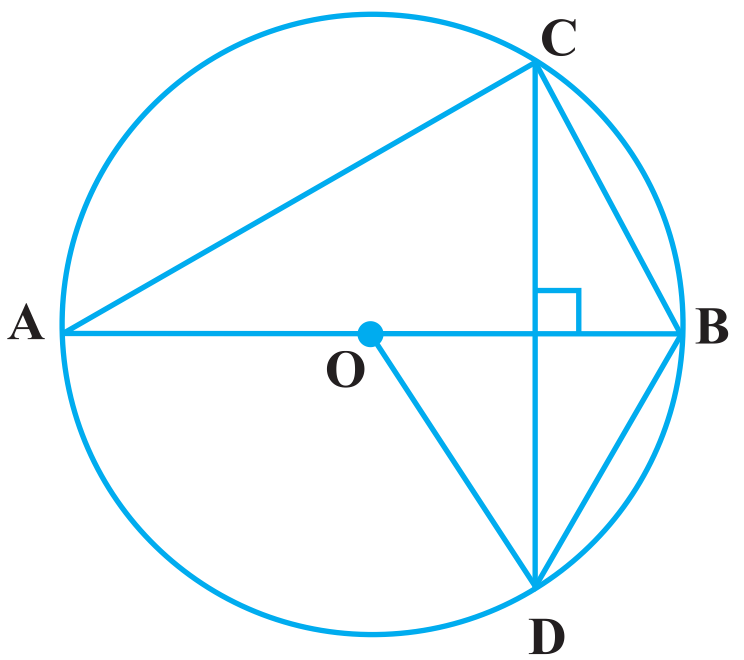
AnswerGiven, in the figure $\text{BD}=\text{OD},\ \text{CD}\bot\text{AB}$
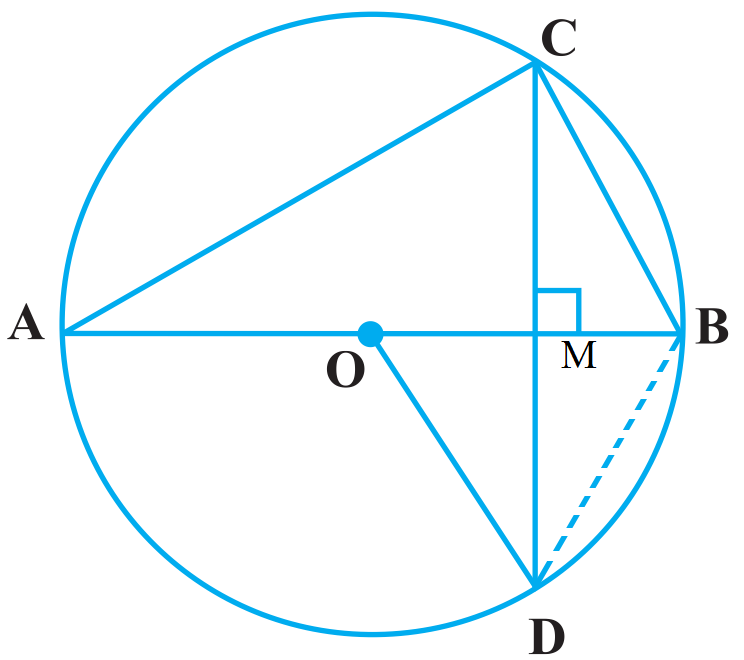
In $\triangle\text{OBD},\ \ \ \text{BD}=\text{OD}$ [given]
$\text{OD}=\text{OB}$ [both are the radius of circle]
$\therefore\text{OB}=\text{OD}=\text{BD}$ Thus,
$\triangle\text{ODB}$ is an equilateral triangle.
$\therefore\angle\text{BOD}=\angle\text{OBD}=\angle\text{ODB}=60^\circ$
In $\triangle\text{MBC}$ and $\triangle\text{MBD},\ \ \text{MB}=\text{MB}$ [common side]
$\angle\text{CMB}=\angle\text{BMD}=90^\circ$ and $CM = MD [$in a circle, any perpendicular draw on a chord also bisects the chord$]$
$\therefore\triangle\text{MBC}=\triangle\text{MBD} [$by $SAS$ congruence rile$]$
$\therefore\angle\text{MBC}=\angle\text{MBD}$ $[$by $CPCT]$
$\Rightarrow\angle\text{MBC}=\angle\text{OBD}=60^\circ\ \ \ [\because\angle\text{OBD}=60^\circ]$
Since, $AB$ is a diameter of the circle,
$\therefore\angle\text{ACB}=90^\circ$
In $\triangle\text{ACB},\ \ \ \angle\text{CAB}+\angle\text{CBA}+\angle\text{ACB}=180^\circ$ [by angle sum property of triangle]
$\Rightarrow\angle\text{CAB}+60^\circ+90^\circ=180^\circ$
$\Rightarrow\angle\text{CAB}=180^\circ-(60^\circ+90^\circ)=30^\circ$ View full question & answer→Question 74 Marks
$ABCD$ is such a quadrilateral that $A$ is the centre of the circle passing through $B, C$ and $D.$ Prove that $\angle\text{CBD}+\angle\text{CDB}=\frac{1}{2}\angle\text{BAD}$
AnswerGiven: In a circle, $ABCD$ is a quadrilateral having centre $A.$
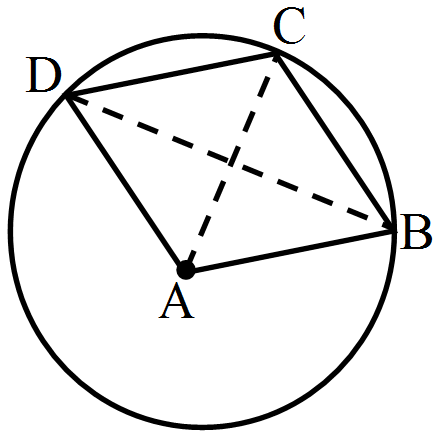
To prove: $\angle\text{CBD}+\angle\text{CDB}=\frac{1}{2}\angle\text{BAD}$
Construction: Join $AC$ and $BD.$
Proof: Since arc $DC$ subtends $\angle\text{DAC}$ at the centre and $\angle\text{CBD}$ at a point $B$ in the remaining part of the circle.
$\therefore\angle\text{DAC}=2\angle\text{CBD}\ ...(\text{i})$
In a circle, the angle subtended by arc at the centre is twice the angle subtended by it at the remaining part of the circle.
Similarly, arc $BC$ subtends $\angle\text{CAB}$ at the centre and $\angle\text{CDB}$ at a point $D$ in the remaining part of the circle.
$\therefore\angle\text{CAB}=2\angle\text{CDB}\ ... (\text{ii})$
In a circle, the angle subtended by an arc at the centre is twice the angle subtended by it at the remaining part of the circle.
On adding Eqs. $(i)$ and $(ii),$ we get
$\angle\text{DAC}+\angle\text{CAB}=2\angle\text{CBD}+2\angle\text{CDB}$ $\Rightarrow\angle\text{BAD}=2(\angle\text{CBD}+\angle\text{CDB})$
$\Rightarrow\angle\text{CDB}+\angle\text{CBD}=\frac{1}{2}\angle\text{BAD}$
Hence, proved. View full question & answer→Question 84 Marks
In Fig. $O$ is the centre of the circle, $\angle\text{BCO}=30^\circ.$ Find $x$ and $y.$
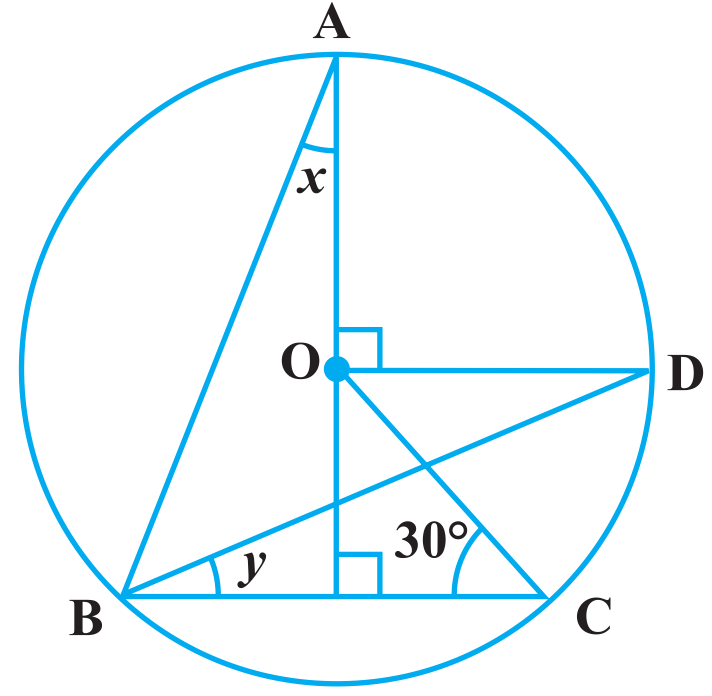
AnswerGiven, Ois the centre of the circle and $\angle\text{BCO}=30^\circ.$ In the given figure join $OB$ and $AC.$ 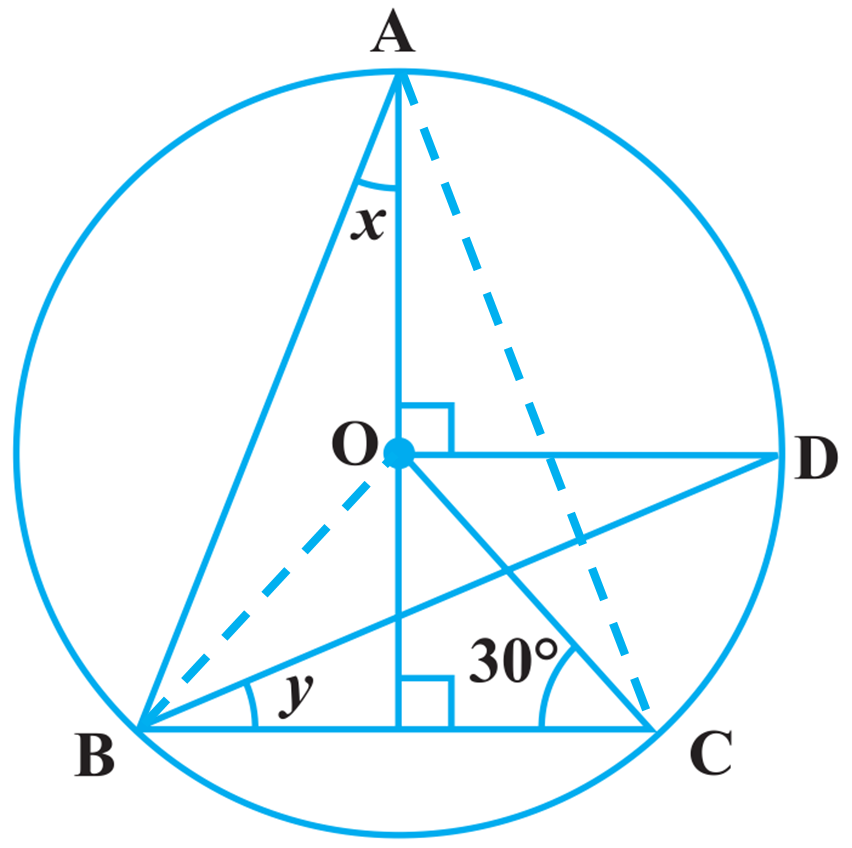
In $\triangle\text{BOC},\ \ \ \text{CO}=\text{BO}$ [both are the radius of circle]
$\therefore\angle\text{OBC}=\angle\text{OCB}=30^\circ$ [angles opposite to equal sides are equal]
$\therefore\angle\text{BOC}=180^\circ-(\angle\text{OBC}+\angle\text{OCE})$ [by angle sum property of a triangle]
$=180^\circ-(30^\circ+30^\circ)=120^\circ$
$\angle\text{BOC}=2\angle\text{BAC}$
We know that, in a circle, the angle subtended by an arc at the centre is twice the angle subtended by it at the remaining part of the circle.
$\therefore\angle\text{BAC}=\frac{120^\circ}{2}=60^\circ$
Also, $\angle\text{BAE}=\angle\text{CAE}=30^\circ [AE$ is an angle bisector of angle $A]$ $\Rightarrow\angle\text{BAE}=\text{x}=30^\circ$ In $\triangle\text{ABE},\ \ \ \angle\text{BAE}+\angle\text{EBA}+\angle\text{AEB}=180^\circ$ [by angle sum property of triangle] $\Rightarrow30^\circ+\angle\text{EBA}+90^\circ=180^\circ$
$\therefore\angle\text{EBA}=180^\circ-(90^\circ+30^\circ)=180^\circ-120^\circ=60^\circ$
Now, $\angle\text{EBA}=60^\circ$
$\Rightarrow\angle\text{ABD}+\text{y}=60^\circ$
$\Rightarrow\frac{1}{2}\times\angle\text{AOD}+\text{y}=60^\circ$ [in a circle, the angle subtended by an arc at the centre is twice the angle subtended by it at the remaining part of the circle]
$\Rightarrow\frac{90^\circ}{2}+\text{y}=60^\circ$
$[\because\angle\text{AOD}=90^\circ,\text{ given}]$
$\Rightarrow45^\circ+\text{y}=60^\circ$
$\Rightarrow\text{y}=60^\circ-45^\circ$
$\therefore\text{y}=15^\circ$ View full question & answer→Question 94 Marks
In Fig. $\angle\text{ADC}=130^\circ$ and chord $BC =$ chord $BE.$ Find $\angle\text{CBE}.$
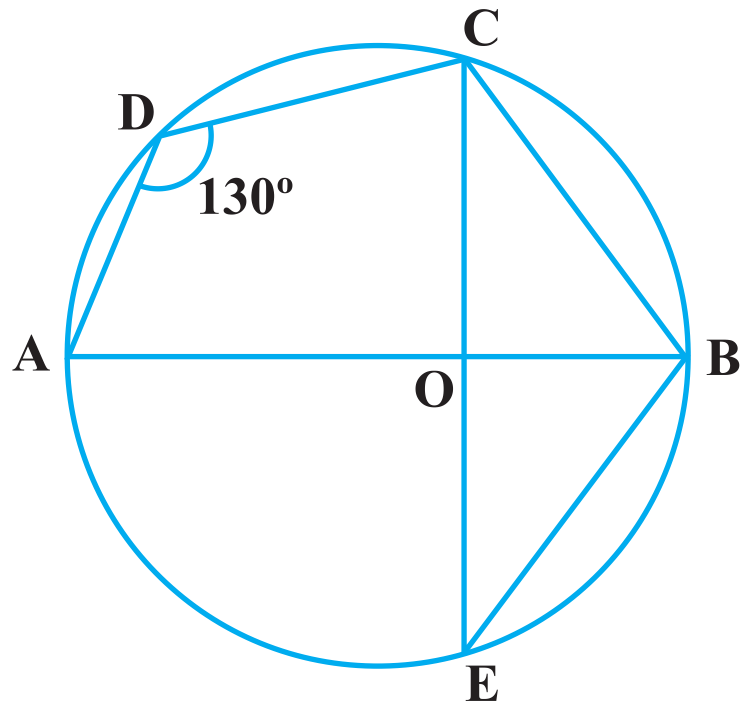
AnswerIn the given figure, we have $\angle\text{ADC}=130^\circ$ and chord $BC = BE.$
We have to find $\angle\text{CBE}.$
Since $ABCD$ is a cyclic quadrilateral and the opposite angles of a cyclic quadrilateral are supplementary. $\therefore\angle\text{D}+\angle\text{ABC}=180^\circ$
$\Rightarrow130^\circ+\angle\text{ABC}=180^\circ$
$\Rightarrow\angle\text{ABC}=180^\circ-130^\circ=50^\circ$
$\Rightarrow\angle\text{OBC}=50^\circ....(1)$ In
$\triangle\text{OBC}$ and $\triangle\text{OBE},$
we have $BC = BE [$Given$] OC = OE [$Radii of same circle$] OB = OB [$Common side$]$
$\therefore\triangle\text{OBC}\cong\triangle\text{OBE} [$By $SSS$ cong. Rule$]$
$\angle\text{OBC}+\angle\text{OBE}=50^\circ$
$\big[$By $C.P.C.T.$ and by $(1) \angle\text{OBC}=50^\circ\big]$
$\therefore\angle\text{OBC}+\angle\text{OBE}=50^\circ+50^\circ=100^\circ$
Hence, $\angle\text{CBE}=100^\circ$
View full question & answer→Question 104 Marks
$A, B$ and $C$ are three points on a circle. Prove that the perpendicular bisectors of $AB, BC$ and $CA$ are concurrent.
AnswerGiven A circle passing through three points $A, B$ and $C.$
Construction: Draw perpendicular bisectors of $AB$ and $AC$ and they meet at a point $O$. Join $OA, OB$ and $OC.$
To prove: Perpendicular bisector of $BC,$ also passes through $O$ i.e., $LO, ON$ and $OM$ are concurrent.
Proof: In $\triangle\text{QEA}$ and $\triangle\text{OEB},$
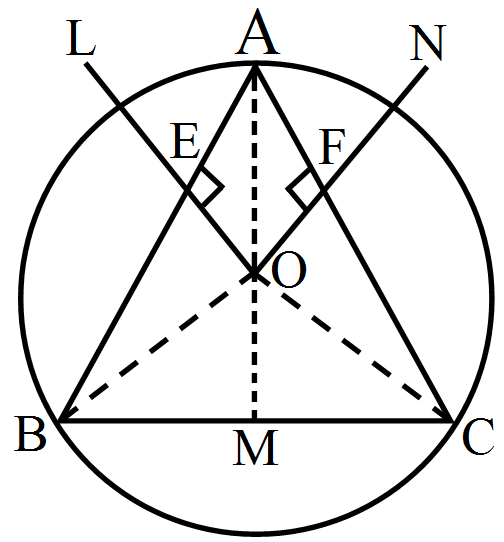
$AE = BE [OL$ is the perpendicular bisector of $AB]$
$\angle\text{AEO}=\angle\text{BEO}\ \ \ [\text{each } 90^\circ]$ and
$\text{OE}=\text{OE}$ [common side]
$\therefore\triangle\text{OEA}\cong\text{OEB} [$by $SAS$ congruence rule$]$
$\therefore\text{OA}=\text{OB}$ Similarly
$\triangle\text{OFA}=\triangle\text{OFC} [$by $SAS$ congruence rule$]$
$\therefore\text{OA}=\text{OC} [$by $CPCT]$
$\therefore\text{OA}=\text{OB}=\text{OC}=\text{r}$ [say]
Now, we draw a perpendicular from $O$ to the $BC$ and join them.
In $\triangle\text{OMB}$ and $\triangle\text{OMC},$
$\text{OB}=\text{OC}$ [proved above] $\text{OM}=\text{OM} [$common side$]$ and
$\angle\text{OMB}=\angle\text{OMC} [$each $90^\circ ]$
$\therefore\triangle\text{OMB}\equiv\triangle\text{OMC} [$by $RHS$ congruence rule$]$
$\Rightarrow\text{BM}=\text{MC} [$by $CPCT]$
Hence, $OM$ is the perpendicular bisector of $BC.$
Hence, $OL, ON$ and $OM$ are concurret. View full question & answer→Question 114 Marks
Two equal chords $AB$ and $CD$ of a circle when produced intersect at a point $P.$ Prove that $PB = PD$
AnswerGiven: Two equal chords $AB$ and $CD$ of a circle intersecting at a point $P.$
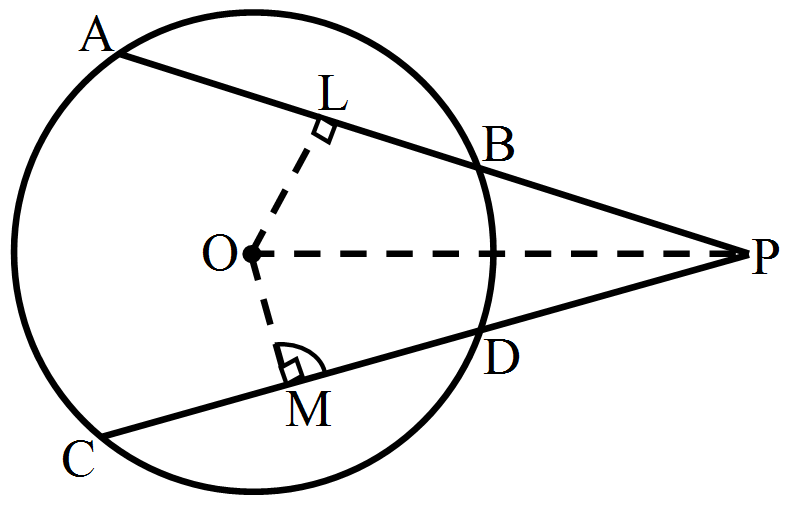
To prove: $PB = PD$
Construction: Join $OP,$ draw $\text{OL}\bot\text{AB}$ and $\text{OM}\bot\text{CD}$
Proof: We have, $AB = CD$
$\Rightarrow\text{OL}=\text{OM} [$equal chords are equidistant from the centre$]$ In
$\triangle\text{OLP}$ and $\triangle\text{OMP}\ \ \text{OL}=\text{OM}$ [proved above]
$\angle\text{OLP}=\angle\text{OMP}[ $each $90^\circ ]$ and $OP = OP [$common side$]$
$\therefore\triangle\text{OLP}=\triangle\text{OMP} [$by $RHS$ congruence rule$]$
$\Rightarrow\text{LP}=\text{MP} [$by $CPCT] ...(i)$
Now, $AB = CD$
$\Rightarrow\frac{1}{2}(\text{AB})=\frac{1}{2}(\text{CD}) [$dividing both sides by $2]$
$\Rightarrow\text{BL}=\text{DM}\ \ ...(\text{ii}) [$perpendicular drawn from centre to the circle bisects the chord i.e., $AL = LB$ and $CM = MD]$
On subtracting Eq. $(ii)$ from Eq. $(ii)$
we get $LP - BL = MP - DM $
$\Rightarrow PB = PD$ Hence proved. View full question & answer→Question 124 Marks
Prove that angle bisector of any angle of a triangle and perpendicular bisector of the opposite side if intersect, they will intersect on the circumcircle of the triangle.
AnswerGiven: $\triangle\text{ABC}$ and l is perpendicular bisector of $BC.$
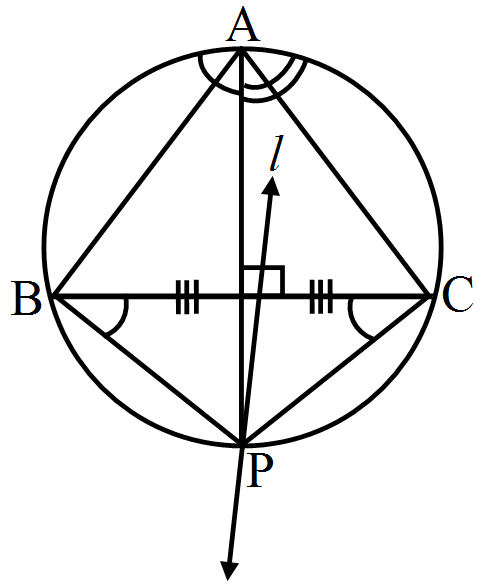
To prove: Angles bisector of $\angle\text{A}$ and perpendicular bisector of $BC$ intersect on the circumcircle of $\triangle\text{ABC}.$
Proof: Let the angle bisector of $\angle\text{A}$ intersect circumcircle of $\triangle\text{ABC}$ at $P.$ Join $BP$ and $CP$.
$\Rightarrow\angle\text{BAP}=\angle\text{BCP}$ [Angles in the same segment are equal]
$\Rightarrow\angle\text{BAP}=\angle\text{BCP}=\frac{1}{2}\angle\text{A}\ ...(1)$ [AP is bisector of $\angle\text{A}$]
Similary, we have
$\angle\text{PAC}=\angle\text{PBC}=\frac{1}{2}\angle\text{A}\ \ ...(2)$
From equation $(1)$ and $(2),$ we have
$\angle\text{BCP}=\angle\text{PBC}$
$\Rightarrow\text{BP}=\text{CP}$
[$\because$ If the angles subtended by two chords of a circle at the centre are equal, the chords are equal]
$⇒ P$ is on perpendicular bisector of $BC.$
Hence, angle bisector of $\angle\text{A}$ and perpendicular bisector of $BC$ intersect on the circumcircle of $\triangle\text{ABC}.$ View full question & answer→Question 134 Marks
If non-parallel sides of a trapezium are equal, prove that it is cyclic.
AnswerGiven: $ABCD$ is a trapezium whose non-parallel sides $AD$ and $BC$ are equal.
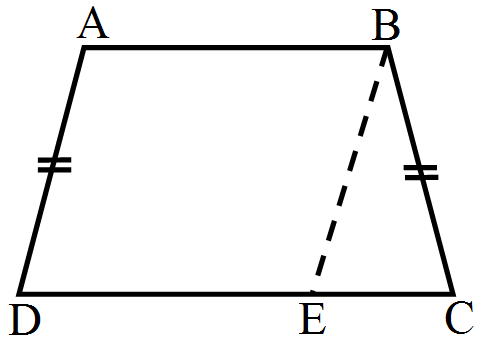
To prove: Trapezium $ABCD$ is a cyclic Join $BE,$ where $BE || AD.$
Proof: Since, $AB || DE$ and $AD || BE$ Since, the quadrilateral $ABCD$ is a parallelogram, $\therefore\angle\text{BAD}=\angle\text{BED}\ \ ...(\text{i})$ [opposite angles of a parallelogram are equal] and $AD = BE ...(ii)$ [opposite sides of a parallelogram are equal] But,
$AD = BC [$given$] ...(iii)$ From Eqs. $(ii)$ and $(iii),$
$BC = BE$
$\Rightarrow\angle\text{BEC}=\angle\text{BCE}\ \ ...\text{(iv)}$ [angle opposite to equal sides are equal]
Also, $\angle\text{BEC}+\angle\text{BED}=180^\circ[$ linear pair axiom$]$
$\therefore\angle\text{BCE}+\angle\text{BAD}=180^\circ [$from Eqs. $(i)$ and $(iv)]$
If sum of opposite angles of a quadrilateral is $180^\circ $, then quadrilateral is cyclic.
Hence, trapezium $ABCD$ is a cyclic. Hence proved. View full question & answer→Question 144 Marks
If a pair of opposite sides of a cyclic quadrilateral are equal, prove that its diagonals are also equal.
AnswerGiven: Let $ABCD$ be a cyclic quadrilateral and $AD = BC.$
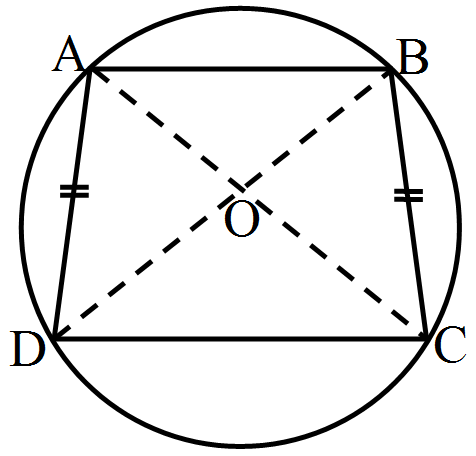
Join $AC$ and $BD$.
To prove: $AC = BD$
Proof: In $\triangle\text{AOD}$ and $\triangle\text{BOC},$
$\triangle\text{OAD} = \angle\text{OBC}$ and $\angle\text{ODA} = \angle\text{OCB}$ [since, same segments subtends equal angle to the circle]
$AB = BC [$given$]$
$\triangle\text{AOD} = \triangle\text{BOC} [$by $ASA$ congruence rule$]$
Adding is $DOC$ on both sides, we get,
$\triangle\text{AOD}+ \triangle\text{DOC} \cong \triangle\text{BOC} + \triangle\text{DOC}$
$\Rightarrow \triangle\text{ADC} \cong \triangle\text{BCD}$
$AC = BD [$by $CPCT]$ View full question & answer→Question 154 Marks
If $ABC$ is an equilateral triangle inscribed in a circle and $P$ be any point on the minor arc $BC$ which does not coincide with $B$ or $C,$ prove that $PA$ is angle bisector of $\angle\text{BPC}.$
AnswerSince equal choeds of a circle subtends equal angle at the centre,
so we have chord $AB =$ chord $AC [$Given$]$
So, $\angle\text{AOB}=\angle\text{AOC}\ \ ...(1)$
Since the angle subtended by an arc at the centre is double the angle subtended by it any point on the remaining part of the circle,
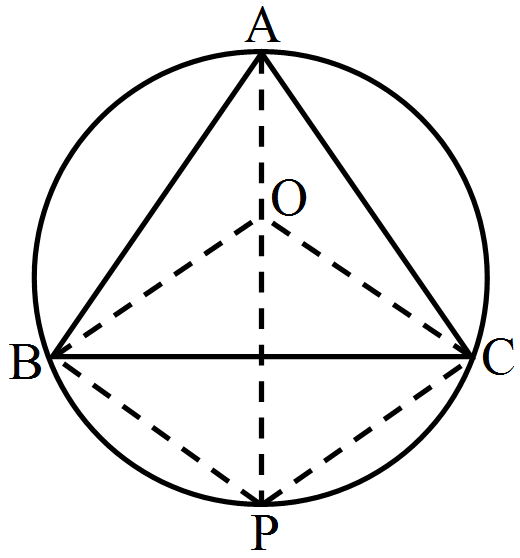
$\therefore\angle\text{APC}=\frac{1}{2}\angle\text{AOC}\ ...(2)$ and
$\angle\text{APB}=\frac{1}{2}\angle\text{AOB}\ ...(3)$
$\therefore\angle\text{APC}=\angle\text{APB}$
$[$From $(1), (2)$ and $(3)]$
Hence, $PA$ is the bisector of $\angle\text{BPC}.$ View full question & answer→Question 164 Marks
If $P, Q$ and $R$ are the mid-points of the sides $BC, CA$ and $AB$ of a triangle and $AD$ is the perpendicular from $A$ on $BC,$ prove that $P, Q, R$ and $D$ are concyclic.
AnswerWe have to prove that $R, D, P$ and $Q$ are concyclic.
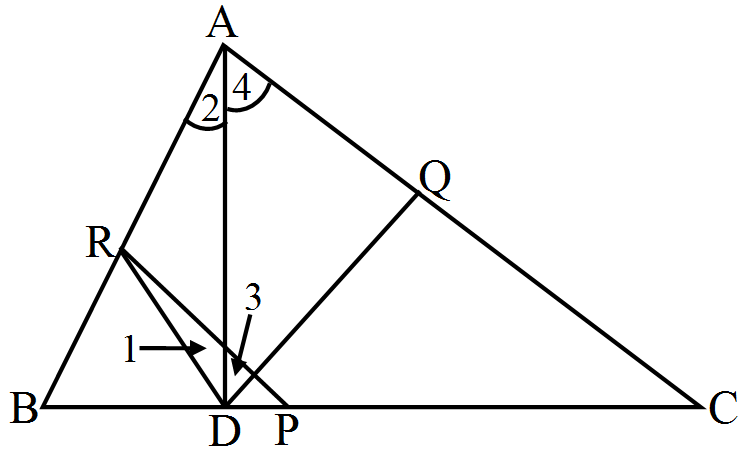
Join $RD, QD, PR$ and $PQ.$
$\because RP$ joints $R$ and $P,$ the mid-point of $AB$ and $BC.$
$\therefore RP || AC [$Mid-point theorem$]$ Similarly, $PQ || AB.$
$\therefore ARPQ$ is $a || gm \angle\text{RAQ}=\angle\text{RPQ} [$opposite angle of $a || gm] .... (1)$
$\because ABD$ is a rt. $\angle\text{D}\triangle$ and $DR$ is a median,
$\therefore RA = DR$ and $\angle1=\angle2\ ....(2)$
Similarly $\angle3=\angle4\ ....(3)$ Adding $(2)$ and $(3),$
we get $\angle1+\angle3=\angle2+\angle4$
$\Rightarrow\angle\text{RDQ}=\angle\text{RAQ}$
$\angle\text{RPQ}$ [Proved above]
Hence, $R, D, P$ and $Q$ are concyclic. $[\because\angle\text{D}$ and $\angle\text{P}$ are subtended by $RQ$ on the same side of it.$]$ View full question & answer→Question 174 Marks
$O$ is the circumcentre of the triangle $ABC$ and $D$ is the mid-point of the base $BC.$ Prove that $\angle\text{BOD}=\angle\text{A}.$
AnswerGiven: In a $\triangle\text{ABC}$ a circle is circumscribed having centre $O.$
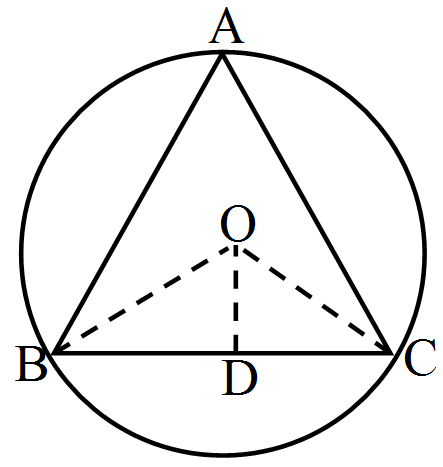
Also, $D$ is the mid-point of $BC.$
To prove: $\angle\text{BOD}=\angle\text{A}\ \ \text{or}\ \ \angle\text{BOD}=\angle\text{BAC}$
Construction: Join $OB, OD$ and $OC.$
Proof: In $\triangle\text{BOD}$ and $\triangle\text{COD}$,
$OB = OC [$both are the radius of circle$]$
$BD = DC [D$ is the mid-point of $BC]$
and $OD = OD [$common side$]$
$\therefore\triangle\text{BOD}\cong\triangle\text{COD}$ [by $SSS$ congruence rule]
$\therefore\angle\text{BOD}=\angle\text{COD} [$by $CPCT] ....(i)$
We know that, in a circle, the angle subtended by an arc at the centre is twice the angle subtended by it at the remaining part of the circle.
$\therefore2\angle\text{BAC}=\angle\text{BOC}$
$\Rightarrow\angle\text{BAC}=\frac{2}{2}\angle\text{BOD}$ $[\because\angle\text{BOC}=2\angle\text{BOD}] [$from Eq. $(i)]$
$\Rightarrow\angle\text{BAC}=\angle\text{BOD}$
Hence proved. View full question & answer→Question 184 Marks
If two chords $AB$ and $CD$ of a circle $AYDZBWCX$ intersect at right angles (see Fig.), prove that $arc\ CXA + arc\ DZB = arc\ AYD + arc\ BWC = $ semi-circle.
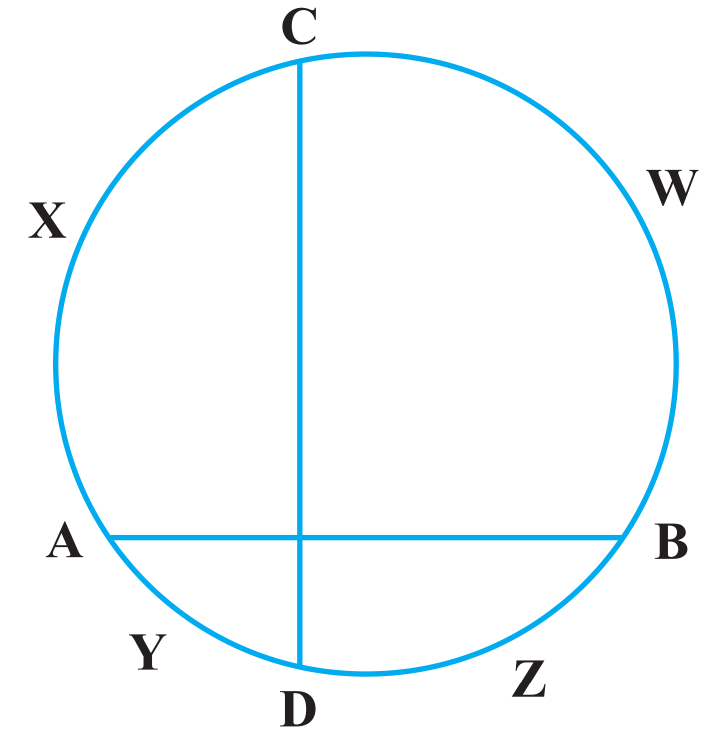
AnswerGiven: In a circle $AYDZBWCX,$ two chords $AB$ and $CD$ intersect at right angles.
To prove: $arc\ CXA + arc\ DZB = arc\ AYD + arc\ BWC =$ Semi-circle
Construction: Draw a diameter $EF$ parallel to $CD$ having centre $M.$
Proof: Since, $CD || EF$
$arc\ EC = arc\ PD …(i)$
$arc\ ECXA = arc\ EWB$ [symmetrical about diameter of a circle] $arc\ AF = arc\ BF …(ii)$
We know that, $arc\ ECXAYDF =$ semi-circle
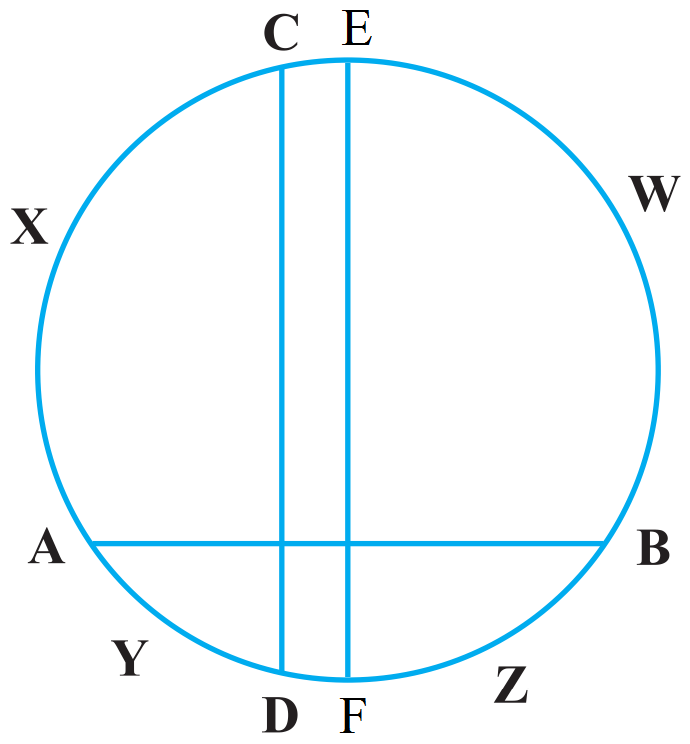
$arc\ EA + arc\ AF =$ semi-circle
$⇒ arc\ EC + arc\ CXA + arc\ FB =$ semi-circle $[$from Eq. $(ii)]$
$⇒ arc\ DF + arc\ CXA + arc\ FB =$ semi-circle $[$from Eq. $(i)]$
$⇒ arc\ DF + arc\ FB + arc\ CXA =$ semi-circle
$⇒ arc\ DZB + arc\ C × A =$ semi-circle
We know that, circle divides itself in two semi-circles, therefore the remaining portion of the circle is also equal to the semi-circle.
$\therefore arc\ AYD + arc\ BEC =$ semi-ciecle
Hence proved. View full question & answer→Question 194 Marks
If bisectors of opposite angles of a cyclic quadrilateral $ABCD$ intersect the circle, circumscribing it at the points $P$ and $Q,$ prove that $PQ$ is a diameter of the circle.
AnswerGiven: $ABCD$ is a cyclic quadrilateral. $DP$ and $QB$ are the bisectors of $\angle\text{D}$ and $\angle\text{B},$ respectively.
To prove: $PQ$ is the diameter of a circle.
Construction: Join $QD$ and $QC.$
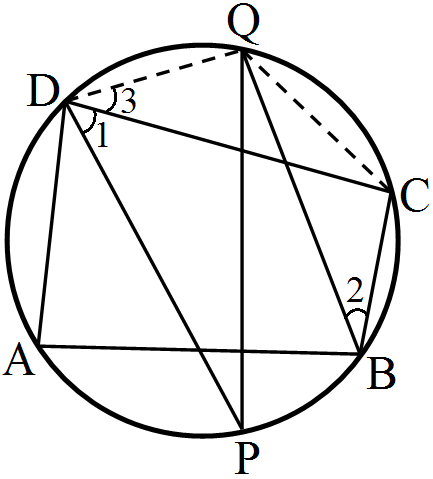
Proof: Since, $ABCD$ is a cyclic quadrilateral.
$\therefore\angle\text{CDA}+\angle\text{CBA}=180^\circ [$sum of opposite angles of cylic quadrilateral is $180^\circ ]$
On dividing both sides by $2,$ we get,
$\frac{1}{2}\angle\text{CDA}+\frac{1}{2}\angle\text{CBA}=\frac{1}{2}\times180^\circ=90^\circ$
$\Rightarrow\angle1+\angle2=90^\circ\ ...(\text{i})$
$\big[\angle1=\frac{1}{2}\angle\text{CDA and}\ \angle2=\frac{1}{2}\angle\text{CBA}\big]$ But,
$\angle2=\angle3 [$angles in the same segment $QC$ are equal$] ...(ii)$
$\angle1+\angle3=90^\circ$ From Eqe. $(i)$ and $(ii),$
$\angle\text{PDQ}=90^\circ$ Hence, $PQ$ is a diameter of a circle,
because diameter of the circle.
Subtends a right angle at the circumference. View full question & answer→Question 204 Marks
$AB$ and $AC$ are two chords of a circle of radius r such that $AB = 2AC$. If $p$ and $q$ are the distances of $AB$ and $AC$ from the centre, prove that $4q^2 = p^2 + 3r^2.$
AnswerGiven: In a circlr of radius $r,$ there are two chords $AB$ and $AC$ such that $AB = 2AC$,
Also, the distance of $AB$ and $AC$ from the centre are $P$ and $q,$ respectively.
To prove: $\text{4q}^2+\text{p}^2+3\text{r}^2,$
Proof: Let $AC = a,$ then $AB = 2a$
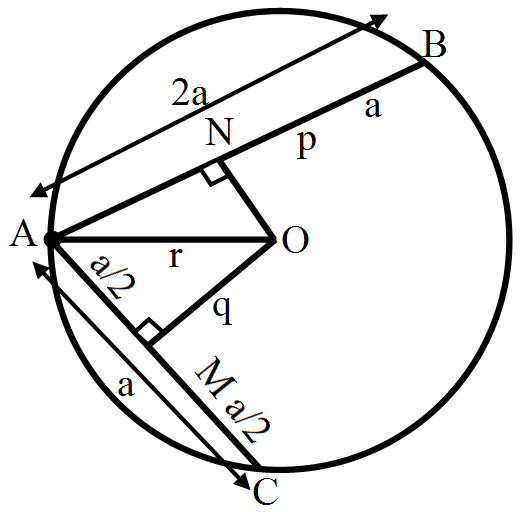
From centre $O,$ perpendicular is drawn to the chords $AC$ and $AB$ at $M$ and $N,$ respectively.
$\therefore\text{AM}=\text{MC}=\frac{\text{a}}{2}$
$\text{AN}=\text{NB}=\text{a}$ In
$\triangle\text{OAM},\ \ \text{AO}^2=\text{AM}^2+\text{MO}^2$ [by pythagoras theorem]
$\Rightarrow\text{AO}^2=\Big(\frac{\text{a}}{2}\Big)^2+\text{q}^2\ \ ...\text{(i)}$ In $\triangle\text{OAN},$
use pythagoras theorem, $\text{AO}^2=(\text{AN})^2+(\text{NO})^2$
$\Rightarrow\text{AO}^2=(\text{a})^2+\text{p}^2\ \ \ ...(\text{ii})$
From Eqs. (i) and (ii), $\Big(\frac{\text{a}}{2}\Big)^2+\text{q}^2=\text{a}^2+\text{p}^2$
$\Rightarrow\frac{\text{a}^2}{4}+\text{q}^2=\text{a}^2+\text{p}^2$
$\Rightarrow\text{a}^2+4\text{q}^2=4\text{a}^2+4\text{p}^2[$ multiplying both sides by $4]$
$\Rightarrow4\text{q}^2=3\text{a}^2+4\text{p}^2$
$\Rightarrow4\text{q}^2=\text{p}^2+3(\text{a}^2+\text{p}^2)$
$\Rightarrow4\text{q}^2=\text{p}^2+3\text{r}^2$
$\big[$In right angled
$\triangle\text{OAN},\ \text{r}^2=\text{a}^2+\text{p}^2\big]$
Hence proved. View full question & answer→Question 214 Marks
In Fig. $AB$ and $CD$ are two chords of a circle intersecting each other at point $E.$ Prove that $\angle\text{AEC}=\frac{1}{2}$ $($Angle subtended by arc $CXA$ at centre $+$ angle subtended by arc $DYB$ at the centre$).$
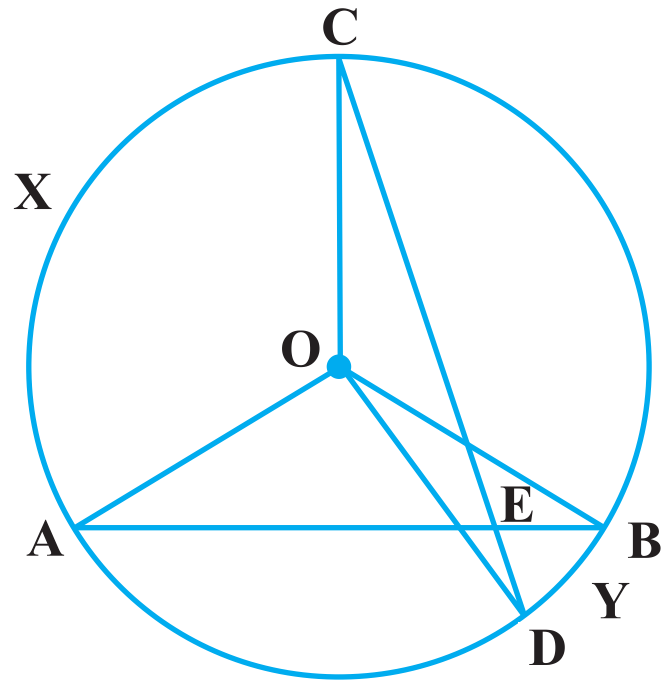
AnswerGiven: In a figure, two chords $AB$ and $CD$ intersecting each other at point $E.$
To prove: $\angle\text{AEC}=\frac{1}{2} [$angle subtended by arc $C \times A$ at centre $+$ angle subtended by arc $DYB$ at the centre$]$
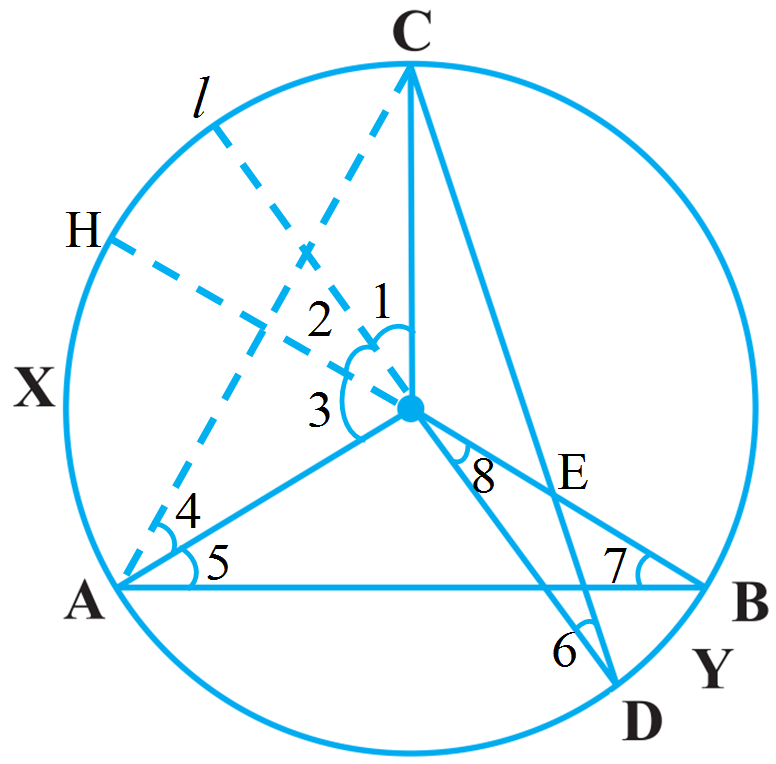
Construction: Extend the line $DO$ and $BO$ at the points $l$ and $H$ on the circle. Also, join $AC.$
Proof: We know that, in a circle, the angle subtended by an arc at the centre is twice the angle subtended by it at the remaining part of the circle.
$\therefore\angle1=2\angle6\ \ ...(\text{i})$ and $\angle3=2\angle7\ \ ...(\text{ii)}$ In $\triangle\text{AOC},\ \ \text{OC}=\text{OA}$ $[$both are the radius of circle$]$
$\angle\text{OCA}=\angle4$ [angles opposite to equal sides are equal] Also,
$\angle\text{AOC}+\angle\text{OCA}+\angle4=180^\circ$ $[$by angle sum property of triangle$]$
$\Rightarrow\angle\text{AOC}+\angle4+\angle4=180^\circ$
$\Rightarrow\angle\text{AOC}=180^\circ-2\angle4\ \ \ ...(\text{iii})$
Now, in $\triangle\text{AEC},\ \ \ \angle\text{AEC}+\angle\text{ECA}+\angle\text{CAE}=180^\circ$ [by angle property sum of a triangle]
$\Rightarrow\angle\text{AEC}=180^\circ-(\angle\text{ECA}+\angle\text{CAE})$
$\Rightarrow\angle\text{AEC}=180^\circ-[(\angle\text{ECO}+\angle\text{OCA})+\angle\text{CAO}+\angle\text{OAE}]$
$=180^\circ-(\angle6+\angle4+\angle4+\angle5)$
$\big[$In $\triangle\text{OCD},\angle6=\angle\text{ECO}$ angles opposite to equal sides are equal$\big]$
$=180^\circ-(2\angle4+\angle5+\angle6)$
$=180^\circ-(180^\circ-\angle\text{AOC}+\angle7+\angle6)[ $From Eq. $(iii)$ and in
$\triangle\text{AOB}.\angle5=\angle7,$ as $($angles opposite to equal sides are equal$)]$
$=\angle\text{AOC}-\frac{\angle3}{2}-\frac{\angle1}{2} [$from Eqs. $(i)$ and $(ii)]$
$=\angle\text{AOC}-\frac{\angle1}{2}-\frac{\angle2}{2}-\frac{\angle3}{2}+\frac{\angle2}{2}$ [adding and subtracting $\frac{\angle2}{2}$]
$=\angle\text{AOC}-\frac{1}{2}(\angle1+\angle2+\angle3)+\frac{\angle8}{2} [ \because\angle2=\angle8$ (vertically opposite angles)]
$=\angle\text{AOC}=\frac{\angle\text{AOC}}{2}+\frac{\angle\text{DOB}}{2}$
$\Rightarrow\angle\text{AEC}=\frac{1}{2}(\angle\text{AOC}+\angle\text{DOB})$
$=\frac{1}{2} [$angle subtended by arc $CXA$ at the centre $+$ angle subtended by arc $DYB$ at the centre$]$ View full question & answer→Question 224 Marks
A circle has radius $\sqrt{2}\text{cm}.$ It is divided into two segments by a chord of length $2\ cm.$ Prove that the angle subtended by the chord at a point in major segment is $45^\circ .$
AnswerDraw a circle having centre $O. $
Let $AB = 2\ cm$ be a chord of a circle.
A chord $AB$ is divided by the line $OM$ in two equal segments.
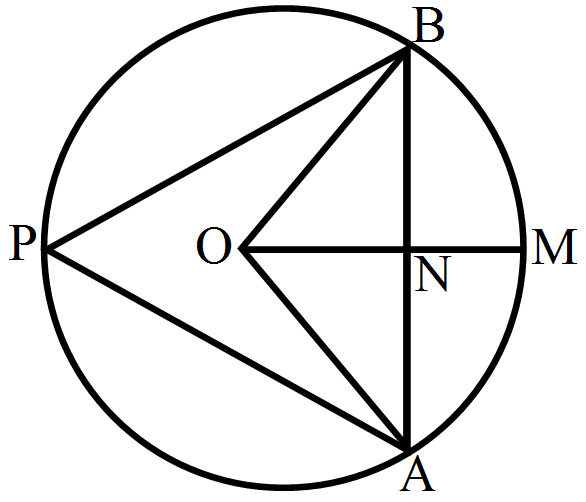
To prove, $\angle\text{APB}=45^\circ$
Here, $AN = NB = 1\ cm$ and $\text{OB}=\sqrt{2}\text{cm}$
In $\triangle\text{ONB},\ \ \text{OB}^2=\text{ON}^2+\text{NB}^2$ [use pythagoras theorem] $\Rightarrow(\sqrt{2})^2=\text{NO}^2+(1)^2$
$\Rightarrow\text{ON}^2=2-1=1$
$\Rightarrow\text{ON}=1\text{cm}$ [taking positive square root, because distance is always positive]
Also, $\angle\text{ONB}=90^\circ [ON$ is the perpendicular bisector of the chord $AB]$
$\therefore\angle\text{NOB}=\angle\text{NBO}=45^\circ$
Similarly, $\angle\text{AON}=45^\circ$
Now, $\angle\text{AOB}=\angle\text{AON}+\angle\text{NOB}$
$=45^\circ+45^\circ=90^\circ$
We know that, chord subtends an angle to the circle is half the angle subtended by it to the centre. $\therefore\angle\text{APB}=\frac{1}{2}\angle\text{AOB}$
$=\frac{90^\circ}{2}=45^\circ$ Hence, proved. View full question & answer→Question 234 Marks
If a line segment joining mid-points of two chords of a circle passes through the centre of the circle, prove that the two chords are parallel.
AnswerGiven: $AB$ and $CD$ are two chords of a circle whose centre of $O.$
The mid-points of $AB$ and $CD$ are $L$ and $M$ respectively.
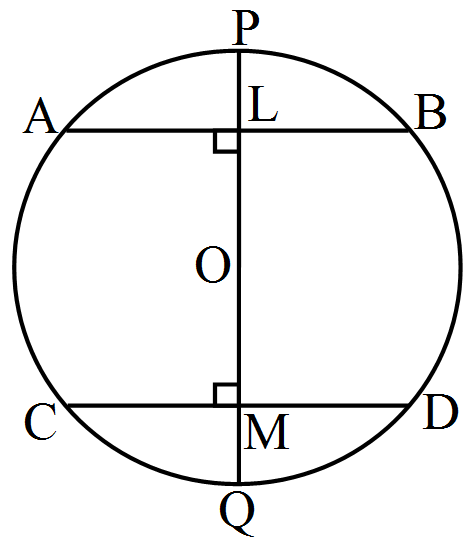
To prove: $AB || CD$
Proof:
$\because L$ is the mid-point of chord $AB$
$\therefore\text{OL}\bot\text{AB},\ \text{or}\ \angle\text{ALO}=90^\circ$
[$\because$ The line joining the centre of a circle to the mid-point of a chord is perpendicular to the chord]
Similarly, $\angle\text{CMO}=90^\circ$
$\therefore\angle\text{ALO}=\angle\text{CMO}$
But, these are corresponding angles.
So, $AB || CD.$
Hence, proved. View full question & answer→Question 244 Marks
A chord of a circle is equal to its radius. Find the angle subtended by this chord at a point in major segment.
AnswerSince chord of a circle is equal radius, so we have $AB = OA = OB.$ Therefore, $ABC$ is an equilateral triangle. 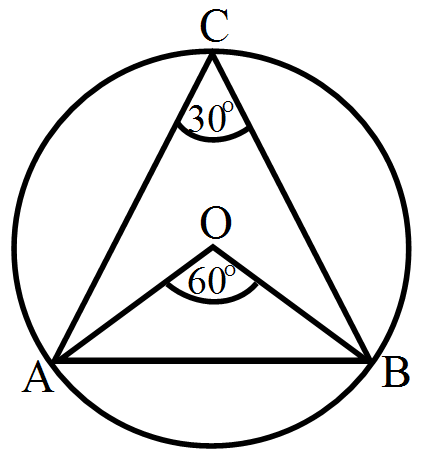
Since each angle of an equilateral triangle is $60^\circ ,$ so we have
$\angle\text{AOB}=60^\circ$ Since angle subtended by an arc at the centre is double the angle subtended by it at any point on the remaining part of the circle, so we have
$\angle\text{AOB}=2\angle\text{ACB}$.
Hence, $\angle\text{ACB}=\frac{1}{2}\angle\text{AOB}=\frac{1}{2}\times60^\circ=30^\circ$ View full question & answer→Question 254 Marks
The circumcentre of the triangle $ABC$ is $O$. Prove that $\angle\text{OBC} + \angle\text{BAC} = 90^\circ.$
Answer$ABC$ is a triangle and $O$ is the circumcentre.
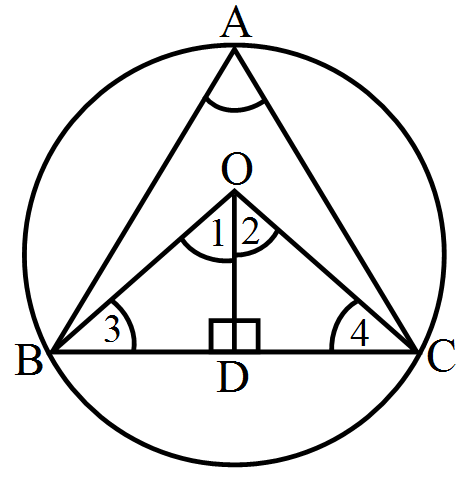
Draw $\text{OD}\bot\text{BC}.$ Join $OB$ and $OC$. In right $\triangle\text{OBD}$ and right $\triangle\text{OCD}$,
we have hyp. $OB $= hyp. $OC$ [Raddi of the same circle] $OD = OD$ [Common side]
$\therefore\triangle\text{OBD}\cong\triangle\text{OCD}$ [By RHS cong. Rule]
$\therefore\angle1=\angle2$ and $\angle1=\angle4$ [By $C.P.C.T.$]
Now, $\angle\text{BOC}=2\angle1$ and $\angle\text{BOC}=2\angle\text{A}$
$\therefore2\angle1=2\angle\text{A}\Rightarrow\angle1=\angle\text{A}$
$\therefore\angle\text{A}=\angle2\ ....(1)\ \ \ [\because\angle1=\angle2]$
$\Rightarrow\angle\text{A}+\angle4=\angle2+\angle4$ [Adding $\angle4$ to both sides]
$\Rightarrow\angle\text{A}+\angle3=90^\circ\ \ [\because\angle2+\angle4=90^\circ\ \text{and}\ \angle4=\angle3]$
$\Rightarrow\angle\text{BOC}=\angle\text{A}=90^\circ$ Hence, proved. View full question & answer→Question 264 Marks
Two circles with centres $O$ and $O′$ intersect at two points $A$ and $B$. A line $PQ$ is drawn parallel to $OO′$ through A(or B) intersecting the circles at $P$ and $Q$. Prove that $PQ = 2OO′.$
AnswerTwo ciecles with centre $O$ and $O'$ intersect at two points $A$ and $B$. A line $PQ$ is drawn parallel to $OO'$ through A (or B) intersecting the circles at $P$ and $Q.$
Draw $\text{OC}\bot\text{PA}$ and $\text{O'D}\bot\text{AQ}.$
We have to prove that $PQ = 2OO'.$
Since perpendicular from the centre to a chord bisect the chord,
so $PA = 2CA ....(1)$ and $AQ = 2AD ...(2)$ Adding $(1)$ and $(2),$
we get $PA + AQ = 2CA + 2AD $
$⇒ PQ = 2(CA + AD) = 2CD$
Hence, $PQ = 2OO'$
[$\because CD$ and $OO'$ are opposite sides of a rectangle]
View full question & answer→Question 274 Marks
In Fig. $\angle\text{ACB}=40^\circ$. Find $\angle\text{OAB}.$
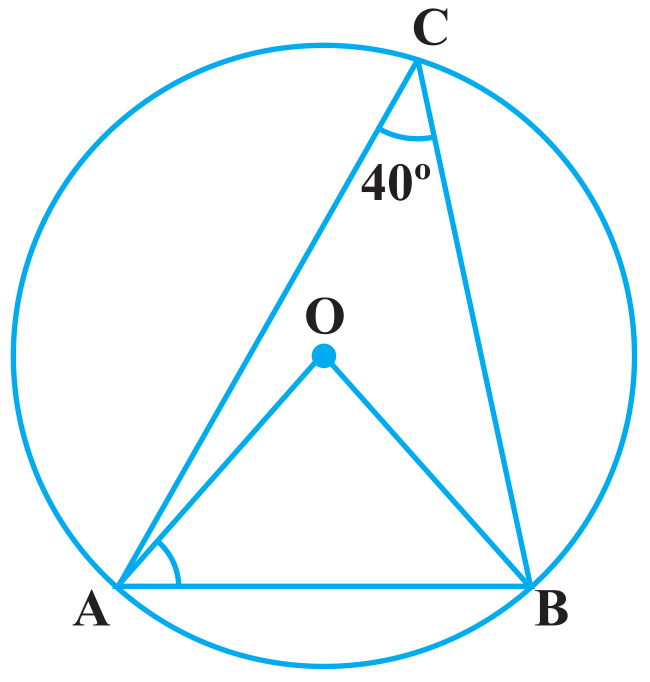
AnswerGiven, $\angle\text{ACB}=40^\circ$
We know that, a segment subtends an angle to the circle is half the angle subtends to the centre. $\therefore\angle\text{AOB}=2\angle\text{ACB}$
$\Rightarrow\angle\text{ACB}=\frac{\angle\text{AOB}}{2}$
$\Rightarrow40^\circ=\frac{1}{2}\angle\text{AOB}$
$\Rightarrow\angle\text{AOB}=80^\circ\ \ \ ...(\text{i})$ In
$\triangle\text{AOB},\ \text{AO}=\text{BO}$ [both are the radius of a circle]
$\Rightarrow\angle\text{OBA}=\angle\text{OAB}\ \ ...(\text{ii})$
[angle opposite to the equal sides are equal]
We know that, the sum of all three angles in a triangle $AOB$ is $180^\circ .$
$\therefore\angle\text{AOB}+\angle\text{OBA}+\angle\text{OAB}=180^\circ$
$\Rightarrow80^\circ+\angle\text{OAB}+\angle\text{OAB}=180^\circ$ [from Eqs. $(i)$ and $(ii)]$
$\Rightarrow2\angle\text{OAB}=180^\circ-80^\circ$
$\Rightarrow2\angle\text{OAB}=100^\circ$
$\therefore\angle\text{OAB}=\frac{100^\circ}{2}=50^\circ$
View full question & answer→Question 284 Marks
If two equal chords of a circle intersect, prove that the parts of one chord are separately equal to the parts of the other chord.
AnswerGiven: Consider $AB$ and $CD$ are two equal chords of a circle, which meet at point $E.$
To prove: $AE = CE$ and $BE = DE$
Construction: Draw $\text{OM}\bot\text{AB}$ and $\text{ON}\bot\text{CD}$ and join $OE$ where $O$ is the centre of circle. 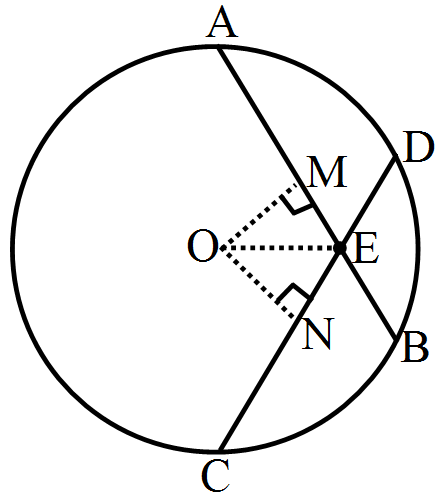
Proof: In $\triangle\text{OME}$ and $\triangle\text{ONE}.$
$OM = ON$ [equal chords are equidistant from the centre] $OE = OE$ [common side] and $\angle\text{OME}=\angle\text{ONE}$ [each $90^\circ ]$
$\therefore\triangle\text{OME}\cong\triangle\text{ONE}$ [by $RHS$ congurence rule] $\Rightarrow\text{EM}=\text{EN}$ [by $CPCT] ...(i)$
Now, $\text{AB} = \text{CD}$ On dividing both sides by $2,$
we get, $\frac{\text{AB}}{2}=\frac{\text{CD}}{2}$
$\Rightarrow\text{AM}=\text{CN}\ \ ...(\text{ii})$ [Since, perpendicular drawn from centre of circle to chord to chord bisects the chord i.e., $AM = MB$ and $CN = ND$]
On adding Eqs. $(i)$ and $(ii),$
we get $\text{EM} + \text{AM} = \text{EN} + \text{CN}$
$\Rightarrow\text{AE}=\text{CE}\ \ \ ...(\text{iii})$
Now, $\text{AB} = \text{CD}$ On subtracting both sides by $AE,$
we get $\text{AB} - \text{AE} = \text{CD} - \text{AE}$
$\Rightarrow\text{BE}=\text{CD}-\text{CE}$ [from Eq. $(iii)]$
$\Rightarrow\text{BE}=\text{DE}$
Hence, proved. View full question & answer→