Questions

5 Marks Questions

🎯

Test yourself on this topic

31 questions · timed · auto-graded

Question 15 Marks
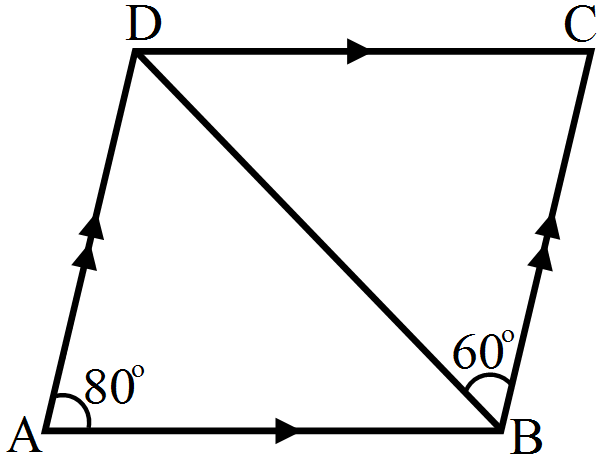
In the adjoining figure, $ABCD$ is a parallelogram in which $\angle\text{DAB}=80^{\circ}$ and $\angle\text{DBC}=60^{\circ}.$ Calculate $\angle\text{CDB}$ and $\angle\text{ADB}.$
Answer
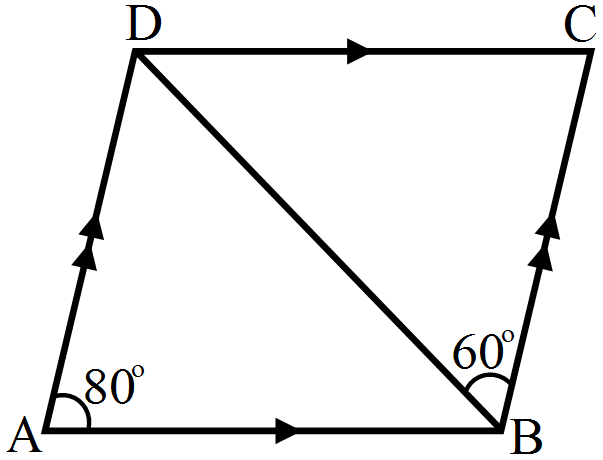
 $ABCD$ is a parallelogram, so opposite angles are equal.
$\therefore\angle\text{C}=\angle\text{A}=80^{\circ}$ As $AD\ ||\ BC$ and $BD$ is a transversal.
So, $\angle\text{ADB}=\angle\text{DBC}=60^{\circ}$ [Alternate angles] In $\triangle\text{ABD}$
$\angle\text{A}+\angle\text{ADB}+\angle\text{ABD}=180^{\circ}$
$\Rightarrow80^{\circ}+60^{\circ}+\angle\text{ABD}=180^{\circ}$
$\Rightarrow140^{\circ}+\angle\text{ABD}=180^{\circ}$
$\Rightarrow\angle\text{ABD}=180^{\circ}-140^{\circ}=40^{\circ}$
$\therefore\angle\text{ABC}=\angle\text{ABD}+\angle\text{DBC}$
$=40^{\circ}+60^{\circ}=100^{\circ}$ In a parallelogarm, opposite angles are equal.
So, $\angle\text{ADC}=\angle\text{ABC}=\angle100^{\circ}$
$\therefore\angle\text{CDB}=\angle\text{ADC}-\angle\text{ADB}$
$=100^{\circ}-60^{\circ}=40^{\circ}$ and $\angle\text{ADB}=60^{\circ}.$
View full question & answer
Question 25 Marks
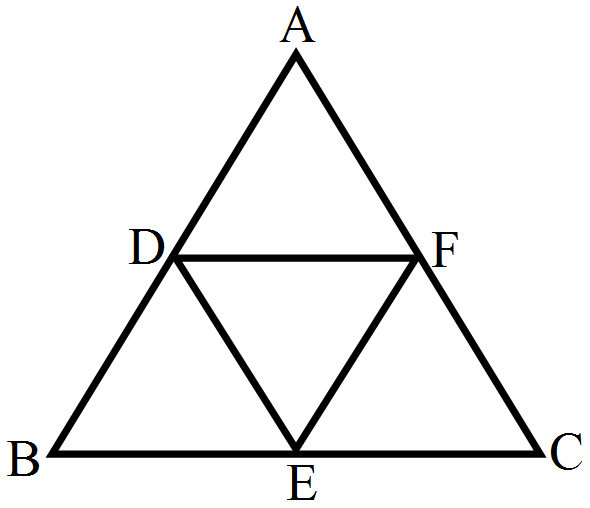
Prove that the line segments joining the middle points of the sides of a triangle divide it into four congruent triangles.
Answer
$\triangle\text{ABC}$ is shown below. $D, E$ and $F$ are the midpoints of sides $AB, BC$ and $CA$, respectively.

As, $D$ and $E$ are the mid points of sides $AB$, and $BC$ of $\triangle\text{ABC}.$
$\therefore$ $DE || AC$ (By midpoint theorem)
Similarly, $DF || BC$ and $EF || AB$.
Therefore, $ADEF, BDFE$ and $DFCE$ are all parallelograms.
Now, $DE$ is the diagonal of the parallelogram $BDFE$.
$\therefore\triangle\text{BDE}\cong\triangle\text{FED}$
Similarly, $DF$ is the diagonal of the parallelogram $ADEF$.
$\therefore\triangle\text{DAF}\cong\triangle\text{FED}$
And, $EF$ is the diagonal of the parallelogram $DFCE$.
$\therefore\triangle\text{EFC}\cong\triangle\text{FED}$
So, all the four triangles are congruent.
View full question & answer
Question 35 Marks
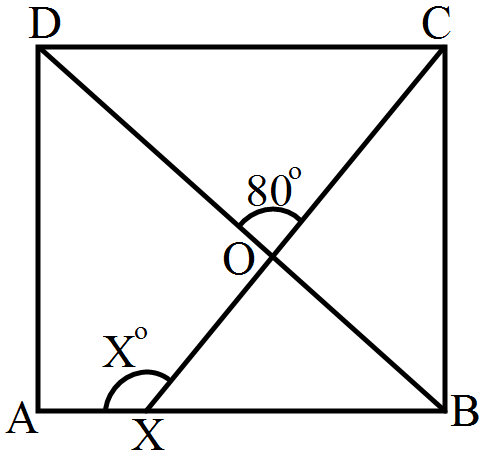
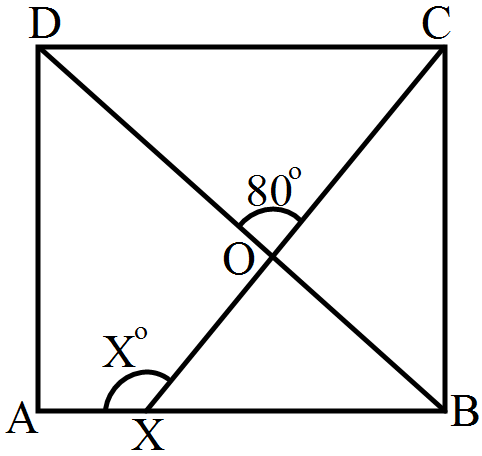
In the adjoining figure, $ABCD$ is a square. $A$ line segment $CX$ cuts $AB$ at $X$ and the diagonal $BD$ at $O$ such that $\angle\text{COD}=80^{\circ}$ and $\angle\text{OXA}=\text{x}^{\circ}.$ Find the value of x.
Answer

Consider the triangle $\triangle\text{ABD}$
$\text{AB = AD}$ [$\therefore$ $ABCD$ is a square]
So, $\angle\text{ADB}=\angle\text{ABD}$ [base angles are equal]
$\therefore\angle\text{ADB}+\angle\text{ABD}=90^{\circ}$
[$\because\angle\text{A}=90^{\circ}$ as $ABCD$ is a square]
​​​​​​​$\Rightarrow2\angle\text{ADB}=90^{\circ}$
$\Rightarrow\angle\text{ADB}=\frac{90}{2}=45^{\circ}$ Now in $\triangle\text{OXB,}$
$\angle\text{XOB}=\angle\text{DOC}=80^{\circ}$ [Vertically opposite angles] and
$\angle\text{ABD}=45^{\circ}\Rightarrow\angle\text{XBD}=45^{\circ}...(1)$
 So, exterior $\angle\text{AXO}=\angle\text{XOB}+\angle\text{XBD}$
$\text{x}^{\circ}=80^{\circ}+45^{\circ}$ [from $(1)$] $=125^{\circ}$
$\therefore\text{x}^{\circ}=125^{\circ}$
View full question & answer
Question 45 Marks
Find the measure of each angle of a parallelogram, if one of its angles is $30^\circ $ less than twice the smallest angle.
Answer
Let $ABCD$ be the given parallelogram.
 If $\angle\text{A}$ is smallest angle, then the greater angle $\Rightarrow\angle\text{B}=2\angle\text{A}-30^{\circ}$ In a parallelogram,
the opposite angles are equal $\Rightarrow\angle\text{A}=\angle\text{C}$ and $\angle\text{B}=\angle\text{D}=2\angle\text{A}-30^{\circ}$
The sum of all the four angles of a parallelogram is $360^\circ$ .
$\Rightarrow\angle\text{A}+\angle\text{B}+\angle\text{C}+\angle\text{D}=360^{\circ}$
$\Rightarrow\angle\text{A}+(2\angle\text{A}-30^{\circ})+\angle\text{A}+(2\angle\text{A}-30^{\circ})=360^{\circ}$
$\Rightarrow\angle\text{A}+2\angle\text{A}-30^{\circ}+\angle\text{A}+2\angle\text{A}-30^{\circ}=360^{\circ}$
$\Rightarrow6\angle\text{A}-60^{\circ}=360^{\circ}$
$\Rightarrow6\angle\text{A}=360^{\circ}+60^{\circ}=420^{\circ}$
$\Rightarrow\angle\text{A}=\frac{420^{\circ}}{6}=70^{\circ}$
$\therefore\angle\text{A}=70^{\circ}\Rightarrow\angle\text{C}=70^{\circ}$
$\angle\text{B}=(2\angle\text{A}-30^{\circ})=(2\times70^{\circ}-30^{\circ})=110^{\circ}$
$\angle\text{D}=\angle\text{B}=110^{\circ}$
$\therefore\angle\text{A}=\angle\text{C}=70^{\circ}$ and $\angle\text{B}=\angle\text{D}=110^{\circ}.$
View full question & answer
Question 55 Marks
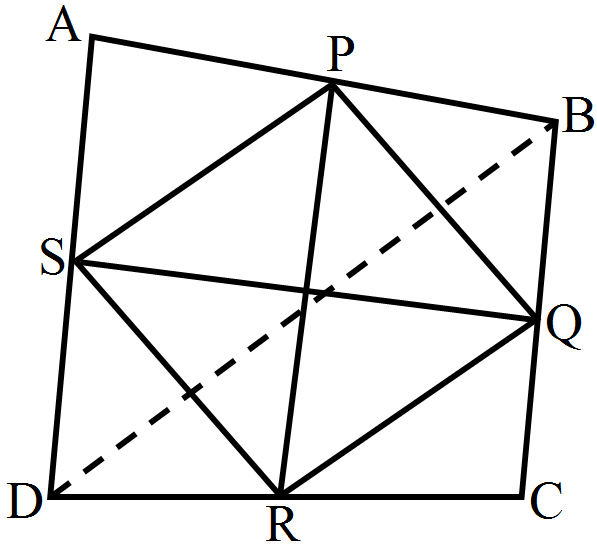
Prove that the line segments joining the midpoints of opposite sides of a quadrilateral bisect each other.
Answer
Let $ABCD$ be the quadrilateral in which $P, Q, R$, and $S$ are the midpoints of sides $AB, BC, CD,$ and $DA$,respectively.
Join $PQ, QR, RS, SP$ and $BD. BD$ is a diagonal of $ABCD$.

In $\triangle\text{ABD},$ $S$ and $P$ are the midpoints of$ AD$ and $AB$, respectively.
$\therefore\text{SP || BD}$ and $\text{SP}=\frac{1}{2}\text{BD }...(\text{i})$ (By midpoint theorem)
Similarly in $\triangle\text{BCD},$ we have:
$\text{QR\ ||\ BD}$ and $\text{QR} = \frac{1}{2}\text{BD }...(\text{ii})$ (By midpoint theorem)
From equations$ (i)$ and $(ii)$, we get:
$\text{SP || BD\ ||\ QR}$
$\therefore\text{SP\ ||\ QR}$ and $\text{SP = QR}$ $\big[$Each equal to $\frac{1}{2}\text{BD}\big]$
In quadrilateral $SPQR$, one pair of the opposite sides is equal and parallel to each other.
$\therefore$ $SPQR$ is a parallelogram.
We know that the diagonals of a parallelogram bisect each other.
$\therefore$ $PR$ and $QS$ bisect each other.
View full question & answer
Question 65 Marks
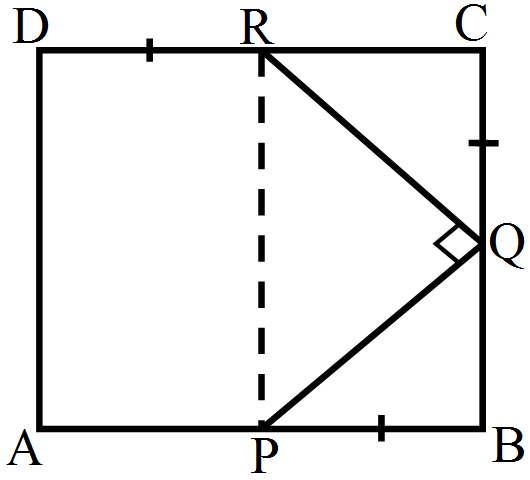
In the given figure, $\text{ABCD}$ is a square and $\angle\text{PQR}=90^{\circ}.$ If $PB = QC = DR,$ prove that:
$i. QB = RC$,
$ii. PQ = QR$,
$iii. \angle\text{QPR}=45^{\circ}$

Answer
Given:$\text{ABCD}$ is a square and $\angle\text{PQR}=90^{\circ}.$
Also, $PB = QC = DR$
$i.$ We have:
$BC = CD ($Sides of square$)$
$CQ = DR ($Given$)$
$BC = BQ + CQ$
$\Rightarrow CQ = BC − B$
$\therefore DR = BC − BQ ...(i)$
Also, $CD = RC+ DR$
$\therefore DR = CD − RC = BC − RC ...(ii)$
From $(i)$ and $(ii)$, we have:
$BC − BQ = ​BC − RC$
$\therefore BQ = RC$
$ii.$ In $\triangle\text{RCQ}$ and $\triangle\text{QBP},$ we have:
$\text{PB = QC} ($Given$)$
$\text{BQ = RC} ($Proven above$)$
$\angle\text{RCQ}=\angle\text{QBP} (90^\circ$ each$)$
i.e., $\triangle\text{RCQ}\cong\triangle\text{QBP} (\text{SAS}$ congruence rule$)$
$\therefore\text{QR = PQ} ($By $\text{C.P.C.T.})$
$iii. \triangle\text{RCQ}\cong\triangle\text{QBP}$ and $\text{QR = PQ} ($Prove above$)$
$\therefore$ in $\triangle\text{RPQ},\angle\text{QRP}=\angle\text{QRP}=\frac{1}{2}(180^{\circ}-90^{\circ})=\frac{90^{\circ}}{2}=45^{\circ}$
View full question & answer
Question 75 Marks
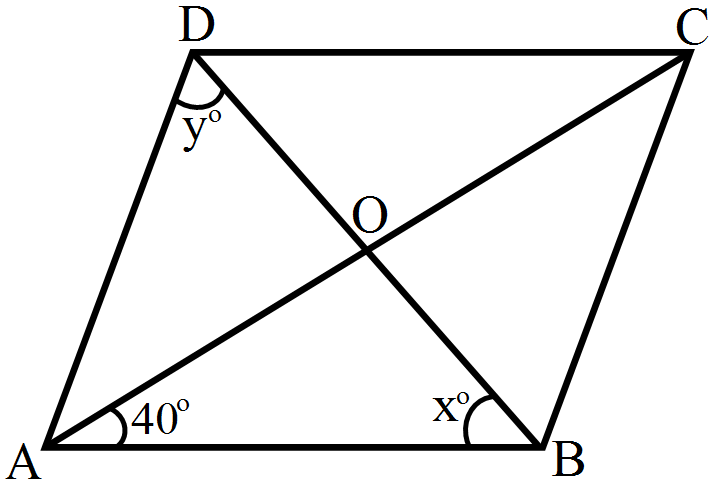
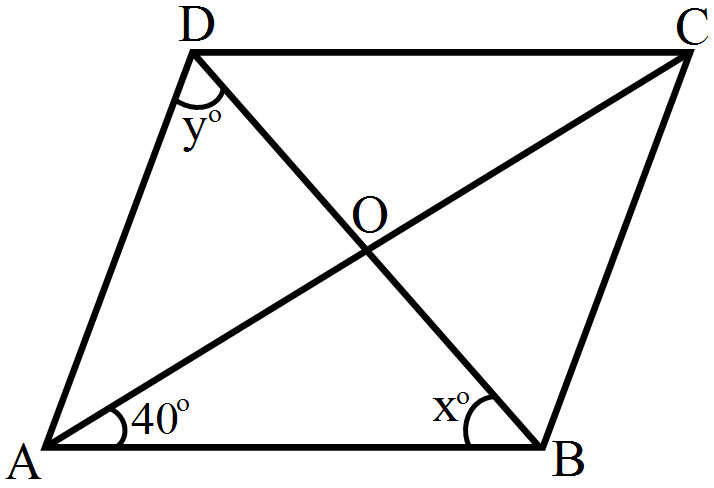
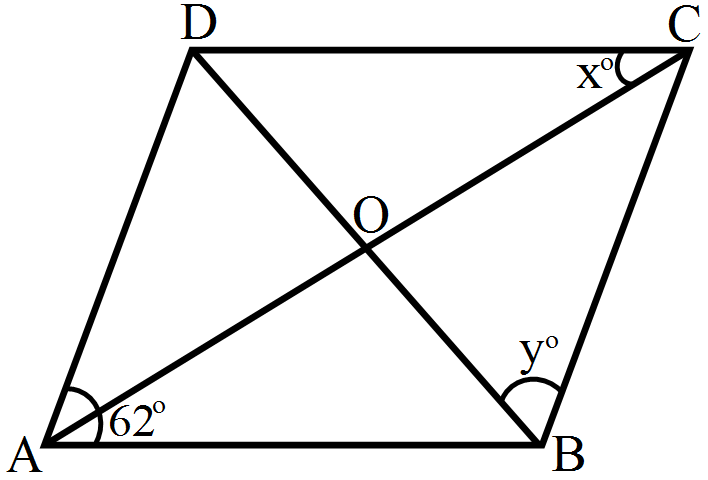
In each of the figures given below, $ABCD$ is a rhombus. Find the value of $x$ and $y$ in each case.
Answer
Since in a rhombus, all sides are equal

So in $\triangle\text{ABD},\text{AB = AD}$
$\Rightarrow\angle\text{ABD}=\angle\text{ADB}$
$\Rightarrow\text{x = y}...(1)$ Now in $\triangle\text{ABC},\text{AB = BC}$
$\Rightarrow\angle\text{CAB}=\angle\text{ACB}$
$\Rightarrow\angle\text{ACB}=40^{\circ}$
$\therefore\angle\text{B}=180^{\circ}-\angle\text{CAB}-\angle\text{ACB}$
$=180^{\circ}-40^{\circ}-40^{\circ}=100^{\circ}$
$\Rightarrow\angle\text{DBC}=\angle\text{B}-\text{x}^{\circ}=100-\text{x}^{\circ}$ But
$\angle\text{DBC}=\angle\text{ADB}=\text{y}^{\circ}$ [alternate angle]
$\Rightarrow100-\text{x}^{\circ}=\text{y}^{\circ}$
$\Rightarrow100^{\circ}-\text{x}^{\circ}=\text{x}^{\circ}$ [from $(1)$]
$\Rightarrow2\text{x}^{\circ}=100$
$\Rightarrow\text{x}^{\circ}=\frac{100}{2}=50^{\circ}$
So, $\text{x}=50^{\circ}$ and $\text{y}=50^{\circ}.$
View full question & answer
Question 85 Marks
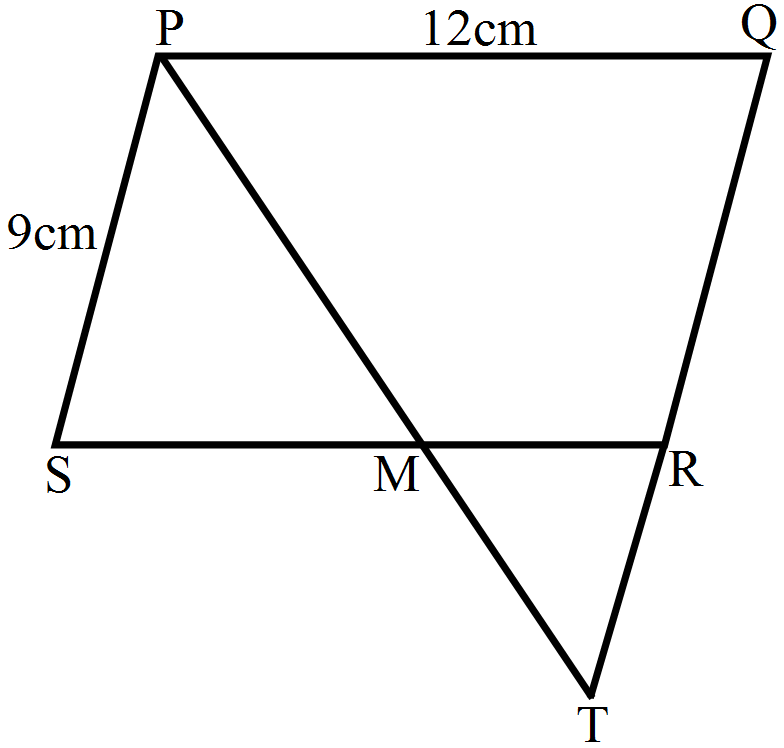
In a parallelogram $PQRS, PQ = 12\ cm$ and $PS = 9\ cm$. The bisector of $\angle\text{P}$ meets $SR$ in $M$. $PM$ and $QR$ both when produced meet at $T$. Find the length of $RT$.
Answer


$PM$ is the bisector of $\angle\text{P}.$
$\Rightarrow\angle\text{QPM}=\angle\text{SPM}...(\text{i})$
$PQRS$ is a parallelogram.
$\therefore\text{PQ || SR}$ and $PM$ is the transversal.
$\Rightarrow\angle\text{QPM}=\angle\text{MS}...(\text{ii})$ (alternate angles)
From $(i)$ and $(ii)$,
$\angle\text{SPM}=\angle\text{PMS ...(iii)}$
$\Rightarrow\text{MS = PS}=9\text{cm}$ (sides opposite to equal angles are equal)
Now, $\angle\text{RMT}=\angle\text{PMS ...(iv)}$ (vertically opposite angles)
Also, $\text{PS || QT}$ and $PT$ is the transversal.
$\angle\text{RTM}=\angle\text{SPM}$
$\Rightarrow\angle\text{RTM}=\angle\text{RMT}$
$\Rightarrow\text{RT = RM}$ (sides opposite to equal angles are equal)
$\text{RM = SR} - \text{MS}=12-9=3\text{cm}$
$\Rightarrow\text{RT}=3\text{cm}$
View full question & answer
Question 95 Marks
If an angle of a parallelogram is four-fifths of its adjacent angle, find the angles of the parallelogram.
Answer
Let $ABCD$ be a parallelogram.
Suppose, $\angle\text{A}=\text{x}^{\circ}$
Then, $\angle\text{B},$ which is adjacent angle of $A$ is $\frac{4}{5}\text{x}^{\circ}.$ In a parallelogram,
the opposite angles are equal $\Rightarrow\angle\text{A}=\angle\text{C}=\text{x}^{\circ}$ and $\angle\text{B}=\angle\text{D}=\frac{4}{5}\text{x}^{\circ}$ The sum of all the four angles of a parallelogram is $360^\circ$ .
​​​​​​​$\Rightarrow\angle\text{A}+\angle\text{B}+\angle\text{C}+\angle\text{D}=360^{\circ}$
$\Rightarrow\text{x}+\frac{4}{5}\text{x + x}+\frac{4}{5}\text{x}=360^{\circ}$
$\Rightarrow2\text{x}+\frac{8}{5}\text{x}=360^{\circ}$
$\Rightarrow\frac{18}{5}\text{x}=360^{\circ}$
$\Rightarrow\text{x}=\frac{360\times5}{18}=100^{\circ}$
$\therefore\angle\text{A}=\text{x}=100^{\circ}$
$\angle\text{B}=\frac{4}{5}\text{x}=\frac{4}{5}\times100=80^{\circ}$
$\angle\text{C}=\text{x}=100^{\circ}$
$\angle\text{D}=\frac{4}{5}\text{x}=\frac{4}{5}\times100=80^{\circ}$
$\therefore\angle\text{A}=\angle\text{C}=100^{\circ}$ and $\angle\text{B}=\angle\text{D}=80^{\circ}.$
View full question & answer
Question 105 Marks
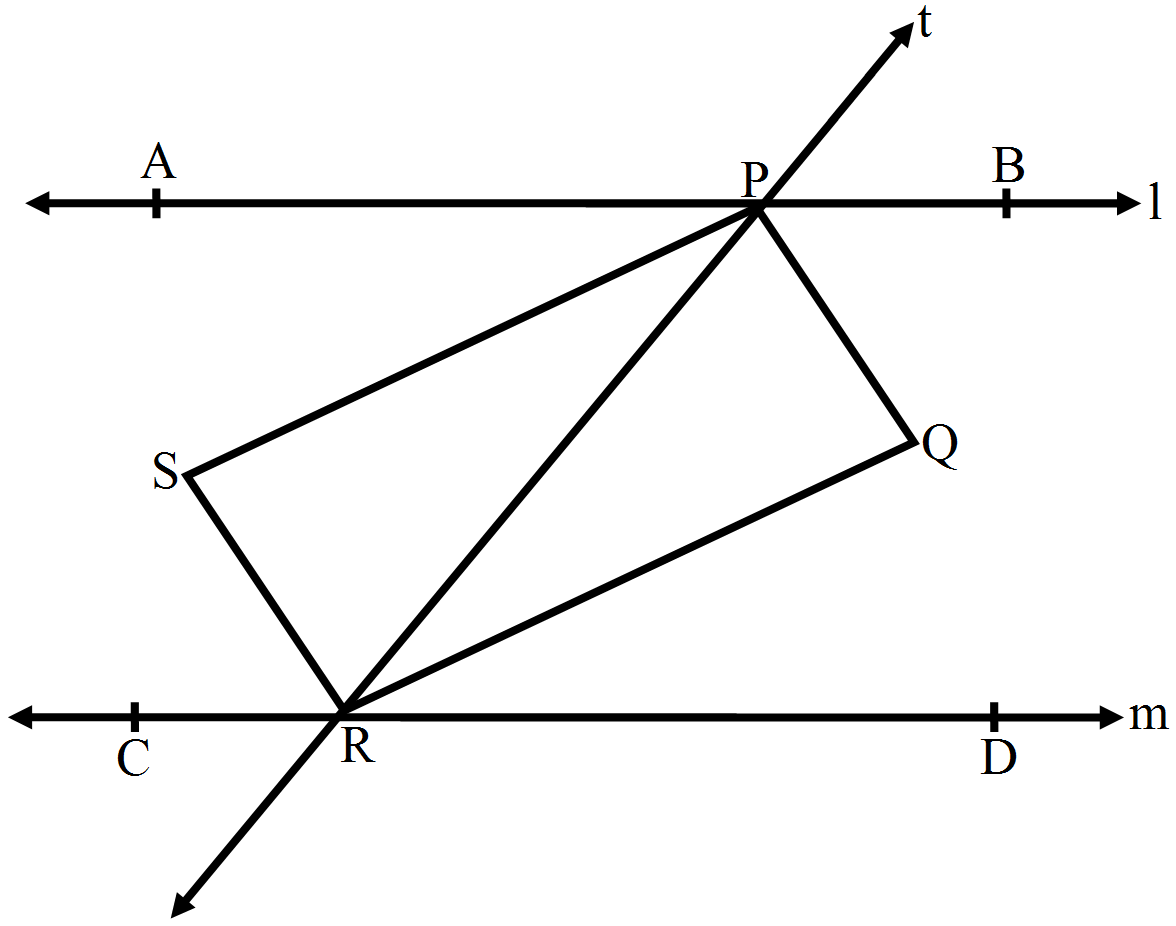
Two parallel lines $l$ and $m$ are intersected by a transversal $t$. Show that the quadrilateral formed by the bisectors of interior angles is a rectangle.
Answer

$l || m$ and $t$ is a transversal.
$\Rightarrow\angle\text{APR}=\angle\text{PRD}$ (alternate angles)
$\Rightarrow\frac{1}{2}\angle\text{APR}=\frac{1}{2}\angle\text{PRD}$
 $\Rightarrow\angle\text{SPR}=\angle\text{PRQ}$ ($PS$ and $RQ$ are the bisectors of $\angle\text{APR}$ and $\angle\text{PRD}$)
Thus, $PR$ intersects $PS$ and $RQ$ at $P$ and $R$ respectively such that $\angle\text{SPR}=\angle\text{PRQ}$ i.e., alternate angles are equal. $\Rightarrow\text{PS\ ||\ RQ}$ Similarly, we have $\text{SR ∥ PQ.}$
Hence, $PQRS$ is a parallelogram. Now, $\angle\text{BPR}+\angle\text{PRD}=180^{\circ}$ (interior angles are supplementary) $\Rightarrow2\angle\text{QPR}+2\angle\text{QRP}=180^{\circ}$ ($PQ$ and $RQ$ are the bisectors of $\angle\text{BPR}$ and $\angle\text{PRD}$) $\Rightarrow\angle\text{QPR}+\angle\text{QRP}=90^{\circ}$ In $\triangle\text{PQR},$ by angle sum property, $\angle\text{PQR}+\angle\text{QPR}+\angle\text{QRP}=180^{\circ}$
$\Rightarrow\angle\text{PQR}+90^{\circ}=180^{\circ}$
$\Rightarrow\angle\text{PQR}=90^{\circ}$ Since $PQRS$ is a parallelogram,
$\angle\text{PQR}=\angle\text{PSR}$
$\Rightarrow\angle\text{PSR}=90^{\circ}$
Now, $\angle\text{SPQ}+\angle\text{PQR}=180^{\circ}$ (adjacent angles in a parallelogram are supplementary)
$\Rightarrow\angle\text{SPQ}+90^{\circ}=180^{\circ}$
$\Rightarrow\angle\text{SPQ}=90^{\circ}$
$\Rightarrow\angle\text{SRQ}=90^{\circ}$
Thus,all the interior angles of quadrilateral $PQRS$ are right angles.
Hence, $PQRS$ is a rectangle.
View full question & answer
Question 115 Marks
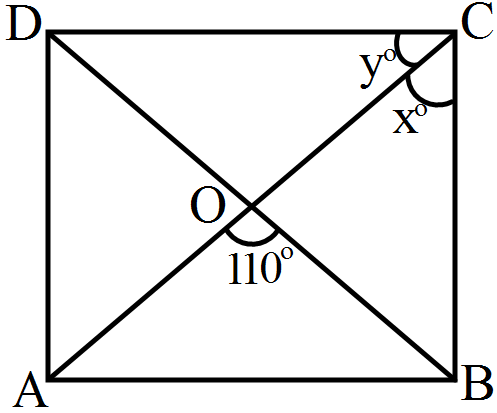
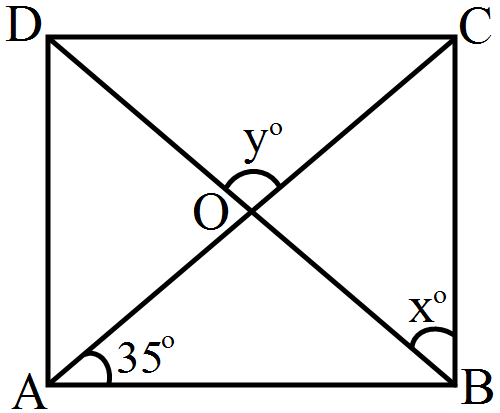
In each of the figures given below, $ABD$ is a rectangle. Find the values of $x$ and $y$ in each case.
Answer
We know that diagonals of a rectangle are equal and bisect each other.

So, in $\triangle\text{AOB},\text{OA = OB}$
$\Rightarrow\angle\text{OAB}=\angle\text{OBA}$ Again in $\triangle\text{AOB},$
$\Rightarrow\angle\text{AOB}+\angle\text{OAB}+\angle\text{OBA}=180^{\circ}$
$\Rightarrow110^{\circ}+\angle\text{OAB}+\angle\text{OBA}=180^{\circ}$
$\Rightarrow2\angle\text{OAB}=180^{\circ}-110^{\circ}=70^{\circ}$
$\Rightarrow\angle\text{OAB}+\angle\text{OBA}=\frac{70}{2}=35^{\circ}$ Since $AB\ ||\ CD$ and $AC$ is a transversal,
​​​​​​​$\angle\text{DCA}$ and $\angle\text{CAB}$ are alternate angles, and thus they are equal.
So, $\angle\text{DCA}=\text{y}^{\circ}=\angle\text{CAB}$ and $\angle\text{CAB}=35^{\circ}...(1)$
$\Rightarrow\text{y}^{\circ}=35^{\circ}$
Now cosider the right triangle, $\triangle\text{ABC}$
$\angle\text{ACB}=\text{x}^{\circ}=90^{\circ}-\angle\text{CAB}$
$=90^{\circ}-35^{\circ}$ [from (1)] $=55^{\circ}$
$\therefore\text{x}=55^{\circ}$ and $\text{y}=35^{\circ}.$
View full question & answer
Question 125 Marks
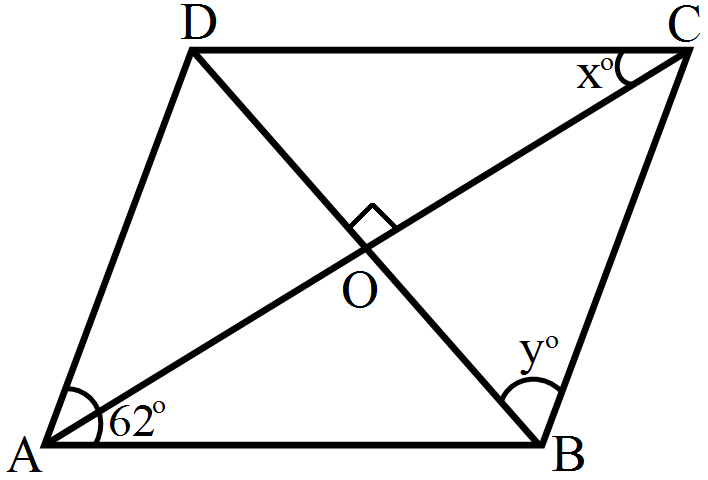
In each of the figures given below, $ABCD$ is a rhombus. Find the value of $x$ and $y$ in each case.
Answer
Since $ABCD$ is a rhombus

So, $\angle\text{A}=\angle\text{C},$ i.e., $\angle\text{C}=62^{\circ}$
Now in $\triangle\text{BCD},\text{BC = DC}$
$\Rightarrow\angle\text{CDB}=\angle\text{DBC}=\text{y}^{\circ}$
As, $\angle\text{BDC}+\angle\text{DBC}+\angle\text{BCD}=180^{\circ}$
$\Rightarrow\text{y + y}+62^{\circ}=180^{\circ}$
$\Rightarrow2\text{y}=180^{\circ}-62^{\circ}=118^{\circ}$
$\Rightarrow\text{y}=\frac{118}{2}=59^{\circ}$
As diagonals of a rhombus are perpendicular to each other,
$\triangle\text{OCD}$ is a right triangle and $\angle\text{DOC}=90^{\circ},\angle\text{ODC}=\text{y}=59^{\circ}$
$\Rightarrow\angle\text{DCO}=90^{\circ}-\angle\text{ODC}$
$=90^{\circ}-59^{\circ}=31^{\circ}$
$\therefore\angle\text{DCO}=\text{x}=31^{\circ}$
$\therefore\text{x}=31^{\circ}$ and $\text{y}=59^{\circ}$
View full question & answer
Question 135 Marks
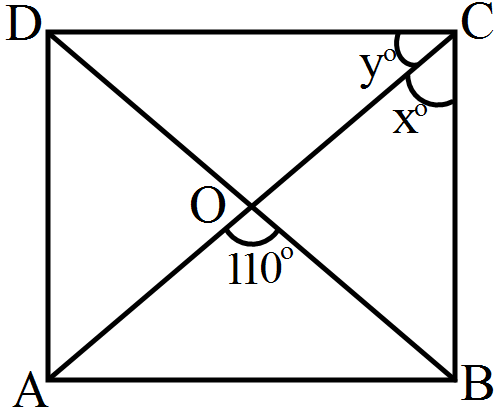
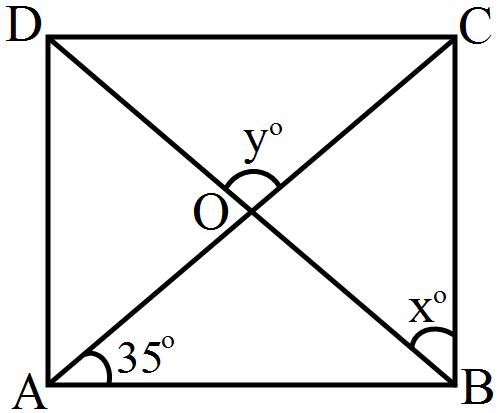
In each of the figures given below, $ABD$ is a rectangle. Find the values of $x$ and $y$ in each case.
Answer


We know that diagonals of a rectangle are equal and bisect each other.
So, in $\triangle\text{AOB}$
$\text{AO = OB}$
$\Rightarrow\angle\text{OAB}=\angle\text{OBA}$ [base angles are equal]
i.e. $\angle\text{OBA}=35^{\circ}$ $[\because\angle\text{OAB}=35^{\circ},\text{given}]$
$\angle\text{AOB}=180^{\circ}-35^{\circ}-35^{\circ}=110^{\circ}$
and, $\angle\text{DOC}=\text{y}^{\circ}=\angle\text{AOB}=110^{\circ}$ [Vertically opp. angle]
Consider the right triangle, $\triangle\text{ABC},$ right angle at $B$.
So, $\angle\text{ABC}=90^{\circ}$ [$\because$ $ABCD$ is a rectangle]
Now, consider the $\triangle\text{OBC}$
So, $\angle\text{OBC}=\text{x}^{\circ}=\angle\text{ABC}-\angle\text{OBA}$
$=90^{\circ}-35^{\circ}$
$=55^{\circ}$
$\therefore\text{x}=55^{\circ}$ and $\therefore\text{y}=110^{\circ}.$
View full question & answer
Question 145 Marks
$\text{ABCD}$ is a rectangle in which diagonal $AC$ bisects $\angle\text{A}$ as well as $\angle\text{C}.$ Show that:
$i. \text{ABCD}$ is a square
$ii.$ diagonal $BD$ bisects $\angle\text{B}$ as well as $\angle\text{D}.$
Answer

$i. \text{ABCD}$ is a rectangle in which diagonal $AC $ bisects $\angle\text{A}$ as well as $\angle\text{C}.$
$\Rightarrow\angle\text{BAC}=\angle\text{DAC}...(1)$
And $\angle\text{BCA}=\angle\text{DCA}...(2)$
Since every rectangle is a parallelogram, therefore
$AB\ \|\ DC$ and $AC $ is the transversal.
$\Rightarrow\angle\text{BAC}=\angle\text{DCA}($alternate angles$)$
$\Rightarrow\angle\text{DAC}=\angle\text{DCA} [$from$]$
Thus in $\triangle\text{ADC},$
$\text{AD = CD} ($opposite sides of equal angles are equal$)$
But, $\text{AD = BC}$ and $\text{CD = AB} (\text{ABCD}$ is a rectangle$)$
$\Rightarrow\text{AB = BC = CD = AD}$
Hence, $\text{ABCD}$ is a square.
$ii.$ In $\triangle\text{BAD}$ and $\triangle\text{BCD},$
$\text{AB = CD}$
$\text{AD = BC}$
$\text{BD = BD}$
$\therefore\triangle\text{BAD}\cong\triangle\text{BCD} ($by $\text{SSS}$ congruence criterion$)$
$\Rightarrow\angle\text{ABD}=\angle\text{CBD}$ and $\angle\text{ADB}=\angle\text{CDB}[\text{CP.C.T.}]$
Hence, diagonal $BD$ bisects $\angle\text{B}$ as well as $\angle\text{D}.$
View full question & answer
Question 155 Marks
Show that the quadrilateral formed by joining the midpoints of the pairs of adjacent sides of a rectangle is a rhombus.
Answer
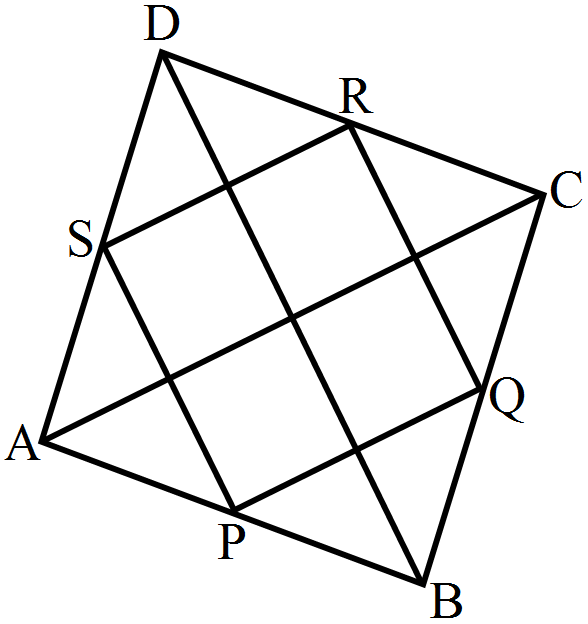
Let $ABCD$ be the rectangle and $P, Q, R$ and $S$ be the midpoints of $AB, BC, CD$ and$ DA$, respectively.
Join $AC$, a diagonal of the rectangle.
In $\triangle\text{ABC},$ we have:
$\therefore$ $PQ || AC$ and $\text{PQ}=\frac{1}{2}\text{AC}$ [By midpoint theorem]
Again, in $\triangle\text{DAC,}$ the points $S$ and $R$ are the mid points of $AD$ and $DC$, respectively.
$\therefore$ SR\ ||\  AC and $\text{SR}=\frac{1}{2}\text{AC}$ [By midpoint theorem]
Now, $PQ\ ||\ AC$ and $SR\ ||\  AC$
$\Rightarrow PQ\  || \ SR$
Also, $PQ = SR$ [Each equal to $\frac{1}{2}$ $AC$]$ ...(i)$
So, $PQRS$ is a parallelogram.
Now, in $\triangle\text{SAP}$ and $\triangle\text{QBP},$ we have:
$AS = BQ$
$\angle\text{A}=\angle\text{B}=90^{\circ}$
$AP = BP$
i.e., $\triangle\text{SAP}\cong\triangle\text{QBP}$
$\therefore$ $PS = PQ ...(ii)$
Similarly, $\triangle\text{SDR}\cong\triangle\text{QCR}$
$\therefore$ $SR = RQ ...(iii)$
From $(i), (ii)$ and $(iii)$, we have:
$PQ = PQ = SR = RQ$
Hence, $PQRS$ is a rhombus.
View full question & answer
Question 165 Marks
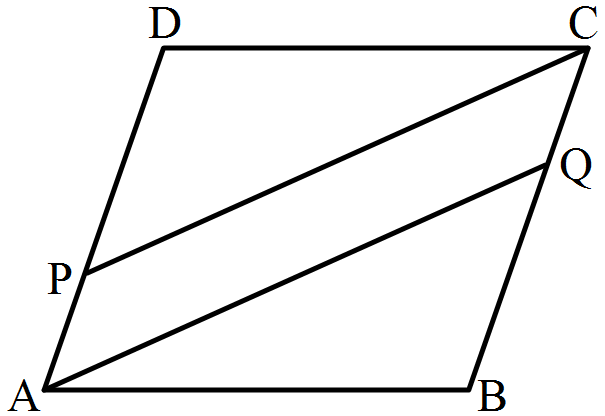
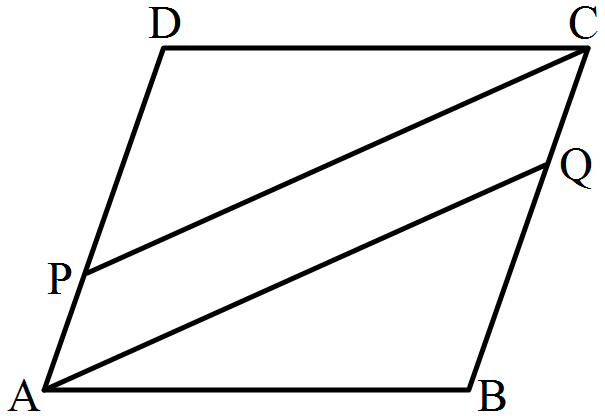
In the adjoining figure, $ABCD$ is a parallelogram. If $P$ and $Q$ are points on $AD$ and $BC$ respectively such that $\text{AP}=\frac{1}{2}\text{AD}$ and $\text{CQ}=\frac{1}{2}\text{BC},$ prove that $AQCP $is a parallelogram.
Answer
Given: A parallelogram $ABCD$ in which $\text{AP}=\frac{1}{3}\text{AD}$ and $\text{CQ}=\frac{1}{3}\text{BC}$

 To Prove: $PAQC$ is a parallelogram.
Proof: In $\triangle\text{ABQ}$ and $\triangle\text{CDP}$
$\text{AB = CD}$ [$\because$ Opposite angles of parallelogram]
$\angle\text{B}=\angle\text{D}$ and $\text{DP = AD}-\text{PA}=\frac{2}{3}\text{AD}$ and,
$\text{BQ = BC}-\text{CQ}=\text{BC}-\frac{1}{3}\text{BC}$
$=\frac{2}{3}\text{BC}=\frac{2}{3}\text{AD}$ [$\because$ $AD = BC$]
 $\therefore\text{BQ = DP}$
Thus, by Side-Angle-Side criterion of congruence,
we have, So, $\triangle\text{ABQ}\cong\triangle\text{CDP}$ [By $SAS$]
The corresponding parts of the congruent triangles are equal.
$\text{AQ = CP}$ [By $C.P.C.T.$] and $\text{PA}=\frac{1}{3}\text{AD}$ and $\text{CQ}=\frac{1}{3}\text{BC}=\frac{1}{3}\text{AD}$
$\text{PA = CQ}$
$[\because\text{AD = BC}]$ Also, by $C.P.C.T.$, $\angle\text{QAB}=\angle\text{PCD}...(1)$
Therefore, $\angle\text{QAP}=\angle\text{A}-\angle\text{QAB}$
$=\angle\text{C}-\angle\text{PCD}$ [Since $\angle\text{A}=\angle\text{C}$ and from $(1)$]
$=\angle\text{PCQ}$ [alternate interior angles are equal]
Therefore, $AQ$ and $CP$ are two parallel lines.
So, $PAQC$ is a parallelogram.
View full question & answer
Question 175 Marks
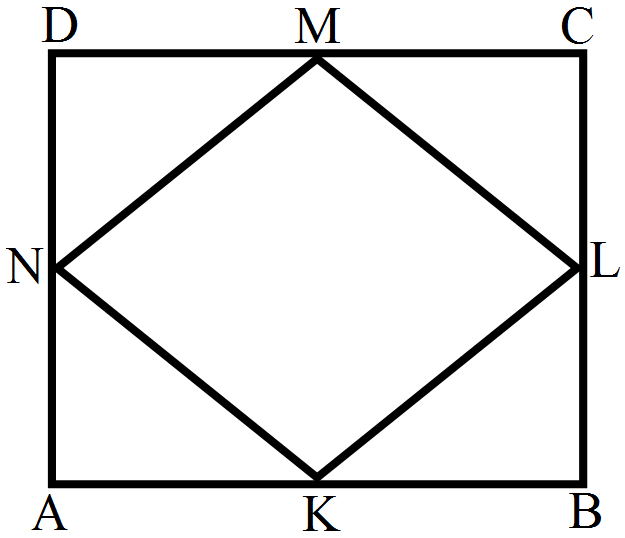
$K, L, M$ and $N$ are points on the sides $AB, BC, CD$ and $DA$ respectively of a square $ABCD$ such that $AK = BL = CM = DN$.
Prove that $KLMN$ is a square.
Answer


$\text{AK = BL = CM = DN}$ (given)
$\Rightarrow\text{BK = CL = DM = AN}...(1)$ (since $ABCD$ is a square)
In $\triangle\text{AKN}$ and $\triangle\text{BLK},$
$\text{AK = BL}$ (given)
$\angle\text{A}=\angle\text{B}$ (Each $90^\circ$)
$\text{AN = BK}$ [From $(i)$]
$\therefore\triangle\text{AKN}\cong\triangle\text{BLK}$ (by $SAS$ congruence criterion)
$\Rightarrow\angle\text{AKN = }\angle\text{BLK}$ and $\angle\text{ANK}=\angle\text{BKL}$$ (C.P.C.T.)$
But, $\angle\text{AKN}+\angle\text{ANK}=90^{\circ}$ and $\angle\text{BLK}+\angle\text{BKL}=90^{\circ}$
$\Rightarrow\angle\text{AKN}+\angle\text{ANK}+\angle\text{BLK}+\angle\text{BKL}=90^{\circ}+90^{\circ}$
$\Rightarrow2\angle\text{AKN}+2\angle\text{BKL}=180^{\circ}$
$\Rightarrow\angle\text{AKN}+\angle\text{BKL}=90^{\circ}$
$\Rightarrow\angle\text{NKL}=90^{\circ}$
Similarly, we have
$\angle\text{KLM}=\angle\text{LMN}=\angle\text{MNK}=90^{\circ}$
Hence, $KLMN$ is a square.
View full question & answer
Question 185 Marks
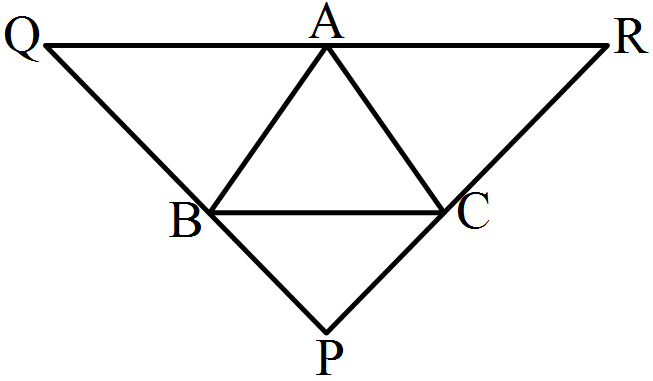
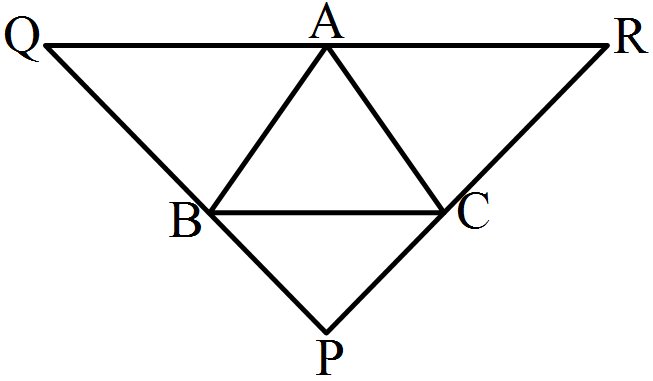
In the adjoining figure, $\triangle\text{ABC}$ is a triangle and through $A, B, C$, lines are drawn, parallel respectively to $BC, CA$ and $AB$, intersecting at $P, Q$ and $R$. Prove that the perimeter of $\triangle\text{PQR}$ is double the perimeter of $\triangle\text{ABC}.$
Answer
Given: A $\triangle\text{ABC},$ in which through points $A, B$ and $C$, lines $QR, QP$ and $RP$ have been draw parrallel to $BC, AC$ and $AB$ of $\triangle\text{ABC}$ respectively
.
To Prove: Perimeter of $\triangle\text{PQR}=2(\text{Perimeter of} \triangle\text{ABC})$
Proof: Since $AR\ ||\ BC$ and $AB\ ||\ RC$ [Given] So, $ABCR$ is a parallelogram.
 Therefore $AR = BC ...(i)$ Also, $AQ\ ||\ BC$ and $QB\ ||\ AC$
So,$ AQBC$ is a parallelogram,
Therefore $QA = BC...(ii)$ Adding both side of $(i)$ and $(ii)$,
we get $AR + QA = BC + BC \Rightarrow QR = 2BC$
$\Rightarrow\text{BC}=\frac{\text{QR}}{2}$
$\therefore\text{BC}=\frac{1}{2}\text{QR}$
Similarly we can prove $\text{AB}=\frac{1}{2}\text{RP}$ and
$\text{AC}=\frac{1}{2}\text{PQ}$
So, Perimeter of $\triangle\text{PQR}$
 $= PQ + QR + RP = 2AC + 2BC + 2AB = 2(AC + BC + AB) =2$(Perimeter of $\triangle\text{ABC}$)
View full question & answer
Question 195 Marks
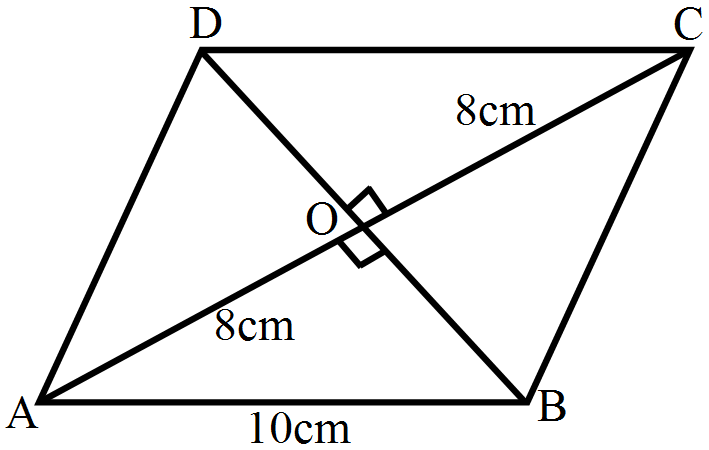
Each side of a rhombus is $10\ cm$ long and one of its diagonals measures $16\ cm$. Find the length of the other diagonal and hence find the area of the rhombus.
Answer
Since diagonals of a rhombus bisect each other at right angles.
So, $\text{AO = OC}=\frac{1}{2}\text{AC}=\frac{1}{2}\times16=8\text{cm}.$
$\therefore$ In right $\triangle\text{AOB},$
$\text{AB}^{2}=\text{AO}^2+\text{OB}^2$
$\Rightarrow10^2=8^2+\text{OB}^2$
$\Rightarrow\text{OB}^2=100-64=36$
$\Rightarrow\text{OB}=\sqrt{36}=6\text{cm}.$
$\therefore$ Length of the other diagonal $\text{BD}=2\times\text{OB}$
$=2\times6=12\text{cm}.$

Area of $\triangle\text{ABC}=\frac{1}{2}\times\text{AC}\times\text{OB}$
$=\frac{1}{2}\times16\times6=48\text{cm}^2.$
​​​​​​​ Area of $\angle\text{ACD}=\frac{1}{2}\times\text{AC}\times\text{OD}$
$=\frac{1}{2}\times16\times6=48\text{cm}^2.$
$\therefore$ Area of rhombus $ABCD$ = $(\text{Area of }\triangle\text{ABC}+\text{Area of }\triangle\text{ACD})$
$=(48+48)\text{cm}^2=96\text{cm}^2.$
View full question & answer
Question 205 Marks
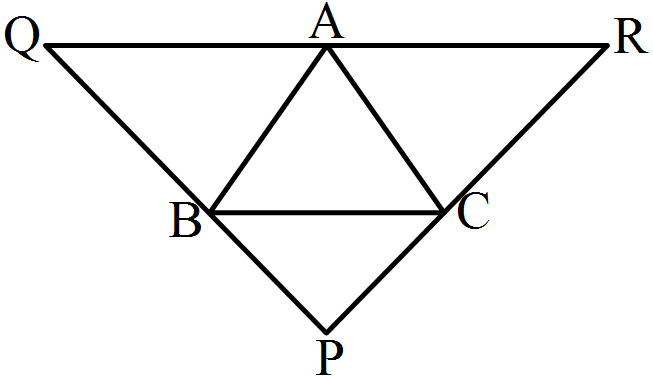
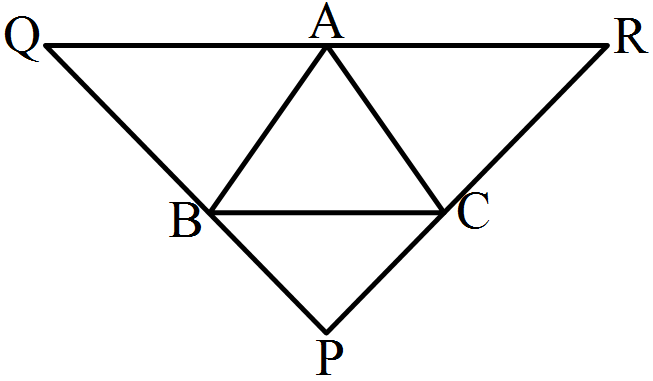
A $\triangle\text{ABC}$ is given. If lines are drawn through $A, B, C,$ parallel respectively to the sides $BC, CA$ and $AB$, forming $\triangle\text{PQR},$ as shown in the adjoining figure, show that $\text{BC}=\frac{1}{2}\text{QR}.$
Answer
Given: A $\triangle\text{ABC}$ in which through points $A, B$ and $C$, line $QR, QP$ and $RP$ are drawn parallel to $BC, CA$ and $AB$.
To prove: $\text{BC}=\frac{1}{2}\text{QR}$
Proof: Since $AR\ ||\ BC$ and $AB\ ||\ RC$ [Given]
So, $ABCR$ is a parallelogram. Therefore $AR = BC ...(i)$
Also, $AQ\ ||\ BC$ and $QB\ ||\ AC$
So, $AQBC$ is a parallelogram.
Therefore $QA = BC ...(ii)$
Adding both side of $(i)$ and $(ii)$,
we get $AR + QA = BC + BC$
$\Rightarrow QR = 2BC$
$\Rightarrow\text{BC}=\frac{\text{QR}}{2}$
$\therefore\text{BC}=\frac{1}{2}\text{QR}$
View full question & answer
Question 215 Marks
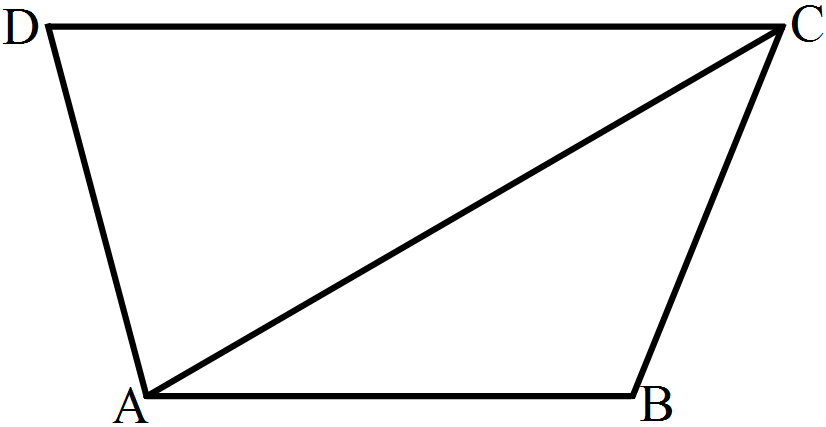
In the adjoining figure, $\text{ABCD}$ is a quadrilateral and $AC$ is one of its diagonals. Prove that:
$(i) AB + BC + CD + DA > 2AC $
$(ii) AB + BC + CD > DA$
$(iii) AB + BC + CD + DA > AC + BD$
Answer
Given: $\text{ABCD}$ is a quadrilateral and $AC$ is one of its diagonal.
$i.$ We know that the sum of any two sides of a triangle is greater than the third side.
In $\triangle\text{ABC},$
$AB + BC > AC ...(1)$
In $\triangle\text{ACD,}$
$CD + DA > AC ...(2)$
​Adding inequalities $(1)$ and $(2)$, we get:
$AB + BC + CD + DA > 2AC$
$ii.$ In $\triangle\text{ABC},$ we have:
$AB + BC > AC ...(1)$
We also know that the length of each side of a triangle is greater than the positive difference of the length of the other two sides.
In $\triangle\text{ACD},$ we have:​
$AC > DA − CD ...(2)$
From $(1)$ and $(2)$, we have:
$AB + BC > DA − CD​$
$\Rightarrow AB + BC + CD > DA$
$iii.$ In $\triangle\text{ABC, AB + BC > AC}$
In $\triangle\text{ACD, CD + DA > AC}$
In $\triangle\text{BCD, BC + CD > BD}$
In $\triangle\text{ABD, DA + AB > BD}$
​Adding these inequalities, we get:
$2(AB + BC + CD + DA) > 2(AC + BD)$
$\Rightarrow (AB + BC + CD + DA) > (AC + BD)$
View full question & answer
Question 225 Marks
In a $||$ gm $ABCD$, if $\angle\text{A}=(2\text{x}+25)^{\circ}$ and $\angle\text{B}=(3\text{x}-5)^{\circ},$ find the value of $x$ and the measure of each angle of the parallelogram.
Answer
In a parallelogarm, the opposite angle are equal.
So, in the parallelogram $ABCD$, $\angle\text{A}=\angle\text{C}$ and $\angle\text{B}=\angle\text{D}$ Since $\angle\text{A}=(2\text{x}+25)^{\circ}$
$\therefore\angle\text{C}=(2\text{x}+25)^{\circ}$ and $\angle\text{B}=(3\text{x}-5)^{\circ}$
$\therefore\angle\text{D}=(3\text{x}-5)^{\circ}$ In a parallelogram, the sum of all the four angles is $360^\circ$
$\therefore\angle\text{A}+\angle\text{B}+\angle\text{C}+\angle\text{D}=360^{\circ}$
$\Rightarrow(2\text{x}+25)+(3\text{x}+5)+(2\text{x}+25)+(3\text{x}-5)=360^{\circ}$
$\Rightarrow10\text{x}+40=360^{\circ}$
$\Rightarrow10\text{x}=360^{\circ}-40^{\circ}=320^{\circ}$
$\Rightarrow\text{x}=\frac{320}{10}=32^{\circ}$
$\therefore\angle\text{A}=(2\text{x}+25)=(2\times32+25)=89^{\circ}$
$\angle\text{B}=(3\text{x}-5)=(3\times32-5)=91^{\circ}$
$\angle\text{C}=(2\text{x}+25)=(2\times32+25)=89^{\circ}$
$\angle\text{D}=(3\text{x}-5)=(3\times32-5)=91^{\circ}$
$\therefore\angle\text{A}=\angle\text{C}=89^{\circ}$ and $\angle\text{B}=\angle\text{D}=91^{\circ}$
View full question & answer
Question 235 Marks
Show that the quadrilateral formed by joining the midpoints of the pairs of adjacent sides of a rhombus is a rectangle.
Answer

Let $ABCD$ be a rhombus and $P, Q, R$ and $S$ be the midpoints of $AB, BC, CD$ and $DA$, respectively.
Join the diagonals, $AC$ and $BD$.
In $\triangle\text{ABC},$ we have:
$\text{PQ ∣∣ AC}$ and $\text{PQ}=\frac{1}{2}\text{AC}$ [By midpoint theorem]
Again, in $\triangle\text{DAC,}$ the points $S$ and $R$ are the midpoints of $AD$ and $DC$, respectively.
$\therefore\text{SR }|| \text{ AC}$ and $\text{SR}=\frac{1}{2}\text{AC}$ [By midpoint theorem]
Now, $\text{PQ || AC}$ and $\text{SR || AC}\Rightarrow\text{PQ || SR}$
Also, $\text{PQ = SR}$ $\big[$Each equal to $\frac{1}{2}\text{AC}\big]$$ ...(i)$
So, $PQRS$ is a parallelogram.
We know that the diagonals of a rhombus bisect each other at right angles.
$\therefore\angle\text{EOF}=90^{\circ}$
Now, $\text{RQ || DB}$
$\Rightarrow\text{RE || FO}$
Also, $\text{SR || AC}$
$\Rightarrow\text{FR || OE}$
$\therefore$ $OERF$ is a parallelogram.
So, $\angle\text{FRE}=\angle\text{EOF}=90^{\circ}$ (Opposite angles are equal)
Thus, $PQRS$ is a parallelogram with $\angle\text{R}=90^{\circ}.$
$\therefore$ $PQRS$ is a rectangle.
View full question & answer
Question 245 Marks
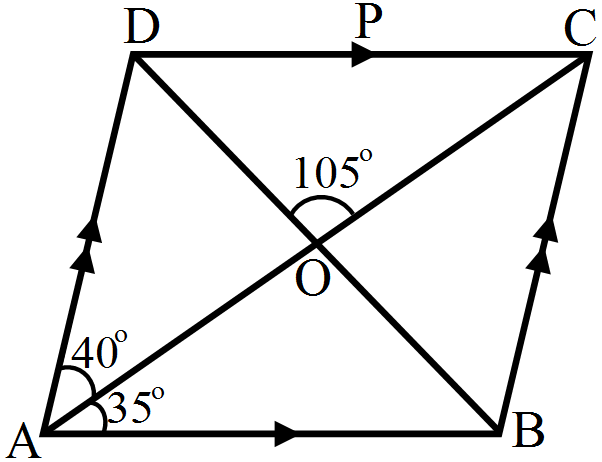
In the adjoining figure, $\text{ABCD}$ is a parallelogram in which $\angle\text{BAO}=35^{\circ},\angle\text{DAO}=40^{\circ}$ and $\angle\text{COD}=150^{\circ}.$ Calculate
$i. \angle\text{ABO},$
$ii. \angle\text{ODC},$
$iii. \angle\text{ACB},$
$iv. \angle\text{CBD}.$
Answer
$\text{ABCD}$ is a parallelogram

$i. \angle\text{AOB}=\angle\text{COB}=105^{\circ} [$Vertical opposite angels$]$
Now in $\triangle\text{AOB},$ we have
$\angle\text{OAB}+\angle\text{AOB}+\angle\text{ABO}=180^{\circ}$
$\Rightarrow35^{\circ}+105^{\circ}+\angle\text{ABO}=180^{\circ}$
$\Rightarrow140^{\circ}+\angle\text{ABO}=180^{\circ}$
$\Rightarrow\angle\text{ABO}=180^{\circ}-140^{\circ}=40^{\circ}.$
$ii.$ Since $AB\ \|\ DC$ and $BD$ is a transversal
So, $\angle\text{ABD}=\angle\text{CDB} [$alternate angles$]$
$\Rightarrow\angle\text{CDO}=\angle\text{CDB}=\angle\text{ABD}=\angle\text{ABO}=40^{\circ}$
$\therefore\angle\text{ODC}=40^{\circ}$
$iii.$ As $AB\ \|\ CD$ and $AC$ is a transversal
So, $\angle\text{ACB}=\angle\text{DAC}=40^{\circ} [$alternate opposite angles$]$
$iv. \angle\text{CBD}=\angle\text{B}-\angle\text{ABO}$
But, $\angle\text{A}+\angle\text{B}+\angle\text{C}+\angle\text{D}=360^{\circ}[\because
\text{ABCD}$ is a parrellogram$]$
$\Rightarrow2\angle\text{A}+2\angle\text{B}=360^{\circ}$
$\Rightarrow2\times(40^{\circ}+35^{\circ})+2\angle\text{B}=360^{\circ}$
$\Rightarrow150^{\circ}+2\angle\text{B}=360^{\circ}$
$\Rightarrow2\angle\text{B}=360^{\circ}-150^{\circ}=210^{\circ}$
$\Rightarrow\angle\text{B}=\frac{210^{\circ}}{2}=105^{\circ}$
and $\angle\text{CBD}=\angle\text{B}-\angle\text{ABO}$
$=105^{\circ}-40^{\circ}=65^{\circ}$
$\angle\text{CBD}=65^{\circ}$
View full question & answer
Question 255 Marks
The midpoints of the sides $AB, BC, CD$ and $DA$ of a quadrilateral $ABCD$ are joined to form a quadrilateral. If $AC = BD$ and $\text{AC}\perp\text{BD}$ then prove that the quadrilateral formed is a square.
Answer


Given: In quadrilateral $ABCD, AC = BD$ and $\text{AC}\perp\text{BD}.$ $P, Q, R$ and $S$ are the mid-points of $AB, BC, CD$ and $AD$, respectively.
To prove: $PQRS$ is a square.
Construction: Join $AC$ and $BD$.
Proof:
In $\triangle\text{ABC},$
$\because$ $P$ and $Q$ are mid-points of $AB$ and $BC$, respectively.
$\therefore\text{PQ || AC}$ and $\text{PQ}=\frac{1}{2}\text{AC}$ (Mid-point theorem)$ ...(1)$
Similarly, in $\triangle\text{ACD},$
$\because$ $R$ and $S$ are mid-points of sides $CD$ and $AD$, respectively.
$\therefore\text{SR || AC}$ and $\text{SR}=\frac{1}{2}\text{AC}$ (Mid-point theorem) $...(2)$

From $(1)$ and $(2)$, we get

$\text{PQ || SR}$ and $\text{PQ = SR}$
But this a pair of opposite sides of the quadrilateral $PQRS$.
So, $PQRS$ is parallelogram.
Now, in $\triangle\text{BCD,}$
$\because$ $Q$ and $R$ are mid-points of sides $BC$ and $CD$, respectively.
$\therefore\text{QR || BD}$ and $\text{QR}=\frac{1}{2}\text{BD}$ (Mid-point theorem) $...(3)$
From $(2)$ and $(3)$, we get
$\text{RS || AC}$ and $\text{QR || BD}$
But, $\text{AC}\perp\text{BD}$ (Given)
$\therefore\text{RS}\perp\text{QR}$
But this a pair of adjacent sides of the parallelogram $PQRS$.
So, $PQRS$ is a rectangle.
Again, $AC = BD$ (Given)
$\Rightarrow\text{RS = QR}$ [From $(2)$ and $(3)$]
But this a pair of adjacent sides of the rectangle $PQRS$.
Hence, $PQRS$ is a square.
View full question & answer
Question 265 Marks
The diagonals of a quadrilateral $ABCD$ are equal. Prove that the quadrilateral formed by joining the midpoints of its sides is a rhombus.
Answer

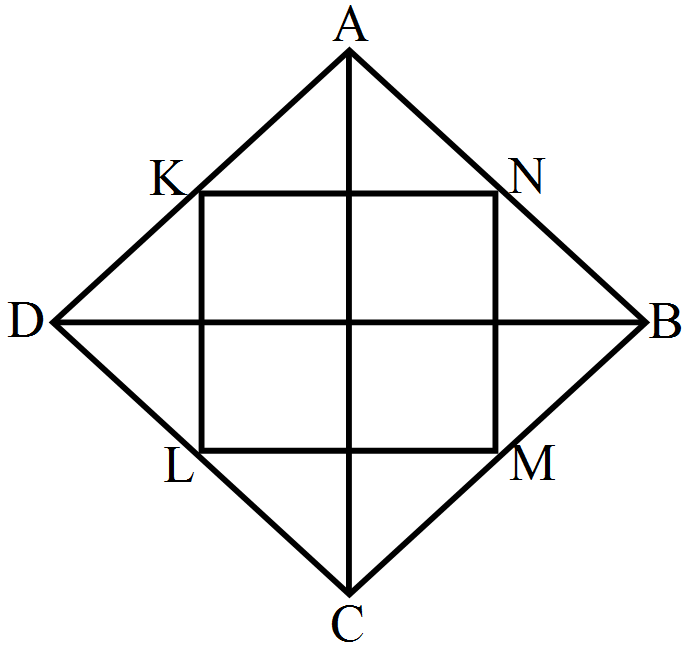
Given: In quadrilateral $ABCD, BD = AC$ and $K, L, M$ and $N$ are the mid-points of $AD, CD, BC$ and $AB$, respectively.
To prove: $KLMN$ is a rhombus.
Proof: In $\triangle\text{ADC},$
Since, $K$ and $L$ are the mid-points of sides $AD$ and $CD$, respectively.
So, $\text{KL || AC}$ and $\text{KL}=\frac{1}{2}\text{AC}...(1)$
Similarly, in $\triangle\text{ABC,}$
 Since, $M$ and $N$ are the mid-points of sides $BC$ and $AB$, respectively.
So, $\text{NM || AC}$ and $\text{NM}=\frac{1}{2}\text{AC}...(2)$ From $(1)$ and $(2)$,
we get $\text{KL = NM}$ and $\text{KL || NM}$ But this a pair of opposite sides of the quadrilateral $KLMN$.
So, $KLMN$ is a parallelogram. Now, in $\triangle\text{ABD},$
​​​​​​​ Since, $K$ and $N$ are the mid-points of sides $AD$ and $AB$, respectively.
So, $\text{KN || BD}$ and $\text{KN}=\frac{1}{2}\text{BD}...(3)$ But $\text{BD = AC}$ (Given)
$\Rightarrow\frac{1}{2}\text{BD}=\frac{1}{2}\text{AC}$
$\Rightarrow\text{KN = NM}$ [From $(2)$ and $(3)$]
But these are a pair of adjacent sides of the parallelogram $KLMN$.
Hence, $KLMN$ is a rhombus.
View full question & answer
Question 275 Marks
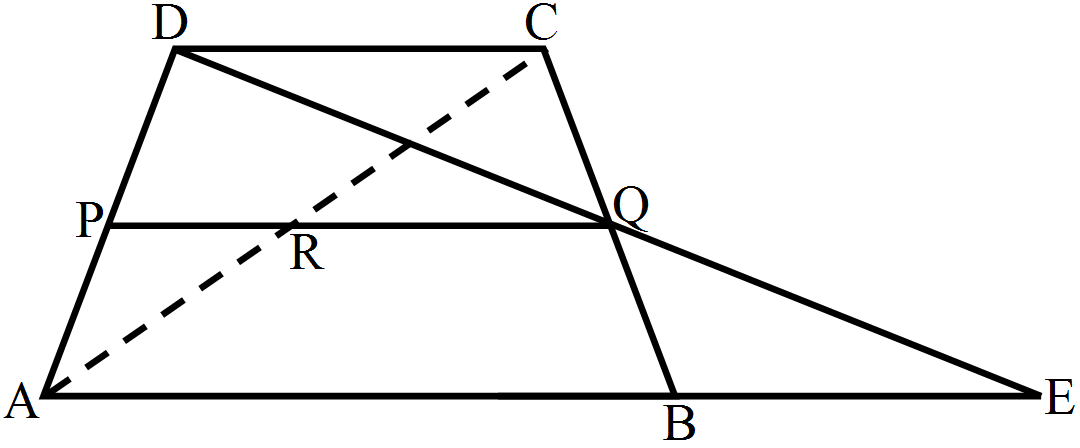
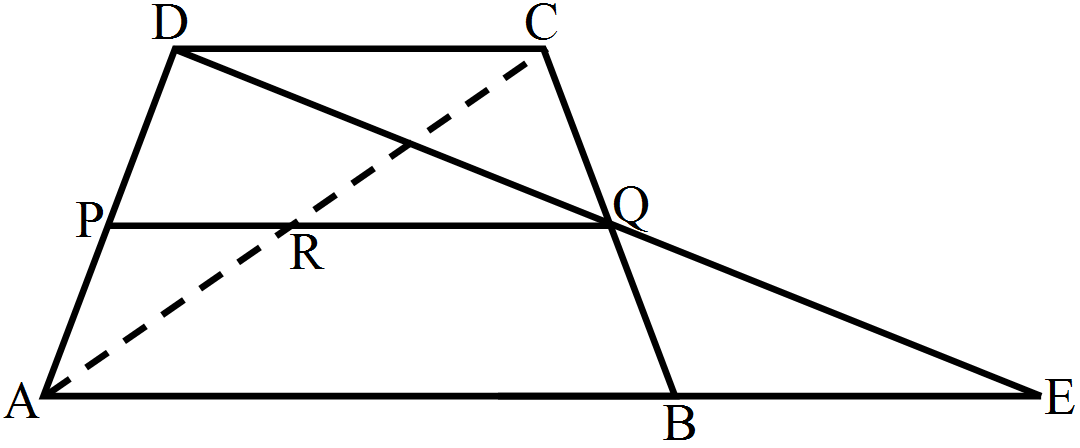
In the adjoining figure, $\text{ABCD}$ is a trapezium in which $AB\ \|\ DC$ and $P, Q$ are the midpoints of $AD$ and $BC$ respectively. $DQ$ and $AB$ when produced meet at $E$. Also, $AC$ and $PQ$ intersect at $R$. Prove that:
$i. DQ = QE,$
$ii. PR \| AB,$
$iii. AR = RC.$
Answer
Given: $\text{ABCD}$ is trapezium in which $AB\ \|\ DC$ $P$ and $Q$ are the mid$-$points of $AD$ and $BC$.
$DQ$ is joined and produced and $Ab$ is also produced and so that they meet at $E$.
$Ac$ cuts $PQ$ at $R$.

To prove: $DQ = QE ,PR \| AB,AR = RC$ Proof:
$i.$ Consider the triangles $\triangle\text{QCD}$ and $\triangle\text{QBE}$
$\angle\text{DQC}=\angle\text{BQE} [$verically opposite angles$]$
$\text{CQ = BQ}[\because Q$ is the midpoint of $BC]$
$\angle\text{QDC}=\angle\text{QEB} [AE \| DC$, is a transversal, and thus alternate angles are equal$]$
Thus, by Angles$-$Side$-$Angle criterion of congruence, we have
$\triangle\text{QCD}\cong\triangle\text{QEB} [$by $\text{ASA}]$
The corresponding parts of the congruent triangles are equal.
Thus, $DQ = QE [$by $\text{C.P.C.T.}]$
$ii.$ Midpoint Theorem: The line segment joining the midpoints of any two sides of a triangle is parallel to the third side and equal to half of it.
Thus by the midpoint Theorem, $PQ\ \|\ AE.$
$AB$ is a part of $AE$ and hence, we have $PQ\ \|\ AB$
Since the intercepts made by the lines $AB, PQ$ and $DC$ on $AD$
Since $PQ\ \|\ AB\ \|\ DC$
SO, $PR$ which is part of $PQ$ is also parallel to $AB$
$PR\ \|\ AB \|\ DC$
$iii.$ Intercept Theorem: If there are three parallel lines and the intercepts made by them on one transversal are equal then the intercept on any other transversal are also equal.
The three lines $PR, AB$ and $DC$ are cut by $AC$ and $AD$.
So, by intercept Theorem, $AR = RC$
View full question & answer
Question 285 Marks
The diagonals of a quadrilateral $ABCD$ are perpendicular to each other. Prove that the quadrilateral formed by joining the midpoints of its sides is a rectangle.
Answer


Given: In quadrilateral $ABCD$, $\text{AC}\perp\text{BD},$ $P, Q, R$ and $S$ are the mid-points of $AB, BC, CD$ and $AD$, respectively.
To prove: $PQRS$ is a rectangle.
Proof:
In $\triangle\text{ABC},$ $P$ and $Q$ are mid-points of $AB$ and $BC$, respectively.
$\therefore\text{PQ || AC}$ and $\text{PQ}=\frac{1}{2}\text{AC}$ (Mid-point theorem)$ ...(1)$
Similarly, in $\triangle\text{ACD},$
So, R and S are mid-points of sides $CD$ and $AD$, respectively.
$\therefore\text{SR || AC}$ and $\text{SR}=\frac{1}{2}\text{AC}$ (Mid-point theorem) $...(2)$
From $(1)$ and $(2)$, we get
$\text{PQ || SR}$ and $\text{PQ || SR}$
But this is a pair of opposite sides of the quadrilateral $PQRS$,
So, $PQRS$ is parallelogram.
Now, in $\triangle\text{BCD},$ $Q$ and $R$ are mid-points of $BC$ and $CD$, respectively.
$\therefore\text{QR || BD}$ and $\text{QR}=\frac{1}{2}\text{BD}$ (Mid-point theorem)$...(3)$
From $(2)$ and $(3)$, we get
$\text{SR || AC}$ and $\text{QR || BD}$
But, $\text{AC}\perp\text{BD}$ (Given)
$\therefore\text{RS}\perp\text{QR}$
Hence, $PQRS$ is a rectangle.
View full question & answer
Question 295 Marks
Show that the quadrilateral formed by joining the midpoints of the pairs of adjacent sides of a square is a square.
Answer


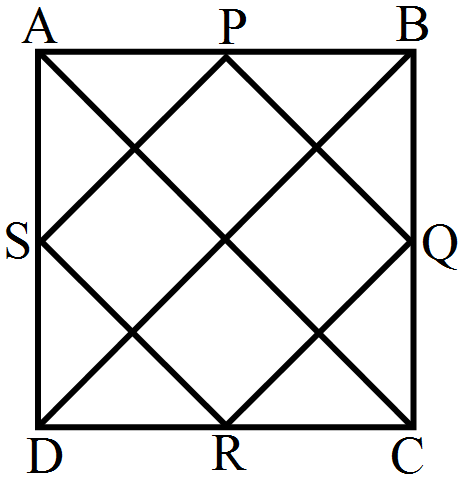
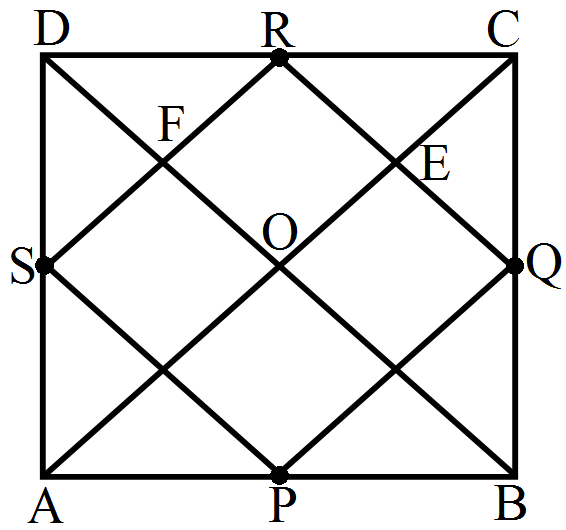
Let $ABCD$ be a square and $P, Q, R$ and $S$ be the midpoints of $AB, BC, CD$ and $DA$,respectively. Join the diagonals $AC$ and $BD.$
 Let $BD$ cut $SR$ at $F$ and $AC$ cut $RQ$ at $E$. Let $O$ be the intersection point of $AC$ and $BD$.
In $\triangle\text{ABC},$ we have:
$\therefore\text{PQ || AC}$ and $\text{PQ}=\frac{1}{2}\text{AC}$ [By midpoint theorem]
Again, in $\triangle\text{DAC,}$, the points $S$ and $R$ are the midpoints of $AD$ and $DC$, respectively.
$\therefore\text{SR || AC}$ and $\text{SR}=\frac{1}{2}\text{AC}$ [By midpoint theorem]
Now, $\text{PQ || AC}$ and $\text{SR || AC}\Rightarrow\text{PQ || SR}$
Also, $\text{PQ = SR}$ $\big[$Each equal to $\frac{1}{2}\text{AC}\big]$ $...(i)$
So, $PQRS$ is a parallelogram.
Now, in $\triangle\text{SAP}$ and $\triangle\text{QBP},$ we have:
$\text{AS = BQ}$
$\angle\text{A}=\angle\text{B}=90^{\circ}$
$\text{AP = BP}$
i.e., $\triangle\text{SAP}\cong\triangle\text{QBP}$
$\therefore\text{PS = PQ }...(\text{ii})$
Similarly, $\triangle\text{SDR}\cong\triangle\text{RCQ}$
$\therefore\text{SR = RQ }...(\text{iii})$
From $(i), (ii)$ and $(iii)$, we have:
$\text{PQ = PS = SR = RQ ...(iv)}$
We know that the diagonals of a square bisect each other at right angles.
$\therefore\angle\text{EOF}=90^{\circ}$
Now, $\text{RQ\ ||\ DB}$
$\Rightarrow\text{RE\ ||\ FO}$
Also, $\text{SR\ ||\ AC}$
$\Rightarrow\text{FR\ ||\ OE}$
$\therefore$ $OERF$ is a parallelogram.
So, $\angle\text{FRE}=\angle\text{EOF}=90^{\circ}$ (Opposite angles are equal)
Thus, $PQRS$ is a parallelogram with $\angle\text{R}=90^{\circ}$ and $\text{PQ = PS = SR = RQ.}$
$\therefore$ $PQRS$ is a square.
View full question & answer
Question 305 Marks
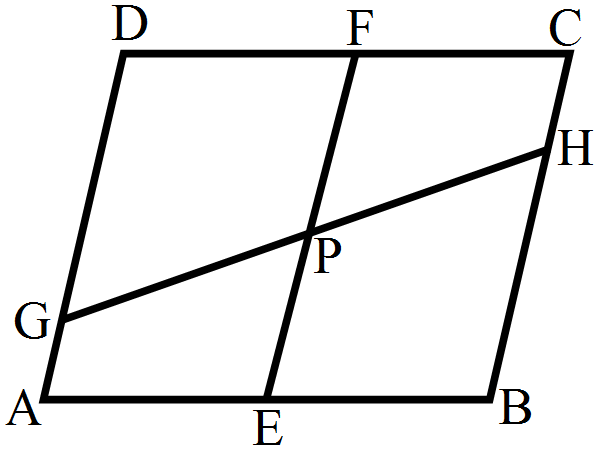
In the adjoining figure, $ABCD$ is a $||$ gm in which $E$ and $F$ are the midpoints of $AB$ and CDrespectively.If $GH$ is a line segment that cuts $AD, EF$ and $BC$ at $G, P$ and $H$ respectively, prove that $GP = PH$.
Answer
Given: A parallelogram $ABCD$ in which $E$ and $F$ are the mid points of $AB$ and $CD$. A line segment $GH$ cuts $EF$ at $P$.
To prove: $GP = PH$
 Proof: $AD, EF$ and $BC$ are three line segments and $DC$ and $Ab$ are two transversal.
The intercepts made by the line on transversal $AB$ and $CD$ are equal because, $AE = EB$ and $DF = FC$
We need to prove that $FE$ is parallel to $AD$.
Let us prove by the method of contradiction.
Let us assume that $FE$ is not parallel to $AD$.
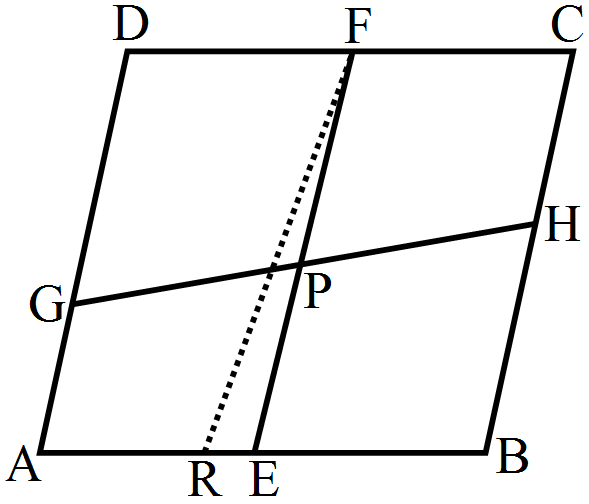
Now, draw $FR$ parallel to $AD$.
Intercept Theorem: If there are three parallel lines and the intercepts made by them on one transversal are equal then the intercept on any other transversal are also equal.
Thus, by Intercept Theorem, $AR = RB$ because
$DF = FC$
But $AE = EB$ [Given]
There can not be two mid points $R$ and $E$ of $AB$. Hence our assumption is wrong.
SO, $AD\ ||\ EF\ ||\ BC$
Now, again by Intercept Theorem, we have
$GP = PH$
because GH is transversal and intecept made by $AD, EF$ and $BC$ on are as $DF = FC$.
View full question & answer
Question 315 Marks
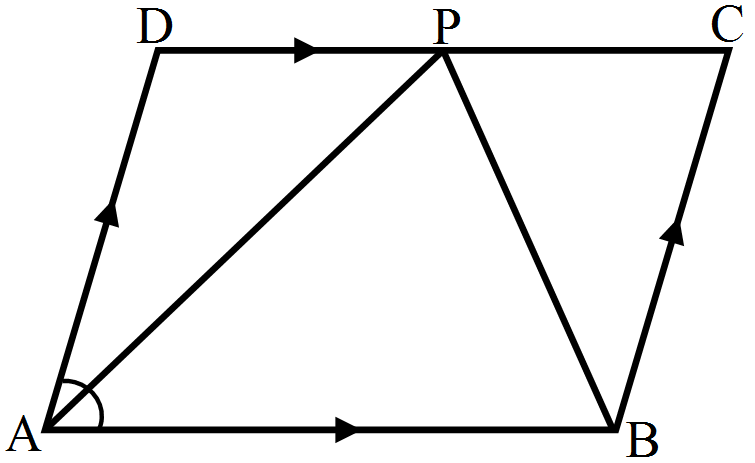
In the adjoining figure, $\text{ABCD}$ is a parallelogram in which $\angle\text{A}=60^{\circ}.$ If the bisectors of $\angle\text{A}$ and $\angle\text{B}$ meet $DC$ at $P$, prove that
$i. \angle\text{APB}=90^{\circ},$
$ii. AD = DP$ and $PB = PC = BC$,
$iii. DC = 2AD$.
Answer

$\text{ABCD}$ is a parallelogram in which $DA = 60^\circ$ and bisectore of $A$ and $B$ meets $DC$ at $P$.
$i.$ In a parallelogram, opposite angles are equal.
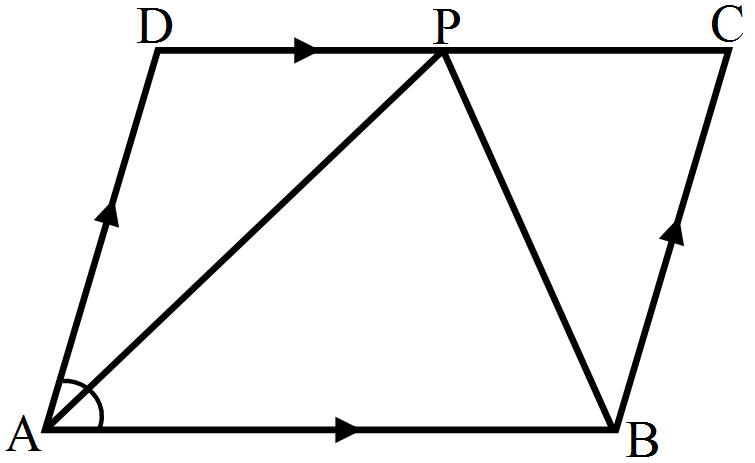
So, $\angle\text{C}=\angle\text{A}=60^{\circ}$
In a parallelogram the sum of all the four angles is $360^\circ $
$\Rightarrow\angle\text{A}+\angle\text{B}+\angle\text{C}+\angle\text{D}=360^{\circ}$
Now, $\angle\text{B}+\angle\text{D}=360^{\circ}-(\angle\text{A}+\angle\text{C})$
$=360^{\circ}-(60^{\circ}+60^{\circ})=240^{\circ}$
$\therefore2\angle\text{B}=240^{\circ}$ $[\because\angle\text{B}=\angle\text{D}]$
So, $\angle\text{B}=\angle\text{D}=\frac{240^{\circ}}{2}=120^{\circ}$
Since $AB\ \|\ DP$ and $AP$ is a transversal
SO, $\angle\text{APD}=\angle\text{PAB}=\frac{60^{\circ}}{2}=30^{\circ}...(1)[\therefore$ alternate angles$]$
Also, $AB\ \|\ PC$ and $BP$ is a transversal.
So, $\angle\text{ABP}=\angle\text{CPB}$
But, $\angle\text{ABP}=\frac{\angle\text{B}}{2}=\frac{120^{\circ}}{2}=60^{\circ}$
$\therefore\angle\text{CPB}=60^{\circ}...(2)$
Now, $\angle\text{APD}+\angle\text{APB}+\angle\text{CPB}=180^{\circ} [$As $\text{DPC}$ is a straight line$]$
$30^{\circ}+\angle\text{APB}+60^{\circ}=180^{\circ}$
$\Rightarrow\angle\text{APB}=180^{\circ}-30^{\circ}-60^{\circ}=90^{\circ}$
$ii.$ Since $\angle\text{APD}=30^{\circ} [$from $(1)]$
and $\angle\text{DAP}=\frac{60^{\circ}}{2}=30^{\circ}$
So, $\angle\text{APD}=\angle\text{DAP}$
Now in $\triangle\text{APD},$
$\angle\text{APD}=\angle\text{DAP}...(3)$
$\therefore\text{DP = AD} [$isosceles triangle, sides are equal$]$
As $\angle\text{CPB}=60^{\circ} [$from $(2)]$
and $\angle\text{C}=60^{\circ}$
So, $\angle\text{PBC}=180^{\circ}-60^{\circ}-60^{\circ}=60^{\circ}$
Since all angles in the $\triangle\text{PCB}$ are equal,
it is an equilateral triangle.
$\therefore\text{PB = PC = BC}...(4)$
$iii. \angle\text{DPA}=\angle\text{PAD}, [$from $(3)]$
$\therefore\text{DP = AD} [$isoscele striangle, sides are equal$]$
$=\text{BC} [$opposite sides are equal$]$
$=\text{PC} [$from $(4)]$
$=\frac{1}{2}\text{DC} [\because\text{DP = PC}\Rightarrow\text{P}$ is the midpoint of $DC]$
$\therefore\text{DC = 2AD.}$
View full question & answer