Question 12 Marks
A trolley, while going down an inclined plane, has an acceleration of $2cm s^{-2}$. What will be its velocity $3$ s after the start?
AnswerInitial velocity $=0 m / s$ (since the trolley was at rest) Acceleration $= a =2 cm s ^{-2}=0.02 ms^{-2}$ Time $= t =3 sec$ Using the first equation of motion, $v=u+$ at $v=0+(0.02 * 3) v=0.06 ms^{-2}$
View full question & answer→Question 22 Marks
A bus decreases its speed from $80\ km/h^{−1}$ to $60km/h^{−1}$ in $5s$. Find the acceleration of the bus.
AnswerInitial speed of the bus, $ u = 80\ km/h=80\times\frac{5}{18}=22.22\text{m/s}$
Final speed of the bus, $v = 60\ km/h=60\times\frac{5}{18}=16.66\text{m/s}$
Time take to decrease the speed, $t = 5s$ Acceleration, $\text{a}=\frac{\text{v}-\text{u}}{\text{t}}$
$=\frac{16.66-22.22}{5}=-1.112\text{m/s}^2$
Here, the negative sign of acceleration indicates that the velocity of the car is decreasing.
View full question & answer→Question 32 Marks
An object is moving along a straight line with uniform acceleration. The following table gives the velocity of the object at various instants of time:
|
Time (in sec.):
|
$0$
|
$1$
|
$2$
|
$3$
|
$4$
|
$5$
|
$6$
|
|
Velocity (in m/s):
|
$2$
|
$4$
|
$6$
|
$8$
|
$10$
|
$12$
|
$14$
|
Plot the graph. From the graph,
- Find the velocity of the object at the end of $2.5$ seconds.
- Calculate the acceleration.
- Calculate the distance covered in the last $4$ seconds.
Answer$\text{a}=\frac{\text{v}-\text{u}}{\text{t}}$$\text{a}=\frac{4-2}{1}=2\text{m/s}^2$
Now for,
$\text{t}=2.5$
$\text{a}=\frac{\text{v}-\text{u}}{\text{t}}$
$2=\frac{\text{v}-2}{2.5}$
$5=\text{v}-2$
$\text{v}=7$
View full question & answer→Question 42 Marks
A car accelerates from $6ms^{-1}$ to $16ms^{-1}$ in $10\sec$. Calculate: The distance covered by the car in that time.
Answerdistance $=?=s$ We know that, $2as =v^2-u^2 2(1)(s)=(16)^2-(6)^2 2 s=256-362 s=220 \mathrm{~s}=110$
View full question & answer→Question 52 Marks
How will you show that the slope of the displacement-time graph gives the velocity of the body?
Answer
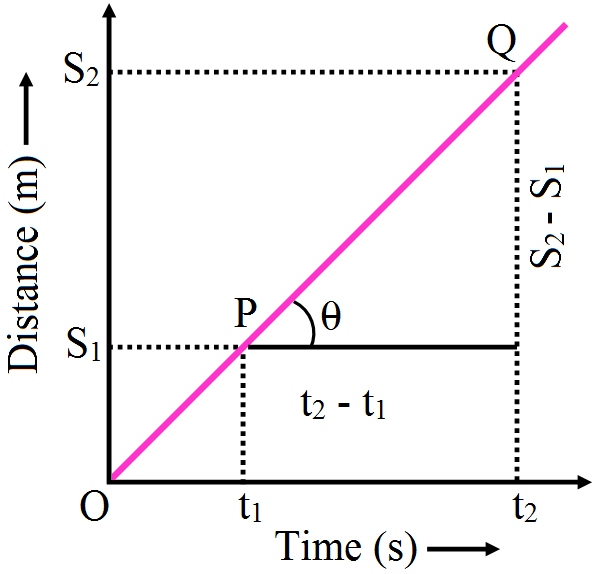
The adjoining figure shows the displacement-time graph for a body moving with unifrom velocity. clearly. it covers distance $s_1$ and $s_2$ at times $t_1$ and $t_2$ respectively.
Slop of line $\text{PQ}=\text{tan}\theta=\frac{\text{QR}}{\text{PR}}$
$=\frac{\text{s}_{2}-\text{s}_{1}}{\text{t}_{2}-\text{t}_{1}}=\frac{\text{Displacement}}{\text{Time}}$
$\text{As}\frac{\text{Displacement}}{\text{Time}}$ is velocity, so the slope of the distance-time graph gives velocity of the body. View full question & answer→Question 62 Marks
Bus $X$ travels a distance of $360\ km$ in $5$ hours whereas bus $Y$ travels a distance of $476\ km$ in $7$ hours. Which bus travels faster$?$
AnswerFor bus $X,\text{Speed}=\frac{\text{Distance}}{\text{Time}}$
Speed $=\frac{360}{5}=72\text{km}/\text{h}$
For bus $Y,\text{Speed}=\frac{\text{Distance}}{\text{Time}}$
Speed $=\frac{476}{7}=68\text{km}/\text{h}$
Speed of bus $X$ is more than that of bus $Y.$ Hence, bus $X$ travels faster.
View full question & answer→Question 72 Marks
What type of motion, uniform or non-uniform, is exhibited by a freely falling body$?$ Give reason for your answer.
AnswerA freely falling body has non-uniform motion because it covers smaller distances in the initial $'1$ second' intervals and larger distances in the later $'1$ second' intervals, i.e., it covers unequal distances in equal intervals of time.
View full question & answer→Question 82 Marks
Joseph jogs from one end $A$ to the other end $B$ of a straight $300m$ road in $2$ minutes $30$ seconds and then turns around and jogs $100m$ back to point $C$ in another $1$ minute. What are Joseph’s average speeds and velocities in jogging $(a)$ from $A$ to $B$ and $(b)$ from $A$ to $C?$
Answer
Total Distance covered from $AB = 300m$
Total time taken $= 2 × 60 + 30s$
$=150s$
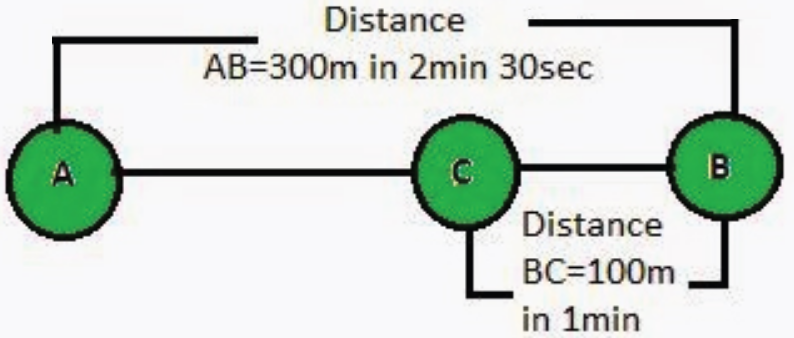
Therefore, Average Speed from $AB =$ Total Distance/Total Time
$=\frac{300}{150}\text{m s}^{-1}$
$=2\text{m s}^{-1}$
Therefore, Velocity from $AB =$ Displacement $AB/$Time
$=\frac{300}{150}\text{m s}^{-1}$
$=2\text{m s}^{-1}$
Total Distance covered from $AC = AB + BC$
$= 300 + 200m$
Total time taken from $A$ to $C = $Time taken for $AB\ +$ Time taken for $BC$
$= (2 × 60 + 30) + 60s$
$= 210s$
Therefore, Average Speed from $AC =$ Total Distance/Total Time
$=\frac{400}{210}\text{m s}^{-1}$
$=1.904\text{m s}^{-1}$
Displacement $(S)$ from $A$ to $C = AB – BC$
$= 300 - 100m$
$= 200m$
Time $(t)$ taken for displacement from $AC = 210s$
Therefore, Velocity from $AC =$ Displacement $(s)/$Time$(t)$
$=\frac{200}{210}\text{m s}^{-1}$
$=0.952\text{m s}^{-1}$ View full question & answer→Question 92 Marks
On a $120\ km$ track a train travels the first $30\ km$ at a uniform speed of $30\ km/h.$ Calculate the speed with which the train should move rest of the track so as to average 60\ km/h for the entire trip.
AnswerTime That Should Be Taken So As. To Attain An Average Speed Of $60\ km/hr$
$=\frac{120}{60}=2\text{ Hours}$
Time Taken To Cover $30\ km =\frac{30}{30}=1\text{ Hour}$
Remaining Time $= 2 - 1 = 1$ Hour
Now Distance Remaining $= 90\ km$
Speed $=\frac{\text{Distance}}{\text{Time}}$
$=\frac{90}{1}=90\text{km/hr}$
View full question & answer→Question 102 Marks
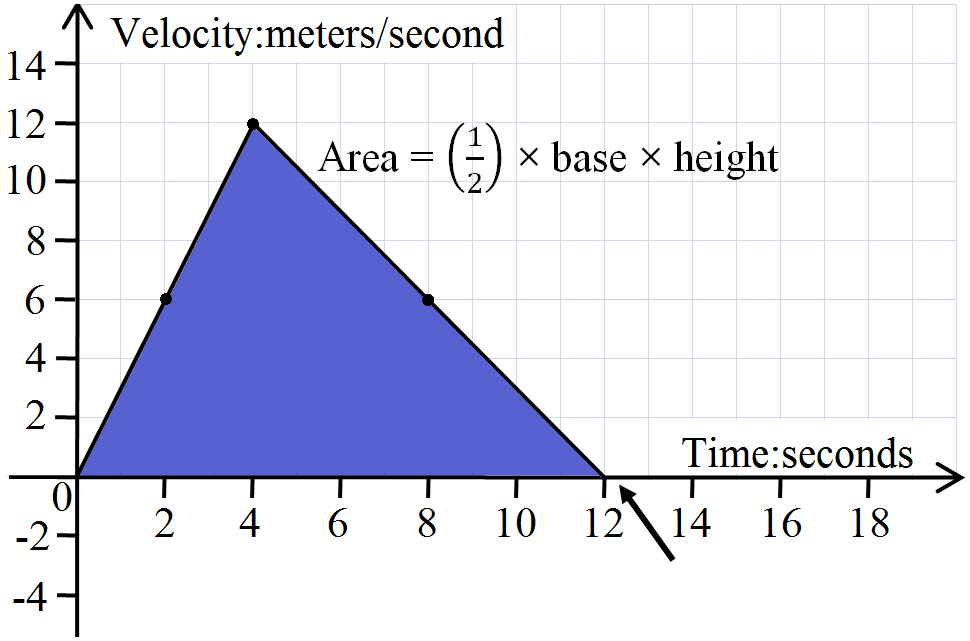
How can you calculate the following? Displacement from velocity-time graph.
Answer
The Magnitude of Displacement is the area under the curve of velocity time graph.
View full question & answer→Question 112 Marks
In the figure below is shown the time-distance graph of cyclist.
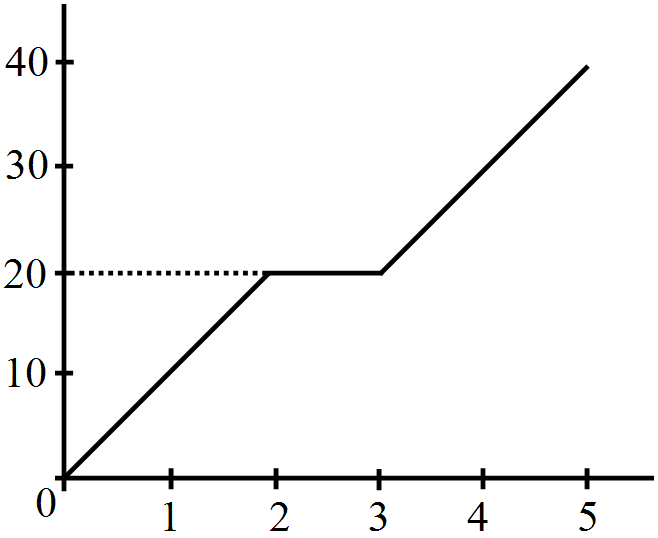
Find out from the graph average speed in the whole journey.
AnswerAverage Speed $=\text{Initial}+\frac{\text{Final speed}}{2}$ Average Speed $=0+\frac{4}{2}$ Average Speed = 20M/S.
View full question & answer→Question 122 Marks
The maximum speed of a train is $80\ km/h.$ It takes $10h$ to cover a distance of $400\ km.$ Find the ratio of its maximum speed to its average speed.
AnswerAccording to question the we can use the formula of average speed
average speed.$=\frac{\text{total distance}}{\text{total times}}$
$=\frac{400}{10}=40\text{km/hr}$
the ratio of maximum speed to average speed$=\frac{80}{40}=2$ (as maximum speed of the train is $80\ km/hr$ given)
$=2:1$
View full question & answer→Question 132 Marks
Draw a velocity-time graph to show the following motion:
A car accelerates uniformly from rest for $5s ;$ then it travels at a steady’ velocity for $5s.$
View full question & answer→Question 142 Marks
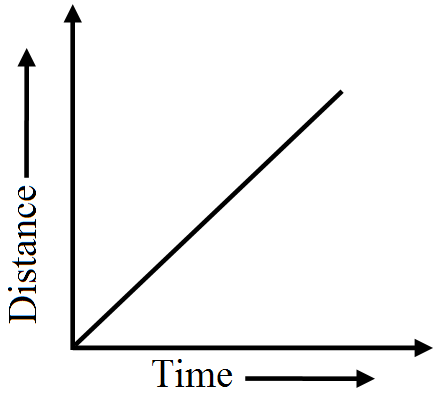
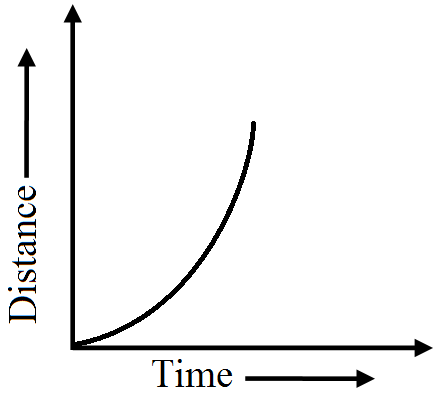
What is the nature of the distance - 'time graphs for uniform and non-uniform motion of an object?
AnswerWhen the motion is uniform,the distance time graph is a straight line with a slope.
When the motion is non uniform, the distance time graph is not a straight line.It can be any curve.
View full question & answer→Question 152 Marks
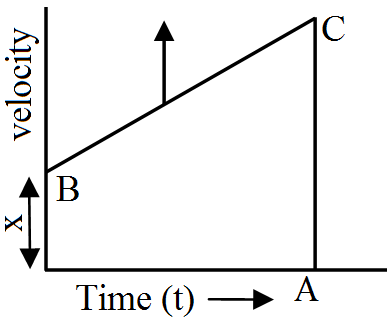
A body with an initial velocity x moves with a uniform acceleration y. Plot its velocity-time graph.
AnswerWe have to plot a graph between velocity and time. From the graph we can conclude that the curve is a straight line showing uniform acceleration.
View full question & answer→Question 162 Marks
State an important characteristic of uniform circular motion. Name the force which brings about uniform circular motion.
AnswerAn important characteristic of uniform circular motion is that the direction of motion in it changes continuously with time, so it is accelerated. Centripetal force brings about uniform circular motion.
View full question & answer→Question 172 Marks
If a bus travelling at $20m/s$ is subjected to a steady deceleration of $5m/s^2$, how long will it take to come to rest$?$
AnswerDeceleration, $a = -5m/s^2$
Initial velocity, $u = 20m/s$
Final velocity, $v = 0m/s $
$t = ?$
$\text{a}=\frac{\text{v}-\text{u}}{\text{t}}$
$-5=\frac{0-20}{\text{t}}$
$\text{t}=\frac{20}{5}=4\text{s}$
View full question & answer→Question 182 Marks
Define speed. What is the SI unit of speed?
AnswerIf an object changes the location relative to the time other than the other, then this state of the object is called motion/ motion. In general terms the meaning of speed - the change in the position of the object is called speed.
View full question & answer→Question 192 Marks
In which one of the following cases will the distance covered and the magnitude of the displacement are not the same? Justify.
- A passenger in a train travels from Delhi to Kolkata.
- A raindrop falling in still air.
- An athlete completes one lap in a race.
Answer
- An athlete completes one lap in a race.
Explanation:
Because the total distance covered by athlete is the total length of race plot but the displacement will be zero because the initial and final point is same.
View full question & answer→Question 202 Marks
A bus starting from rest moves with a uniform acceleration of $0.1m/ s^{-2}$ for $2$ minutes. Find (a) the speed acquired, (b) the distance travelled.
Answer
- Given:
$u = 0$
$v = ?$
$a = 0.1 m/s^2$
$t = 120 sec$
$a = v - ut$
$0.1 = \frac{\text{v}–0}{120}$
$= 12m/ s$
- Given:
$u = 0$
$v = 12m/ s$
$t = 120 sec$
$a = 0.1m/ s^2$
According to the third equation of motion,
$v^2 + u^2 = 2 as$
$(12)^2+ (0)^2 = 2(0.1)s$
On solving the above equation, $s=720$ metres. View full question & answer→Question 212 Marks
When is a body said to have uniform velocity?
AnswerWhen a body covers equal distances in equal intervals of time in a particular direction however small or big the time interval may be, the object is said to have uniform velocity.
View full question & answer→Question 222 Marks
Define velocity. What is the $SI$ unit of velocity$?$
AnswerSpeed of a body is the distance travelled by it per unit time. The $S.I.$ unit of speed is $m/s.$
View full question & answer→Question 232 Marks
A bus running at a speed of $18\ km/h$ is stopped in $2.5$ seconds by applying brakes. Calculate the retardation produced.
AnswerInitial velocity, $u = 18\ km/h$
$\text{u}=18\times\frac{1000}{3600}=\frac{18000}{3600}\text{m/s}=\text{m/s}$
Final velocity, $v = 0\ m/s$
Time, $t = 2.5\ \sec$
Acceleration, $a = ?$
Using, $v = u + at$
$\text{a}=\frac{\text{v-u}}{\text{t}}=\frac{0-5}{2.5}2\text{m/s}^2$
So, retardation is $2m/s^2.$
View full question & answer→Question 242 Marks
Give two factors on which acceleration depends.
AnswerYes, that's right, a change in the direction of motion results in an acceleration even if the moving object neither sped up nor slowed down. That's because acceleration depends on the change in velocity and velocity is a vector quantity-one with both magnitude and direction.
View full question & answer→Question 252 Marks
Three speed-time graphs are given below:
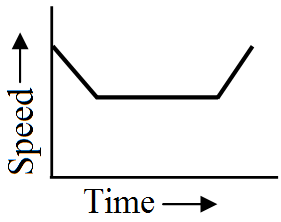
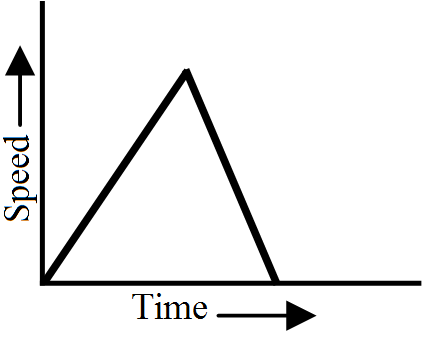
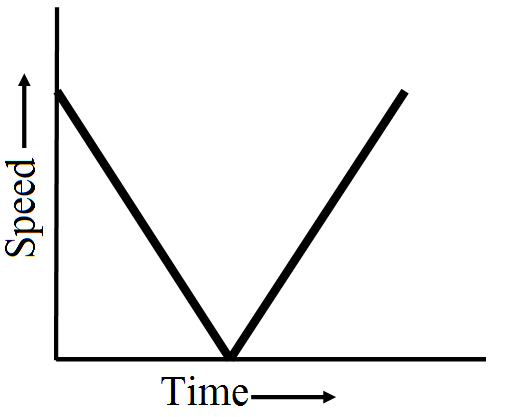
Which graph represents the case of:
- A cricket ball thrown vertically upwards and returning to the hands of the thrower?
- A trolley decelerating to a constant speed and then accelerating uniformly?
Answer
- Graph $(c)$ represents a cricket ball thrown vertically upwards and returning to the hands of the thrower.
- Graph $(a)$ represents a trolley decelerating to a constant speed and then accelerating uniformly.
View full question & answer→Question 262 Marks
A ball hits a wall horizontally at $6.0\ ms^{-1}$. It rebounds horizontally at $4.4\ ms^{-1}$. The ball is in contact with the wall for $0.040\ s .$
What is the acceleration of the ball$?$
AnswerInitial velocity, $u = 6\ m/s$
Final velocity, $v = -4.4\ m/s ($the ball rebounds in opposite direction$)$
Time, $t = 0.040\ s$
Acceleration velocity $=\frac{\text{u}-\text{v}}{\text{t}}=\frac{-4,4-6}{0.040}=-260\text{m/s}^2$
View full question & answer→Question 272 Marks
An artificial satellite is moving in a circular orbit of radius $42250\ km.$ Calculate its speed if it takes $24$ hours to revolve around the earth.
AnswerRadius of the circular orbit, $r= 42250\ km$
Time taken to revolve around the earth, $t= 24 h$
Speed of a circular moving object, $\text{v}=\frac{(2\pi\text{r})}{\text{t}}$
$=\frac{[2× (22/7)×42250 × 1000]}{(24 × 60 × 60)}$
$=\frac{(2×22×42250×1000)}{(7 ×24 × 60 × 60)}\text{m s}^{-1}$
$=3073.74\text{m s}^{-1}$
View full question & answer→Question 282 Marks
A train starting from stationary position and moving with uniform acceleration attains a speed of $36\ km$ per hour in $10$ minutes. Find its acceleration.
AnswerInitial velocity, $u = 0m/s$
Final velocity, $v = 36km/h = 10m/s$
Time,$ t = 10min = 10 \times 60 = 600 \sec$
Acceleration, $a = ?$
Acceleration $=\frac{\text{Final velocity-Initial velocity}}{\text{time taken}}$
So, $\text{a}=\frac{\text{v-u}}{\text{t}}$
$=\frac{10-0}{600}=\frac{10}{600}\text{m/s}^2$
$=\frac{1}{60}\text{m/s}^2-0.16\text{m/s}^2$
View full question & answer→Question 292 Marks
During an experiment, a signal from a spaceship reached the ground station in five minutes. What was the distance of the spaceship from the ground station? The signal travels at the speed of light, that is, $3 \times 10^8m/ s^{−1}.$
AnswerSpeed $= 3 \times 10^8 m/ s^{−1}$ Time
$= 5\ min = 5 \times 60 = 300$ secs.
Distance $=$ Speed $\times $ Time
Distance $= 3 \times 10^8m/ s^{−1} \times 300$
secs. $= 9 \times 10^{10}m.$
View full question & answer→Question 302 Marks
What is the difference between uniform linear motion and uniform circular motion$?$ Explain with examples.
AnswerUniform linear motion is uniform motion along a linear path or a straight line. The direction of motion is fixed. So, it is not accelerated.
For example: A car running with uniform speed of $10\ km/hr$ on a straight road.
Uniform circular motion is uniform motion along a circular path. The direction of motion changes continuously. So, it is accelerated.
For example: Motion of earth around the sun.
View full question & answer→Question 312 Marks
The velocity-time graph for part of a train journey is a horizontal straight line. What does this tell you about $(a)$ the train’s velocity, and $(b)$ about its acceleration$?$
Answer
- The train has a uniform velocity.
- There is no acceleration.
View full question & answer→Question 322 Marks
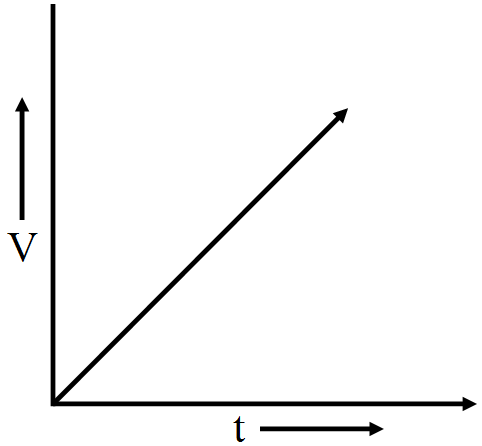
Plot velocity-time graph of a body. Moving with a variable acceleration.
AnswerVariable acceleration.
View full question & answer→Question 332 Marks
Given figures represent the motion of two objects $P$ and $Q.$ Which of the objects has positive acceleration and which one has negative acceleration?
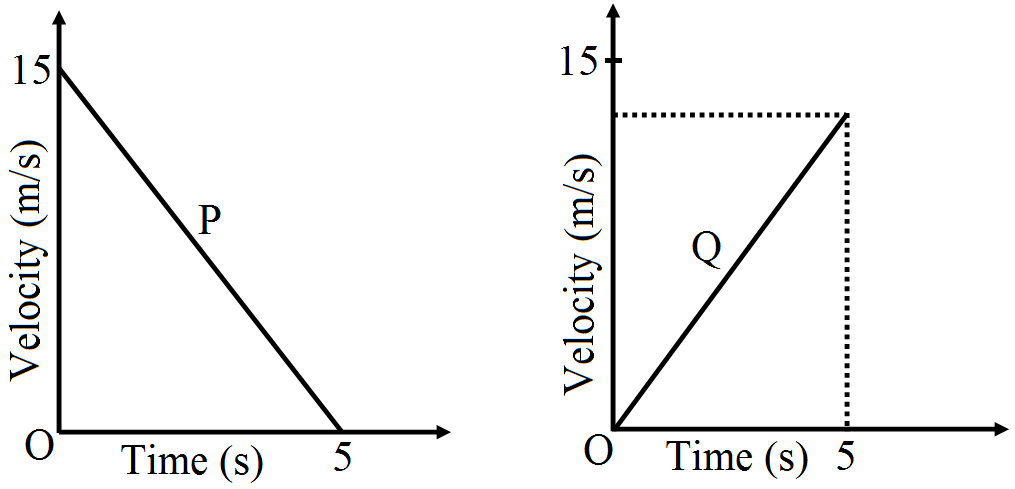
AnswerGraph $P$ is having negative acceleration as the time is increasing, velocity is decreasing and finally comes to rest which shows retardation whereas Graph $Q$ represents positive acceleration as the time is increasing velocity is also increasing.
View full question & answer→Question 342 Marks
A body is moving along a circular path of radius $R.$ What will be the distance travelled and displacement of the body when it completes half a revolution$?$
AnswerDistance travelled in half a rotation of a circular path is equal to the circumference of semi-circle,
i.e. Distance travelled in half a rotation of a circular path is equal to the circumference of semi-circle,
i.e $=\pi\text{R}.$
Displacement $=$ diameter of circle $= 2R.$
View full question & answer→Question 352 Marks
A body is moving with a velocity of $10m/s$. If it starts acceleration with the rate of $2.5m/s^2$. Find out its velocity after 10s.
Answer$V = u +$ at $u = 10m/s a = 2.5m/s^2 t = 10s v = 10+ 2.5 × 10 = 35m/s$ The velocity of the body after $10s$ is $35m/s$.
View full question & answer→Question 362 Marks
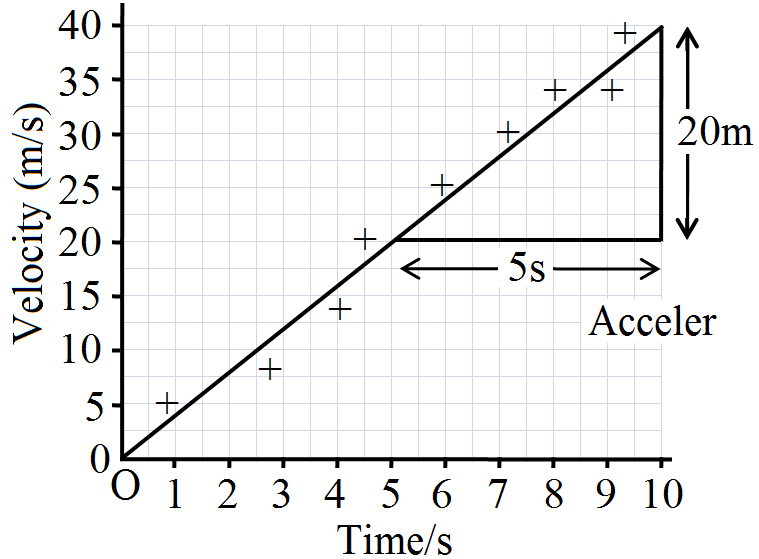
How can you calculate the following? Acceleration from velocity-time graph.
Answer
Acceleration is also the slope of the velocity-time graph.
$\text{Slope = Acceleration}=\frac{\text{Change in velocity}}{\text{Change in time}}$
View full question & answer→Question 372 Marks
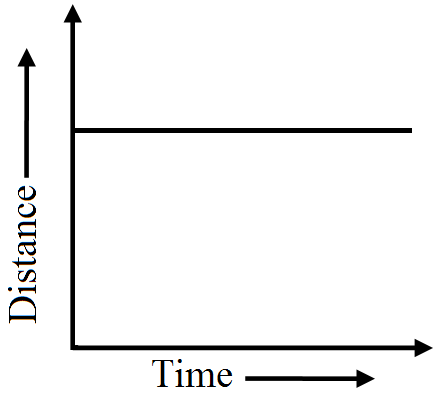
What can you say about the motion of an object whose distance - time graph is a straight line parallel to the time axis?
AnswerIf distance time graph is a straight line parallel to the time axis, the body is at rest.
View full question & answer→Question 382 Marks
Explain the meaning of the following equation of motion: $v = u + at$ where symbols have their usual meanings.
Answer$v = u + at$ is the first equation of motion. It gives the velocity acquired by a body in time t when the body has initial velocity u and uniform acceleration a.
View full question & answer→Question 392 Marks
Velocity-time graphs of two objects $P$ and $Q$ are as given below:
Which object has more velocity after $5s?$
AnswerGraph $P$ will have more velocity after $5$secs as from the graphs we can infer that in Graph $P$ after $5$secs the velocity is $14m/s$ whereas in Graph $Q$ the velocity reaches $12m/s.$ Both the graph shows uniform acceleration but object in graph $P$ has an initial velocity of $2m/s$ and object in graph $Q$ starts from rest.
View full question & answer→Question 402 Marks
A train starting from Railway Station attains a speed of $21\ m/s$ in one minute. Find its acceleration.
Answer$u = 0m/s $
$v = 21m/s$
Time, $t = 1\ min = 60\sec$
$\text{a}=\frac{\text{v}-\text{u}}{\text{t}}$
$\text{a}=\frac{\text{21}-\text{0}}{\text{60}}$
$\text{a}=\frac{21}{60}=0.35\text{m}/\text{s}^2$
View full question & answer→Question 412 Marks
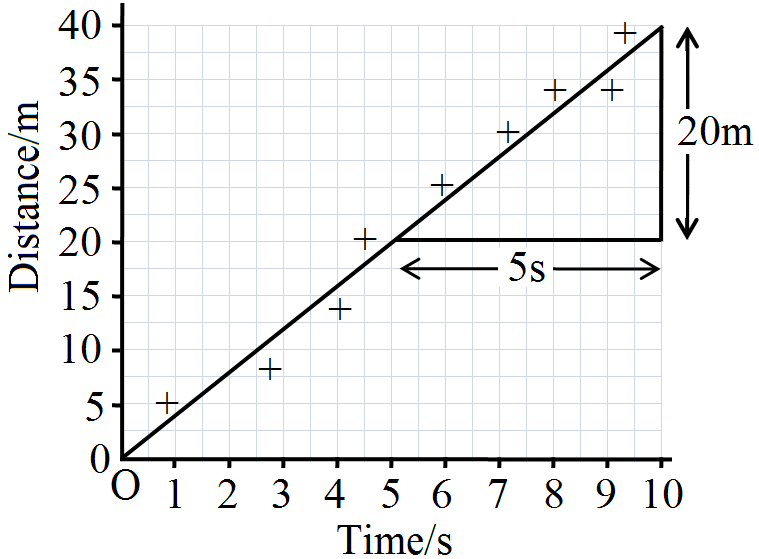
How can you calculate the following? Speed from distance-time graph?
AnswerSpeed is equal to the slope of the distance-time graph.$\text{Slope = Speed}=\frac{\text{Change in distance}}{\text{Change in time}}$
View full question & answer→Question 422 Marks
An aircraft travelling at $60\ km/h$ accelerates steadily at $10\ km/h$ per second. Taking the speed of sound as $1100\ km/h$ at the aircraft’s altitude, how long will it take to reach the ‘sound barrier’$?$
AnswerInitial velocity, $u = 600\ km/h$
Final velocity, $v = 1100\ km/h$
Acceleration $= 10\ km/h/s = 600\ km/h^2$
From relation, $\text{a} = \frac{(\text{v-u})}{\text{t}}$
$\text{t} = \frac{(\text{v-u})}{\text{a}}$
$\text{t} = \frac{(1100-600)}{600} = \frac{500}{600}= \frac{5}{6}\text{hr} = 50 \text{sec}$
View full question & answer→Question 432 Marks
Plot velocity-time graph of a body.
Moving with a uniform retardation.
Answer Uniform accelaration. 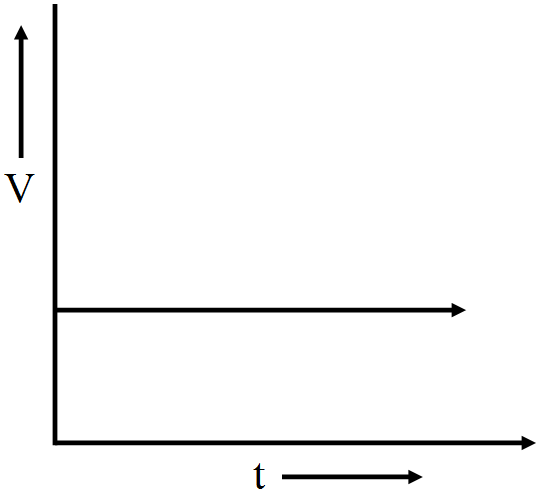
View full question & answer→Question 442 Marks
What is meant by uniform circular motion? Give two examples of uniform circular motion.
AnswerWhen a body moves in a circular path with uniform speed (constant speed), its motion is called uniform circular motion.
For example:
- Artificial satellites move in uniform circular motion around the earth.
- Motion of a cyclist on a circular track.
View full question & answer→Question 452 Marks
What is meant by:
- Average speed
- Uniform speed?
Answer
- Average Speed: The average speed of a body is the total distance travelled divided by the total time taken to cover this distance.
- Uniform Speed: A body has a uniform speed if it travels equal distances in equal intervals of time, no matter how small these intervals may be.
View full question & answer→Question 462 Marks
A motorcycle moving with a speed of 5m/s is subjected to an acceleration of $0.2m/s^2$. Calculate the speed of the motorcycle after $10$ seconds, and the distance travelled in this time.
AnswerInitial velocity, $u =5 m / s$ Final velocity, $v =$ ? Acceleration, $a =0.2 m / s ^2$
Time, $t =10 sec$ Using, $v=u+$ at $v=5+0.2 \times 10 v=5+2=7 m / s$
Now distance travelled in time is calculated;
Using, $\text{s}=\text{ut}+\frac{1}{2}\text{at}^2$$\text{s}=5\times10+\frac{1}{2}\times0.2\times10\times10$
$\text{s}=50+10=60\text{m}$
View full question & answer→Question 472 Marks
A racing car has a uniform acceleration of $4ms^{-2}$. What distance will it cover in $10\ s$ after start?
AnswerInitial velocity $= u =0 ms^{-1}$ Acceleration $= a =4 ms^{-2}$
Time $= t =10 sec$ Using the second equation of motion, $S = ut +0.5 at ^2 S=0=\left(0.5 * 4 * 10^2\right) S =200 m$ Hence the horse covers 200 metres in the first 10 seconds.
View full question & answer→Question 482 Marks
Give an example of situation in which distance- is equal to displacement.
AnswerDisplacement is the shortest distance between two points, while distance is the length of the path travelled. Therefore if the body takes the shortest path between two points, distance and displacement will be equal. Imagine it in this way: Between two points you can draw any line-curved, with turns, etc, but you can draw only one straight line connecting the points which will be of the shortest distance. If an object travels across the curved line, the distance is equal to the length of the curved line, while displacement is equal to the length of the straight line. In case the object travels asking this straight line, distance will be equal to the length of this line, which is also equal to displacement.
View full question & answer→Question 492 Marks
Arrange the following speeds in increasing order (keeping the least speed first):
- An athlete running with a speed of $10\ m/s.$
- A bicycle moving with a speed of $200\ m/min.$
- A scooter moving with a speed of $30\ km/h.$
AnswerSpeed of athelete $= 10\ m/s$
Speed of bicycle $= 200\ m/min$
$= \frac{200}{60}\text{m/s} = 3.33\text{m/s}$
Speed of scooter $= 30\ km/h $
$= \frac{30000}{3600}\text{m/s} = 8.33\text{m/s}$
$3.33\ m/s < 8.33\ m/s < 10\ m/s$
i.e. $200\ m/min < 30\ km/h < 10\ m/s$
View full question & answer→Question 502 Marks
Study the velocity-time graph and calculate.
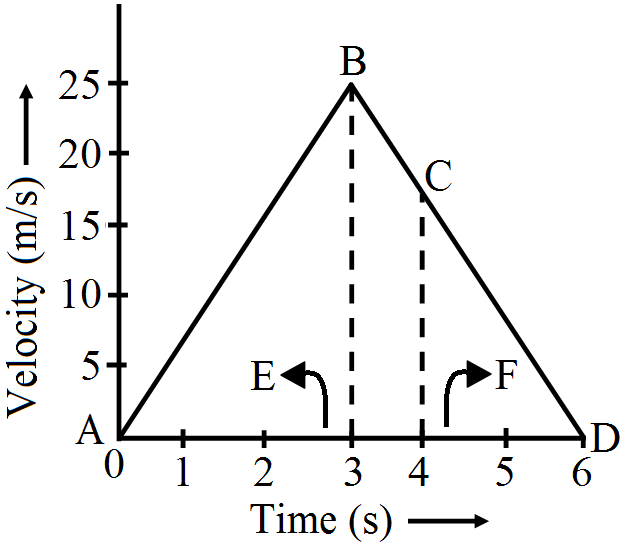
- The acceleration from $A$ to $B.$
- The acceleration from $B$ to $C.$
- The distance covered in the region $ABE.$
- The average velocity from $C$ to $D.$
- The distance covered in the region $BCFE.$
Answer
- $\text{a}=\frac{(25-0)}{(3-0)}=8.3\text{m/s}^{2}$
- $\text{a}=\frac{(20-25)}{(4-3)}=5\text{m/s}^{2}$
- Distance $=$ Area of triangle $ABE.$
- $=\frac{1}{2}\times3\times25=37.5\text{m}$
- $\text{V}=\frac{(20-0)}{2}=10\text{m/s}$
This Distance $=$ Area of trapezium $BCFE.$
$=\frac{1}{2}(25+20)\times(4-3)=22.5\text{m}$ View full question & answer→