Question 15 Marks
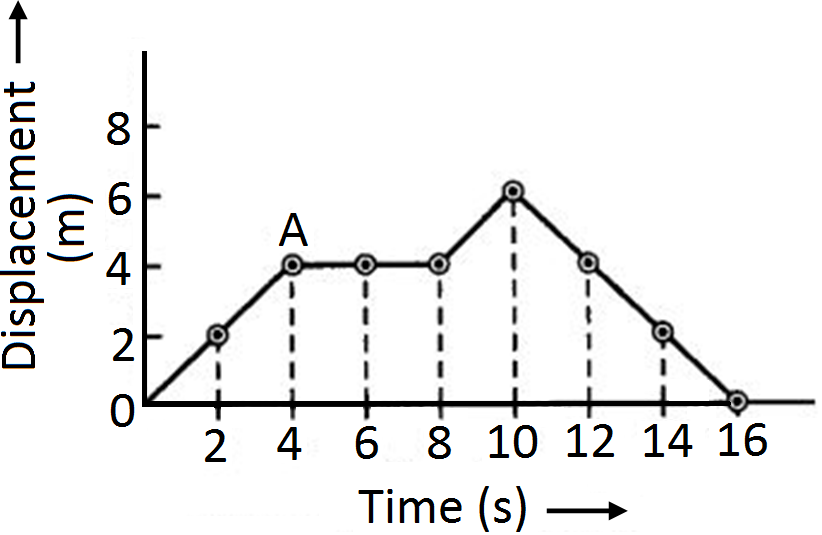
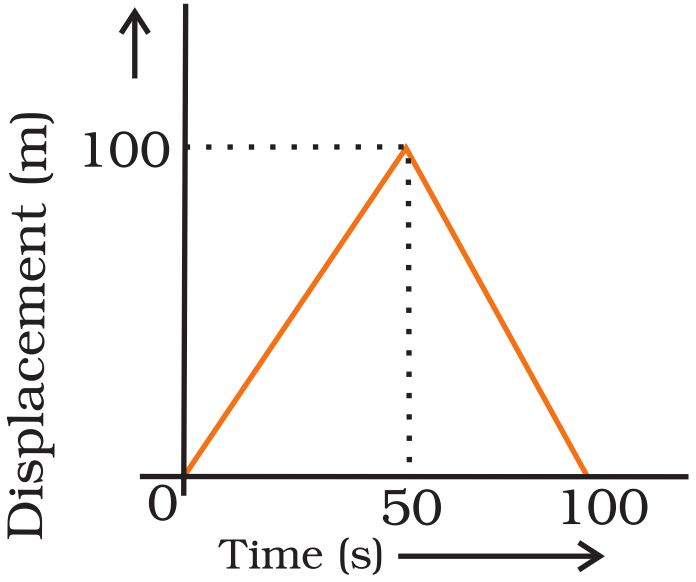
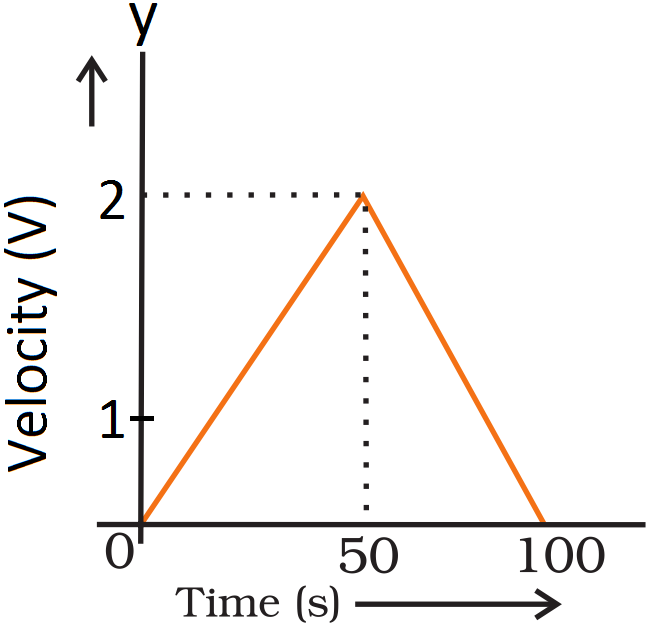
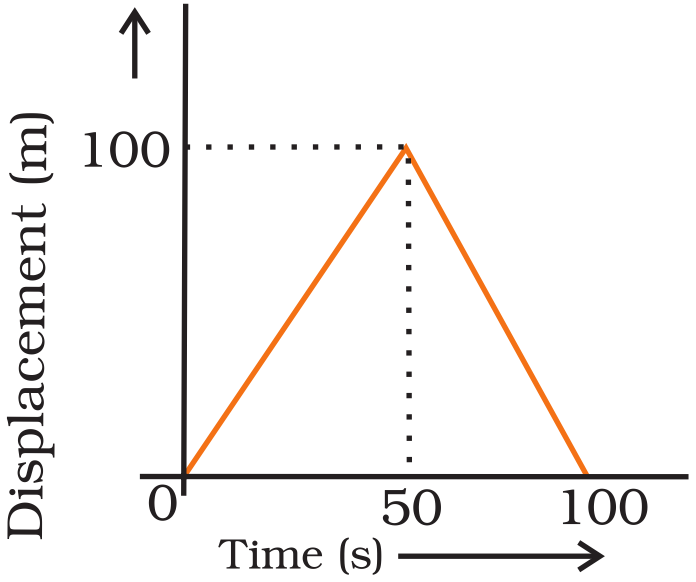
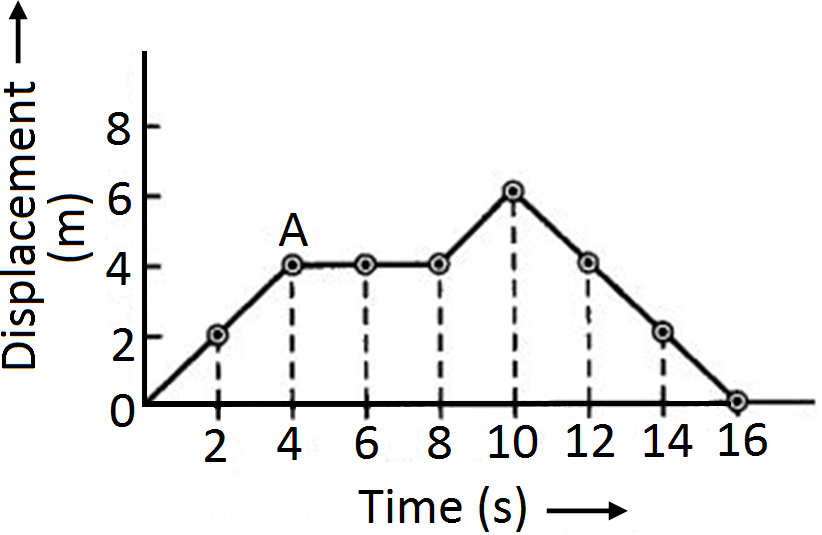
A girl walks along a straight path to drop a letter in the letterbox and comes back to her initial position. Her displacement–time graph is shown in Plot a velocity–time graph for the same.
Answer
From the graph,
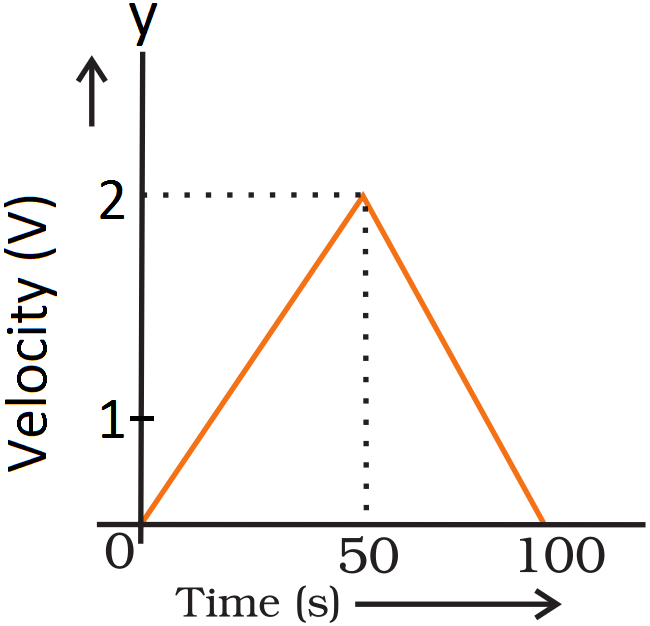
Velocity-time graph plotted from the above data is shown below
View full question & answer→From the graph,
- Initial velocity, $u = 0 [$since displacement and time is zero $]$
- Velocity after $100s,$ $\text{v}=\frac{\text{Displacement}}{\text{Time}} [$Here, displacement $=$ zero and time $=$ $100s]$
Therefore,
|
$v$
|
$0$
|
$2$
|
$0$
|
|
$t$
|
$0$
|
$50$
|
$100$
|
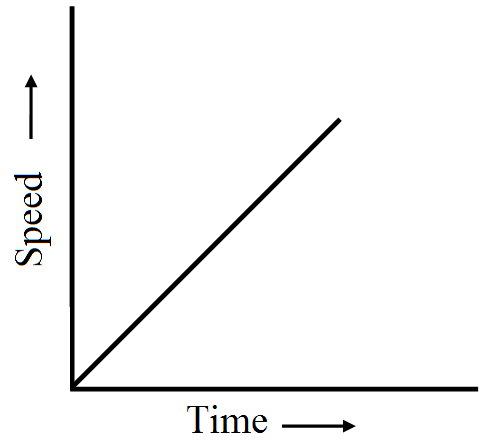
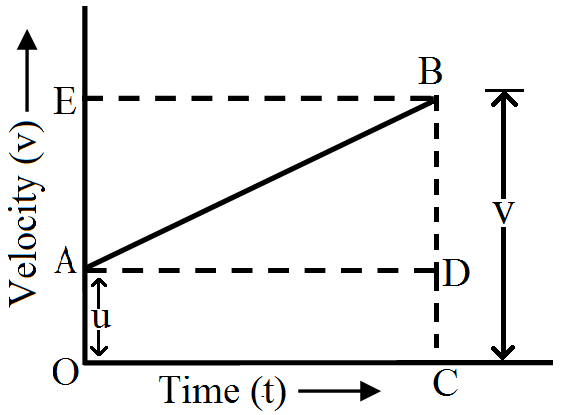
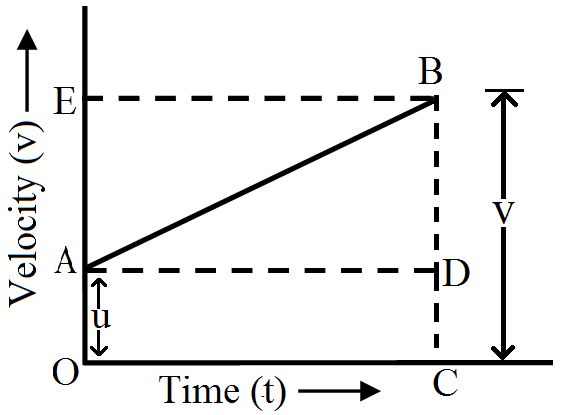
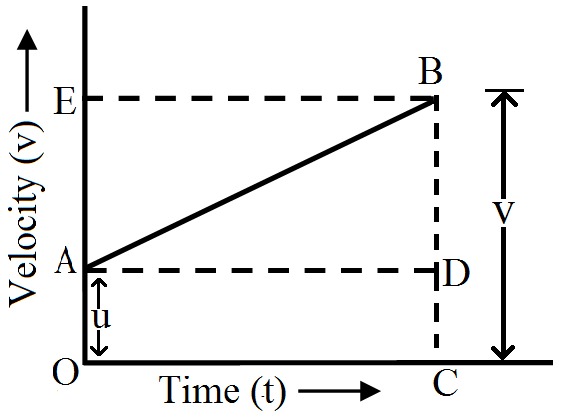

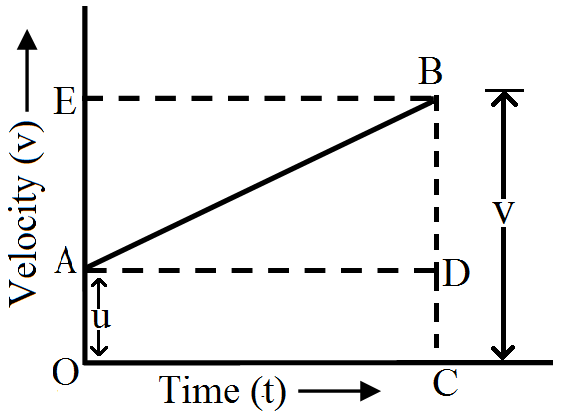 Suppose the body travels a distance s in time t. In the figure, the distance travelled by the body is given by the area of the space between the velocity-time graph AB and the time axis OC, which is equal to the area of the figure OABC. Thus: Distance travelled = Area of figure OABC = Area of rectangle OABC + area of triangle ABD Now, we will find out the area of rectangle OABC and area of triangle ABD.
 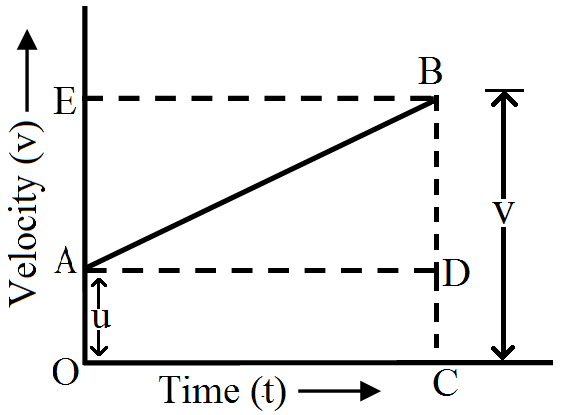 The body has an initial velocity u at a point A and then its velocity changes at a uniform rate from A to B in time t. In other words, there is a uniform acceleration a from A to B, and after time t its final velocity becomes v which is equal to BC in the graph. The time t is represented by OC. To complete the figure, we draw the perpendicular CB from point C, and draw AD parallel to OC. BE is the perpendicular from point B to OE. Now, Initial velocity of the body, u = OA ...(1) And, Final velocity of the body, v = BC ...(2) But from the graph BC = BD + DC Therefore, v = BD + DC ...(3) Again DC = OA So, v = BD + OA Now, from equation (1), OA = u So, v = BD + u ...(4) We should find out the value of BD now. We know the slope of a velocity-time graph is equal to the acceleration, a. Thus, Acceleration, a = slope of line AB or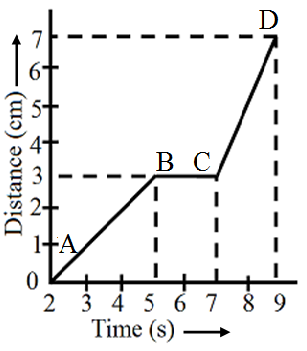
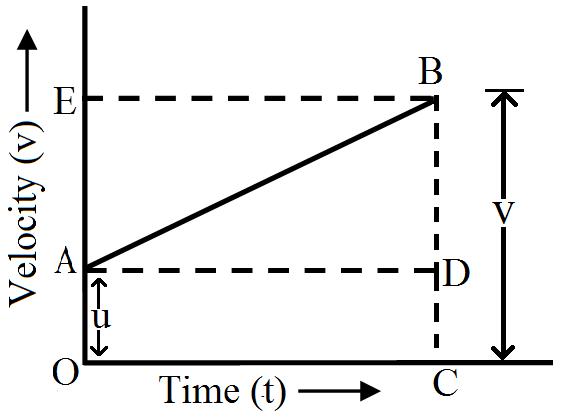 Consider the velocity-time graph of a body shown in figure. The body has an initial velocity u at a point A and then its velocity changes at a uniform rate from A to B in time t. In other words, there is a uniform acceleration a from A to B, and after time t its final velocity becomes v which is equal to BC in the graph. The time t is represented by OC. To complete the figure, we draw the perpendicular CB from point C, and draw AD parallel to OC. BE is the perpendicular from point B to OE. The distance travelled s by a body in time t is given by the area of the figure OABC which is a trapezium. Distance travelled, s = Area of trapezium OABC