Question
Jack is much worried about his upcoming assessment on A.P. He was vigorously practicing for the exam but unable to solve some questions. One of these questions is as shown below. If the $3^{rd}$​​​​​​​ and the $9^{th}​​​​​​​$​​​​​​​ terms of an A.P. are 4 and - 8 respectively, then help Jack in solving the problem.

  1. What is the common difference?
  1. 2
  2. -1
  3. -2
  4. 4
  1. What is the first term?
  1. 6
  2. 2
  3. -2
  4. 8
  1. Which term of the A.P. is -160?
  1. $80^{th}$
  2. $85^{th}$
  3. $81^{th}$
  4. $84^{th}$
  1. Which of the following is not a term of the given A.P.?
  1. -123
  2. -100
  3. 0
  4. -200
  1. What is the $75^{lh}​​​​​​​$​​​​​​​ term of the A.P.?
  1. -140
  2. -102
  3. -150
  4. -158

Answer

We have, $3^{\text {rd }}$ term $=4$ and $9^{\text {th }}$ term $=-8$ i.e., $a+2 d=4$ and $a+8 d=-8$ Solving (1) and (2), we get $d=-2, a=8$
  1. (c) -2
  2. (d) 8
  3. (b) $85^{th}$​​​​​​​
Solution:
Let $t_n= -160$
$\Rightarrow a + (n - 1) d = -160$
$\Rightarrow 8 + (n - 1)(-2) = -160$
$\Rightarrow (n - 1)(-2) = -168$
$\Rightarrow n - 1 = 84$
$\Rightarrow n = 85$
So, $t_{85} = -160​​​​​​​$​​​​​​​
  1. (a) -123
  2. (a) -140
Solution:
$t_{75} = a + 74d = 8 + 74(-2) = -140$

Need a full question paper?

Generate a complete, print-ready paper with questions like this in minutes — across 16+ boards, with answer keys.

Start Generating Free

Similar questions

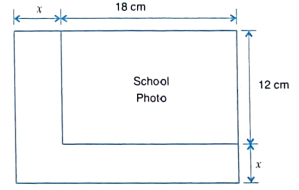
While designing the school year book, a teacher asked the student that the length and width of a particular photo is increased by $x$ units each to double the area of the photo. The original photo is 18 cm long and 12 cm wide.
Image
Based on the above information, answer the following questions:
(i) Write an algebraic equation depicting the above information.
(ii) Write the corresponding quadratic equation in standard form.
(iii) What should be the new dimensions of the enlarged photo?
(iv) Can any rational value of $x$ make the new area equal to $220 cm^2$ ?
Read the text carefully and answer the questions:
The students of a school decided to beautify the school on an annual day by fixing colourful flags on the straight passage of the school.They have $27$ flags to be fixed at intervals of every $2$ metre. The flags are stored at the position of the middlemost flag.Ruchi was given the responsibility of placing the flags. Ruchi kept her books where the flags were stored. She could carry only one flag at a time.
Image
$(a)$ How much distance did she cover in pacing $6$ flags on either side of center point?
$(b)$ Represent above information in Arithmetic progression
OR
How much distance did she cover in completing this job and returning to collect her books?
$(c)$ What is the maximum distance she travelled carrying a flag?
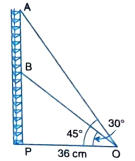
Radio towers are used for transmitting a range of communication services including radio and television. The tower will either act as an antenna itself or support one or more antennas on its structure. On a similar concept, a radio station tower was built in two Sections A and B. Tower is supported buy wires from a point $O$.
Distance between the base of the tower and point O is 36 cm . From point O, the angle of elevation of the top of the Section B is $30^{\circ}$ and the angle of elevation of the top of Section A is $45^{\circ}$.
(i) Find the length of the wire from the point $O$ to the top of Section B.
(ii) Find the distance $A B$.
(iii) Find the area of $\triangle O P B$.
(iv) Find the height of the Section A from the base of the tower.
Image
Teaching Mathematics through activities is a powerful approach that enhances students' understanding and engagement. Keeping this in mind, Ms. Mukta planned a prime number game for class 5 students. She announces the number 2 in her class and asked the first student to multiply it by a prime number and then pass it to second student. Second student also multiplied it by a prime number and passed it to third student. In this way by multiplying to a prime number, the last student got 173250.
Now. Mukta asked some questions as given below to the students:
(i) What is the least prime number used by students?
(ii) (a) How many students are in the class ?
OR
(b) What is the highest prime number used by students?
(iii) Which prime number has been used maximum times?
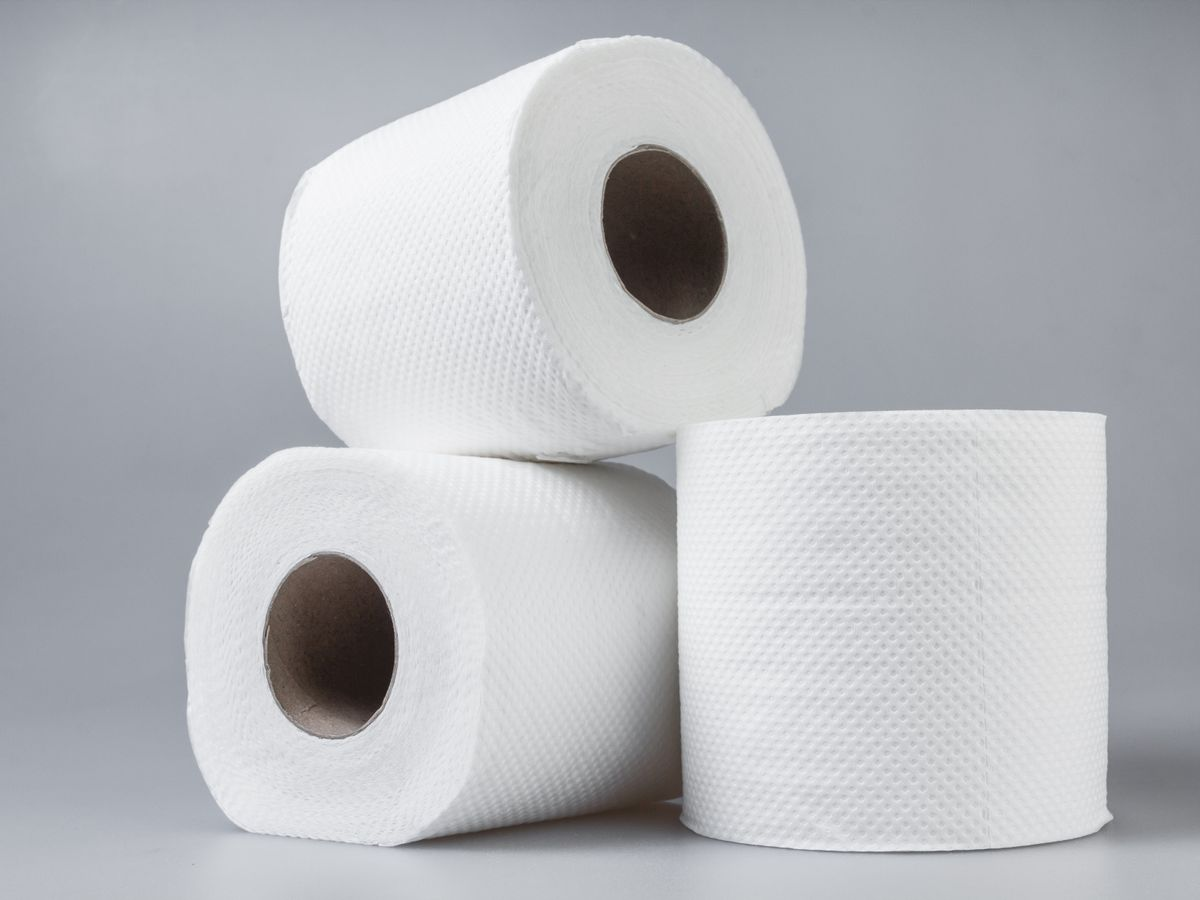
Do you know, we can find A.P. in many situations in our day-to-day life. One such example is a tissue paper roll, in which the first term is the diameter of the core of the roll and twice the thickness of the paper is the common difference. If the sum of first n rolls of tissue on a roll is $S_n = 0.1 n^2 + 7$.9n, then answer the following questions.
  1. Find $S_{n - 1$}$
  1. $0.in^2 - 0.2n - 7.8$
  2. $0.in^2 - 7.9n$
  3. $0.in^2 - 7.7n - 7.8$
  4. None of these
  1. Find the radius of the core.
  1. 8cm
  2. 4cm
  3. 16cm
  4. Can't be determined
  1. $S_2 =$
  1. 16.2
  2. 8.2
  3. 2.8
  4. 4.8
  1. What is the diameter of roll when one tissue sheet is rolled over it?
  1. 7.6cm
  2. 7.9cm
  3. 8.1cm
  4. 8.2cm
  1. Find the thickness of each tissue sheet.
  1. 2cm
  2. 1cm
  3. 1mm
  4. 2mm
Read the following text carefully and answer the questions that follow:
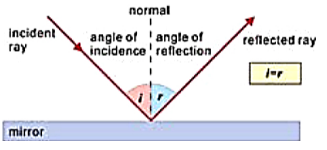
The law of reflection states that when a ray of light reflects off a surface, the angle of incidence is equal to the angle of reflection.

Image
Suresh places a mirror on level ground to determine the height of a pole $($with traffic light fired on it$)$. He stands at a certain distance so that he can see the top of the pole reflected from the mirror. Suresh's eye level is $1.5 m$ above the ground. The distance of Suresh and the pole from the mirror are $1.8 m$ and $6 m$ respectively.
Image
$i$. Which criterion of similarity is applicable to similar triangles? $(1)$
$ii$. What is the height of the pole? $(1)$
$iii$. If angle of incidence is $i,$ find tan i. $(2)$
OR
Now Suresh move behind such that distance between pole and Suresh is $13$ meters.He place mirror between
him and pole to see the reflection of light in right position. What is the distance between mirror and Suresh? $(2)$
Do you know, we can find A.P. In many situations in our day-to-day life. One such example
is a tissue paper roll, in which the first term is the diameter of the core of the roll and twice
the thickness of the paper is the common difference. If the sum of first n rolls of tissue on a
roll is S,, = 0.1 m² +7.9n, then answer the following questions.
(i) Find Sn-1
(ii) Find the radius of the core.
(iii) What is the diameter of roll when one tissue sheet is rolled over it?
OR
Find the thickness of each tissue sheet.
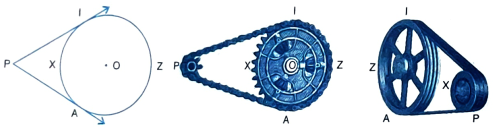
The chain and gears of bicycles or motorcycles or belt around pulleys are some real-life illustrations of tangents to circles.
Image
(i) $P I$ and $P A$ are tangents to the circle from point $P$. If arc $I Z A$ subtends an angle $240^{\circ}$ at the centre of the circle, then $\angle I P A=$
(a) $120^{\circ}$ $\qquad$ (b) $90^{\circ}$ $\qquad$ (c) $60^{\circ}$ $\qquad$ (d) $30^{\circ}$
(ii) If $I P=15 cm$, then $A I=$
(a) 7.5 cm $\qquad$ (b) 15 cm $\qquad$ (c) 30 cm $\qquad$ (d) 18 cm
(iii) If $I P=21 cm$ and measure of $A P$ is $x^2+5$, then $x=$
(a) 4 $\qquad$ (b) 16 $\qquad$ (c) $\sqrt{26}$ $\qquad$ (d) $\sqrt{30}$
(iv) $\angle O I P+\angle A P O=$
(a) $90^{\circ}$ $\qquad$ (b) $60^{\circ}$ $\qquad$ (c) $120^{\circ}$ $\qquad$ (d) $150^{\circ}$

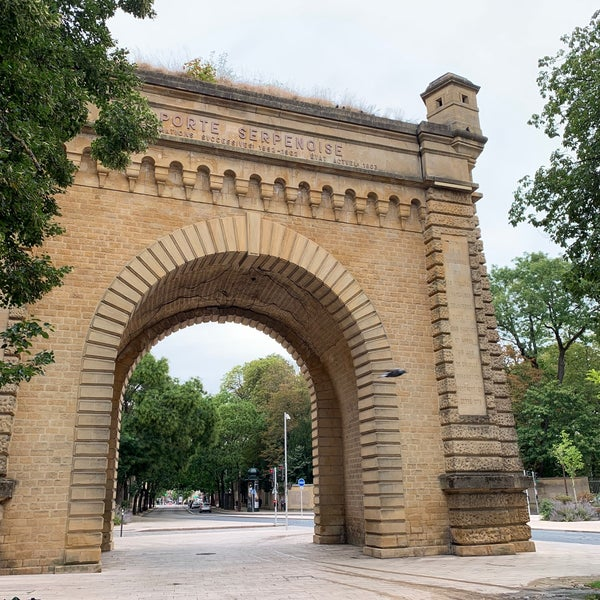
Quadratic polynomial can be used to model the shape of many architectural structures in the world. Pershing field of Jersey city in US is one such structure.

Based on the above information, answer the following questions.
  1. If the Arch is represented by $10x^2 - x - 3$, then its zeroes are:
  2. The quadratic polynomial whose sum of zeroes is 0 and product of zeroes is 1 is given by?
  3. Which of the following has $\frac{-1}{2}$ and 2 as their zeroes?
    Or
    The product of zeroes of the polynomial $\sqrt{3}\text{x}^2-14\text{x}+8\sqrt{3}$ is: