MCQ 511 Mark
$\Bigg\{\frac{\big(\sin^222^\circ+\sin^268^\circ\big)}{\big(\cos^222^\circ+\cos^268^\circ\big)}+\sin^263^\circ +\cos63^\circ\sin27^\circ\Bigg\}=?$
Answer$=\Bigg\{\frac{\big(\sin^222^\circ+\sin^268^\circ\big)}{\big(\cos^222^\circ+\cos^268^\circ\big)}+\sin^263^\circ \ +\cos63^\circ\sin27^\circ\Bigg\}$
$=\Bigg\{\frac{\big(\sin^222^\circ+\sin^2(90^\circ-22^\circ)\big)}{\big(\cos^222^\circ+\cos^2(90^\circ-22^\circ)\big)}+\sin^263^\circ \ +\cos63^\circ\sin(90^\circ-63^\circ)\Bigg\}$
$=\Bigg\{\frac{\big(\sin^222^\circ+\cos^222^\circ\big)}{\big(\cos^222^\circ+\sin^222^\circ\big)}+\sin^263^\circ \ +\cos63^\circ\cos63^\circ\Bigg\}$
$=\Bigg\{\frac{1}{1}+\sin^263^\circ+\cos^263^\circ\Bigg\}$
$=1+1$
$=2$
View full question & answer→MCQ 521 Mark
Choose the correct answer from the given four options. If $\triangle\text{ABC}$ is right angled at $C,$ then the value of $\cos\text{(A+ B)}$ is :
- ✓
$0$
- B
$1$
- C
$\frac{1}{2}$
- D
$\frac{\sqrt{3}}{2}$
AnswerWe know that, in $\triangle\text{ABC,}$ sum of three angles $= 180^\circ $
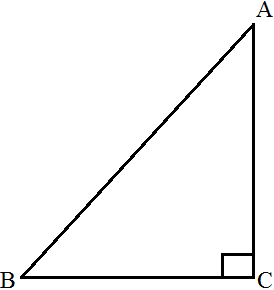
$\text{i.e., }\angle\text{A}+\angle\text{B}+\angle\text{C}=180^\circ$
But right angled at $C$.
i.e., $\angle\text{C}=90^\circ\ [$given$]$
$\angle\text{A}+\angle\text{B}+90^\circ=180^\circ$
$\Rightarrow\ \ \text{A}+\text{B}=90^\circ$
$[\because\angle\text{A}=\text{A}]$
$\therefore\ \ \cos(\text{A}+\text{B})=\cos90^\circ=0$ View full question & answer→MCQ 531 Mark
If $\text{a}\cos\theta+\text{b}\sin\theta=\text{m}$ and $\text{a}\sin\theta-\text{b}\cos\theta=\text{n},$ then $a^2+ b^2=$
- A
$m^2-n^2 $
- B
$ m^2 n^2 $
- C
$ n^2-m^2 $
- ✓
$ m^2+n^2 $
AnswerCorrect option: D. $ m^2+n^2 $
$\text{a}\cos\theta+\text{b}\sin\theta=\text{m}$
$\text{a}\sin\theta-\text{b}\cos\theta=\text{n}$
Squaring and adding
$\text{a}^2\cos^2\theta+\text{b}^2\sin^2\theta+2\text{ab }\sin\theta\cos\theta=\text{m}^2$
$\text{a}^2\sin^2\theta+\text{b}^2\cos^2\theta-2\text{ab }\sin\theta\cos\theta=\text{n}^2$
$\text{a}^2(\cos^2\theta+\sin^2\theta)+\text{b}^2(\sin^2\theta+\cos^2\theta)$
$=\text{m}^2+\text{n}^2\ \{\sin^2\theta+\cos^2\theta=1\}$
$\Rightarrow\ \text{a}^2+1+\text{b}^2\times1=\text{m}^2-\text{n}^2$
$\Rightarrow\ \text{a}^2+\text{b}^2=\text{m}^2+\text{n}^2$
Hence, $a^2+ b^2=$
$ m^2+n^2 $
View full question & answer→MCQ 541 Mark
If $\sin\theta=\frac{\sqrt3}{2}$ then $(\text{cosec }\theta+\cot\theta)=?$
- A
$\big(2+\sqrt3\big)$
- B
$2\sqrt3$
- C
$\sqrt2$
- ✓
$\sqrt3$
AnswerCorrect option: D. $\sqrt3$
Given $\sin\theta=\frac{\sqrt3}{2}$ and $\text{cosec }\theta=\frac{2}{\sqrt3}$
$\text{cosec}^2\theta-\cot^2\theta=1$
$\Rightarrow\cot^2\theta=\text{cosec}^2\theta-1$
$\Rightarrow\cot^2\theta=\frac{4}3{}-1\ [$Given$]$
$\Rightarrow\cot\theta=\frac{1}{\sqrt3}$
$\therefore\text{cosec }\theta+\cot\theta=\frac{2}{\sqrt3}+\frac{1}{\sqrt3}$
$=\frac{2}{\sqrt3}=\frac{\sqrt3\times\sqrt3}{\sqrt3}=\sqrt3$
View full question & answer→MCQ 551 Mark
The value of $\cos1^\circ\cos2^\circ\cos3^\circ.....\cos180^\circ$ is :
AnswerHere we have to find : $\cos1^\circ\cos2^\circ\cos3^\circ.....\cos180^\circ$
$\cos1^\circ\cos2^\circ\cos3^\circ.....\cos180^\circ$
$=\cos1^\circ\cos2^\circ\cos3^\circ...\cos89^\circ\cos90^\circ\cos91^\circ...\cos180^\circ$
$[\text{since} \cos90^\circ=0]$
$=\cos1^\circ\cos2^\circ\cos3^\circ...0\times\cos90^\circ...\cos180^\circ$
$=0$
Hence the correct option is $(b)$
View full question & answer→MCQ 561 Mark
$\frac{\cot(90^\circ-\theta).\sin(90^\circ-\theta)}{\sin\theta}+\frac{\cot40^\circ}{\tan50^\circ} -\big(\cos^220^\circ+\cos^270^\circ\big)=? $
Answer$\frac{\cot(90^\circ-\theta).\sin(90^\circ-\theta)}{\sin\theta}+\frac{\cot40^\circ}{\tan50^\circ}$
$\ -\big(\cos^220^\circ+\cos^270^\circ\big)$
$=\frac{\tan\theta\times\cos\theta}{\sin\theta}+\frac{\cot40^\circ}{\tan(90^\circ-40^\circ)}$
$\ -\big(\cos^220^\circ+\cos^2(90^\circ-20^\circ)\big)$
$=\frac{\frac{\sin\theta}{\cos\theta}\times\cos\theta}{\sin\theta}+\frac{\cot40^\circ}{\cot40^\circ}$
$\ -\big(\cos^220^\circ+\sin^220^\circ\big)$
$=\frac{\sin\theta}{\sin\theta}+1-1$
$=1+0$
$=1$
View full question & answer→MCQ 571 Mark
If $\text{x}\tan45^\circ\cos60^\circ=\sin60^\circ\cot60^\circ$ then $\text{x}=?$
- ✓
$1$
- B
$\frac{1}{2}$
- C
$\frac{1}{\sqrt2}$
- D
$\sqrt3$
Answer$\text{x}\tan45^\circ\cos60^\circ=\sin60^\circ\cot60^\circ$
$\Rightarrow\text{x}\times1\times\frac{1}{2}$
$=\frac{\sqrt3}{2}\times\frac{1}{\sqrt3}$
$\Rightarrow\frac{\text{x}}2{}=\frac{1}{2}$
$\Rightarrow\text{x}=1$
View full question & answer→MCQ 581 Mark
$\frac{\sin\theta}{1-\cot\theta}+\frac{\cos\theta}{1-\tan\theta}$ is equal to :
- A
$0$
- B
$1$
- ✓
$\sin\theta+\cos\theta$
- D
$\sin\theta-\cos\theta$
AnswerCorrect option: C. $\sin\theta+\cos\theta$
$\frac{\sin\theta}{1-\cot\theta}+\frac{\cos\theta}{1-\tan\theta}=\frac{\sin\theta}{1-\frac{\cos\theta}{\sin\theta}}+\frac{\cos\theta}{1-\frac{\sin\theta}{\cos\theta}}$
$=\frac{\sin\theta\times\sin\theta}{\sin\theta-\cos\theta}+\frac{\cos\theta\times\cos\theta}{\cos\theta-\sin\theta}$
$=\frac{\sin^2\theta}{\sin\theta-\cos\theta}-\frac{\cos^2\theta}{\sin\theta-\cos\theta}$
$=\frac{\sin^2\theta-\cos^2\theta}{\sin\theta-\cos\theta}$
$=\frac{(\sin\theta+\cos\theta)(\sin\theta-\cos\theta)}{\sin\theta-\cos\theta}$
$=\sin\theta+\cos\theta$
View full question & answer→MCQ 591 Mark
The value of $(4\tan^2A − 4\sec^2A)$ is equal to :
Answer$4\tan^2A − 4\sec^2A $
$= 4\tan^2A − 4(1 − \tan^2A)$
$= 4\tan^2A − 4 − 4\tan^2A$
$= −4$
View full question & answer→MCQ 601 Mark
If $\text{x}=\text{a}\sec\theta\cos\phi,\text{y}=\text{b}\sec\theta\sin\phi$ and ${z}=\text{c}\tan\theta,$ then $\frac{\text{x}^2}{\text{a}^2}+\frac{\text{y}^2}{\text{b}^2}=$
- A
$\frac{\text{z}^2}{\text{c}^2}$
- B
$1-\frac{\text{z}^2}{\text{c}^2}$
- C
$\frac{\text{z}^2}{\text{c}^2}-1$
- ✓
$1+\frac{\text{z}^2}{\text{c}^2}$
AnswerCorrect option: D. $1+\frac{\text{z}^2}{\text{c}^2}$
$\text{x}=\text{a}\sec\theta\cos\phi$
$\text{y}=\text{b}\sec\theta\sin\phi$
$\text{z}=\text{c}\tan\theta$
$\frac{\text{x}}{\text{a}}=\sec\theta\cos\phi\ .....(\text{i})$
$\frac{\text{y}}{\text{b}}=\sec\theta\sin\phi\ .....(\text{ii})$
$\frac{\text{z}}{\text{c}}=\tan\theta\ .....(\text{iii})$
Squaring and adding $(i)$ and $(ii)$
$\frac{\text{x}^2}{\text{a}^2}+\frac{\text{y}^2}{\text{b}^2}=\sec^2\theta\cos^2\phi+\sec^2\theta\sin^2\phi$
$=\sec^2\theta(\cos^2\phi+\sin^2\phi)$
$=\sec^2\theta\times1=\sec^2\theta$
Squaring $(iii)$ and subtracting from $(iv)$
$\frac{\text{x}^2}{\text{a}^2}+\frac{\text{y}^2}{\text{b}^2}-\frac{\text{z}^2}{\text{c}^2}$
$=\sec^2\theta-\tan^2\theta=1$
$\frac{\text{x}^2}{\text{a}^2}+\frac{\text{y}^2}{\text{b}^2}=1+\frac{\text{z}^2}{\text{c}^2}$
View full question & answer→MCQ 611 Mark
The value of $\sqrt{\frac{1+\cos\theta}{1-\cos\theta}}$ is :
- A
$\cot\theta-\text{cosec }\theta$
- ✓
$\text{cosec }\theta+\cot\theta$
- C
$\text{cosec}^2\theta+\cot^2\theta$
- D
$(\cot\theta+\text{cosec }\theta)^2$
AnswerCorrect option: B. $\text{cosec }\theta+\cot\theta$
The given expression is $\sqrt{\frac{1+\cos\theta}{1-\cos\theta}}$
Multiplying both the numerator and denominator under the root by $(1+\cos\theta)$, we have
$\sqrt{\frac{(1+\cos\theta)(1+\cos\theta)}{(1+\cos\theta)(1-\cos\theta)}}$
$=\sqrt{\frac{(1+\cos\theta)^2}{(1-\cos^2\theta)}}$
$=\sqrt{\frac{(1+\cos\theta)^2}{\sin^2\theta}}$
$=\frac{1+\cos\theta}{\sin\theta}$
$=\frac{1}{\sin\theta}+\frac{\cos\theta}{\sin\theta}$
$=\text{cosec }\theta+\cot\theta$
Therefore, the correcr choise is $(b).$
View full question & answer→MCQ 621 Mark
If $\tan^245^\circ-\cos^230^\circ=\text{x}\sin45^\circ\cos45^\circ,$ then $x =$
- A
$2$
- B
$-2$
- C
$-\frac{1}{2}$
- ✓
$\frac{1}{2}$
AnswerCorrect option: D. $\frac{1}{2}$
We have,
$\tan^245^\circ-\cos^230^\circ$
$=\text{x}\sin45^\circ\cos45^\circ\dots(1)$
Put the values in $(1)$
$\Rightarrow(1)^2-\Big(\frac{\sqrt{3}}{2}\Big)^2$
$=\text{x}\times\frac{1}{\sqrt{2}}\times\frac{1}{\sqrt{2}}$
$\Rightarrow1-\frac{3}{4}=\text{x}\times\frac{1}{2}$
$\Rightarrow\frac{1}{4}=\frac{\text{x}}{2}$
$\Rightarrow\text{x}=\frac{1}{2}$
Thus, $\text{x}=\frac{1}{2}$
Hence the correct option is $(d)$
View full question & answer→MCQ 631 Mark
$3\cos^260^\circ+2\cot^230^\circ-5\sin^245^\circ=?$
- A
$\frac{13}{6}$
- ✓
$\frac{17}{4}$
- C
$1$
- D
$4$
AnswerCorrect option: B. $\frac{17}{4}$
$3\cos^260^\circ+2\cot^230^\circ-5\sin^245^\circ$
$=3\times\Big(\frac{1}{2}\Big)^2+2\big(\sqrt3\big)^2-5\Big(\frac{1}{\sqrt2}\Big)^2$
$=3\times\frac{1}{4}+2\times3-5\times\frac{1}{2}$
$=\frac{3}{4}+6-\frac{5}{2}$
$=\frac{3+24-10}{4}$
$=\frac{17}{4}$
View full question & answer→MCQ 641 Mark
$\frac{1-\tan^245^\circ}{1+\tan^245^\circ}$ is equal to :
- A
$\tan90^\circ$
- B
$1$
- C
$\sin45^\circ$
- ✓
$\sin0^\circ$
AnswerCorrect option: D. $\sin0^\circ$
We have to find the value of the following
$\frac{1-\tan^245^\circ}{1+\tan^245^\circ}$
So,
$\frac{1-\tan^245^\circ}{1+\tan^245^\circ}$
$=\frac{1-(1)^2}{1+(1)^2}$
$=\frac{0}{1}$
$=0$
We know that $\begin{bmatrix}\tan45^\circ=1\\\sin0^\circ=0\end{bmatrix}$
$=\sin0^\circ$
Hence the correct option is $(d)$
View full question & answer→MCQ 651 Mark
$\frac{\sin\theta}{1+\cos\theta}$ is equal to :
- A
$\frac{1+\cos\theta}{\sin\theta}$
- B
$\frac{1-\cos\theta}{\cos\theta}$
- ✓
$\frac{1-\cos\theta}{\sin\theta}$
- D
$\frac{1-\sin\theta}{\cos\theta}$
AnswerCorrect option: C. $\frac{1-\cos\theta}{\sin\theta}$
The given expression is $\frac{\sin\theta}{1+\cos\theta}$
Multiplying both the numerator and denominator under the root by $(1-\cos\theta)$, we have
$\frac{\sin\theta}{1+\cos\theta}$
$=\frac{\sin\theta(1-\cos\theta)}{(1+\cos\theta)(1-\cos\theta)}$
$=\frac{\sin\theta(1-\cos\theta)}{1-\cos^2\theta}$
$=\frac{\sin\theta(1-\cos\theta)}{\sin^2\theta}$
$=\frac{1-\cos\theta}{\sin\theta}$
Therefore, the correct option is $(C)$.
View full question & answer→MCQ 661 Mark
If $\tan\theta=\frac{\text{a}}{\text{b}}$ then $\frac{(\cos\theta+\sin\theta)}{(\cos\theta-\sin\theta)}=?$
- A
$\frac{\text{a}+\text{b}}{\text{a}-\text{b}}$
- B
$\frac{\text{a}-\text{b}}{\text{a}+\text{b}}$
- ✓
$\frac{\text{b}+\text{a}}{\text{b}-\text{a}}$
- D
$\frac{\text{b}-\text{a}}{\text{b}+\text{a}}$
AnswerCorrect option: C. $\frac{\text{b}+\text{a}}{\text{b}-\text{a}}$
Given, $\tan\theta=\frac{\text{a}}{\text{b}}$
Now, $\frac{(\cos\theta+\sin\theta)}{(\cos\theta-\sin\theta)}$
$=\frac{\frac{\cos\theta}{\cos\theta}+\frac{\sin\theta}{\cos\theta}}{\frac{\cos\theta}{\cos\theta}-\frac{\sin\theta}{\cos\theta}}$
$=\frac{1+\tan\theta}{1-\tan\theta}$
$=\frac{1+\frac{\text{a}}{\text{b}}}{1-\frac{\text{a}}{\text{b}}}$
$=\frac{\frac{\text{b}+\text{a}}{\text{b}}}{\frac{\text{b}-\text{a}}{\text{b}}}$
$=\frac{\text{b}+\text{a}}{\text{b}-\text{a}}$
View full question & answer→MCQ 671 Mark
If $2\cos3\theta=1$ then $\theta=?$
- A
$10^\circ$
- B
$15^\circ$
- ✓
$20^\circ$
- D
$30^\circ$
AnswerCorrect option: C. $20^\circ$
$2\cos3\theta=1$
$\Rightarrow\cos3\theta=\frac{1}{2}$
$\Rightarrow\cos3\theta=\cos60^\circ$
$\Rightarrow3\theta=\cos60^\circ$
$\Rightarrow\theta=20^\circ$
View full question & answer→MCQ 681 Mark
If $\tan\theta=\frac{\text{a}}{\text{b}},$ then $\frac{\text{a sin}\theta+\text{b cos}\theta}{\text{a sin}\theta-\text{b cos}\theta}$ is equal to :
- ✓
$\frac{\text{a}^2+\text{b}^2}{\text{a}^2-\text{b}^2}$
- B
$\frac{\text{a}^2-\text{b}^2}{\text{a}^2+\text{b}^2}$
- C
$\frac{\text{a}+\text{b}}{\text{a}-\text{b}}$
- D
$\frac{\text{a}-\text{b}}{\text{a}+\text{b}}$
AnswerCorrect option: A. $\frac{\text{a}^2+\text{b}^2}{\text{a}^2-\text{b}^2}$
We have,
$\tan\theta=\frac{\text{a}}{\text{b}}$
In $\triangle \text{ABC}.$
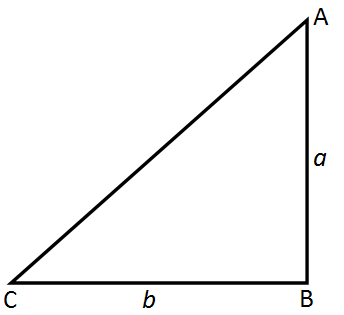
$\text{AC}^2=\text{AB}^2+\text{BC}^2$
$\text{AC}^2=\text{a}^2+\text{b}^2$
$\text{AC}=\sqrt{\text{a}^2+\text{b}^2}$
$\therefore \sin\theta=\frac{\text{AB}}{\text{AC}}=\frac{\text{a}}{\sqrt{\text{a}^2+\text{b}^2}}$
$\cos\theta=\frac{\text{BC}}{\text{AC}}=\frac{\text{b}}{\sqrt{\text{a}^2+\text{b}^2}}$
Now, $\frac{\text{a sin}\theta+\text{b cos}\theta}{\text{a sin}\theta-\text{b cos}\theta}$
$=\frac{\text{a}\times\frac{\text{a}}{\sqrt{a^2+b^2}}+\text{b}\times\frac{\text{b}}{\sqrt{a^2+b^2}}}{\text{a}\times\frac{a}{\sqrt{a^2+b^2}}-\text{b}\times\frac{\text{b}}{\sqrt{a^2+^2}}}$
$= \frac{\frac{\text{a}^2+\text{b}^2}{\sqrt{\text{a}^2+\text{b}^2}}}{\frac{\text{a}^2-\text{b}^2}{\sqrt{\text{a}^2+\text{b}^2}}}$
$= \frac{\text{a}^2+\text{b}^2}{\text{a}^2-\text{b}^2}$
Hence the correct option is $(a)$ View full question & answer→MCQ 691 Mark
$\frac{\cot\theta}{\cot \theta-\cot3 \theta}+\frac{\tan\theta}{\tan\theta-\tan3\theta}$ is equal to :
Answer$=\frac{\cot\theta}{\cot\theta-\cot3\theta}+\frac{\tan\theta}{\tan\theta-\tan3\theta}$
$=\frac{\cot\theta\tan\theta-\cot\theta\tan3\theta+\cot\theta\tan\theta-\tan\theta\cot3\theta}{(\cot\theta-\cot3\theta)(\tan\theta-\tan3\theta)}$
$\{\tan\theta\cot\theta=1\}$
$\Rightarrow\ \frac{1-\cot\theta\tan3\theta+1-\tan\theta\cot3\theta}{\cot\theta\tan\theta-\cot\theta\tan3\theta-\tan\theta\cot3\theta+\cot3\theta\tan3\theta}$
$=\frac{2-\cot\theta\tan3\theta-\tan\theta\cot3\theta}{1-\cot\theta\tan3\theta-\tan\theta\cot3\theta+1}$
$=\frac{2-\cot\theta\tan3\theta-\tan\theta\cot3\theta}{2-\cot\theta\tan\theta-\tan\theta\cot3\theta}=1$
View full question & answer→MCQ 701 Mark
$\frac{\tan35^\circ}{\cot55^\circ}+\frac{\cot78^\circ}{\tan12^\circ}=?$
Answer$\frac{\tan35^\circ}{\cot55^\circ}+\frac{\cot78^\circ}{\tan12^\circ}$
$=\frac{\tan(90^\circ-55^\circ)}{\cot55^\circ}+\frac{\cot78^\circ}{\tan(90^\circ-78^\circ)}$
$=\frac{\cot55^\circ}{\cot55^\circ}+\frac{\cot78^\circ}{\cot78^\circ}$
$=1+1$
$=2$
View full question & answer→MCQ 711 Mark
Choose the correct option and justify your choice : $\frac{2\tan30^\circ}{1+\tan^230^\circ}=$
- ✓
$\sin 60^\circ$
- B
$\cos 60^\circ$
- C
$\tan 60^\circ$
- D
$\sin 30^\circ$
AnswerCorrect option: A. $\sin 60^\circ$
$\frac{2\tan30^\circ}{1+\tan^230^\circ}=\frac{2\times\frac{1}{\sqrt{3}}}{1+\Big(\frac{1}{\sqrt{3}}\Big)^2}=\frac{\frac{2}{\sqrt{3}}}{1+\frac{1}{3}} $
$=\frac{\frac{2}{\sqrt{3}}\times3}{4} $
$ =\frac{{2}{\sqrt{3}}}{4}=\frac{\sqrt{3}}{2}$
$=\sin 60^\circ $
View full question & answer→MCQ 721 Mark
If $\tan\theta=\frac{1}{\sqrt{7}},$ then $\frac{\text{cosec}^2\theta-\sec^2\theta}{\text{cosec}^2\theta+\sec^2\theta}=$
- A
$\frac{5}{7}$
- B
$\frac{3}{7}$
- C
$\frac{1}{12}$
- ✓
$\frac{3}{4}$
AnswerCorrect option: D. $\frac{3}{4}$
Given that :
$\tan\theta=\frac{1}{\sqrt{7}}$
We are asked to find the value of the following expression
$\frac{\text{cosec}^2\theta-\sec^2\theta}{\text{cosec}^2\theta+\sec^2\theta}$
Since $\tan\theta=\frac{\text{Perpendicular}}{\text{Base}}$
$\Rightarrow{\text{perpendicular}}=1$
$\Rightarrow{\text{Base}}=\sqrt{7}$
$\Rightarrow{\text{Hypotennuse}}=\sqrt{1+7}$
$\Rightarrow{\text{Hypotennuse}}=\sqrt{8}$
We know that $\sec\theta=\frac{\text{Hypotenuse}}{\text{Base}}$ and $\text{cosec}\theta=\frac{\text{Hypotenuse}}{\text{perpendicular}}$
We find :
$\frac{\text{cosec}^2\theta-\sec^2\theta}{\text{cosec}^2\theta+\sec^2\theta}$
$=\frac{\Big(\frac{\sqrt{8}}{1}\Big)^2-\Big(\frac{\sqrt{8}}{\sqrt{7}}\Big)^2}{\Big(\frac{\sqrt{8}}{1}\Big)^2+\Big(\frac{\sqrt{8}}{\sqrt{7}}\Big)^2}$
$=\frac{\frac{{8}}{1}-\frac{{8}}{{7}}}{\frac{{8}}{1}+\frac{{8}}{{7}}}$
$=\frac{\frac{48}{7}}{\frac{64}{7}}$
$=\frac{3}{4}$
Hence the correct option is $(d)$
View full question & answer→MCQ 731 Mark
Choose the correct answer from the given four options. If $\cos9\alpha=\sin\alpha$ and $9\alpha<90^\circ,$ then the value of $\tan5\alpha$ is :
- A
$\frac{1}{\sqrt{3}}$
- B
$\frac{\sqrt{3}}{1}$
- ✓
$1$
- D
$0$
AnswerGiven $,\cos9\alpha=\sin\alpha$ and $9\alpha<90^\circ\text{ i.e., acute angle.}$
$\sin(90^\circ-9\alpha)=\sin\alpha$
$[\because\cos\text{A}=\sin(90^\circ-\text{A})]$
$\Rightarrow\ \ 90^\circ-9\alpha=\alpha$
$\Rightarrow\ \ 10\alpha=90^\circ$
$\Rightarrow\ \ \alpha=9^\circ$
$\therefore\tan5\alpha=\tan(5\times9^\circ)=\tan45^\circ=1$
$[\because\tan45^\circ=1]$
View full question & answer→MCQ 741 Mark
If $\tan\theta=\sqrt3$ then $\sec\theta=?$
- A
$\frac{2}{\sqrt3}$
- B
$\frac{\sqrt3}{2}$
- C
$\frac{1}{2}$
- ✓
$2$
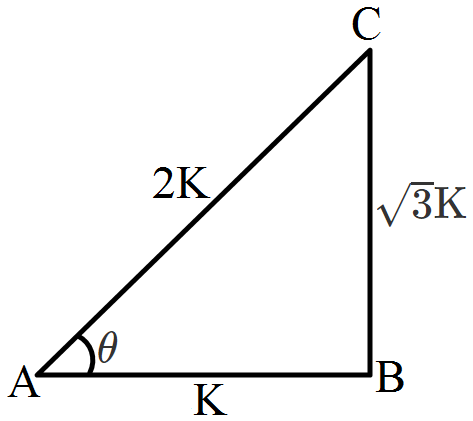
AnswerConsider $\triangle\text{ABC}$ where $\angle\text{B}=90^\circ,\angle\text{A}=\theta.$
Then, $\tan\theta=\frac{\text{perpendicular}}{\text{Base}}$
$=\frac{\text{BC}}{\text{AB}}=\frac{\sqrt3}{1}$
Let $\text{BC}=\sqrt{3}\text{k}$ and $\text{AB}=\text{k},$ where $k$ is positive.
By Pythagoras Theorem,
$\text{AC}^2=\text{AB}^2+\text{BC}^2$
$\Rightarrow\text{AC}^2=(\text{k})^2+(\sqrt3\text{k})^2$
$=\text{k}^2+3\text{k}^2=4\text{k}^2$
$\Rightarrow\text{AC}=\text{2k}$
Now, $\sec\theta=\frac{\text{Hypotenuse}}{\text{Base}}$
$\frac{\text{AC}}{\text{AB}}=\frac{2\text{k}}{\text{k}}=2$
View full question & answer→MCQ 751 Mark
The value of $\sec90^\circ$ is :
- A
$1$
- B
$\frac{\sqrt{2}}{3}$
- C
$\sqrt{2}$
- ✓
$\text{None of these}$
AnswerCorrect option: D. $\text{None of these}$
$\sec90^\circ=\frac{1}{\cos90^\circ}=\frac{1}{0},$ undefined.
View full question & answer→MCQ 761 Mark
The value of $\frac{\cos(90^\circ-\theta)\sec(90^\circ-\theta)\tan\theta}{\text{cosec}(90^\circ-\theta)\sin(90^\circ-\theta)\cot(90^\circ-\theta)}+\frac{\tan(90^\circ-\theta)}{\cot\theta}$ is :
AnswerWe have to find : $\frac{\cos(90^\circ-\theta)\sec(90^\circ-\theta)\tan\theta}{\text{cosec}(90^\circ-\theta)\sin(90^\circ-\theta)\cot(90^\circ-\theta)}+\frac{\tan(90^\circ-\theta)}{\cot\theta}$
So, $\frac{\cos(90^\circ-\theta)\sec(90^\circ-\theta)\tan\theta}{\text{cosec}(90^\circ-\theta)\sin(90^\circ-\theta)\cot(90^\circ-\theta)}+\frac{\tan(90^\circ-\theta)}{\cot\theta}$
$=\frac{\sin\theta\text{cosec }\theta\tan\theta}{\sec\theta\cos\theta\tan\theta}+\frac{\cot\theta}{\cot\theta}$
$=\frac{1\times\tan\theta}{1\times\tan\theta}+\frac{\cot\theta}{\cot\theta}$
$=1+1$
$=2$
Hence the correct option is $(c)$
View full question & answer→MCQ 771 Mark
If $\sqrt3\tan2\theta-3=0$ then $\theta=?$
- A
$15^\circ$
- ✓
$30^\circ$
- C
$45^\circ$
- D
$60^\circ$
AnswerCorrect option: B. $30^\circ$
$\sqrt3\tan2\theta-3=0$
$\Rightarrow\sqrt3\tan2\theta-3$
$\Rightarrow\tan2\theta=\frac{3}{\sqrt3}$
$\Rightarrow\tan2\theta=\sqrt3$
$\Rightarrow\tan2\theta=\tan60^\circ$
$\Rightarrow2\theta=60^\circ$
$\Rightarrow\theta=30^\circ$
View full question & answer→MCQ 781 Mark
Choose the correct answer from the given four options. The value of the expression $\Big[\frac{\sin^222^\circ+\sin^268^\circ}{\cos^222^\circ+\cos^268^\circ}+\sin^263^\circ+\cos63^\circ\sin27^\circ\Big]$ is :
AnswerGiven expression, $\frac{\sin^222^\circ+\sin^268^\circ}{\cos^222^\circ+\cos^268^\circ}+\sin^263^\circ+\cos63^\circ\sin27^\circ$
$=\frac{\sin^222^\circ+\sin^2(90^\circ-22^\circ)}{\cos^2(90^\circ-68^\circ)+\cos^268^\circ}+\sin^263+\cos63^\circ\sin(90^\circ-63^\circ)$
$=\frac{\sin^222^\circ+\cos^222^\circ}{\sin^268^\circ+\cos^268^\circ}+\sin^263^\circ+\cos63^\circ.\cos63^\circ$
$\begin{bmatrix}\because\ \sin(90^\circ-\theta)=\cos\theta \\\text{and }\cos(90^\circ-\theta)=\sin\theta \end{bmatrix}$
$=\frac{1}{1}+(\sin^263^\circ+\cos^263^\circ)$ $[\because\sin^2\theta+\cos^2\theta=1]$
$=1+1=2$
View full question & answer→MCQ 791 Mark
$9\sec^2\text{A}-9\tan^2\text{A}$ is equal to :
AnswerGiven,
$9\sec^2\text{A}-9\tan^2\text{A}$
$=9(\sec^2\text{A}-\tan^2\text{A})$
We know that, $\sec^2-\tan^2\text{A}=1$
Therefore, $9\sec^2\text{A}-9\tan^2\text{A}=9$
Hence, the correct option is $(b)$.
View full question & answer→MCQ 801 Mark
If $\cos9\theta=\sin\theta$ and $9\theta<90^\circ,$ then value of $\tan6\theta$ is :
- A
$\frac{1}{\sqrt{3}}$
- ✓
$\sqrt{3}$
- C
$1$
- D
$0$
AnswerCorrect option: B. $\sqrt{3}$
$\cos(9\theta)=\sin\theta$
$\Rightarrow\ \sin(90^\circ-9\theta)=\sin\theta$
$\Rightarrow\ 90^\circ-9\theta=\theta$
$\Rightarrow\ 90^\circ=\theta+9\theta$
$\Rightarrow\ \theta=10$
$\tan6\theta=\tan6$
$=\tan60^\circ=\sqrt{3}$
View full question & answer→MCQ 811 Mark
$\sec^260^\circ-1=?$
Answer$\sec^260^\circ-1=(2)^2-1$
$=4-1=3$
View full question & answer→MCQ 821 Mark
If $\tan\theta=\frac{3}{4},$ then $\cos^2\theta-\sin^2\theta=$
- ✓
$\frac{7}{25}$
- B
$1$
- C
$\frac{-7}{25}$
- D
$\frac{4}{25}$
AnswerCorrect option: A. $\frac{7}{25}$
We have,
$\tan\theta= \frac{3}{4}$
In $\triangle \text{ABC},$
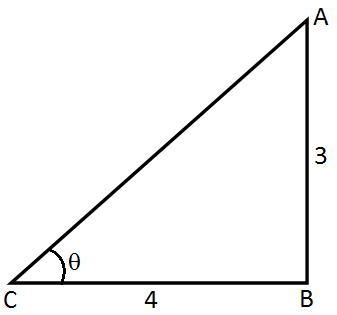
$\text{AC}^2=\text {AB}^2+\text{BC}^2$
$\Rightarrow \text {AC}^2=(3)^2+(4)^2$
$\Rightarrow \text {AC}^2=9+16$
$\Rightarrow \text {AC}^2=25$
$\Rightarrow \text {AC}=5$
$\therefore \sin \theta=\frac{3}{5}$ and $\cos\theta=\frac{4}{5}$
Now, $\cos^2\theta-\sin^2 =\Big(\frac{4}{5}\Big)^2-\Big(\frac{3}{5}\Big)^2$
$=\frac{16}{25}- \frac{9}{25}$
$=\frac{16-9}{25}$
$=\frac{7}{25}$
Hence the correct option is $(a)$ View full question & answer→MCQ 831 Mark
Choose the correct answer from the given four options. If $\sin A + \sin^2 A = 1,$ then the value of the expression $(\cos^2A + \cos^4A)$ is :
- ✓
$1$
- B
$\frac{1}{2}$
- C
$2$
- D
$3$
AnswerGiven, $\sin A + \sin^2A = 1$
$\Rightarrow\ \sin\text{A}=1-\sin^2\text{A}=\cos^2\text{A}$
$[\because\sin^2\theta+\cos^2\theta=1]$
On squaring both sides, we get
$\sin^2A = \cos^4A$
$\Rightarrow\ 1-\cos^2\text{A}=\cos^4\text{A}$
$ \Rightarrow \cos^2 A + \cos^4 A = 1$
View full question & answer→MCQ 841 Mark
$\frac{\cos38^\circ\text{cosec}52^\circ}{\tan18^\circ\tan35^\circ\tan60^\circ\tan72^\circ\tan55^\circ}=?$
- A
$\sqrt3$
- B
$\frac{1}{3}$
- ✓
$\frac{1}{\sqrt3}$
- D
$\frac{2}{\sqrt3}$
AnswerCorrect option: C. $\frac{1}{\sqrt3}$
$\frac{\cos38^\circ\text{cosec}52^\circ}{\tan18^\circ\tan35^\circ\tan60^\circ\tan72^\circ\tan55^\circ}$
$=\frac{\cos(90^\circ-52^\circ)\text{cosec}52^\circ}{\tan18^\circ\times\tan35^\circ\times\sqrt3\times\tan(90^\circ-18^\circ)\times\tan(90^\circ-35^\circ)}$
$=\frac{\sin52^\circ\text{cosec}52^\circ}{\tan18^\circ\times\tan35^\circ\times\sqrt3\times\sec18^\circ\times\sec35^\circ}$
$=\frac{\sin52^\circ\times\frac{1}{\sin52^\circ}}{(\tan18^\circ\sec18^\circ)\times\sqrt3\times(\tan35^\circ\sec35^\circ)}$
$=\frac{1}{1\times\sqrt3\times1}$
$=\frac{1}{\sqrt3}$
View full question & answer→MCQ 851 Mark
If $(\cos\theta+\sec\theta)=\frac{5}{2}$ then $(\cos^2\theta+\sec^2\theta)=?$
- A
$\frac{21}{4}$
- ✓
$\frac{17}{4}$
- C
$\frac{29}{4}$
- D
$\frac{33}{4}$
AnswerCorrect option: B. $\frac{17}{4}$
$(\cos\theta+\sec\theta)=\frac{5}{2}$
$\Rightarrow(\cos\theta+\sec\theta)^2=\Big(\frac{5}{2}\Big)^2$
$\Rightarrow\cos^2\theta+\sec^2\theta+2\cos\theta\sec\theta=\frac{25}{4}$
$\Rightarrow\cos^2\theta+\sec^2\theta+2\cos\theta\times\frac{1}{\cos\theta}=\frac{25}{4}$
$\Rightarrow\cos^2\theta+\sec^2\theta+2=\frac{25}{4}$
$\Rightarrow\cos^2\theta+\sec^2\theta=\frac{25}{4}-2$
$\Rightarrow\cos^2\theta+\sec^2\theta=\frac{25-8}{4}$
$\Rightarrow\cos^2\theta+\sec^2\theta=\frac{17}{4}$
View full question & answer→MCQ 861 Mark
If $\theta$ and $2\theta-45^\circ$ are acute angles such that $\sin\theta=\cos(2\theta-45^\circ),$ then $\tan\theta$ is equal to :
- ✓
$1$
- B
$-1$
- C
$\sqrt{3}$
- D
$\frac{1}{\sqrt{3}}$
AnswerGiven that : $\sin\theta=\cos(2\theta-45^\circ)$ and $\theta$ and $2\theta-45$ are acute angles
We have to find $\tan\theta$
$\Rightarrow\sin\theta=\cos(2\theta-45^\circ)$
$\Rightarrow\cos(90^\circ-\theta)=\cos(2\theta-45^\circ)$
$\Rightarrow90^\circ-\theta=2\theta-45^\circ$
$\Rightarrow3\theta=135^\circ$
Where $\theta$ and $2\theta-45^\circ$ are acute angles
Since $\theta=45^\circ$
Now
$\tan\theta$
$=\tan45^\circ$ Put $\theta=45^\circ$
$=1$
Hence the correct option is $(a)$
View full question & answer→MCQ 871 Mark
The value of $\cos0^\circ$ is :
- A
$0$
- B
$\frac{1}{2}$
- C
$\frac{\sqrt{3}}{2}$
- ✓
$1$
AnswerUsing the trigonometric table.
The value of $\cos0^\circ$ is $1$
View full question & answer→MCQ 881 Mark
$\frac{\cos^256^\circ+\cos^234^\circ}{\sin^256^\circ+\sin^234^\circ}+3\tan^256^\circ\tan^234^\circ=?$
- A
$3\frac{1}2{}$
- ✓
$4$
- C
$6$
- D
$5$
Answer$\frac{\cos^256^\circ+\cos^234^\circ}{\sin^256^\circ+\sin^234^\circ}+3\tan^256^\circ\tan^234^\circ$
$=\frac{\big\{\cos(90^\circ-34^\circ)\big\}^2+\cos^234^\circ}{\big\{\sin(90^\circ-34^\circ)\big\}^2+\sin^234^\circ}$
$\ +3\big\{\tan(90^\circ-34^\circ)\big\}^2\tan^234^\circ$
$=\frac{\sin^234^\circ+\cos^234^\circ}{\cos^234^\circ+\sin^234^\circ}+3\cot^234^\circ\tan^234^\circ$ $\begin{bmatrix}\because\cos(90^\circ-\theta)=\sin\theta,\sin(90^\circ-\theta)\\=\cos\theta\ \text{and }\tan(90^\circ-\theta)=\cot\theta\end{bmatrix}$
$=\frac{1}{1}+3\times1$
$\Big[\because\cot\theta=\frac{1}{\tan\theta}$ and $\sin^2\theta+\cos^2\theta=1\Big]$
$=4$
View full question & answer→MCQ 891 Mark
If $\text{cosec}\theta=\sqrt{10}$ then $\sec\theta=?$
- A
$\frac{3}{\sqrt{10}}$
- ✓
$\frac{\sqrt{10}}{3}$
- C
$\frac{1}{\sqrt{10}}$
- D
$\frac{2}{\sqrt{10}}$
AnswerCorrect option: B. $\frac{\sqrt{10}}{3}$
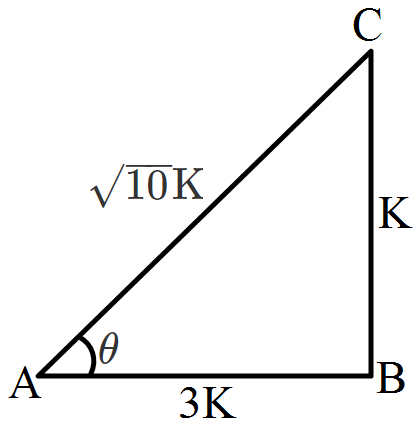
Consider $\triangle\text{ABC}$ where $\angle\text{B}=90^\circ,\angle\text{A}=\theta.$
Then, $\text{cosec}\theta=\frac{\text{Hypotenuse}}{\text{perpendicular}}$
$=\frac{\text{AC}}{\text{BC}}=\frac{\sqrt{10}}{1}$
Let $\text{AC}=\sqrt{10}\text{k}$ and $\text{BC}=\text{k}$ where $k$ is positive.
By Pythagoras Theorem,
$\text{AC}^2=\text{AB}^2+\text{BC}^2$
$\Rightarrow\big(\sqrt{10}\text{k}\big)^2=\text{AB}^2+(\text{k})^2$
$\Rightarrow\text{AB}^2=10\text{k}^2-\text{k}^2=\text{9k}^2$
$\Rightarrow\text{AB}=\text{3k}$
$\sec\theta=\frac{\text{Hypotenuse}}{\text{Base}}=\frac{\text{AC}}{\text{AB}}$
$=\frac{\sqrt{10}\text{k}}{\text{3k}}=\frac{\sqrt{10}}3{}$
View full question & answer→MCQ 901 Mark
The value of $(\cos60^\circ\cos30^\circ-\sin60^\circ\sin30^\circ)\text{is:}$
- A
$0$
- ✓
$\frac{\sqrt{3}}{2}$
- C
$\frac{1}{2}$
- D
$1$
AnswerCorrect option: B. $\frac{\sqrt{3}}{2}$
(B) $\frac{\sqrt{3}}{2}$
View full question & answer→MCQ 911 Mark
If $\tan\theta=\frac{8}{15}$ then $\text{cosec}\theta=?$
- ✓
$\frac{17}{8}$
- B
$\frac{8}{17}$
- C
$\frac{17}{15}$
- D
$\frac{15}{17}$
AnswerCorrect option: A. $\frac{17}{8}$
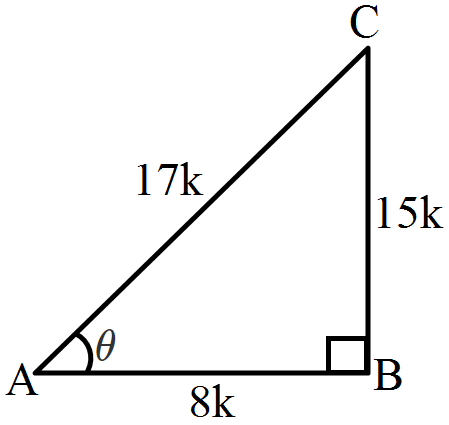
Consider $\triangle\text{ABC}$ where $\angle\text{B}=90^\circ,\angle\text{A}=\theta.$
Then, $\tan\theta=\frac{\text{perpendicular}}{\text{Base}}$
$=\frac{\text{BC}}{\text{AB}}=\frac{8}{15}$
Let $\text{BC}={8}\text{k}$ and $\text{AB}=15\text{k},$ where $k$ is positive.
By Pythagoras Theorem,
$\text{AC}^2=\text{AB}^2+\text{BC}^2$
$\Rightarrow\text{AC}^2=(15\text{k})^2+(8\text{k})^2$
$=225\text{k}^2+64\text{k}^2=289\text{k}^2$
$\Rightarrow\text{AC}=\text{17k}$
Now, $\text{cosec}\theta=\frac{\text{Hypotenuse}}{\text{Perpendicular}}$
$\frac{\text{AC}}{\text{BC}}=\frac{17\text{k}}{8\text{k}}=\frac{17}{8}$
View full question & answer→MCQ 921 Mark
The value of $\cos^217^\circ-\sin^273^\circ$ is :
- A
$1$
- B
$\frac{1}{3}$
- ✓
$0$
- D
$-1$
AnswerWe have :
$= \cos^217^\circ-\sin^273^\circ$
$= \cos^2(90^\circ-73^\circ)-\sin^273^\circ$
$= \sin^273^\circ-\sin^273^\circ$
$= 0$
Hence the correct option is $(c)$
View full question & answer→MCQ 931 Mark
The value of $\sin(45^\circ+\theta)-\cos(45^\circ-\theta)$ is equal to :
- A
$2\cos\theta$
- ✓
$0$
- C
$2\sin\theta$
- D
$1$
AnswerWe know that, $\sin(90-\theta)=\cos\theta$
So,
$\sin(45^\circ+\theta)=\cos\big[90-(45^\circ+\theta)\big]=\cos(45^\circ-\theta)$
$\therefore\ \sin(45^\circ+\theta)-\cos(45^\circ-\theta)$
$= \cos(45^\circ-\theta)-\cos(45^\circ-\theta)$
$=0$
Hence, the correct answer is option $(b)$.
View full question & answer→MCQ 941 Mark
Directions : In the following questions, a statement of assertion $(A)$ is followed by a statement of reason $(R)$. Mark the correct choice as :
Assertion : In a right $ \triangle\text{ABC}$, right angled at $B,$ if $\tan\text{A}=\frac{12}{5}$, then $\sec\text{A}=\frac{13}{5}.$
Reason : $\cot\text{A}$ is the product of $\cot$ and $ \text{A}.$
- A
Both assertion $(A)$ and reason $(R)$ are true and reason $(R)$ is the correct explanation of assertion $(A).$
- B
Both assertion $(A)$ and reason $(R)$ are true but reason $(R)$ is not the correct explanation of assertion $(A).$
- ✓
Assertion $(A)$ is true but reason $(R)$ is false.
- D
Assertion $(A)$ is false but reason $(R)$ is true.
AnswerCorrect option: C. Assertion $(A)$ is true but reason $(R)$ is false.
Assertion $(A)$ is true but reason $(R)$ is false.
View full question & answer→MCQ 951 Mark
If $8\tan \text{x} = 15,$ then $\sin \text{x} - \cos \text{x}$ is equal to :
- A
$\frac{8}{17}$
- B
$\frac{17}{7}$
- C
$\frac{1}{17}$
- ✓
$\frac{7}{17}$
AnswerCorrect option: D. $\frac{7}{17}$
We have,
$8\tan\text{x}=15$
$\Rightarrow\tan\text{x}=\frac{15}{8}$
In $\triangle\text{ABC,}$
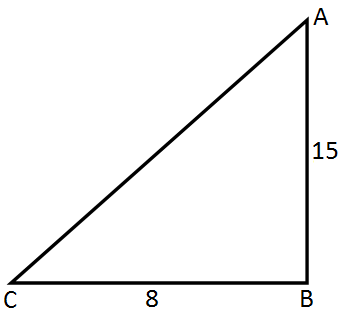
$\text{AC}^2=\text{AB}^2+\text{BC}^2$
$\Rightarrow\text{AC}^2=(15)^2+(8)^2$
$\Rightarrow\text{AC}^2=225+64$
$\Rightarrow\text{AC}^2=289$
$\Rightarrow\text{AC}=17$
$\therefore\sin\text{x}=\frac{15}{17} $ and $\cos\text{x}=\frac{8}{17}$
Now, $\sin\text{x}-\cos\text{x}=\frac{15}{17}-\frac{8}{17}$
$=\frac{15-8}{17}$
$=\frac{7}{17}$
Hence the correct option is $(d)$ View full question & answer→MCQ 961 Mark
$(\sec\text{A}+\tan\text{A})(1-\sin\text{A})=?$
- A
$\sin\text{A}$
- ✓
$\cos\text{A}$
- C
$\sec\text{A}$
- D
$\text{cosec}\text{A}$
AnswerCorrect option: B. $\cos\text{A}$
$(\sec\text{A}+\tan\text{A})(1-\sin\text{A})$
$=\Big(\frac{1}{\cos\text{A}}+\frac{\sin\text{A}}{\cos\text{A}}\Big)(1-\sin\text{A})$
$=\frac{(1+\sin\text{A})}{\cos\text{A}}\times(1-\sin\text{A})$
$=\frac{1-\sin^2\text{A}}{\cos\text{A}}$
$=\frac{\cos^2\text{A}}{\cos\text{A}}$
$=\cos\text{A}$
View full question & answer→MCQ 971 Mark
$\tan5^\circ\tan25^\circ\tan30^\circ\tan65^\circ\tan85^\circ=?$
- A
$\sqrt{3}$
- ✓
$\frac{1}{\sqrt{3}}$
- C
$1$
- D
AnswerCorrect option: B. $\frac{1}{\sqrt{3}}$
$\tan5^\circ\tan25^\circ\tan30^\circ\tan65^\circ\tan85^\circ$
$=\tan5^\circ\times\tan25^\circ\times\frac{1}{\sqrt{3}}\times\tan(90^\circ-25^\circ)\times\tan(90^\circ-5^\circ)$
$=\tan5^\circ\times\tan25^\circ\times\frac{1}{\sqrt{3}}\times\cot25^\circ\times\cot5^\circ$
$=\tan5^\circ\cot5^\circ\tan25^\circ\cot25^\circ\times\frac{1}{\sqrt{3}}$
$=1\times1\times\frac{1}{\sqrt{3}}$
$=\frac{1}{\sqrt{3}}$
View full question & answer→MCQ 981 Mark
Choose the correct option and justify your choice : $\sin 2\text{A}=2 \sin \text{A}$ is true when $A=$
- ✓
$0^\circ$
- B
$30^\circ$
- C
$45^\circ$
- D
$60^\circ$
AnswerCorrect option: A. $0^\circ$
$\sin 2\text{A}=2 \sin \text{A}$ is true when $\text{A}=0^\circ$
View full question & answer→MCQ 991 Mark
Choose the correct answer from the given four options. The value of the expression $[\text{cosec}(75^\circ+\theta)-\sec(15^\circ-\theta)-\tan(55^\circ+\theta)+\cot(35^\circ-\theta)]$ is :
- A
$–1$
- ✓
$0$
- C
$1$
- D
$\frac{3}{2}$
AnswerGiven, expression $=\text{cosec}(75^\circ+\theta)-\sec(15^\circ-\theta)-\tan(55^\circ+\theta)+\cot(35^\circ-\theta)$
$=\text{cosec}[90^\circ-(15^\circ-\theta)]-\sec(15^\circ-\theta)-\tan(55^\circ+\theta)+\cot(90^\circ-(55^\circ+\theta))$
$=\sec(15^\circ-\theta)-\sec(15^\circ-\theta)-\tan(55^\circ+\theta)+\tan(55^\circ+\theta)$
$[\therefore\text{cosec}(90^\circ-\theta)=\sec\theta$ and $\cot(90^\circ-\theta)=\tan\theta]$
$=0$
Hence, the required value of the given expression is $0$.
View full question & answer→MCQ 1001 Mark
$\cos^4\text{A}-\sin^4\text{A}$ is equal to :
- A
$2\cos^2\text{A}+1$
- ✓
$2\cos^2\text{A}-1$
- C
$2\sin^2\text{A}-1$
- D
$2\sin^2\text{A}+1$
AnswerCorrect option: B. $2\cos^2\text{A}-1$
$\cos^4\text{A}-\sin^4\text{A}=(\cos^2\text{A}+\sin^2\text{A})(\cos^2\text{A}-\sin^2\text{A})$
$=1(\cos^2\text{A}-\sin^2\text{A})=\cos^2\text{A}-(1-\cos^2\text{A})$
$=\cos^2\text{A}-1+\cos^2\text{A}$
$=2\cos^2\text{A}-1$
View full question & answer→