MCQ 1011 Mark
If $\sin\theta=\frac{1}{2}$ then $\cot\theta=?$
- A
$\frac{1}{\sqrt3}$
- ✓
$\sqrt{3}$
- C
$\frac{\sqrt3}{2}$
- D
$1$
AnswerCorrect option: B. $\sqrt{3}$
$\sin^2\theta+\cos^2\theta=1$
$\Rightarrow\Big(\frac{1}2{}\Big)^2+\cos^2\theta=1$
$\Rightarrow\cos^2\theta=1-\frac{1}{4}=\frac{3}{4}$
$\Rightarrow\cos\theta=\frac{\sqrt3}{2}$
$\therefore\cot\theta=\frac{\cos\theta}{\sin\theta}$
$=\frac{\frac{\sqrt3}{2}}{\frac{1}{2}}=\sqrt3$
View full question & answer→MCQ 1021 Mark
$\cot1^\circ\cos2^\circ\cos3^\circ\dots\cos180^\circ=?$
AnswerSince $\cos90^\circ=0$
$\cos1^\circ\cos2^\circ\cos3^\circ\dots\cos90^\circ\dots\cos180^\circ=0$
View full question & answer→MCQ 1031 Mark
$\sqrt{\frac{1+\cos\text{A}}{1-\cos\text{A}}}=?$
- A
$\text{cosec }\text{A}-\cot\text{A}$
- ✓
$\text{cosec }\text{A}+\cot\text{A}$
- C
$\text{cosec }\text{A}\cot\text{A}$
- D
AnswerCorrect option: B. $\text{cosec }\text{A}+\cot\text{A}$
$\sqrt{\frac{1+\cos\text{A}}{1-\cos\text{A}}}$
$=\sqrt{\frac{1+\cos\text{A}}{1-\cos\text{A}}\times\frac{1+\cos\text{A}}{1+\cos\text{A}}}$
$=\sqrt{\frac{(1+\cos\text{A})^2}{1-\cos^2\text{A}}}$
$=\sqrt{\frac{(1+\cos\text{A})^2}{\sin^2\text{A}}}$
$=\frac{1+\cos\text{A}}{\sin\text{A}}$
$=\frac{1}{\sin\text{A}}-\frac{\cos\text{A}}{\sin\text{A}}$
$=\text{cosec }\text{A}+\cot\text{A}$
View full question & answer→MCQ 1041 Mark
If $\sec\theta+\tan\theta=\text{x},$ then $\sec\theta=$
- A
$\frac{\text{x}^2+1}{\text{x}}$
- ✓
$\frac{\text{x}^2+1}{2\text{x}}$
- C
$\frac{\text{x}^2-1}{2\text{x}}$
- D
$\frac{\text{x}^2-1}{\text{x}}$
AnswerCorrect option: B. $\frac{\text{x}^2+1}{2\text{x}}$
Given, $\sec\theta+\tan\theta=\text{x}$
We know that,
$\sec^2\theta-\tan^2\theta=1$
$\Rightarrow (\sec\theta+\tan\theta)(\sec\theta-\tan\theta)=1$
$\Rightarrow\ \text{x}(\sec\theta-\tan\theta)=\frac{1}{\text{x}}$
Now,
$\sec\theta+\tan\theta=\text{x},$
$\sec\theta-\tan\theta=\frac{1}{\text{x}}$
Adding the two equations, we get
$(\sec\theta+\tan\theta)+(\sec\theta-\tan\theta)=\text{x}+\frac{1}{\text{x}}$
$\Rightarrow\ \sec\theta+\tan\theta+\sec\theta-\tan\theta=\frac{\text{x}^2+1}{\text{x}}$
$\Rightarrow\ 2\sec\theta=\frac{\text{x}^2+1}{\text{x}}$
$\Rightarrow\ \sec\theta=\frac{\text{x}^2+1}{2\text{x}}$
Therefore, the correct choice is $(b).$
View full question & answer→MCQ 1051 Mark
Choose the correct answer from the given four options. Given that $\sin\theta=\frac{\text{a}}{\text{b}},\text{then}\cos\theta$ is equal to :
- A
$\frac{\text{b}}{\sqrt{\text{b}^2-\text{a}^2}}$
- B
$\frac{\text{b}}{\text{a}}$
- ✓
$\frac{\sqrt{\text{b}^2-\text{a}^2}}{\text{b}}$
- D
$\frac{\text{a}}{\sqrt{\text{b}^2-\text{a}^2}}$
AnswerCorrect option: C. $\frac{\sqrt{\text{b}^2-\text{a}^2}}{\text{b}}$
Given $,\sin\theta=\frac{\text{a}}{\text{b}}$
$[\because\sin^2\theta+\cos^2\theta=1$
$\Rightarrow\cos\theta=\sqrt{1-\sin^2\theta}]$
$\therefore\ \cos\theta=\sqrt{1-\sin^2\theta}$
$=\sqrt{1-\Big(\frac{\text{a}}{\text{b}}\Big)^2}$
$=\sqrt{1-\frac{\text{a}^2}{\text{b}^2}}=\frac{\sqrt{\text{b}^2-\text{a}^2}}{\text{b}}$
View full question & answer→MCQ 1061 Mark
If $\sin\theta+\sin^2\theta=1$ then $\cos^2\theta+\cos^4\theta$ :
Answer$\sin\theta+\sin^2\theta=1$
$\Rightarrow\ \sin\theta=1-\sin^2\theta$
$\Rightarrow\ \sin\theta=\cos^2\theta$
$\cos^2\theta+\cos^4\theta=\sin\theta+\sin^2\theta\ \{\because \cos^2\theta=\sin\theta\}$
$\Rightarrow\ \cos^2\theta+\cos^4\theta=1$
$\{\because \sin\theta+\sin^2\theta=1(\text{given})\}$
View full question & answer→MCQ 1071 Mark
Choose the correct option. Justify your choice : $(1+\tan\theta+\sec\theta)(1+\cot\theta-\text{cosec}\theta) $
Answer$(1+\tan\theta+\sec\theta)(1+\cot\theta-\text{cosec}\theta) $
$=\Big(1+\frac{\sin\theta}{\cos\theta}+\frac{1}{\cos\theta}\Big)\Big(1+\frac{\cos\theta}{\sin\theta}-\frac{1}{\sin\theta}\Big) $
$=\Big(\frac{\cos\theta+\sin\theta+1}{\cos\theta}\Big)\Big(\frac{\sin\theta+\cos\theta-1}{\sin\theta}\Big)$
$=\frac{(\cos\theta+\sin\theta)^2-(1)^2}{\cos\theta.\sin\theta} $
$=\frac{\cos^2\theta+\sin^2+2\cos\theta\sin\theta-1}{\cos\theta.\sin\theta} $
$=\frac{1+2\cos\theta\sin\theta-1}{\cos\theta.\sin\theta} $
$[\because\sin^2\theta+\cos^2\theta=1] $
$=\frac{2\cos\theta\sin\theta}{\cos\theta.\sin\theta}=2 $
View full question & answer→MCQ 1081 Mark
If $\theta=30^\circ$ then $\tan2\theta$ is :
- A
$0$
- B
$1$
- ✓
$\frac{1}{2}$
- D
$\frac{\sqrt{3}}{2}$
AnswerCorrect option: C. $\frac{1}{2}$
Given : $\theta=30^\circ\cos2\theta$
$=\cos2(30^\circ)=\cos60^\circ=\frac{1}{2}$
View full question & answer→MCQ 1091 Mark
$(\text{cosec }\theta-\cot\theta)^2=?$
- A
$\frac{1+\cos\theta}{1-\cos\theta}$
- ✓
$\frac{1-\cos\theta}{1+\cos\theta}$
- C
$\frac{1+\sin\theta}{1-\sin\theta}$
- D
AnswerCorrect option: B. $\frac{1-\cos\theta}{1+\cos\theta}$
$(\text{cosec }\theta-\cot\theta)^2=\Big(\frac{1}{\sin\theta}-\frac{\cos\theta}{\sin\theta}\Big) ^2$
$=\Big(\frac{1-\cos\theta}{\sin\theta}\Big)^2$
$=\frac{(1-\cos\theta)^2}{\sin^2\theta}$
$=\frac{(1-\cos\theta)^2}{1-\cos^2\theta}$
$=\frac{(1-\cos\theta)^2}{(1-\cos\theta)(1+\cos\theta)}$
$=\frac{1-\cos\theta}{1+\cos\theta}$
View full question & answer→MCQ 1101 Mark
The value of $(1+\cot\theta-\text{cosec }\theta)(1+\tan\theta+\sec\theta)$ is
Answer$(1+\cot\theta-\text{cosec }\theta)(1+\tan\theta+\sec\theta)$
$=\Big(1+\frac{\cos\theta}{\sin\theta}-\frac{1}{\sin\theta}\Big)\Big(1+\frac{\sin\theta}{\cos\theta}+\frac{1}{\cos\theta}\Big)$
$=\frac{(\sin\theta+\cos\theta-1)(\cos\theta+\sin\theta+1)}{\sin\theta\times\cos\theta}$
$=\frac{\{(\sin\theta+\cos\theta)-1\}\{(\cos\theta+\sin\theta)+1\}}{\sin\theta\cos\theta}$
$=\frac{(\cos\theta+\sin\theta)^2-1}{\sin\theta\cos\theta}$
$=\frac{\cos^2\theta+\sin^2\theta+2\sin\theta\cos\theta-1}{\sin\theta\cos\theta}$
$=\frac{1+2\sin\theta\cos\theta-1}{\sin\theta\cos\theta}=\frac{2\sin\theta\cos\theta}{\sin\theta\cos\theta}$
$=2$
View full question & answer→MCQ 1111 Mark
If $\tan\theta=\frac{4}{3}$ then $(\sin\theta+\cos\theta)=?$
- A
$\frac{7}{3}$
- B
$\frac{7}{4}$
- ✓
$\frac{7}{5}$
- D
$\frac{5}{7}$
AnswerCorrect option: C. $\frac{7}{5}$
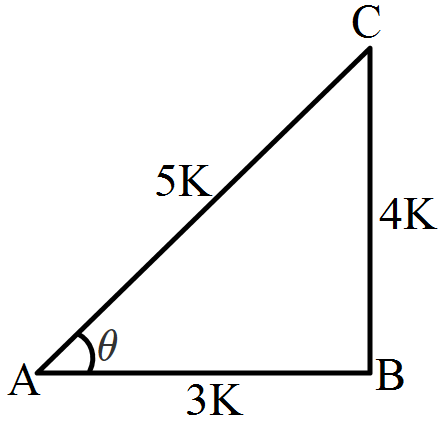
Consider $\triangle\text{ABC}$ where $\angle\text{A}=90^\circ,\angle\text{A}=\theta$
Then, $\tan\theta=\frac{\text{Perpendicular}}{\text{Base}}=\frac{\text{BC}}{\text{AB}}=\frac{4}{3}$
Let $BC = 4k$ and $AB = 3k,$ where $k$ is positive.
By pythagoras theorem,
$\text{AC}^2=\text{AB}^2+\text{BC}^2$
$\Rightarrow\text{AC}^2=(\text{3k})^2+(\text{4k})^2$
$=\text{9k}^2+\text{16k}^2=\text{25k}^2$
$\Rightarrow\text{AC}=\text{5k}$
Now, $\sin\theta=\frac{\text{Perpendicular}}{\text{Hypotenuse}}=\frac{\text{BC}}{\text{AC}}=\frac{\text{4k}}{\text{5k}}=\frac{4}{5}$
And, $\cos\theta=\frac{\text{Base}}{\text{Hypotenuse}}=\frac{\text{AB}}{\text{AC}}=\frac{3\text{k}}{\text{5k}}=\frac{3}{5}$
$\therefore\sin\theta+\cos\theta=\frac{4}{5}+\frac{3}{5}=\frac{7}{5}$
View full question & answer→MCQ 1121 Mark
The value of ${\left(17 \sec ^2 29^{\circ}-17 \cot ^2 61^{\circ}\right)} $ is equal to :
AnswerTo find the value of ${\left[17 \sec ^2 29^{\circ}-17 \cot ^2 61^{\circ}\right]} $
Now,
${\left[17 \sec ^2 29^{\circ}-17 \cot ^2 61^{\circ}\right]} $
$ =\left[17\left(1+\tan ^2 29^{\circ}\right)-17 \cot ^2 61^{\circ}\right] $
$ =\left[17+17 \tan ^2 29^{\circ}-17 \cot ^2 61^{\circ}\right] $
$ =\left[17+17 \tan ^2\left(90^{\circ}-61^{\circ}\right)-17 \cot ^2 61^{\circ}\right] $
$ =\left[17+17 \cot ^2 61^{\circ}-17 \cot ^2 61^{\circ}\right] $
$= 17$
View full question & answer→MCQ 1131 Mark
$\text{cosec}^257^\circ-\tan^233^\circ=?$
View full question & answer→MCQ 1141 Mark
$\sin47^\circ\cos43^\circ+\cos47^\circ\sin43^\circ=?$
- A
$\sin4^\circ$
- B
$\cos4^\circ$
- ✓
$1$
- D
$0$
Answer$\sin47^\circ\cos43^\circ+\cos47^\circ\sin43^\circ$
$=\sin47^\circ\cos(90^\circ-47^\circ)+\cos47^\circ\sin(90^\circ-47^\circ)$
$=\sin47^\circ\sin47^\circ+\cos47^\circ\cos47^\circ$
$=\sin^247^\circ+\cos^247^\circ$
$=1$
View full question & answer→MCQ 1151 Mark
$\sin90^\circ$ is :
View full question & answer→MCQ 1161 Mark
If $A$ and $B$ are complementary angles, then :
- A
$\sin\text{A}=\sin\text{B}$
- B
$\cos\text{A}=\cos\text{B}$
- C
$\tan\text{A}=\tan\text{B}$
- ✓
$\sec\text{A}=\text{cosec B}$
AnswerCorrect option: D. $\sec\text{A}=\text{cosec B}$
Given : $A$ and are $B$ are complementary angles
Since $\sec(90^\circ-\text{B})=\text{cosec }\text{B}$
therefore $A + B = 90^\circ $
$\Rightarrow\text{A}=90^\circ-\text{B}$
$\Rightarrow\sec\text{A}=\sec(90^\circ-\text{B})$
$\Rightarrow\sec\text{A}=\text{cosec }\text{B}$
Hence the correct option is $(d)$
View full question & answer→MCQ 1171 Mark
If $\frac{\text{x cosec}^230^\circ\sec^245^\circ}{8\cos^245^\circ\sin^260^\circ}=\tan^260^\circ-\tan^230^\circ,$ then $x =$
AnswerWe have,
$=\frac{\text{x cosec}^230^\circ\sec^245^\circ}{8\cos^245^\circ\sin^260^\circ}$
$=\tan^2 60^\circ-\tan^230^\circ$
$\Rightarrow\frac{\text{x}\times(2)^2\times(\sqrt{2})^2}{8\Big(\frac{1}{\sqrt{2}}\Big)^2\times \Big(\frac{\sqrt{3}}{2}\Big)^2}$
$=(\sqrt{3})^2-\Big(\frac{1}{\sqrt{3}}\Big)^2$
$\Rightarrow\frac{4\text{x}\times2}{\frac{8}{2}\times\frac{3}{4}}=3-\frac{1}{3}$
$\Rightarrow\frac{8\text{x}}{3}=\frac{9-1}{3}$
$\Rightarrow8\text{x}=8$
$\Rightarrow\text{x}=\frac{8}{8}$
$\Rightarrow\text{x}=1$
Hence the correct option is $(a)$
View full question & answer→MCQ 1181 Mark
If $\sin\text{A}+\sin^2\text{A}=1$ then $\cos^2\text{A}+\cos^4\text{A}=?$
- A
$ \frac{1}{2}$
- ✓
$1$
- C
$2$
- D
$3$
Answer$\sin\text{A}+\sin^2\text{A}=1$
$\Rightarrow\sin\text{A}=1-\sin^2\text{A}$
$\Rightarrow\sin\text{A}=\cos^2\text{A}$
Now, $\cos^2\text{A}+\cos^4\text{A}$
$=\sin\text{A}+\sin^2\text{A}=1$
View full question & answer→MCQ 1191 Mark
$\frac{\sec30^\circ}{\text{cosec }60^\circ}=?$
- A
$\frac{2}{\sqrt{3}}$
- B
$\frac{\sqrt{3}}{2}$
- C
$\sqrt{3}$
- ✓
$1$
Answer$\frac{\sec30^\circ}{\text{cosec }60^\circ}=\frac{\frac{2}{\sqrt{3}}}{\frac{2}{\sqrt{3}}}=1$
View full question & answer→MCQ 1201 Mark
If $\cos\text{A}+\cos^2\text{A}=1$ then $\big(\sin^2\text{A}+\sin^4\text{A}\big)=?$
- A
$\frac{1}2{}$
- B
$2$
- ✓
$1$
- D
$4$
Answer$\cos\text{A}+\cos^2\text{A}=1$
$\Rightarrow\cos\text{A}=\sin^2\text{A}\dots(\text{i})$
Squaring both sides of $(i),$ we get:
$\cos^2\text{A}=\sin^4\text{A}\dots(\text{ii})$
Adding $(i)$ and $(ii),$ we get:
$\sin^2\text{A}=\sin^4\text{A}=\cos\text{A}+\cos^2\text{A}$
$\Rightarrow\sin^2\text{A}+\sin^4\text{A}$
$=1\ [\because\cos\text{A}+\cos^2\text{A}=1]$
View full question & answer→MCQ 1211 Mark
If $\theta$ is an acute angle such that $\cos\theta=\frac{3}{5},$ then $\frac{\sin\theta\tan\theta-1}{2\tan^2\theta}=$
- A
$\frac{16}{625}$
- B
$\frac{1}{36}$
- ✓
$\frac{3}{160}$
- D
$\frac{160}{3}$
AnswerCorrect option: C. $\frac{3}{160}$
Given $\cos\theta=\frac{3}{5}$ and we need to find the value of the following expression $\frac{\sin\theta\tan\theta-1}{2\tan^2\theta}$
We know that : $\cos\theta=\frac{\text{Base}}{\text{Hypotenuse}}$
We know that :
$\Rightarrow \text{Base}=3$
$\Rightarrow\text{Hypotenuse}=5$
$\Rightarrow\text{Perpendicular}=\sqrt{(\text{Hypotenuse)}^2-(\text{Base)}^2}$
$\Rightarrow\text{Perpendicular}=\sqrt{25-9}$
$\Rightarrow\text{Perpendicular}=4$
Since $\sin \theta=\frac{\text{perpendicular}}{\text{Hypotenuse}}$
and $\tan \theta=\frac{\text{perpendicular}}{\text{Base}}$
So we find,
$\frac{\sin\theta\tan\theta-1}{2\tan^2\theta}$
$=\frac{\frac{4}{5}\times\frac{4}{3}-1}{2\times\Big(\frac{4}{3}\Big)^2}$
$=\frac{\frac{16}{15}-1}{\frac{32}{9}}$
$=\frac{\frac{1}{15}}{\frac{32}{9}}$
$=\frac{3}{160}$
Hence the correct option is $(c)$
View full question & answer→MCQ 1221 Mark
If $\sin\text{A} = \frac{12}{13}$ then $\tan\text{A} = $
- A
$\frac{13}{5}$
- ✓
$\frac{12}{5}$
- C
$\frac{13}{2}$
- D
$\frac{5}{12}$
AnswerCorrect option: B. $\frac{12}{5}$
Let $BC = 12\ cm$ and $AB = 13\ cm$
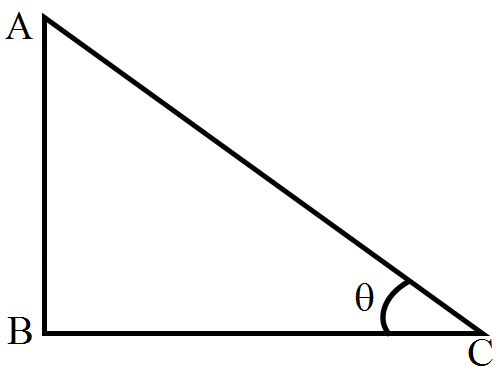
$\therefore\text{AC} = \sqrt{(13\text{k})^{2}+(12\text{k})^{2}} $
$= \sqrt{169\text{k}}^{2} - 144\text{k}^{2}$
$\Rightarrow\text{AC} = \sqrt{25\text{k}^{2}} = 5\text{k}$
$\therefore\tan\text{A} = \frac{12\text{k}}{5\text{k}} = \frac{12}{5}$ View full question & answer→MCQ 1231 Mark
If $\tan^245^\circ-\cos^230^\circ=\text{x}\sin45^\circ\cos45^\circ$ then $\text{x}=?$
- A
$2$
- B
$-2$
- ✓
$\frac{1}{2}$
- D
$\frac{-1}{2}$
AnswerCorrect option: C. $\frac{1}{2}$
$\tan^245^\circ-\cos^230^\circ$
$=\text{x}\sin45^\circ\cos45^\circ$
$\Rightarrow(1)^2-\Big(\frac{\sqrt3}{2}\Big)^2$
$=\text{x}\times\frac{1}{\sqrt2}\times\frac{1}{\sqrt2}$
$\Rightarrow1-\frac{3}{4}=\text{x}\times\frac{1}{2}$
$\Rightarrow\frac{1}{4}=\frac{\text{x}}2{}$
$\Rightarrow\text{x}=\frac{1}{2}$
View full question & answer→MCQ 1241 Mark
If $\tan\theta = \frac{20}{21}$ then $\frac{\cos\theta-\sin\theta}{\cos\theta+\sin\theta} = $
- A
$\frac{21}{20}$
- B
$\frac{1}{20}$
- ✓
$\frac{1}{41}$
- D
$\frac{1}{21}$
AnswerCorrect option: C. $\frac{1}{41}$
Given : $\tan\theta = \frac{20}{21}$
Dividing all terms of $\frac{\cos\theta-\sin\theta}{\cos\theta+\sin\theta}$ by $\cos\theta$
$= \frac{1-\tan\theta}{1+\tan\theta} =\frac{ 1-\frac{20}{21}}{1+\frac{20}{21}} $
$= \frac{21-20}{21+20} = \frac{1}{41}$
View full question & answer→MCQ 1251 Mark
If $\text{3x}=\text{cosec}\theta$ and $\frac{3}{\text{x}}=\cot\theta$ then $3\Big(\text{x}^2-\frac{1}{\text{x}^2}\Big)=?$
- A
$\frac{1}{27}$
- B
$\frac{1}{81}$
- ✓
$\frac{1}{3}$
- D
$\frac{1}{9}$
AnswerCorrect option: C. $\frac{1}{3}$
We know that
$\text{cosec}^2\theta-\cot^2\theta=1$
$\Rightarrow(\text{3x})^2-\Big(\frac{3}{\text{x}}\Big)^2=1$
$\Rightarrow\text{9x}^2-\frac{9}{\text{x}^2}=1$
$\Rightarrow9\Big(\text{x}^2-\frac{1}{\text{x}^2}\Big)=1$
$\Rightarrow\Big(\text{x}^2-\frac{1}{\text{x}^2}\Big)=\frac{1}9{}$
$\Rightarrow3\Big(\text{x}^2-\frac{1}{\text{x}^2}\Big)=\frac{1}3{}$
View full question & answer→MCQ 1261 Mark
$\cos^230^\circ\cot^245^\circ+4\sec^260^\circ+\frac{1}{2}\cos^290^\circ-2\tan^260^\circ=?$
- A
$\frac{73}{8}$
- B
$\frac{75}{8}$
- C
$\frac{81}{8}$
- ✓
$\frac{83}{8}$
AnswerCorrect option: D. $\frac{83}{8}$
$\cos^230^\circ\cot^245^\circ+4\sec^260^\circ+\frac{1}{2}\cos^290^\circ-2\tan^260^\circ$
$=\Big(\frac{\sqrt3}{2}\Big)^2\times\Big(\frac{1}{\sqrt2}\Big)^2+4(2)^2+\frac{1}{2}\times0-2\big(\sqrt3\big)^2$
$=\frac{3}{4}\times\frac{1}{2}+16+0-6$
$=\frac{3}{8}+10$
$=\frac{3+80}{8}$
$=\frac{83}{8}$
View full question & answer→MCQ 1271 Mark
If $\text{a}\cot\theta+\text{b}\text{ cosec}\theta=\text{p}$ and ${b}\cot\theta+\text{a cosec }\theta=\text{q},$ then $p^2- q^2=$
- A
$ a^2-b^2 $
- ✓
$ b^2-a^2 $
- C
$ a^2+b^2 $
- D
$b - a$
AnswerCorrect option: B. $ b^2-a^2 $
$\text{a}\cot\theta+\text{b cosec }\theta=\text{p}$
$\text{b}\cot\theta+\text{a cosec }\theta=\text{q}$
Squaring and subtracting,
$\text{p}^2-\text{q}^2=(\text{a}\cot\theta+\text{b cosec }\theta)^2-(\text{b}\cot\theta+\text{a cosec}\theta)^2$
$=\text{a}^2\cot^2\theta+\text{b}^2\text{cosec}^2\theta+2\text{ab}\cot\theta\text{ cosec }\theta$
$=-(\text{b}^2\cot^2\theta+\text{a}^2\text{cosec}^2\theta+2\text{ab}\cot\theta\text{ cosec }\theta)$
$=\text{a}^2\cot^2\theta+\text{b}^2\text{cosec}^2\theta+2\text{ab}\cot\theta\text{ cosec }\theta$
$=-\text{b}^2\cot^2\theta-\text{a}^2\text{cosec}^2\theta-2\text{ab}\cot\theta\text{ cosec }\theta$
$=\text{a}^2(\cot^2\theta-\text{cosec}^2\theta)+\text{b}^2(\text{cosec}^2\theta-\cot^2\theta)$
$=-\text{a}^2(\text{cosec}^2\theta-\cot^2\theta)+\text{b}^2(\text{cosec}^2\theta-\cot^2\theta)$
$=-\text{a}^2\times1+\text{b}^2\times1=\text{b}^2-\text{a}^2$
View full question & answer→MCQ 1281 Mark
$\sqrt{\frac{1-\sin\text{A}}{1+\sin\text{A}}}=?$
- A
$\sec\text{A}+\tan\text{A}$
- ✓
$\sec\text{A}-\tan\text{A}$
- C
$\sec\text{A}\tan\text{A}$
- D
AnswerCorrect option: B. $\sec\text{A}-\tan\text{A}$
$\sqrt{\frac{1-\sin\text{A}}{1+\sin\text{A}}}$
$=\sqrt{\frac{1-\sin\text{A}}{1+\sin\text{A}}\times\frac{1-\sin\text{A}}{1-\sin\text{A}}}$
$=\sqrt{\frac{(1-\sin\text{A})^2}{1-\sin^2\text{A}}}$
$=\sqrt{\frac{(1-\sin\text{A})^2}{\cos^2\text{A}}}$
$=\frac{1-\sin\text{A}}{\cos\text{A}}$
$=\frac{1}{\cos\text{A}}-\frac{\sin\text{A}}{\cos\text{A}}$
$=\sec\text{A}-\tan\text{A}$
View full question & answer→MCQ 1291 Mark
$(\text{cosec }\theta-\sin\theta)(\sec\theta-\cos\theta)(\tan\theta+\cot\theta)$ is equal to :
Answer$(\text{cosec }\theta-\sin\theta)(\sec\theta-\cos\theta)(\tan\theta+\cot\theta)$
$=\Big(\frac{1}{\sin\theta}-\sin\theta\Big)\Big(\frac{1}{\cos\theta}-\cos\theta\Big)$
$\Big(\frac{\sin\theta}{\cos\theta}+\frac{\cos\theta}{\sin\theta}\Big)$
$=\frac{1-\sin^2\theta}{\sin\theta}\times\frac{1-\cos^2\theta}{\cos\theta}\times\frac{\sin^2\theta+\cos^2\theta}{\sin\theta\cos\theta}$
$=\frac{\cos^2\theta}{\sin\theta}\times\frac{\sin^2\theta}{\cos\theta}\times\frac{1}{\sin\theta\cos\theta}$
$=\frac{\sin^2\theta\cos^2\theta}{\sin^2\theta\cos^2\theta}=1$
View full question & answer→MCQ 1301 Mark
$\sqrt{\frac{1+\sin\theta}{1-\sin\theta}}$ is equal to :
AnswerCorrect option: A. $\sec\theta+\tan\theta$
$\sqrt{\frac{1+\sin\theta}{1-\sin\theta}}=\sqrt{\frac{(1+\sin\theta)(1+\sin\theta)}{(1-\sin\theta)(1+\sin\theta)}}$
$=\sqrt{\frac{(1+\sin\theta)^2}{1-\sin^2\theta}}$
$=\sqrt{\frac{(1+\sin\theta)^2}{\cos^2\theta}}$
$=\frac{1+\sin\theta}{\cos\theta}=\frac{1}{\cos\theta}+\frac{\sin\theta}{\cos\theta}$
$=\sec\theta+\tan\theta$
View full question & answer→MCQ 1311 Mark
Choose the correct option. Justify your choice:$9\sec^2\text{A}-9\tan^2\text{A}= $
Answer$9\sec^2\text{A}-9\tan^2\text{A}$
$=9(\sec^2\text{A}-\tan^2\text{A}) $
$=9\times1=9\ [$since $ \sec^2\theta-\tan^2\theta=1] $
View full question & answer→MCQ 1321 Mark
Choose the correct answer from the given four options. If $\cos\text{A}=\frac{4}{5},$ then the value of $\tan\text{A}$ is :
- A
$\frac{3}{5}$
- ✓
$\frac{3}{4}$
- C
$\frac{4}{3}$
- D
$\frac{5}{3}$
AnswerCorrect option: B. $\frac{3}{4}$
Given $,\cos\text{A}=\frac{4}{5}$
$\therefore\ \sin\text{A}=\sqrt{1-\cos^2\text{A}}$ $\begin{bmatrix}\because\sin^2\text{A}+\cos^2\text{A}=1\\\therefore\sin\text{A}=\sqrt{1-\cos^2\text{A}}\end{bmatrix}$
$=\sqrt{1-\Big(\frac{4}{5}\Big)^2}=\sqrt{1-\frac{16}{25}}$
$=\sqrt{\frac{9}{25}}=\frac{3}{5}$
Now $, \tan\text{A}=\frac{\sin\text{A}}{\cos\text{A}}=\frac{\frac{3}{5}}{\frac{4}{5}}=\frac{3}{4}$
Hence, the required value of $\tan\text{A}$ is $\frac{3}{4}.$
View full question & answer→MCQ 1331 Mark
$(\cos0^\circ+\sin30^\circ+\sin45^\circ)(\sin90^\circ+\cos60^\circ-\cos45^\circ)=?$
- A
$\frac{5}{6}$
- B
$\frac{5}{8}$
- C
$\frac{3}{5}$
- ✓
$\frac{7}{4}$
AnswerCorrect option: D. $\frac{7}{4}$
$(\cos0^\circ+\sin30^\circ+\sin45^\circ)(\sin90^\circ+\cos60^\circ-\cos45^\circ)$
$=\Big(1+\frac{1}{2}+\frac{1}{\sqrt2}\Big)\Big(1+\frac{1}{2}-\frac{1}{\sqrt2}\Big)$
$=\Big(\frac{3}{2}+\frac{1}{\sqrt2}\Big)\Big(\frac{3}{2}-\frac{1}{\sqrt2}\Big)$
$=\Big(\frac{3}{2}\Big)^2-\Big(\frac{1}{\sqrt2}\Big)^2$
$=\frac{9}{4}-\frac{1}{2}$
$=\frac{9-2}{4}$
$=\frac{7}{4}$
View full question & answer→MCQ 1341 Mark
Choose the correct answer from the given four options. If $\sin\theta-\cos\theta=0,$ then the value of $(\sin^4\theta+\cos^4\theta)$ is :
- A
$1$
- B
$\frac{3}{4}$
- ✓
$\frac{1}{2}$
- D
$\frac{1}{4}$
AnswerCorrect option: C. $\frac{1}{2}$
Given $,\sin\theta-\cos\theta=0$
$\Rightarrow\ \sin\theta=\cos\theta$
$\Rightarrow\frac{\sin\theta}{\cos\theta}=1$
$\Rightarrow\ \tan\theta=1\bigg[\because\tan\theta=\frac{\sin\theta}{\cos\theta}$ and $\tan45^\circ=1\bigg]$
$\Rightarrow\ \tan\theta=\tan45^\circ$
$\therefore\ \theta=45^\circ$
Now $, \sin^4\theta+\cos^4\theta$
$=\sin^445^\circ+\cos^445^\circ$
$=\Big(\frac{1}{\sqrt{2}}\Big)^4+\Big(\frac{1}{\sqrt{2}}\Big)^4\Big[\because\sin45^\circ=\cos45^\circ=\frac{1}{\sqrt{2}}\Big]$
$=\frac{1}{4}+\frac{1}{4}=\frac{2}{4}=\frac{1}{2}$
View full question & answer→MCQ 1351 Mark
Directions : In the following questions, a statement of assertion $(A)$ is followed by a statement of reason $(R).$ Mark the correct choice as:
Assertion : $ (\cos^4\text{A}-\sin^4\text{A})$ is equal to $ 2\cos^2\text{A}-1.$
Reason : The value of $\cos\theta$ decreases as $\theta$ increases.
- A
Both assertion $(A)$ and reason $(R)$ are true and reason $(R)$ is the correct explanation of assertion $(A).$
- ✓
Both assertion $(A)$ and reason $(R)$ are true but reason $(R)$ is not the correct explanation of assertion $(A).$
- C
Assertion $(A)$ is true but reason $(R)$ is false.
- D
Assertion $(A)$ is false but reason $(R)$ is true.
AnswerCorrect option: B. Both assertion $(A)$ and reason $(R)$ are true but reason $(R)$ is not the correct explanation of assertion $(A).$
Both assertion $(A)$ and reason $(R)$ are true but reason $(R)$ is not the correct explanation of assertion $(A).$
View full question & answer→MCQ 1361 Mark
$\sec^4\text{A}-\sec^2\text{A}$ is equal to :
- A
$\tan^2\text{A}-\tan^4\text{A}$
- B
$\tan^4\text{A}-\tan^2\text{A}$
- ✓
$\tan^4\text{A}+\tan^2\text{A}$
- D
$\tan^2\text{A}+\tan^4\text{A}$
AnswerCorrect option: C. $\tan^4\text{A}+\tan^2\text{A}$
$\sec^4-\sec^2\text{A}=\sec^2\text{A}(\sec^2\text{A}-1)$
$=(1+\tan^2\text{A})\tan^2\text{A}$
$\begin{cases}\sec^2\text{A}=1+\tan^2\text{A} \\ \sec^2\text{A}-1=\tan^2\text{A}\end{cases}$
$=\tan^2\text{A}+\tan^4\text{A}$
$=\tan^4\text{A}+\tan^2\text{A}$
View full question & answer→MCQ 1371 Mark
If $\sec\theta+\tan\theta=\text{x}\sec\theta+\tan\theta=\text{x},$ then $\tan\theta=\tan\theta=$
- A
$\frac{\text{x}^2+1}{\text{x}}$
- B
$\frac{\text{x}^2-1}{\text{x}}$
- C
$\frac{\text{x}^2+1}{2\text{x}}$
- ✓
$\frac{\text{x}^2-1}{2\text{x}}$
AnswerCorrect option: D. $\frac{\text{x}^2-1}{2\text{x}}$
$\sec\theta+\tan\theta=\text{x}\ .....\text{(i)}$
We know that
$\sec^2\theta-\tan^2\theta=1$
$\Rightarrow \ (\sec\theta+\tan\theta)(\sec\theta-\tan\theta)=1$
$\Rightarrow\ \text{x}(\sec\theta-\tan\theta)=1$
$\Rightarrow\ \sec\theta-\tan\theta=\frac{1}{\text{x}}\ .....(\text{ii})$
Subtracting $(ii)$ from $(i)$
$2\tan\theta=\text{x}-\frac{1}{\text{x}}=\frac{\text{x}^2-1}{\text{x}}$
$\tan\theta=\frac{\text{x}^2-1}{2\text{x}}$
View full question & answer→MCQ 1381 Mark
$\sec^260-1=$
AnswerTo find :
$\sec^260-1$
$=(2)^2-1$
$=4-3=3$
View full question & answer→MCQ 1391 Mark
If $\tan\text{x}-3\cot\text{x}$ then $\text{x}=?$
- A
$45^\circ$
- ✓
$60^\circ$
- C
$30^\circ$
- D
$15^\circ$
AnswerCorrect option: B. $60^\circ$
$\tan\text{x}-3\cot\text{x}$
$\Rightarrow\tan\text{x}=3\times\frac{1}{\tan\text{x}}$
$\Rightarrow\tan^2\text{x}=3$
$\Rightarrow\tan\text{x}=\sqrt3$
$\Rightarrow\tan\text{x}=\tan60^\circ$
$\Rightarrow\text{x}=60^\circ$
View full question & answer→MCQ 1401 Mark
Directions : In the following questions, a statement of assertion $(A)$ is followed by a statement of reason $(R)$. Mark the correct choice as:
Assertion : If $ \cos\text{A}+\cos^2\text{A}=1$ then $\sin^2\text{A}+\sin^4\text{A}=1.$
Reason : $\sin^2\text{A}+\cos^2\text{A}=1$, for any value of $A$.
- ✓
Both assertion $(A)$ and reason $(R)$ are true and reason $(R)$ is the correct explanation of assertion $(A)$.
- B
Both assertion $(A)$ and reason $(R)$ are true but reason $(R)$ is not the correct explanation of assertion $(A).$
- C
Assertion $(A)$ is true but reason $(R)$ is false.
- D
Assertion $(A)$ is false but reason $(R)$ is true.
AnswerCorrect option: A. Both assertion $(A)$ and reason $(R)$ are true and reason $(R)$ is the correct explanation of assertion $(A)$.
Both assertion $(A) $ and reason $(R)$ are true and reason $(R)$ is the correct explanation of assertion $(A).$
View full question & answer→MCQ 1411 Mark
If $\tan\theta=\frac{\text{a}}{\text{b}}$ then $\frac{(\text{a}\sin\theta-\text{b}\cos\theta)}{(\text{a}\sin\theta+\text{b}\cos\theta)} =?$
- A
$\frac{(\text{a}^2+\text{b}^2)}{(\text{a}^2-\text{b}^2)}$
- ✓
$\frac{(\text{a}^2-\text{b}^2)}{(\text{a}^2+\text{b}^2)}$
- C
$\frac{\text{a}^2}{(\text{a}^2+\text{b}^2)}$
- D
$\frac{\text{b}^2}{(\text{a}^2+\text{b}^2)}$
AnswerCorrect option: B. $\frac{(\text{a}^2-\text{b}^2)}{(\text{a}^2+\text{b}^2)}$
Given, $\tan\theta=\frac{\text{a}}{\text{b}}$
Now, $\frac{(\text{a}\sin\theta-\text{b}\cos\theta)}{(\text{a}\sin\theta+\text{b}\cos\theta)} $
$=\frac{\frac{\text{a}\sin\theta}{\cos\theta}-\frac{\text{b}\cos\theta}{\cos\theta}}{\frac{\text{a}\sin\theta}{\cos\theta}+\frac{\text{b}\cos\theta}{\cos\theta}}$
$=\frac{\text{a}\tan\theta-\text{b}}{\text{a}\tan\theta+\text{b}}$
$=\frac{\text{a}\times\frac{\text{a}}{\text{b}}-\text{b}}{\text{a}\times\frac{\text{a}}{\text{b}}+\text{b}}$
$=\frac{\frac{\text{a}^2-\text{b}^2}{\text{b}}}{\frac{\text{a}^2+\text{b}^2}{\text{b}}}$
$=\frac{\text{a}^2-\text{b}^2}{\text{a}^2+\text{b}^2}$
View full question & answer→MCQ 1421 Mark
If $(\tan\theta+\cot\theta)=5$ then $(\tan^2\theta+\cot^2\theta)=?$
Answer$(\tan\theta+\cot\theta)=5$
$\Rightarrow(\tan\theta+\cot\theta)^2=5^2$
$\Rightarrow\tan^2\theta+\cot^2\theta+2\tan\theta\cot\theta=25$
$\Rightarrow\tan^2\theta+\cot^2\theta+2(1)=25$
$\Rightarrow\tan^2\theta+\cot^2\theta=23$
View full question & answer→MCQ 1431 Mark
If $\theta$ is an acute angle such that $\sec^2\theta=3,$ then the value of $\frac{\tan^2\theta-\text{cosec}^2\theta}{\tan^2\theta+\text{cosec}^2\theta}$ is :
- A
$\frac{4}{7}$
- B
$\frac{3}{7}$
- C
$\frac{2}{7}$
- ✓
$\frac{1}{7}$
AnswerCorrect option: D. $\frac{1}{7}$
Given that :
$\sec^2\theta=3$
$\sec\theta=\sqrt{3}$
We need to find the value of the expression
$\frac{\tan^2\theta-\text{cosec}^2\theta}{\tan^2\theta+\text{cosec}^2\theta}$
$\text{since}\ \sec \theta=\frac{\text{Hypotenuse}}{\text{Base}}$
So, $\Rightarrow{\text{Hypotenuse}}=\sqrt{3}$
$\Rightarrow\text{Base}=1$
$\Rightarrow\text{Perpendicular}=\sqrt{3-1}$
$\Rightarrow\text{Perpendicular}=\sqrt{2}$
Here we have to find : $\frac{\tan^2\theta-\text{cosec}^2\theta}{\tan^2\theta+\text{cosec}^2\theta}$
$\Rightarrow\frac{\tan^2\theta-\text{cosec}^2\theta}{\tan^2\theta+\text{cosec}^2\theta}=\frac{\frac{2}{1}-\frac{3}{2}}{\frac{2}{1}+\frac{3}{2}}$
$\Rightarrow\frac{\tan^2\theta-\text{cosec}^2\theta}{\tan^2\theta+\text{cosec}^2\theta}=\frac{\frac{1}{2}}{\frac{7}{2}}$
$\Rightarrow\frac{\tan^2\theta-\text{cosec}^2\theta}{\tan^2\theta+\text{cosec}^2\theta}=\frac{1}{7}$
Hence the correct option is $(d)$
View full question & answer→MCQ 1441 Mark
If $\triangle\text{ABC}$ is right angled at $C,$ then the value of $\cos(\text{A}+\text{B})$ is :
- ✓
$0$
- B
$1$
- C
$\frac{1}{2}$
- D
$\frac{\sqrt{3}}{2}$
AnswerIn a right angled traingle $\text{ABC}, \triangle\text{C}$ is a righta angle.
We know that, the sum of angles of a triangle is $180^\circ .$
$\therefore\ \angle\text{A}+\angle\text{B}+\angle\text{C}=180^\circ$
$\Rightarrow\ \angle\text{A}+\angle\text{B}+90^\circ=180^\circ$
$\Rightarrow\ \angle\text{A}+\angle\text{B}=90^\circ$
$\therefore\ \cos(\text{A}+\text{B})=\cos90^\circ=0$
Hence, the correct answer is option $(a).$
View full question & answer→MCQ 1451 Mark
If $\text{a}\cos\theta-\text{b}\sin\theta=\text{c},$ then $\text{a}\sin\theta+\text{b}\cos\theta=$
- A
$\pm\sqrt{\text{a}^2+\text{b}^2+\text{c}^2}$
- ✓
$\pm\sqrt{\text{a}^2+\text{b}^2-\text{c}^2}$
- C
$\pm\sqrt{\text{c}^2-\text{a}^2-\text{b}^2}$
- D
AnswerCorrect option: B. $\pm\sqrt{\text{a}^2+\text{b}^2-\text{c}^2}$
$\text{a}\cos\theta-\text{b}\sin\theta=\text{c}$
Squaring,
$\text{a}^2\cos^2\theta+\text{b}^2\sin^2\theta-2\text{ab}\sin\theta\cos\theta=\text{c}^2$
$\Rightarrow\ \text{a}^2(1-\sin^2\theta)+\text{b}^2(1-\cos^2\theta)-2\text{ab}\sin\theta\cos\theta=\text{c}^2$
$\Rightarrow\ \text{a}^2-\text{a}^2\sin^2\theta+\text{b}^2(1-\cos^2\theta)-2\text{ab}\sin\theta\cos\theta=\text{c}^2$
$\Rightarrow\ -\text{a}^2\sin^2\theta-\text{b}^2\cos^2\theta-2\text{ab}\sin\theta\cos\theta=\text{c}^2-\text{a}^2-\text{b}^2$
$\Rightarrow\ \text{a}^2\sin^2\theta+\text{b}^2\cos\theta+2\text{ab}\sin\theta\cos\theta=\text{a}^2+\text{b}^2-\text{c}^2 $
$\ (\text{Dividing by}-1)$
$(\text{a}\sin\theta+\text{b}\cos\theta)^2=\text{a}^2+\text{b}^2-\text{c}^2$
$\therefore\ \text{a}\sin\theta+\text{b}\cos\theta=\pm\sqrt{\text{a}^2+\text{b}^2-\text{c}^2}$
View full question & answer→MCQ 1461 Mark
If $5\theta$ and $4\theta$ are acute angles satisfying $\sin5\theta=\cos4\theta,$ then $2\sin3\theta-\sqrt{3}\tan3\theta$ is equal to :
- A
$1$
- ✓
$0$
- C
$-1$
- D
$1+\sqrt{3}$
AnswerWe are given that $5\theta$ and $4\theta$ are acute angles satisfying the following condition
$\sin5\theta=\cos4\theta$
We are asked to find $2\sin3\theta-\sqrt{3}\tan3\theta$
$\Rightarrow\sin5\theta=\cos4\theta$
$\Rightarrow\cos(90^\circ-5\theta)=\cos4\theta$
$\Rightarrow90^\circ-5\theta=4\theta$
$\Rightarrow9\theta=90^\theta$
Where $5\theta$ and $4\theta$ are acute angles
$\Rightarrow\theta=10^\circ$
Now we have to find:
$2\sin3\theta-\sqrt{3}\tan3\theta$
$=2\sin30^\circ-\sqrt{3}\tan30^\circ$
$=2\times\frac{1}{2}-\sqrt{3}\times\frac{1}{\sqrt{3}}$
$=1-1$
$=0$
Hence the correct option is $(b)$
View full question & answer→MCQ 1471 Mark
If $2\sin2\theta=\sqrt3$ then $\theta=?$
- ✓
$30^\circ$
- B
$45^\circ$
- C
$60^\circ$
- D
$90^\circ$
AnswerCorrect option: A. $30^\circ$
$2\cos2\theta=\sqrt3$
$\Rightarrow\sin2\theta=\frac{\sqrt3}{2}$
$\Rightarrow\sin2\theta=\sin60^\circ$
$\Rightarrow2\theta=60^\circ$
$\Rightarrow\theta=30^\circ$
View full question & answer→MCQ 1481 Mark
If $\text{x}=\text{a}\cos\theta$ and ${ y}=\text{b}\sin\theta,$ then $b^2x^2 + a^2y^2 =$
- ✓
$a^2 b^2 $
- B
$ab$
- C
$a^4 b^4 $
- D
$ a^2+b^2$
AnswerCorrect option: A. $a^2 b^2 $
$\text{x}=\text{a}\cos\theta,\text{y}=\text{b}\sin\theta\ .....(\text{i})$
$\text{bx}=\text{ab}\cos\theta,\text{y}=\text{ab}\sin\theta\ .....(\text{ii})$
Adding $\text{(i)}$ and $\text{(ii)}$ we get,
$=\text{b}^2\text{x}^2+\text{a}^2\text{b}^2\cos^2\theta+\text{a}^2\text{b}^2\sin^2\theta$
$=\text{a}^2\text{b}^2(\cos^2\theta+\sin^2\theta)$
$=\text{a}^2\text{b}^2\times1$
$=\text{a}^2\text{b}^2$
View full question & answer→MCQ 1491 Mark
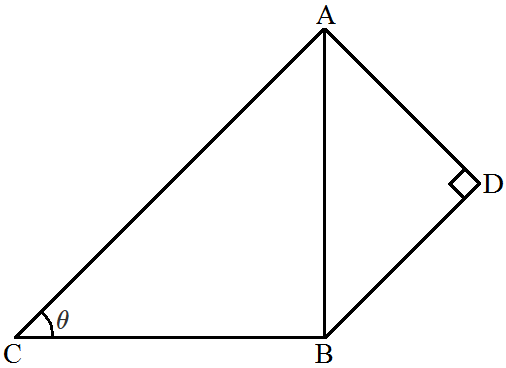
In Fig. $AD = 4\ cm, BD = 3\ cm$ and $CB = 12\ cm,$ find the $\cot\theta.$
- ✓
$\frac{12}{5}$
- B
$\frac{5}{12} $
- C
$\frac{13}{12}$
- D
$\frac{12}{13}$
AnswerCorrect option: A. $\frac{12}{5}$
We have the following given data in the figure, $AD= 4\ cm, BD = 3\ cm, CB = 12\ cm$
Now we will use Pythagoras theorem in $\triangle\text{ABD},$
$\text{AB}=\sqrt{3^2+4^2}$
$=5\text{ cm}$
Therefore,
$\cot\theta=\frac{\text{CB}}{\text{AB}}$
$=\frac{12}{5}$
So the answer is $(a)$
View full question & answer→MCQ 1501 Mark
Directions : In the following questions, a statement of assertion $(A)$ is followed by a statement of reason $(R).$ Mark the correct choice as :
Assertion : $\sin(\text{A}+\text{B})=\sin\text{A} + \sin\text{B}$
Reason : For any value of $ \theta , 1+\tan^2\theta = \sec^2\theta $
- A
Both assertion $(A)$ and reason $(R)$ are true and reason $(R)$ is the correct explanation of assertion $(A)$.
- B
Both assertion $(A)$ and reason $(R)$ are true but reason $(R)$ is not the correct explanation of assertion $(A).$
- C
Assertion $(A)$ is true but reason $(R)$ is false.
- ✓
Assertion $(A)$ is false but reason $(R)$ is true.
AnswerCorrect option: D. Assertion $(A)$ is false but reason $(R)$ is true.
Assertion $(A)$ is false but reason $(R)$ is true.
View full question & answer→