MCQ 11 Mark
If $a=\left(2^2 \times 3^3 \times 5^4\right)$ and $b=\left(2^3 \times 3^2 \times 5\right)$, then $HCF (a, b)$ is equal to:
AnswerThe $HC$F of a and $b =\left(2^2 \times 3^2 \times 5\right)$
$=(4 \times 9 \times 5)=(36 \times 5)$
$=(180)$
View full question & answer→MCQ 21 Mark
If $p$ and $q$ are two co-prime numbers, then HCF $(p, q)$ is:
Answer(d)
LCM of the given number $=p q$$
HCF=\frac{\text { product of numbers }}{\text { LCM of numbers }}=\frac{p \times q}{p q}=1
$
Two integers are co prime when they have no common factor other than 1.
Therefore the H.C.F is 1.
Hence the correct option is (d).
View full question & answer→MCQ 31 Mark
Decimal expansion of $\frac{23}{\left(2^3 5^2\right)}$ will be:
- ✓
- B
- C
Non terminating and repeating.
- D
Non-terminating and non-repeating
Answer(a)
We know by a theorem that, If $x=\frac{p}{q}$ be a rational number, such that the prime factorization of $q$ is in the form $2^n 5^m$, where $n, m$ are non-negative integers. Then $x$ has a decimal expansion which terminates.
Hence, Decimal expansion of $\frac{23}{2^3 5^2}$ will be terminating
So, the correct option is (a).
View full question & answer→MCQ 41 Mark
L.C.M. of $2^3 \times 3^2$ and $2^3 \times 3^3$ is:
- A
$2^3$
- B
$3^3$
- ✓
$2^3 \times 3^3$
- D
$2^2 \times 3^2$
AnswerCorrect option: C. $2^3 \times 3^3$
(c)
Given, $2^3 \times 3^2$ and $2^2 \times 3^3$
We know, LCM is the product of terms containing highest powers of
$(2,3) \Rightarrow 2^3 \times 3^3
$
Hence, the correct option is (c).
View full question & answer→MCQ 51 Mark
The decimal expansion of $\frac{6}{1250}$ will terminate after how many places of decimal?
AnswerExpress $6$ and $1250$ as a product of prime factors.
$\frac{6}{1250}=\frac{2 \times 3}{2 \times 5^4}$
$\Rightarrow \frac{6}{1250}=\frac{2 \times 3}{2 \times 5^4} \times \frac{2^3}{2^3}=\frac{48}{5^4 \times 2^4}$
$\Rightarrow \frac{6}{1250}=\frac{48}{(5 \times 2)^4}=\frac{48}{10000}=0.0048$
Hence, decimal expansion terminates after $4$ places of decimal. The correct option is $(d).$
View full question & answer→MCQ 61 Mark
The prime factorization of the denominator of the rational number expressed as $46 . \overline{123}$ is:
- A
$2^m \times 5^n$ Where m and n are integers
- B
$2^m \times 5^n$ Where m and n are positive integers
- C
$2^m \times 5^n$ Where m and n are rational numbers
- ✓
Not of the form $2^m \times 5^n$ where m and n are non-negative integers.
AnswerCorrect option: D. Not of the form $2^m \times 5^n$ where m and n are non-negative integers.
(d)
As the decimal expansion $46 . \overline{123}$ is a nonterminating repeating, the given number is a rational number of the form $\frac{p}{q}$ where q is not of the form $2^m \times 5^n$.
Let$
\begin{aligned}
x & =46 . \overline{123} \\
1000 x & =46123 . \overline{123}
\end{aligned}
$
$
(2)-(1) \Rightarrow \quad \frac{46077}{999}=x
$
Hence, the correct option is (d).
View full question & answer→MCQ 71 Mark
The LCM of two numbers is 2400 . Which of the following can not be their HCF?
Answer(c)
According to the property, HCF of two numbers is also a factor of LCM of same two numbers.
Out of all the options, only (c) 500 is not a factor of 2400 .
Therefore, 500 cannot be the HCF.
View full question & answer→MCQ 81 Mark
If n is a natural number, then $2\left(5^{ n }+6^{ n }\right)$ always ends with
Answer(d)
Let us take an example of different powers of 5.
As, $5^1=5 ; 5^2=25 ; 5^3=125 ; 5^4=625$
It is clear from above example that $5^n$ will always end with 5.
Similarly, $6^n$ will always end with 6 .
So, $5^n+6^n$ will always end with 6 .
Also, $2\left(5^n+6^n\right)$ always ends with $2 \times 11=22$
i.e., it will always end with 2 .
View full question & answer→MCQ 91 Mark
If $a$ and $b$ are two coprime numbers, then $a^3$ and $b^3$ are
Answer(a)
As $a$ and $b$ are co-prime then $a^3$ and $b^3$ are also co-prime.
We can understand above situation with the help of an example.
Let $a=3$ and $b=4$$
a^3=3^3=27 \text { and } b^3=4^3=64
$
Clearly, $\operatorname{HCF}(a, b)=\operatorname{HCF}(3,4)=1$
Then, $\operatorname{HCF}\left(a^3, b^3\right)=\operatorname{HCF}(27,64)=1$
View full question & answer→MCQ 101 Mark
The greatest number which when divides $1251 , 9377$ and $15628$ leaves remainder $1, 2$ and $3$ respectively is
AnswerFirst subtract the remainders from their respective number,
$1251-1=1250$
$9377-2=9375$
$15628-3=15625$
According to the prime factorisation,
$1250=2 \times 5 \times 5 \times 5 \times 5$
$9375=3 \times 5 \times 5 \times 5 \times 5 \times 5$
$15625=5 \times 5 \times 5 \times 5 \times 5 \times 5$
$\operatorname{HCF}(1250,9375,15625)$
$=5 \times 5 \times 5 \times 5$
$=625$
View full question & answer→MCQ 111 Mark
The exponent of 5 in the prime factorisation of 3750 is
Answer(a)
According to the prime factorisation, 3750 can be written as$
3750=5 \times 5 \times 5 \times 5 \times 3 \times 2=5^4 \times 3^1 \times 2^1
$
It is clear from above, that exponent of 5 in the prime factorisation of 3750 is 4.
View full question & answer→MCQ 121 Mark
Assertion - Reason Based Questions: A statement of Assertion (A) is followed by a statement of Reason (R)
Statement A (Assertion): If $5+\sqrt{7}$ is aroot of a quadratic equation with rational co-efficients, then its other root is $5-\sqrt{7}$.
Statement R (Reason): Surdroots of a quadratic equation with rational co-efficients occur in conjugate pairs.
Choose the correct option out of the following:
- ✓
Both Assertion (A) and Reason (R) are true; and Reason (R) is the correct explanation of Assertion (A).
- B
Both Assertion (A) and Reason (R) are true; but Reason (R) is not the correct explanation of Assertion (A).
- C
Assertion (A) is true but Reason (R) is false.
- D
Assertion (A) is false but Reason (R) is true.
AnswerCorrect option: A. Both Assertion (A) and Reason (R) are true; and Reason (R) is the correct explanation of Assertion (A).
View full question & answer→MCQ 131 Mark
If $p ^2=\frac{32}{50}$, then p is $a / an$
Answer(c)
$
\begin{aligned}
p^2 & =\frac{32}{50} \\
p^2 & =\frac{16}{25} \\
p & =\frac{4}{5}
\end{aligned}
$
Here, rational number is a number in the form of $\frac{p}{q}$ where $p$ and $q$ are integ ers having no common factor other than 1 and $q$ doesn't equals to 0 .
View full question & answer→MCQ 141 Mark
Euclid's division Lemma states that for two positive integers a and b , there exists unique integer $q$ and $r$ satisfying $a=b q+r$, and
- A
- B
- ✓
$0 \leq r < b$
- D
$0 \leq r \leq b$
AnswerCorrect option: C. $0 \leq r < b$
(c)
$0 \leq r < b$
View full question & answer→MCQ 151 Mark
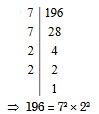
The sum of exponents of prime factors in the prime-factorisation of 196 is
MCQ 161 Mark
The decimal expansion of $\frac{13}{2 \times 5^2 \times 7}$ is
- A
terminating after 1 decimal place
- B
non-terminating and non-repeating
- C
terminating after 2 decimal places
- ✓
non-terminating but repeating
AnswerCorrect option: D. non-terminating but repeating
(d)
The denominator of $\frac{13}{2 \times 5^2 \times 7}$ is not of the form $2^{ m } \times 5^{ n }$, so, its decimal expansion is nonterminating but repeating.
View full question & answer→MCQ 171 Mark
$5 . \overline{213}$ can also be written as
Answer(a)
Bar present on 213 in $5 . \overline{213}$ means 213 is repeated multiple times.
View full question & answer→MCQ 181 Mark
$\frac{57}{300}$ is a
- A
non-terminating and non-repeating decimal expansion
- ✓
terminating decimal expansion after 2 places of decimals
- C
terminating decimal expansion after 3 places of decimals
- D
non-terminating but repeated decimal expension
AnswerCorrect option: B. terminating decimal expansion after 2 places of decimals
(b)
Terminating decimal expansion after 2 places of decimals.Here $\frac{57}{300}$ can be written as $=\frac{57}{2^2 \times 3^1 \times 5^2}$
Further, it can be written as
$
\frac{19}{2^2 \times 5^2}=\frac{19}{100}=0.19
$
Since, the denominator is of the form $2^{ m } \times 5^{ n }$, the decimal expansion will be terminating.
Therefore, it is terminating decimal expansion after 2 decimal places.
View full question & answer→MCQ 191 Mark
For which natural number $n, 6^n$ ends with digit zero?
Answer(d)
Since $6^{ n }$ is expressed as $(2 \times 3)^{ n }$, it can never end with digit 0 as it does not have 5 in its prime factorisation.
View full question & answer→MCQ 201 Mark
The $( \text{HCF} \times \text{LCM} )$ for the numbers $50$ and $20$ is
AnswerCorrect option: A. $1000$
We know that $\ce{HCF \times LCM =}$ Product of two numbers
$\Rightarrow \ce{HCF \times LCM}=20 \times 50$
$\therefore \ce{HCF \times LCM}=1000$
View full question & answer→MCQ 211 Mark
HCF of two consecutive even numbers is
Answer(c)
Let the two consecutive even numbers be 2 n and $(2 n+2)$.
Prime factorisation of $2 n =2 \times n$
Prime factorisation of $(2 n+2)=2 \times(n+1)$
To find HCF, we multiply all the prime factors common to both numbers
Therefore, HCL = 2
View full question & answer→MCQ 221 Mark
Answer(a)
Prime factorisation of $92=2 \times 2 \times 23$
Prime factorisation of $152=2 \times 2 \times 2 \times 19$
To find HCF, we multiply all the prime factors common to both number:
Therefore, $HCF =2 \times 2=4$
View full question & answer→MCQ 231 Mark
The number $(5-3 \sqrt{5}+\sqrt{5})$ is :
View full question & answer→MCQ 241 Mark
(HCF $\times LCM$ ) for the number 30 and 70 is :
Answer(a)
LCM of 30 and 70 is 210 and HCF of 30 and 70 is 10 .
Hence, $( HCF \times LCM )$ of 30 and $70=2100$
View full question & answer→MCQ 251 Mark
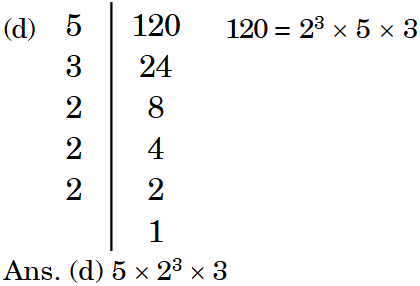
120 can be expressed as a product of its prime factors as
- A
$5 \times 8 \times 3$
- B
$15 \times 2^3$
- C
$10 \times 2^2 \times 3$
- ✓
$5 \times 2^3 \times 3$
AnswerCorrect option: D. $5 \times 2^3 \times 3$
(d)
View full question & answer→MCQ 261 Mark
The decimal expansion of the rational number $\frac{14587}{1250}$ will terminate after.
Answer(d)
$\frac{14587}{1250}=11.6696$
So, the given expression terminates after four decimal place.
View full question & answer→MCQ 271 Mark
$\sqrt{3}+\sqrt{2}$ is
Answer(b)
$\because \sqrt{3}$ is an irrational number and $\sqrt{2}$ is also an irrational number and addition of two irrational number is also irrational $\therefore(\sqrt{3}+\sqrt{2})$ is an irrational.
View full question & answer→MCQ 281 Mark
The decimal expansion of the rational number $\frac{33}{15}$ will terminate after.
- ✓
- B
- C
- D
More then three decimal place
Answer(a)
$\frac{33}{15}=2.2$
So, the given expression is terminating after one decimal place.
View full question & answer→MCQ 291 Mark
The smallest rational number by which $\frac{1}{3}$ should be multiplied so that its decimal expansion terminates after one place of decimal, is
- ✓
$\frac{3}{10}$
- B
$\frac{1}{10}$
- C
$\frac{3}{100}$
- D
AnswerCorrect option: A. $\frac{3}{10}$
(a)
$\because \frac{1}{3}=\frac{1}{3} \times \frac{3}{10}=\frac{1}{10}=0.1$
$\therefore \frac{1}{3}$ should be multiplied by $\frac{3}{10}$, so that its decimal expansion terminates after one place of decimal.
View full question & answer→MCQ 301 Mark
The smallest number by which $\sqrt{27}$ should be divided so as to get a rational number.
- A
$\sqrt{27}\
- ✓
$\sqrt{3}$
- C
$3 \sqrt{3}$
- D
AnswerCorrect option: B. $\sqrt{3}$
(b)
$\because \sqrt{27}=\sqrt{3 \times 3 \times 3}$
$=3 \sqrt{3}$
On divide by $\sqrt{3}$
$\frac{3 \sqrt{3}}{\sqrt{3}}=3$ (rational number)
So, $\sqrt{27}$ is divided by $\sqrt{3}$ to get a rational number.
View full question & answer→MCQ 311 Mark
$3 . \overline{27}$ is
Answer(c)
$3 . \overline{27}$Let $x =3 . \overline{27}$
Then $x =3.2727$
On multiplying by 100 on both side.
$100 x =327.27$--
$\Rightarrow 100 x =324+3.272727 \ldots$
$\Rightarrow 100 x =324+ x \quad$ (from eq. (i))
$\Rightarrow 100 x - x =324$
$\Rightarrow 99 x =324$
$\Rightarrow x =\frac{324}{99}=\frac{36}{11}$
So, $3 . \overline{27}$ is a rational number.
View full question & answer→MCQ 321 Mark
Which of the following rational numbers have terminating decimal?
- A
$\frac{5}{18}$
- B
$\frac{16}{225}$
- ✓
$\frac{7}{250}$
- D
$\frac{2}{21}$
AnswerCorrect option: C. $\frac{7}{250}$
$\frac{5}{18}=0.2777 \ldots$
$\frac{16}{225}=0.071111 \ldots$
$\frac{7}{250}=0.028$
$\frac{2}{21}=0.0952380 \ldots$
So, $\frac{7}{250}$ have terminating decimal.
View full question & answer→MCQ 331 Mark
The decimal expansion of the rational number $\frac{14587}{1250}$ will terminate after
Answer(d)
$\frac{14587}{1250}=11.6696$
So, the given expression will terminate after 4 decimal place.
View full question & answer→MCQ 341 Mark
The number of decimal places after which the decimal expansion of the rational number $\frac{23}{2^2 \times 5}$ will terminate, is
Answer(b)
$\frac{23}{2^2 \times 5}=\frac{23}{20}=1.15$
So, the given expression will terminate after 2 decimal place.
View full question & answer→MCQ 351 Mark
Which of the following number are irrational.
- A
$\sqrt{25}$
- B
$\sqrt{9}$
- ✓
$\sqrt{5}$
- D
$2$
AnswerCorrect option: C. $\sqrt{5}$
$\sqrt{25}=5$
$\sqrt{9}=3$
$\sqrt{5}=2.236067$
So $\sqrt{5}$ is an irrational number.
View full question & answer→MCQ 361 Mark
For some integer $q$, every odd integer is of the form
AnswerCorrect option: D. $2 q+1$
(d)
for some integer $q$, every odd integer is of the form $(2 q+1)$
View full question & answer→MCQ 371 Mark
For some integer m, every even integer is of the form
Answer(c)
Some integer $m$, every even integer is of the form of 2 m .
View full question & answer→MCQ 381 Mark
The largest number which divides $70$ and $125 ,$ leaving remainders $5$ and $8$ respectively is
AnswerRequired number
$=HCF \text { of }(70-5) \text { and }(125-8)$
$=HCF \text { of } 65 \text { and } 117=13$
View full question & answer→MCQ 391 Mark
The least number that is divisible by all the numbers from 1 to 10 (both inclusive) is.
Answer(d)
Required number $= LCM$ of $1,2,3,4,5,--10$
$
=2 \times 2 \times 2 \times 3 \times 3 \times 5 \times 5 \times 7=2520
$
View full question & answer→MCQ 401 Mark
If the sum of $\text{LCM}$ and $\text{HCF}$ of two numbers is $1260$ and their $\text{LCM}$ is $900$ more than their $\text{HCF}$, then the product of two numbers is
- A
$203400$
- ✓
$194400$
- C
$198400$
- D
$205400$
AnswerCorrect option: B. $194400$
According to the question.
$\because LCM=900+HCF$
$LCM-HCF=900 \ldots \text { (i) }$
$\text { and } LCM+HCF=1260 ......(ii)$
Solving eq $(i)$ and $(ii)$, we get,
$2 LCM=2160$
$\Rightarrow LCM=\frac{2160}{2}=1080$
Putting the value of LCM in eq. (ii), we get
$HCF=1260-1080=180$
$\because \text { Product of two numbers }=LCM \times HCF$
$=1080 \times 180=194400$
View full question & answer→MCQ 411 Mark
The LCM and HCF of two rational numbers are equal, then the numbers must be
Answer(d)
If LCM and HCF of two rational numbers are equal then the numbers must be equal.
View full question & answer→MCQ 421 Mark
If HCF of 26 and 169 is 13 , then LCM of 26 and 169 be.
Answer(c)
$\because$ We know that
LCM $\times$ HCF $=$ First number $\times$ second number
$13 \times LCM =26 \times 169$
$LCM =\frac{26 \times 169}{13}=338$
View full question & answer→MCQ 431 Mark
If the LCM of a and 18 is 36 and the HCF of a and 18 is 2 , then $a =$
Answer(c)
$\because$ We know that
$LCM \times HCF =$ first number $\times$ second number
$36 \times 2= a \times 18$
$\Rightarrow a =\frac{36 \times 2}{18}=4$
View full question & answer→MCQ 441 Mark
In question $3, \operatorname{HCF}( a , b )$ is.
- ✓
- B
$p ^3 q ^3$
- C
$p ^3 q ^2$
- D
$p^2 q^2$
Answer(a)
$a = pq ^2= p \times q \times q$
$b=p^3 q=p \times p \times p \times q$
$\therefore$ Required HCF (a, b) $= pq$
View full question & answer→MCQ 451 Mark
If two positive integers $a$ and $b$ are expressible in the form $a = pq ^2$ and $b = p ^3 q ; p , q$ being prime numbers, then $\operatorname{LCM}(a, b)$ is
- A
- B
$p ^3 q ^3$
- ✓
$p ^3 q ^2$
- D
$p ^2 q ^2$
AnswerCorrect option: C. $p ^3 q ^2$
(c)
$a = pq ^2$
$b=p^3 q$
$\operatorname{LCM}( a , b )= p ^3 q ^2$.
View full question & answer→MCQ 461 Mark
The LCM of two numbers is 1200 . Which of the following cannot be their HCF?
Answer(b)
500 cannot be their HCF because 1200 can not be completed divided by 500 .
View full question & answer→MCQ 471 Mark
Euclid's division lemma states that for two positive integers $a$ and $b$, there exist unique integers $q$ and r such that $a = bq + r$, where r must satisfy
- A
$1< r < b$
- B
$0< r \leq b$
- ✓
$0 \leq r < b$
- D
$0< r < b$
AnswerCorrect option: C. $0 \leq r < b$
(c)
Euclid's division lemma states that for two positive integers $a$ and $b$ there exist unique integers $q$ and $r$ such that $a=b q+r$, where $r$ must satisfy 0 $\leq r < b$
View full question & answer→