Question 513 Marks
In a $\triangle\text{ABC,D}\ \text{and E}$ are points on the sides AB and AC respectively such that DE || BC.
If AD = 6cm, DB = 9cm and AE = 8cm, find AC.
Answer
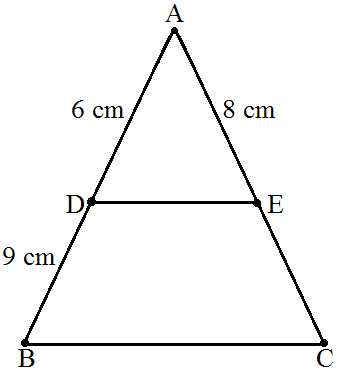 We have,
DE || BC
therefore, by basic proportionally theorem,
We have $\frac{\text{AD}}{\text{DB}}=\frac{\text{AE}}{\text{EC}}$
$\Rightarrow\frac{6}{9}=\frac{8}{\text{EC}}$
$\Rightarrow\frac{2}{3}=\frac{8}{\text{EC}}$
$\Rightarrow\text{EC}=\frac{8\times3}{2}$
$\Rightarrow\text{EC}=12\text{cm}$
$\Rightarrow\text{Now, AC}=\text{AE}+\text{EC}=8+12=20\text{cm}$
$\therefore\text{AC}=20\text{cm}$ View full question & answer→Question 523 Marks
In $\triangle\text{ABC},$ AL and CM are the perpendiculars from the vertices A and C to BC and AB respectively. If AL and CM intersect at O, prove that:
- $\triangle\text{OMA}\sim\triangle\text{OLC}$
- $\frac{\text{OA}}{\text{OC}}=\frac{\text{OM}}{\text{OL}}$
Answer
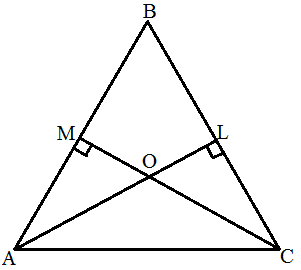
- In $\triangle\text{OMA}$ and $\triangle\text{OLC,}$
$\angle\text{AOM}=\angle\text{COL}$ [Vertically opposite angles]
$\angle\text{OMA}=\angle\text{OLC}$ [90° each]
$\Rightarrow\triangle\text{OMA}\sim\triangle\text{OLC}$ [AA similarity]
- Since $\triangle\text{OMA}\sim\triangle\text{OLC}$ by AA similarity,
then $\frac{\text{OM}}{\text{OL}}=\frac{\text{OA}}{\text{OC}}=\frac{\text{MA}}{\text{LC}}$ [Corresponding sides of similar triangles are proportional]
$\Rightarrow\frac{\text{OA}}{\text{OC}}=\frac{\text{OM}}{\text{OL}}$ View full question & answer→Question 533 Marks
If $\triangle\text{ABC}$ and $\triangle\text{AMP}$ are two right triangles, right angled at B and M respectively such that $\angle\text{MAP}=\angle\text{BAC.}$ Prove that
- $\triangle\text{ABC}\sim\triangle\text{AMP}$
- $\frac{\text{CA}}{\text{PA}}=\frac{\text{BC}}{\text{MP}}$
Answer
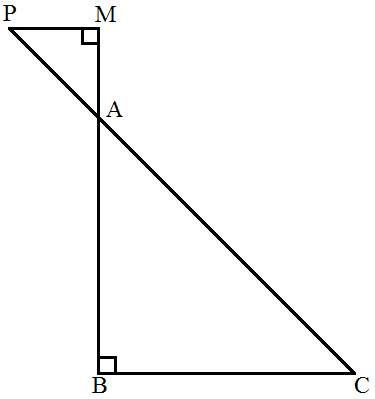
- It is given that $\triangle\text{ABC}$ and $\triangle\text{AMP}$ are two right angle triangles.
Now, in $\triangle\text{ABC}$ and $\triangle\text{AMP}$, we have
$\angle\text{MAP}=\angle\text{BAC}$ (Given)
$\angle\text{AMP}=\angle\text{B}=90^\circ$
$\triangle\text{ABC}\sim\triangle\text{AMP}$ (AA Similarity)
- $\triangle\text{ABC}\sim\triangle\text{AMP}$
So, $\frac{\text{CA}}{\text{PA}}=\frac{\text{BC}}{\text{MP}}$ (Corresponding sides are proportional) View full question & answer→Question 543 Marks
Diagonals AC and BD of a trapezium ABCD with AB || DC intersect each other at the point O. Using similarity criterion for two triangles, show that $\frac{\text{OA}}{\text{OC}}=\frac{\text{OB}}{\text{OD}}$
Answer
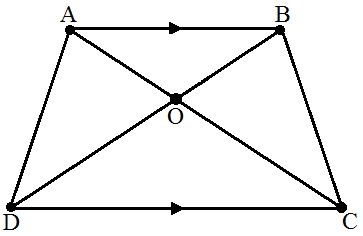 We have,
ABCD is a trapezium with AB || DC
In $\triangle\text{AOB and }\triangle\text{COD}$
$\angle\text{AOB}=\angle\text{COD}$ [Vertically opposite angles]
$\angle\text{OAB}=\angle\text{OCD}$ [Alternate interior angles]
Then, $\triangle\text{AOB}\sim\triangle\text{COD}$ [By AA similarity]
$\therefore\frac{\text{OA}}{\text{OC}}=\frac{\text{OB}}{\text{OD}}$ [Corresponding parts of similar $\triangle$ are proportional] View full question & answer→Question 553 Marks
Determine whether the triangle having sides $(a - 1)$ cm, $2\sqrt{\text{a}}\text{ cm}$ and $(a + 1)$ cm is a right angled triangle.
AnswerSides of a triangle are (a - 1)cm, $2\sqrt{\text{a}}\text{ cm}$ and (a + 1)cm
Let, $AB = (a - 1)cm, BC = (a + 1)cm$ and $\text{AC}=2\sqrt{\text{a}}$
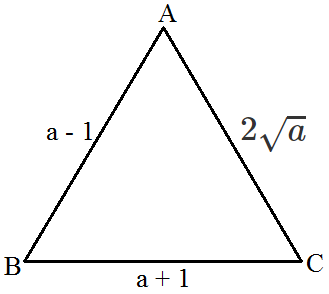
Now $AB^2 = (a - 1)^2 = a^2 - 2a + 1 BC^2 = (a + 1)^2 = a^2 + 2a + 1$
$\text{AC}^2=\big(2\sqrt{\text{a}}\big)^2=4\text{a}$
Now $AB^2 + AC^2 = a^2 - 2a + 1 + 4a = a^2 + 2a + 1 = BC^2$^
$\therefore\triangle\text{ABC}$ is a right triangle right angle at $\angle\text{A}$ (By converse of pythagoras theorem) View full question & answer→Question 563 Marks
ABC is a triangle in which $\angle\text{A}=90^\circ,\ \text{AN}\perp\text{BC}$ BC = 12cm and AC = 5cm. Find the ratio of the area of $\triangle\text{ANC}$ and $\triangle\text{ABC}.$
AnswerGiven: In $\triangle\text{ABC},\angle\text{A}=90^\circ,\text{AN}\perp\text{BC},$ BC = 12cm and AC = 5cm.
To find: Retio of the triangle $\triangle\text{ANC}$ and $\triangle\text{ABC}.$
In $\triangle\text{ANC}$ and $\triangle\text{ABC}$
$\angle\text{ACN}=\angle\text{ACB}$ (Common)
$\angle\text{A}=\angle\text{ANC}$ (90° each)
$\therefore\triangle\text{ANC}\sim\triangle\text{ABC}$ (AA Similarity)
We know that the ratio of areas of two similar triangle isequal to the ratio of squares of their corresponding sides.
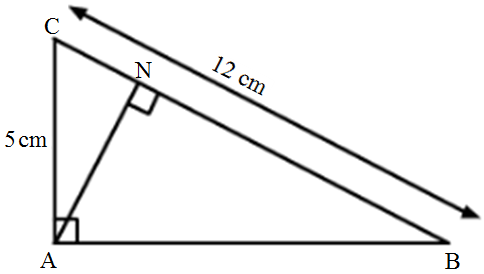
$\therefore\frac{\text{Ar}(\triangle\text{ANC})}{\text{Ar}(\triangle\text{ABC})}=\Big(\frac{\text{AC}}{\text{BC}}\Big)^2$
$\Rightarrow\frac{\text{Ar}(\triangle\text{ANC})}{\text{Ar}(\triangle\text{ABC})}=\Big(\frac{5\text{cm}}{12\text{cm}}\Big)^2$
$\Rightarrow\frac{\text{Ar}(\triangle\text{ANC})}{\text{Ar}(\triangle\text{ABC})}=\frac{25}{144}$ View full question & answer→Question 573 Marks
In a $\triangle\text{ABC,D}\ \text{and E}$ are points on the sides AB and AC respectively such that DE || BC.
If $\frac{\text{AD}}{\text{DB}}=\frac{3}{4}$ and AC = 15cm, find AE.
AnswerGiven $\frac{\text{AD}}{\text{DB}}=\frac{3}{4}$ and AC = 15cm
$\text{AB}=\text{AD}+\text{DB}$
$=3+4$
$=7\text{cm}$
We know that,
$\frac{\text{AD}}{\text{AB}}=\frac{\text{AE}}{\text{AC}}$
$\Rightarrow\frac{3}{7}=\frac{\text{AE}}{15}$
$\Rightarrow\text{AE}=\frac{3\times15}{7}$
$\Rightarrow\text{AE}=\frac{45}{7}$
$\Rightarrow\text{AE}=6.428$
$\Rightarrow\text{AE}=6.43\text{cm}$
View full question & answer→Question 583 Marks
In a quadrilateral $ABCD$, given that $\angle\text{A}+\angle\text{D}=90^\circ.$ Prove that $AC^2 + BD^2 = AD^2 + BC^2.$
AnswerGiven: A quadrilateral ABCD where $\angle\text{A}+\angle\text{D}=90^\circ.$
To prove: $AC^2 + BD^2 = AD^2 + BC^2$
Construction: Extend AB and CD to intersect at O.
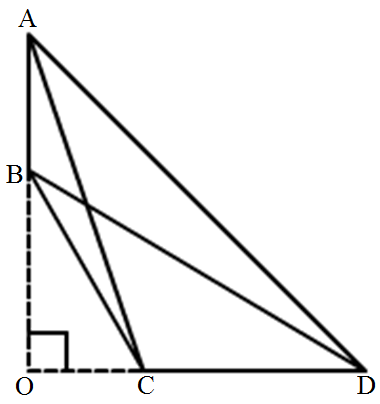
Proof: In $\triangle\text{AOD, }\angle\text{A}+\angle\text{O}+\angle\text{D}=180^\circ$
$\Rightarrow\angle\text{O}=90^\circ\ [\angle\text{A}+\angle\text{D}=90^\circ]$
Apply Pythagoras Theorem in $\triangle\text{AOC}$ and $\triangle\text{BOD},$
$AC^2 = AO^2 + OC^2$
$BD^2 = OB^2 + OD^2$
$\therefore AC^2 + BD^2 = (AO^2 + OD^2) + (OC^2 + OB^2)$
$\Rightarrow AC^2 + BD^2 = AD^2 + BC^2$
This proves the given relation.
View full question & answer→Question 593 Marks
A ladder $17\ m$ long reaches a window of a building $15\ m$ above the ground. Find the distance of the foot of the ladder from the building.
AnswerLet us draw the diagram from the given information we get a right angled triangle $ABC$ as shown below, Let the window be at the point A. We know that angle formed between the building and ground is always $90^\circ$
.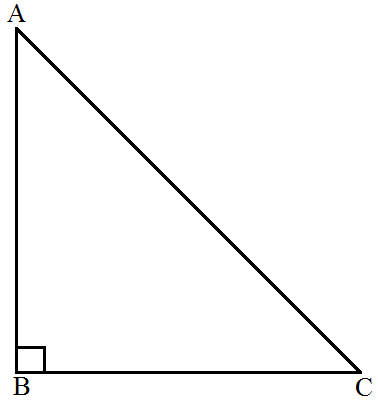
Given: $A B=15 m$ and $C A=17 m$ Now we will use Pythagoras theorem to find $I(B C)$.
$\therefore A C^2=A B^2+B C^2$ Let us substitute the values we get,
$\therefore 17^2=15^2+B C^2$
$\therefore 289=225+B C^2$
Subtracting 225 from both the sides of the equation we get,
$\therefore 289-225=B C^2$
$\therefore 64=B C^2$
Let us take the square root we get,
$BC=\sqrt{64}$
$\therefore BC=8 \text { Therefore, }$
the distance of the foot of the ladder from the building is 8 m . View full question & answer→Question 603 Marks
The areas of two similar triangles are $169 cm^2$ and $121 cm^2$ respectively. If the longest side of the larger triangle is $26$ cm , find the longest side of the smaller triangle.
AnswerGiven: The area of two similar triangles is $169 cm^2$ and $121 cm^2$ respectively. The longest side of the larger triangle is 26 cm .
To find: Longest side of the smaller triangle
We know that the ratio of areas of two similar triangles is equal to the ratio of squares of their corresponding sides.
$\frac{\text{ar(larger triangle)}}{\text{ar(smaller triangle)}}=\Big(\frac{\text{side of the larger triangle}}{\text{side of the smaller triangle}}\Big)^2$
$\frac{169}{121}=\Big(\frac{\text{side of the larger triangle}}{\text{side of the smaller triangle}}\Big)^2$
Taking square root on both sides, we get
$\frac{13}{11}=\frac{\text{side of the larger triangle}}{\text{side of the smaller triangle}}$
$\frac{13}{11}=\frac{26}{\text{side of the smaller triangle}}$
side of the smaller triangle $=\frac{11\times26}{13}=22\text{cm}$
Hence, the longest side of the smaller triangle is 22cm.
View full question & answer→Question 613 Marks
In a $\triangle\text{ABC, D}$ and E are points on the sides AB and AC respectively. For the following cases show that DE || BC:
AB = 12cm, AD = 8cm, AE = 12cm and AC = 18cm.
Answer
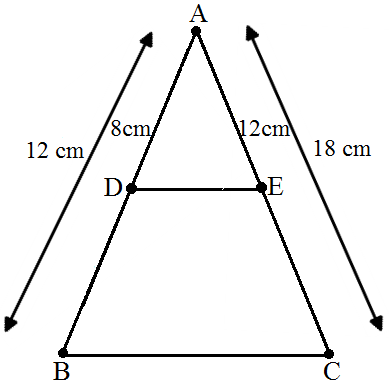 $\text{AB} = 12\text{cm}, \text{AD} = 12\text{cm}\ \text{and AC} = 18\text{cm.}$
$\therefore\text{AD}=\text{AB}-\text{AD}$
$=12-8$
$\Rightarrow\text{DB}=4\text{cm}$
$\text{And, EC}=\text{AC}-\text{AE}$
$=18-12$
$\Rightarrow\text{EC}=6\text{cm}$
$\text{Now},\frac{\text{AD}}{\text{DB}}=\frac{8}{4}=\frac{2}{1}\ \ [\because\text{DB}=4\text{cm}]$
$\text{And},\frac{\text{AE}}{\text{EC}}=\frac{12}{6}=\frac{2}{1}\ \ [\because\text{EC}=6\text{cm}]$
$\Rightarrow\frac{\text{AD}}{\text{DB}}=\frac{\text{AE}}{\text{EC}}$
Thus, DE divides sides AB and AC of $\triangle\text{ABC}$ in the same ratio.
Therefore, by the converse of basic proportionality theorem. View full question & answer→Question 623 Marks
Using Pythagoras theorem determine the length of AD in terms of b and c shown in the given figure.
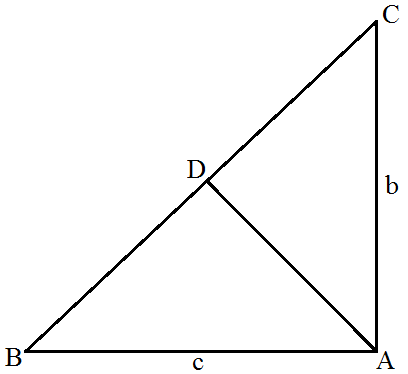
AnswerWe have,In $\triangle\text{BAC,}$ by pythagoras theorem
$\text{BC}^2 = \text{AB}^2 +\text{AC}^2$
$\Rightarrow \text{BC}^2 = \text{c}^2 + \text{b}^2$
$\Rightarrow\text{BC}=\sqrt{\text{c}^2+\text{b}^2}\ \ ....(\text{i})$
In $\triangle\text{ABD}$ and $\triangle\text{CBA}$
$\angle\text{B}=\angle\text{B}$ [Common]
$\angle\text{ADB}=\angle\text{BAC}\ \ \ [\text{Each}\ 90^\circ]$
Then, $\triangle\text{ABD}\sim\triangle\text{CBA}$ [By AA similarity]
$\therefore\frac{\text{AB}}{\text{CB}}=\frac{\text{AD}}{\text{CA}}$ [Corresponding parts of similar $\triangle$ are proportional]
$\Rightarrow\frac{\text{c}}{\sqrt{\text{c}^2+\text{b}^2}}=\frac{\text{AD}}{\text{b}}$
$\Rightarrow\text{AD}=\frac{\text{bc}}{\sqrt{\text{c}^2+\text{b}^2}}$
View full question & answer→Question 633 Marks
Corresponding sides of two triangles are in the ratio $2: 3$. If the area of the smaller triangle is $48 cm^2$, determine the area of the larger triangle.
AnswerThe ratio of the areas of two similar triangles is equal to the ratio of the square of any two corresponding sides.
$\frac{\text{Area of smaller triangle}}{\text{Area of larger triangle}}$ $=\frac{(\text{Corresponding side of smaller triangle})^2}{(\text{Corresponding side of larger triangle})^2}$
$\frac{\text{Area of smaller triangle}}{\text{Area of larger triangle}}=\frac{2^2}{3^2}$
$\frac{48}{\text{Area of larger triangle}}=\frac{4}{9}$
Area of larger triangle $=\frac{48\times9}{4}$
Area of larger triangle = 108
Hence the area of the larger triangle is $108cm^2.$
View full question & answer→Question 643 Marks
In a right $\triangle\text{ABC}$ right-angled at $C$, if $D$ is the mid-point of $BC$, prove that $BC^2 = 4(AD^2 - AC^2).$
AnswerIt is given that $\triangle\text{ABC}$ is a right-angled at $C$ and $D$ is the mid-point of $BC$.
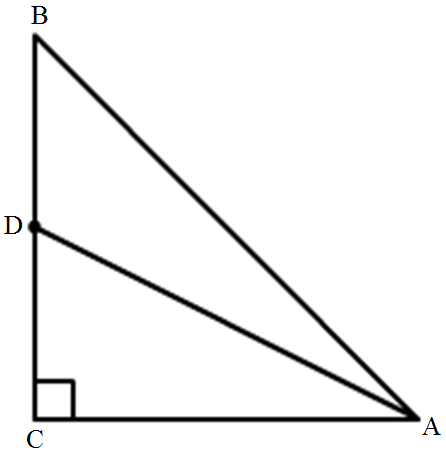
In the right angled triangle $ADC$, we will use Pythagoras theorem,
$AD^2 = DC^2 + AC^2 .....(1)$
Since D is the midpoint of BC, we have
$\text{DC}=\frac{\text{BC}}{2}$
Substituting $\text{DC}=\frac{\text{BC}}{2}$ in equation (1) we get,
$(\text{AD})^2=\Big(\frac{\text{BC}}{2}\Big)^2+(\text{AC})^2$
$(\text{AD})^2=\Big(\frac{\text{BC}}{4}\Big)^2+(\text{AC})^2$
$4\text{AD}^2=\text{BC}^2+4\text{AC}^2$
$\text{BC}^2=4\text{AD}^2-4\text{AC}^2$
$\text{BC}^2=4(\text{AD}^2-\text{AC}^2)$ View full question & answer→Question 653 Marks
In three line segments OA, OB, and OC, points L, M, N respectively are so chosen that LM || AB and MN || BC but neither of L, M, N nor of A, B, C are collinear. Show that LN || AC.
AnswerGiven: On OA, OB and OC, points are L, M, and N respectively
Such that LM || AB, MN || BC
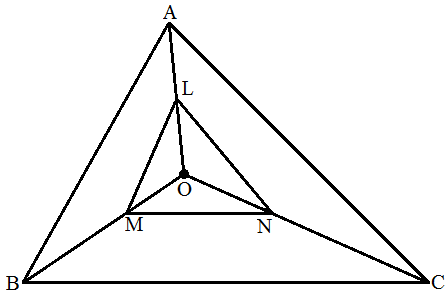
To prove: LN || AC
Proof: In $\triangle\text{OAB},$
LM || AB
$\therefore\frac{\text{OL}}{\text{LA}}=\frac{\text{OM}}{\text{MB}}\ \ ....(\text{i})$
Similarly in $\triangle\text{OBC},$
MN || BC
$\therefore\frac{\text{OM}}{\text{MB}}=\frac{\text{ON}}{\text{NC}}\ \ ....(\text{ii})$
From (i) and (ii)
$\frac{\text{OL}}{\text{LA}}=\frac{\text{ON}}{\text{NC}}$
$\therefore\text{LN}||\text{AC}$
Hence proved. View full question & answer→Question 663 Marks
In the given figure, $\triangle\text{ABC}$ is right angled at C and $\text{DE}\perp\text{AB.}$ Prove that $\triangle\text{ABC}\sim\triangle\text{ADE}$ and hence find the length of AE and DE.
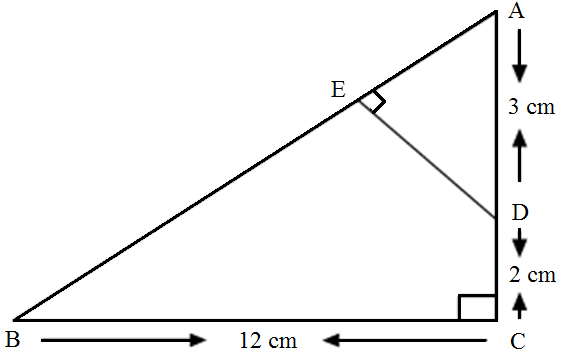
AnswerGiven: In the figure, $\triangle\text{ABC}$ is a right angled triangle right angle at C.
$\text{DE}\perp\text{AB}$To prove:
- $\triangle\text{ABC}\sim\triangle\text{ADE}$
- Find the length of AE and DE
Proof: In $\triangle\text{ABC}$ and $\triangle\text{ADE},$ $\angle\text{ACB}=\angle\text{AED}$ (each 90°) $\angle\text{BAC}=\angle\text{DAE}$ (Common) $\triangle\text{ABC}\sim\triangle\text{ADE}$ (AA axiom) $\therefore\frac{\text{AB}}{\text{AD}}=\frac{\text{BC}}{\text{DE}}=\frac{\text{AC}}{\text{AE}}$ (Corresponding sides are proportional) $\Rightarrow\frac{13}{3}=\frac{12}{\text{DE}}=\frac{5}{\text{AE}}$ $\begin{Bmatrix}\because\text{AB}=\sqrt{\text{AC}^2+\text{BC}^2}\\=\sqrt{(5)^2+(12)^2=\sqrt{25+144}}\\=\sqrt{169}=13\text{cm} \end{Bmatrix}$ $\therefore\frac{5}{\text{AE}}=\frac{13}{3}\Rightarrow\text{AE}=\frac{5\times3}{13}=\frac{15}{13 }\text{cm}$ and $\frac{12}{\text{DE}}=\frac{13}{3}\Rightarrow\text{DE}=\frac{12\times3}{13}=\frac{36}{13}\text{cm}$ View full question & answer→Question 673 Marks
In FIg. check whether AD is the bisector of $\angle\text{A}$ of $\triangle\text{ABC}$ in the following:
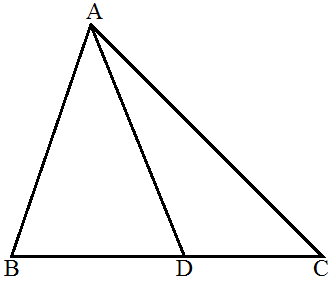
AB = 5cm, AC = 10cm, BD = 1.5cm and CD = 3.5cm. AnswerAB = 5cm, AC = 10cm, BD = 1.5cm and CD = 3.5cm.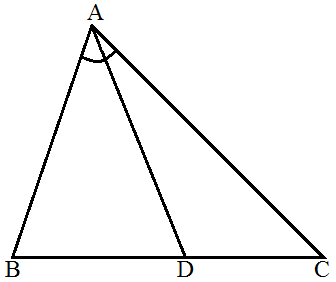
Now $\frac{\text{AB}}{\text{AC}}=\frac{5}{10}=\frac{1}{2}$ and $\frac{\text{BD}}{\text{CD}}=\frac{1.5}{3.5}=\frac{3}{7}$ $\because\frac{\text{AB}}{\text{AC}}\neq\frac{\text{BD}}{\text{CD}}$ $\therefore$ AD is not the bisector of $\angle\text{A}$ View full question & answer→Question 683 Marks
A girl of heigh 90cm is walking away from the base of a lamp-post at a speed of 1.2m/sec. If the lamp is 3.6m above the ground, find the length of her shadow after 4 seconds.
AnswerIt is given that, girl height = 90cm, speed = 1.2m/sec and height of lamp = 3.6m.
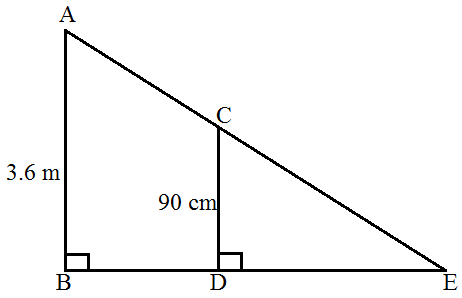
We have to find the length of her shadow after 4sec
Let AB be the lamp post and CD be the girl.
Suppose DE is the length of her shadow.
Let DE = x
And BD = 1.2 × 4 = 4.8m
Now in $\triangle\text{ABE}$ and $\triangle\text{CDE}$ we have
$\angle\text{B}=\angle\text{D}$ and $\angle\text{E}=\angle\text{E}$
So by AA similarly criterion $\triangle\text{ABE}\sim\triangle\text{CDE}$
$\frac{\text{BE}}{\text{DE}}=\frac{\text{AB}}{\text{CD}}$
$\frac{4.8+\text{x}}{\text{x}}=\frac{3.6}{0.9}=4$
$\Rightarrow3\text{x}=4.8$
$\Rightarrow\text{x}=1.6$
Hence the lenght of her shadow after 4sec is 1.6cm. View full question & answer→Question 693 Marks
In $\triangle\text{ABC},\ \angle\text{A}=60^\circ.$ Prove that $BC^2 = AB^2 + AC^2 - AB \times AC.$
AnswerIn $\triangle\text{ABC}$ in which A is an acute angle with $60^\circ.$
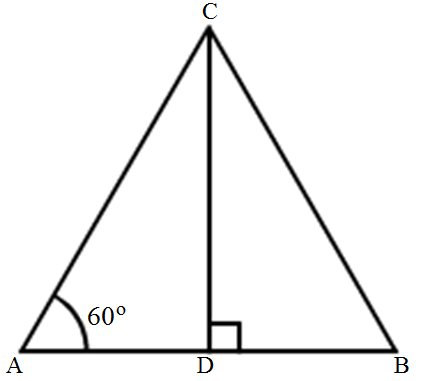
$\sin60^\circ=\frac{\text{CD}}{\text{AC}}=\frac{\sqrt{3}}{2}$
$\Rightarrow\text{CD}=\frac{\sqrt{3}}{2}\text{AC}\ \ \ ....(1)$
$\cos60^\circ=\frac{\text{AD}}{\text{AC}}=\frac{1}{2}$
$\Rightarrow\text{AD}=\frac{1}{2}\text{AC}\ \ \ ....(2)$
Now apply Pythagoras theorem in triangle BCD
$BC^2 = CD^2 + BD^2$
$= CD^2 + (AB - AD)^2$
$=\Big(\frac{\sqrt{3}}{2}\text{AC}\Big)+\text{AB}^2+\Big(\frac{1}{2}\text{AC}\Big)^2-2\text{AB}\frac{1}{2}\text{AC}$
$= AC^2 + AB^2 - AB \times AC$
Hence $BC^2 = AB^2 + AC^2 - AB \times AC$ View full question & answer→Question 703 Marks
In the given figure, XY || BC. Find the length of XY.
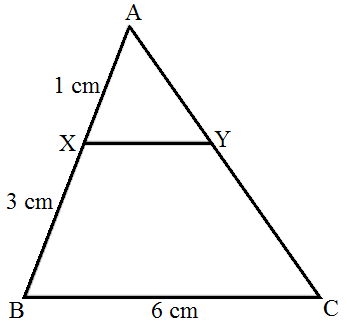
AnswerWe have, XY || BC
In $\triangle\text{AXY}\ \text{and}\ \triangle\text{ABC}$
$\angle\text{A}=\angle\text{A}$ [common]
$\angle\text{AXY}=\angle\text{ABC}$ [corresponding angles]
Then, $\triangle\text{AXY}\sim\triangle\text{ABC}$ [By AA similarity]
$\therefore\frac{\text{AX}}{\text{AB}}=\frac{\text{XY}}{\text{BC}}$ [Corresponding parts of similar $\triangle$ are proportional]
$\Rightarrow\frac{1}{4}=\frac{\text{XY}}{6}$
$\Rightarrow\text{XY}=\frac{6}{4}=1.5\text{cm}$
View full question & answer→Question 713 Marks
State Pythagoras theorem and its converse.
AnswerPythagoras theorem: In a right angled triangle, the square of the hypotenuse is equal to the sum of the aquares of the other two sides.
Converse of Pythagoras theorem: In a triangle in the aquare of one side is equal to the sum of the squares of the other two sides, then the angle opposite to the side is a right angle.
View full question & answer→Question 723 Marks
In $\triangle\text{PQR},$ M and N are points on sides PQ and PR respectively such that PM = 15cm and NR = 8cm. If PQ = 25cm and PR = 20cm state whether MN || QR.
AnswerIn $\triangle\text{PQR},$ P and Q are points on PQ and PR such that
PM = 15cm, NR = 8cm, PQ = 25cm,
and PR = 20cm, PN = PR - NR = 20 - 8 = 12cm
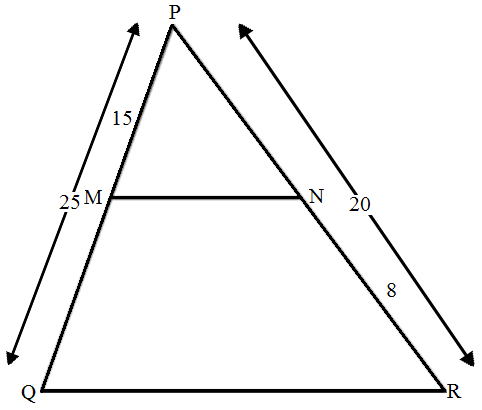
Now in $\triangle\text{PMN}$ and $\triangle\text{PQR},$
$\frac{\text{PM}}{\text{PQ}}=\frac{15}{25}=\frac{3}{5}$
and $\frac{\text{PN}}{\text{PR}}=\frac{12}{20}=\frac{3}{5}$
$\because\frac{\text{PM}}{\text{PQ}}=\frac{\text{PN}}{\text{PR}}$
$\therefore\text{MN}||\text{QR}$ View full question & answer→Question 733 Marks
In a $\triangle\text{ABC, D}$ and E are points on the sides AB and AC respectively. For the following cases show that DE || BC:
AD = 5.7cm, BD = 9.5cm, AE = 3.3cm and EC = 5.5cm.
Answer
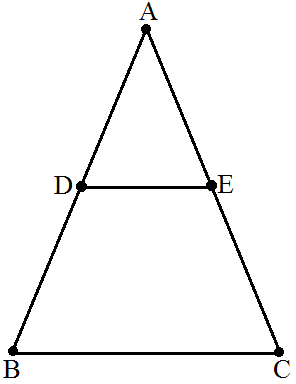 We have,
DE || BC
We have, AD = 5.7cm, BD = 9.5cm, AE = 3.3cm and EC = 5.5cm
Now $\frac{\text{AD}}{\text{BD}}=\frac{5.7}{9.5}=\frac{57}{95}$
$\Rightarrow\frac{\text{AD}}{\text{BD}}=\frac{3}{5}$
And $\frac{\text{AE}}{\text{EC}}=\frac{3.3}{5.5}=\frac{33}{55}$
$\Rightarrow\frac{\text{AE}}{\text{EC}}=\frac{3}{5}$
Thus DE divides sides AB and AC of $\triangle\text{ABC}$ in the same ratio.Therefore, by the converse of basic proportionality theorem. We have DE || BC. View full question & answer→Question 743 Marks
ABC is a triangle and PQ is a straight line meeting AB in P and AC in Q. If AP = 1cm, PB = 3cm, AQ = 1.5cm, QC = 4.5m, prove that the area of $\triangle\text{APQ}$ is one-sixteenth of the area of $\triangle\text{ABC}.$
Answer
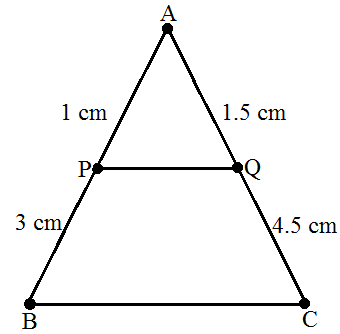 We have,
AP = 1cm, PB = 3cm, AQ = 1.5cm and QC = 4.5m
In $\triangle\text{APQ}$ and $\triangle\text{ABC}$
$\angle\text{A}=\angle\text{A}$ [Common]
$\frac{\text{AP}}{\text{AB}}=\frac{\text{AQ}}{\text{AC}}\ \ \ \big[\text{Each equal to}\frac{1}{4}\big]$
Then, $\triangle\text{APQ}\sim\triangle\text{ABC}$ [By SAS similarity]
By area of similar triangle theorem
$\frac{\text{ar}(\triangle\text{APQ})}{\text{ar}(\triangle\text{ABC})}=\frac{1^2}{4^2}$
$\Rightarrow\text{ar}(\triangle\text{APQ})=\frac{1}{16}\times\text{ar}(\triangle\text{ABC})$ View full question & answer→Question 753 Marks
M and N are points on the sides PQ and PR respectively of a $\triangle\text{PQR}$. For the following cases, state whether MN || QR.
PM = 4cm, QM = 4.5cm, PN = 4cm, NR = 4.5cm
AnswerIn the $\triangle\text{PQR}$
M and N are points on PQ and PR respectively
PM = 4cm, QM = 4.5cm, PN = 4cm, RN = 4.5cm
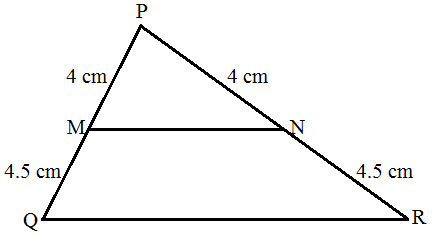
Now $\frac{\text{PM}}{\text{MQ}}=\frac{4.0}{4.5}=\frac{8}{9}$
And $\frac{\text{PN}}{\text{NR}}=\frac{4.0}{4.5}=\frac{8}{9}$
$\because\frac{\text{PM}}{\text{MQ}}=\frac{\text{PN}}{\text{NR}}$
$\therefore\text{MN}||\text{QR}.$ View full question & answer→Question 763 Marks
In an isosceles triangle $ABC$, if $AB = AC = 13\ cm$ and the altitude from $A$ on $BC$ is $5cm$, find $BC.$
Answer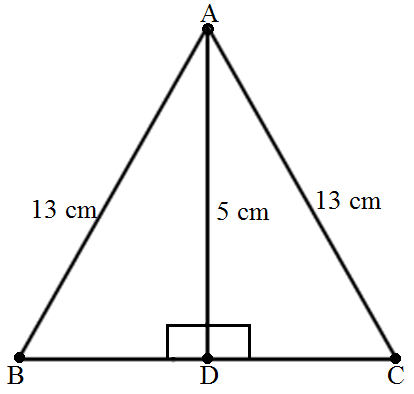
In $\triangle\text{ADB},$ by Pythagoras theorem
$AD^2 + BD^2 = 13^2$
$\Rightarrow 25 + BD^2 = 169$
$\Rightarrow BD^2 = 169 - 25 = 144$
$\Rightarrow\text{BD}=\sqrt{144}=12\text{cm}$
In $\triangle\text{ADB}$ and $\triangle\text{ADC}$
$\angle\text{ADB}=\angle\text{ADC}$ [Each 90°]
AB = AC [Each 13cm]
AD = AD [Common]
Then, $\triangle\text{ADB}\cong\triangle\text{ADC}$ [By RHS condition]
$\therefore$ $BD = CD = 12cm$ [By c.p.c.t]
Hence, $BC = 12 + 12 = 24cm.$ View full question & answer→Question 773 Marks
In the given figure, AB || QR. Find the length of PB.
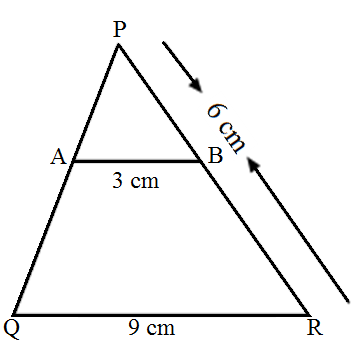
AnswerWe have,
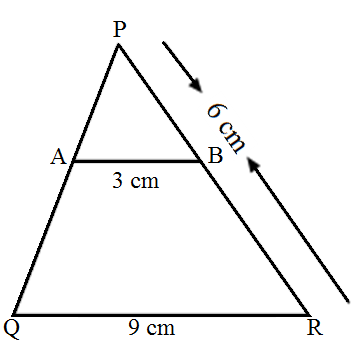
AB = 3cm, QR = 9cm and PR = 6cm
In $\triangle\text{PAB}\ \text{and}\ \triangle\text{PQR},$
$\angle\text{APB}=\angle\text{QPR}$ (Common)
and PB and PR or AB and QR are
proportional so,
$\triangle\text{APB}\sim\triangle\text{PQR}$
$\Rightarrow\frac{\text{AB}}{\text{QR}}=\frac{\text{PB}}{\text{PR}}$
$\Rightarrow\frac{3}{9}=\frac{\text{PB}}{6}$
$\Rightarrow\text{PB}=\frac{3}{9}\times6$
$\Rightarrow\text{PB}=\frac{6}{3}=2\text{cm}$
Thus, PB = 2cm. View full question & answer→Question 783 Marks
In the given figure, DE || BC. Determine AC and AE.
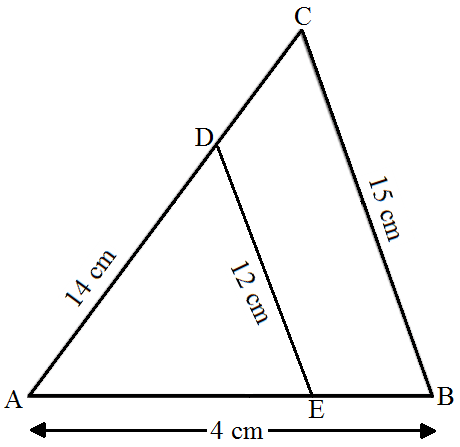
AnswerIn the figure ABC is a triangle in which DE || BC
$\therefore\triangle\text{AED}\sim\triangle\text{ABC}$
$\therefore\frac{\text{AE}}{\text{AB}}=\frac{\text{AD}}{\text{AC}}=\frac{\text{ED}}{\text{BC}}$
$\Rightarrow\frac{\text{AE}}{4}=\frac{14}{\text{AC}}=\frac{12}{15}$
Now, $\frac{\text{AE}}{4}=\frac{12}{15}\Rightarrow\text{AE}=\frac{12\times4}{15}$
$=\frac{4\times4}{5}=\frac{16}{5}$
and $\frac{14}{\text{AC}}=\frac{12}{15}\Rightarrow\text{AC}=\frac{14\times15}{12}=\frac{35}{2}$
Hence $\text{AC}=\frac{35}{2},\text{AE}=\frac{16}{5}$
View full question & answer→Question 793 Marks
The areas of two similar triangles are $81 cm^2$ and $49 cm^2$ respectively. Find the ratio of their corresponding heights. What is the ratio of their corresponding medians?
AnswerGiven: The area of two similar triangles is $81 cm^2$ and $49 cm^2$ respectively.
To find:
- Ratio of their corresponding heights.
- Ratio of their corresponding medians.
- We know that the ratio of areas of two similar triangles is equal to the ratio of squares of their corresponding altitudes.
$\frac{\text{ar(triangle 1)}}{{\text{ar(triangle 2)}}}=\Big(\frac{\text{altitude 1}}{\text{altitude 2}}\Big)^2$
$\frac{81}{49}=\Big(\frac{\text{altitude 1}}{\text{altitude 2}}\Big)^2$
Taking square root on both sides, we get
$\frac{9}{7}=\frac{\text{altitude 1}}{\text{altitude 2}}$
altitude1 : altitude2 $= 9 : 7$
- We know that the ratio of areas of two similar triangles is equal to the ratio of squares of their medians.
$\frac{\text{ar(triangle 1)}}{{\text{ar(triangle 2)}}}=\Big(\frac{\text{median 1}}{\text{median 2}}\Big)^2$
$\frac{81}{49}=\Big(\frac{\text{median 1}}{\text{median 2}}\Big)^2$
Taking square root on both sides, we get
$\frac{9}{7}=\frac{\text{median 1}}{\text{median 2}}$
median1 : median2 $= 9 : 7$ View full question & answer→Question 803 Marks
In a $\triangle\text{ABC,D}\ \text{and E}$ are points on the sides AB and AC respectively such that DE || BC.If AD = 4x - 3, AE = 8x - 7, BD = 3x - 1 and CE = 5x - 3, find the value of x.
AnswerGiven: AD = 4x - 3, AE = 8x - 7, BD = 3x - 1 and CE = 5x - 3
by thales theorem
$\frac{\text{AD}}{\text{BD}}=\frac{\text{AE}}{\text{CE}}$
$\Rightarrow\frac{4\text{x}-3}{3\text{x}-1}=\frac{8\text{x}-7}{5\text{x}-3}$
$\Rightarrow(4\text{x}-3)(5\text{x}-3)=(8\text{x}-7)(3\text{x}-1)$
$\Rightarrow20\text{x}^2+9-15\text{x}-12\text{x}=24\text{x}^2-21\text{x}-8\text{x}+7$
$\Rightarrow9-7-27\text{x}+29\text{x}=24\text{x}^2-20\text{x}^2$
$\Rightarrow2+2\text{x}=4\text{x }^2$
$\Rightarrow4\text{x}^2-2\text{x }-2=0$
$\Rightarrow2\text{x}^2-2\text{x}+\text{x}-1=0$
$\Rightarrow2\text{x}(\text{x}-1)+(\text{x}-1)=0$
$\Rightarrow(2\text{x}+1)(\text{x}-1)=0$
$\Rightarrow2\text{x}+1=0\ \text{or}\ \text{x}-1=0$
$\Rightarrow2\text{x}=-1\ \text{or x}=1$
$\Rightarrow\text{x}=\frac{-1}{2}$
$\text{Thus, x}=\frac{-1}{2}\ \text{and x}=1$
View full question & answer→Question 813 Marks
Each side of a rhombus is $10\ cm$. If one its diagonals is $16\ cm$ find the length of the other diagonal.
AnswerIn rhombus $ABCD$, diagonals $AC$ and $BD$ bisect each other at $O$ at right angles
Each side $= 10\ cm$ and one diagonal $AC = 16\ cm$
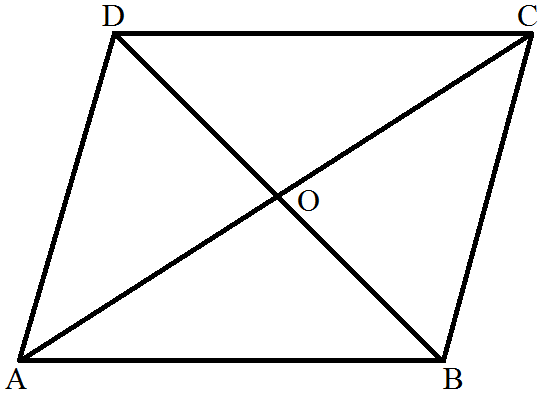
$\text{AO}=\text{OC}=\frac{16}{2}=8\text{cm}$
Now in right angled triangle AOB,
$AB^2 = AO^2 + OB^2$ (Pythagoras Theorem)
$(10)^2 = (8)^2 + (BO)^2$
$\Rightarrow 100 = 64 + BO^2$
$\Rightarrow BO^2 = 100 – 64 = 36 = (6)^2$
$BO = 6$
$BD = 2BO = 2 x 6 = 12cm.$ View full question & answer→Question 823 Marks
If a $\triangle\text{ABC},$ AD is the bisector of $\angle\text{A},$ Meeting side BC at D.
If AB = 10cm, AC = 6cm and BC = 12cm, find BD and DC.
AnswerIt is given that AB = 10cm, AC = 6cm and BC = 12cm.
In $\triangle\text{ABC},$ AD is the bisector of $\angle\text{A},$ meeting side BC at D.
We have to find BD and DC
Since AD is $\angle\text{A}$ bisectoe
So $\frac{\text{AC}}{\text{AB}}=\frac{\text{DC}}{\text{BD}}$
Let BD = x cm
Then
$\frac{6}{10}=\frac{12-\text{x}}{\text{x}}$
$\Rightarrow6\text{x}=120-10\text{x}$
$\Rightarrow16\text{x}=120$
$\Rightarrow\text{x}=\frac{120}{16}$
$\Rightarrow\text{x}=7.5$
Now
DC = 12 - BD
= 12 - 7.5
= 4.5
Hence BD = 7.5cm and DC = 4.5cm.
View full question & answer→Question 833 Marks
In the given figure, each of PA, QB, RC and SD is perpendicular to l. If AB = 6cm, BC = 9cm, CD = 12cm and PS = 36cm, then determine PQ, QR and RS.
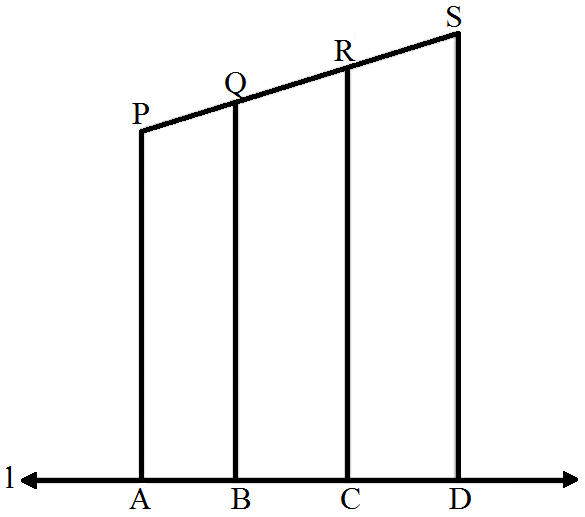
AnswerGiven: In the figure,
PA, QB, RC and SD are perpendiculars on l
AB = 6cm, BC = 9cm, CD = 12cm and PS = 36cm
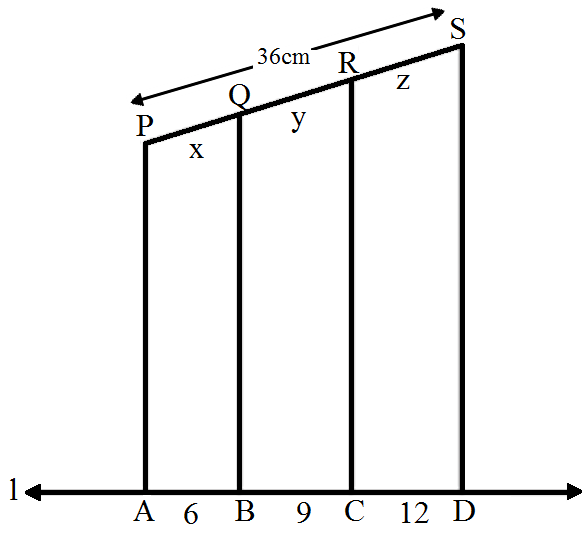
Let PQ = x, QR = y and Rs = z
$\because$ AP || BQ || CR || DS
$\therefore\frac{\text{AB}}{\text{PQ}}=\frac{\text{BC}}{\text{QR}}=\frac{\text{CD}}{\text{RS}}=\frac{\text{AD}}{\text{PS}}$
$\Rightarrow\frac{6}{\text{x}}=\frac{9}{\text{y}}=\frac{12}{\text{z}}=\frac{27}{36}$ ($\because$ AD = 6 + 9 + 12 = 27)
$\therefore\frac{6}{\text{x}}=\frac{27}{36}\Rightarrow\text{x}=\frac{6\times36}{27}=8\text{cm}$
$\frac{9}{\text{y}}=\frac{27}{36}\Rightarrow\text{y}=\frac{9\times36}{27}=12\text{cm}$
and $\frac{12}{\text{z}}=\frac{27}{36}\Rightarrow\text{z}=\frac{12\times36}{27}=16\text{cm}$
Hence PQ = 8cm, QR = 12cm and RS = 16cm. View full question & answer→Question 843 Marks
In a right angled triangle with sides a and b and hypotenuse c, the altitude drawn on the hypotenuse is x. Prove that ab = cx.
Answer
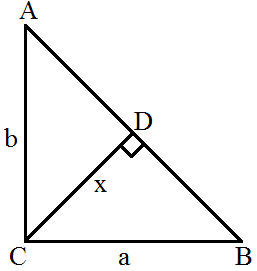 In $\triangle\text{BAC}\ \text{and}\ \triangle\text{CDB}$
$\angle\text{BCA}=\angle\text{COB}=90^\circ$
$\angle\text{B}=\angle\text{B}$
By, AA criterion of similarily
$\triangle\text{BAC}\sim\triangle\text{CDB}$
$\Rightarrow\frac{\text{CD}}{\text{BC}}=\frac{\text{AC}}{\text{AB}}$
$\Rightarrow\frac{\text{x}}{\text{a}}=\frac{\text{b}}{\text{c}}$
$\Rightarrow\text{ab}=\text{cx}$ "proved" View full question & answer→Question 853 Marks
A man goes $15$ meters due west and then 8 meters due north. How far is he from the starting point?
Answer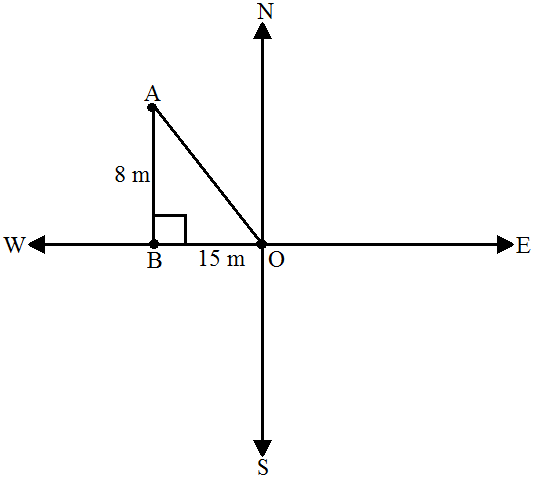
Let the starting point of the man be $O$ and final point be A.
$\therefore$ In $\triangle\text{ABO},$ by Pythagoras theorem $AO2 = AB2 + BO2$
$\Rightarrow AO^2 = 8^2 + 15^2$
$\Rightarrow AO^2 = 64 + 225 = 289$
$\Rightarrow\text{AO}=\sqrt{289}=17\text{m}$
$\therefore$ He is 17m far from the starting point. View full question & answer→Question 863 Marks
In the figure, if $\text{AB}\perp\text{BC,}$ $\text{DC}\perp\text{BC,}$ and $\text{DE}\perp\text{AC,}$ prove that $\triangle\text{CED}\sim\triangle\text{ABC.}$
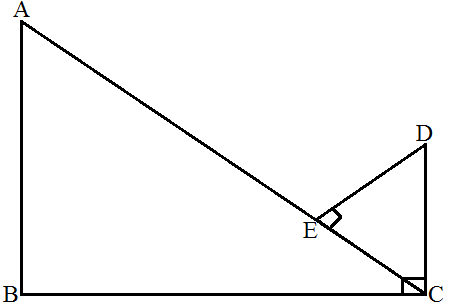
AnswerGiven: In the figure $\text{AB}\perp\text{BC}, \text{DC} \perp\text{BC}$ and $ \text{DE} \perp \text{AC}$
To prove: $\triangle\text{CED}\sim\triangle\text{ABC}$.
Proof: $\text{AB}\perp \text{BC}$
$\angle\text{B} = 90^\circ$
and $\angle\text{A}+\angle\text{ACB}=90^\circ\ ...(\text{i})$
$\text{DC}\perp \text{BC}$
$\angle\text{DCB}=90^\circ$
$\Rightarrow\angle\text{ACB} + \angle\text{DCA} = 90^\circ ….(\text{ii})$
From (i) and (ii)
$\angle\text{A} = \angle\text{DCA}$
Now in $\triangle\text{CED}$ and $\triangle\text{ABC,}$
$\angle\text{E} = \angle\text{B}$ (each 90°)
$\angle\text{DEA or } \angle\text{DCE} = \angle\text{A}$ (proved)
$\triangle\text{CED} \sim \triangle\text{ABC}$ (AA axiom)
Hence proved.
View full question & answer→Question 873 Marks
In $\triangle\text{ABC},$ if $\text{BD}\perp\text{AC}$ and $BC^2 = 2AC \times CD$, then prove that $AB = AC.$
Answer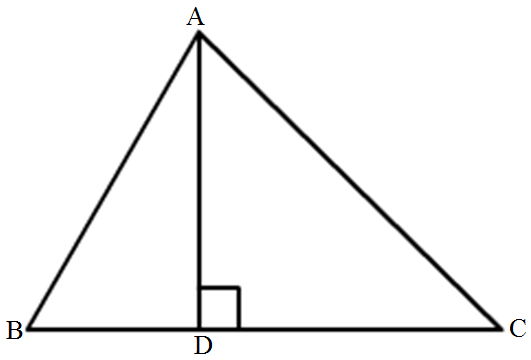
Since $\triangle\text{ADB}$ is right triangle right angled at D
$AB^2 = AD^2 + BD^2$
In right $\triangle\text{BDC,}$ we have
$CD^2 + BD^2 = BC^2$
Since $2AC \times DC = BC^2$
$\Rightarrow DC^2 + BD^2 = 2AC \times DC$
$2AC \times DC = AC^2 - AC^2 + DC^2 + BD^2$
$AC^2 = AC^2 + DC^2 - 2AC \times DC + BD^2$
$AC^2 = (AC - DC)^2 + BD^2$
$AC^2 = AD^2 + BD^2$
Now substitute $AD^2 + BD^2 = AB^2$
$AC^2 = AB^2$
$AC = AB$ View full question & answer→Question 883 Marks
In the given figure, $\triangle\text{ACB}\sim\triangle\text{APQ}.$ If BC = 8cm, PQ = 4cm, BA = 6.5cm and AP = 2.8cm, find CA and AQ.
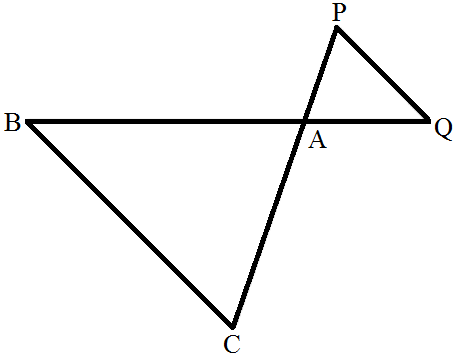
AnswerIt is given that $\triangle\text{ACB}\sim\triangle\text{APQ}$
BC = 8cm, PQ = 4cm, BA = 6.5cm and AP = 2.8cm.
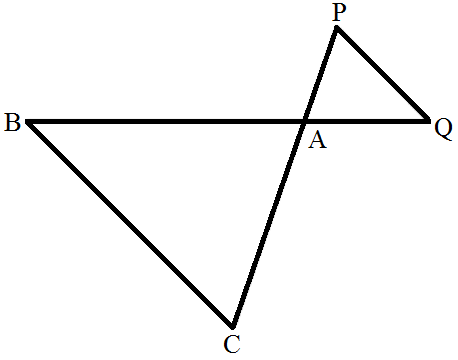
We have to find CA and AQ
Since $\triangle\text{ACB}\sim\triangle\text{APQ}$
$\Rightarrow\frac{\text{BA}}{\text{AQ}}=\frac{\text{CA}}{\text{AP}}=\frac{\text{BC}}{\text{PQ}}$
So $\frac{6.5\text{cm}}{\text{AQ}}=\frac{8\text{cm}}{4\text{cm}}$
$\text{AQ}=\frac{6.5\text{cm}\times4\text{cm}}{8\text{cm}}$
$=3.25\text{cm}$
Similarly $\frac{\text{CA}}{\text{AP}}=\frac{\text{BC}}{\text{PQ}}$
$\frac{\text{CA}}{2.8\text{cm}}=\frac{8\text{cm}}{4\text{cm}}$
$\text{CA}=2.8\text{cm}\times2\text{cm}$
$=5.6\text{cm}$
Hence, CA = 5cm and AQ = 3.25cm. View full question & answer→Question 893 Marks
In the given figure, DE || BC
If DE = 4cm, BC = 8cm and Area $(\triangle\text{ADE})=25\text{cm}^2$, find the area of $\triangle\text{ABC}.$
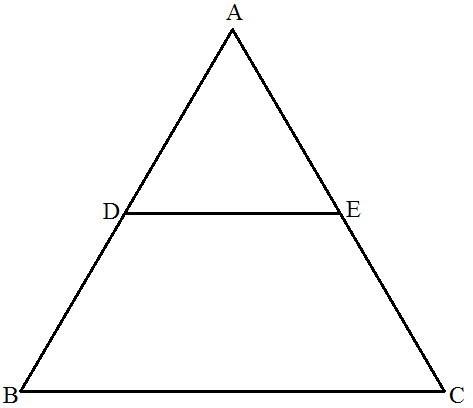
AnswerWe have, DE || BC, DE = 4cm, BC = 8cm and area $\triangle\text{ADE}=25\text{cm}^2$
In $\triangle\text{ADE}$ and $\triangle\text{ABC}$
$\angle\text{A}=\angle\text{A}$ [Common]
$\angle\text{ADE}=\angle\text{ABC}$ [Corresponding angles]
Then, $\triangle\text{ADE}\sim\triangle\text{ABC}$ [By AA similarity]
By area of similar triangle theorem
$\frac{\text{Area}(\triangle\text{ADE)}}{\text{Area}(\triangle\text{ABC})}=\frac{\text{DE}^2}{\text{BC}^2}$
$\Rightarrow\frac{25}{\text{Area}(\triangle\text{ABC})}=\frac{4^2}{8^2}$
$\Rightarrow\text{Area}(\triangle\text{ABC})=\frac{25\times64}{16}=100\text{cm}^2$
View full question & answer→Question 903 Marks
In the given figure, $\triangle\text{ABC}$ and $\triangle\text{DBC}$ are on the same base BC. If AD and BC intersect at O, prove that $\therefore\frac{\text{Area}(\triangle\text{ABC)}}{\text{Area}(\triangle\text{DBC})}=\frac{\text{AO}}{\text{DO}}$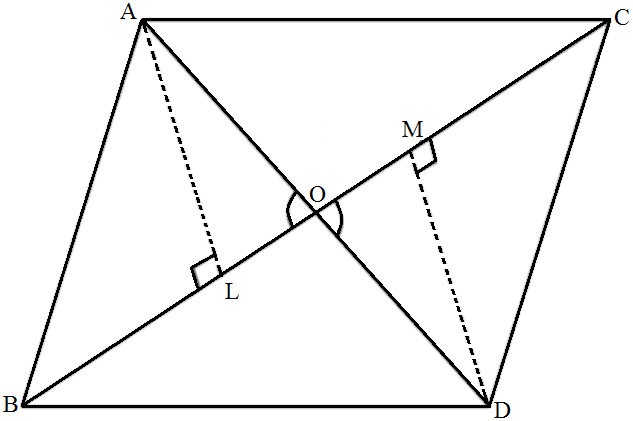
AnswerGiven: $\triangle\text{ABC}$ and $\triangle\text{DBC}$ are on the same base BC. AD and BC intersect at O.
Prove that: $\therefore\frac{\text{Area}(\triangle\text{ABC)}}{\text{Area}(\triangle\text{DBC})}=\frac{\text{AO}}{\text{DO}}$
Construction: Draw $\text{AL}\perp\text{BC and }\text{DM}\perp\text{BC}.$
Now, in $\triangle\text{ALO}$ and $\triangle\text{DMO,}$ we heve
$\angle\text{ALO}=\angle\text{DMO}=90^\circ$
$\angle\text{AOL}=\angle\text{DOM}$ (vertically opposite angles)
Therefore $\triangle\text{ALO}\sim\triangle\text{DMO}$
$\therefore\frac{\text{AL}}{\text{DM}}=\frac{\text{AO}}{\text{DO}}$ (Corresponding sides are proportional)
$\therefore\frac{\text{Ar}(\triangle\text{ABC)}}{\text{Ar}(\triangle\text{BCD})}=\frac{\frac{1}{2}\text{BC}\times\text{AL}}{\frac{1}{2}\text{BC}\times\text{DM}}$
$=\frac{\text{AL}}{\text{DM}}$
$=\frac{\text{AO}}{\text{DO}}$
View full question & answer→Question 913 Marks
An aeroplane leaves an airport and flies due north at a speed of 1000km/hr. At the same time, another aeroplane leaves the same airport and flies due west at a speed of 1200km/hr. How far apart will be the two planes after $1\frac{1}{2}$ hours?
Answer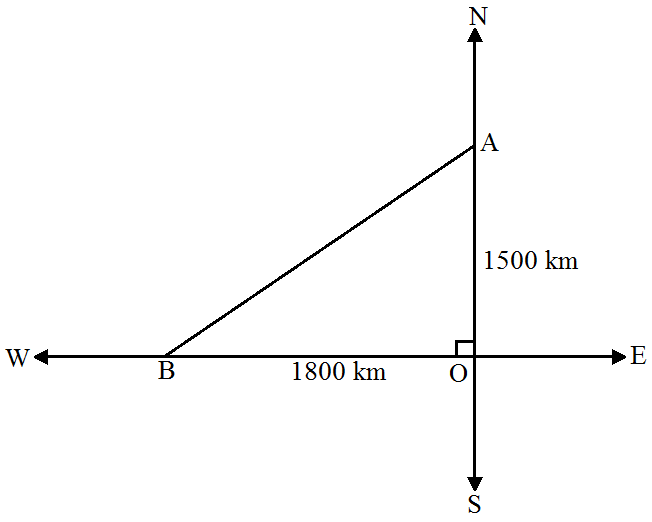
Speed of the first plane = 1000km/hr
Distance travelled in $1\frac{1}{2}$ hour due north $=1000\times\frac{3}{2}=1500\text{km}$
Speed of the second plane = 1200km/hr
Distance travelled in $1\frac{1}{2}$ hours due west
$=1200\times\frac{3}{2}=1800\text{km}$
Now in right $\triangle\text{AOB},$
$AB^2 = OA^2 + OB^2$
$= (1500)^2 + (1800)^2$
$= 2250000 + 3240000 = 5490000$
$\therefore\text{AB}=\sqrt{5490000}$
$=\sqrt{90000\times61}\text{ km}$
$=300\sqrt{61}=300\times7.81\text{km}$
$=2343\text{km}$ (approximate) View full question & answer→Question 923 Marks
In a $\triangle\text{ABC,D}\ \text{and E}$ are points on the sides AB and AC respectively such that DE || BC.If AD = 8x - 7, DB = 5x - 3, AE = 4x - 3 and EC = (3x - 1), find the value of x.
Answer
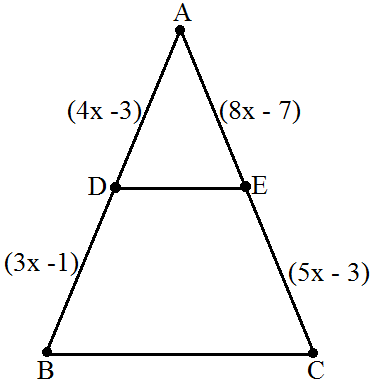 We have,
DE || BC
Therefore, by basic proportionality theorem, we have,
$\frac{\text{AD}}{\text{DB}}=\frac{\text{AE}}{\text{EC}}$
$\Rightarrow\frac{8\text{x}-7}{5\text{x}-3}=\frac{4\text{x}-3}{3\text{x}-1}$
$\Rightarrow(8\text{x}-7)(3\text{x}-1)=(4\text{x}-3)(5\text{x}-3)$
$\Rightarrow24\text{x}^2-8\text{x}-21\text{x}+7=20\text{x}^2-12\text{x}-15\text{x}+9$
$\Rightarrow24\text{x}^2-20\text{x}^2-29\text{x}+27\text{x}+7-9=0$
$\Rightarrow4\text{x}^2-2\text{x}-2=0$
$\Rightarrow2[2\text{x}^2-\text{x}-1]=0$
$\Rightarrow2\text{x}^2-\text{x}-1=0$
$\Rightarrow2\text{x}^2-2\text{x}+1\text{x}-1=0$
$\Rightarrow2\text{x}(\text{x}-1)+1(\text{x}-1)=0$
$\Rightarrow(2\text{x}+1)(\text{x}-1)=0$
$\Rightarrow2\text{x}+1=0\ \text{or x}-1=0$
$\Rightarrow\text{x}=-\frac{1}{2}\ \text{or x}=1$
$\text{x}=-\frac{1}{2}$ is not possible
$\therefore\text{x}=1$ View full question & answer→Question 933 Marks
In $\triangle\text{ABC},\ \angle\text{C}$ is an obtuse angle. $\text{AD}\perp\text{BC}$ and $AB^2 = AC^2 + 3BC^2$. Prove that $BC = CD.$
AnswerGiven: $\triangle\text{ABC}$ where $\angle\text{C}$ is an obtuse angle, $\text{AD}\perp\text{BC}$ and A$B^2 = AC^2 + 3BC^2$
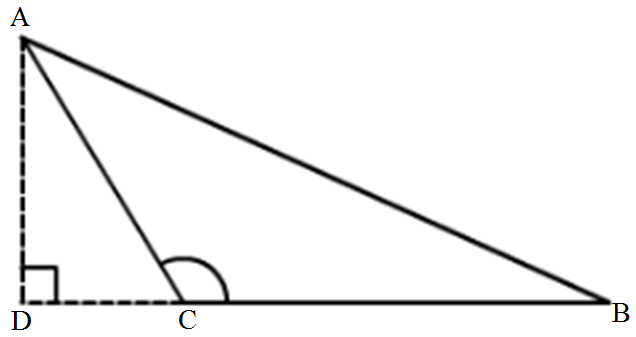
To prove: $BC = CD$
Proof: In $\triangle\text{ABC},\ \angle\text{C}$ is obtuse.
Therefore, $AB^2 = AC^2 + BC^2 + 2BC \times DC$ (Obtuse angle theorem) ....(1)
$AB^2 = AC^2 + 3BC^2 (Given) .....(2)$
From (1) and (2) we get,
$AC^2 + 3BC^2 = AC^2 + BC^2 + 2BC \times DC$
$\Rightarrow 3BC^2 = BC^2 + 2BC \times DC$
$\Rightarrow 2BC^2 = 2BC \times DC$
$\Rightarrow BC = DC.$ View full question & answer→Question 943 Marks
The areas of two similar triangles are $25 cm^2$ and $36 cm^2$ respectively. If the altitude of the first triangle is $2.4 \ cm$ , find the corresponding altitude of the other.
AnswerArea of first triangle $= 25cm^2$
Area of second $= 36cm^2$
Altitude of the first triangle = 2.4cm
Let altitude of the second triangle = x
The triangles are similar
$\therefore\frac{\text{Area of the first }\triangle}{\text{Area of the second }\triangle}$
$=\frac{(\text{Altitude of first}\ \triangle)^2}{(\text{Altitude of second }\triangle)^2}$
$\Rightarrow\frac{25}{36}=\frac{(2.4)^2}{\text{x}^2}$
$\Rightarrow\frac{(2.4)^2}{(\text{x})^2}=\frac{(5)^2}{(6)^2}\Rightarrow\frac{2.4}{\text{x}}=\frac{5}{6}$
$\Rightarrow\text{x}=\frac{2.4\times6}{5}=\frac{14.4}{5}=2.88$
$\therefore$ Altitude of secoud triangle = 2.88cm.
View full question & answer→Question 953 Marks
If $\triangle\text{ABC}\sim\triangle\text{DEF}$ such that AB = 5cm, area $(\triangle\text{ABC})$ $= 20cm^2$ and area $(\triangle\text{DEF})$ $= 45cm^2$, determine DE.
Answer$\triangle\text{ABC}\sim\triangle\text{DEF}$ area $(\triangle\text{ABC})$ $= 20cm^2 $area $(\triangle\text{DEF})$ $= 45cm^2$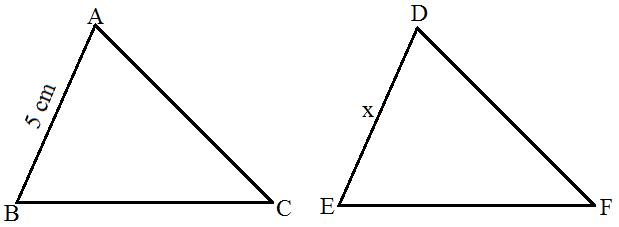
AB = 5cm Let DE = x cm Now $\because\triangle\text{ABC}\sim\triangle\text{DEF}$
$\therefore\frac{\text{area}(\triangle\text{ABC})}{\text{area}(\triangle\text{DEF})}=\frac{\text{AB}^2}{\text{DE}^2}$ $\Rightarrow\frac{20}{45}=\frac{(5)^2}{\text{x}^2}\Rightarrow\frac{20}{45}=\frac{25}{\text{x}^2}$ $\Rightarrow\text{x}^2=\frac{25\times45}{20}=\frac{225}{4}=\Big(\frac{15}{2}\Big)^2$
$\therefore\text{x}=\frac{15}{2}=7.5$
$\therefore\text{DE}=7.5\text{cm}$ View full question & answer→Question 963 Marks
In an acute-angled triangle, express a median in terms of its sides.
AnswerLet $\triangle\text{ABC}$ acute angled triangle where AD is its median with respect side BC.
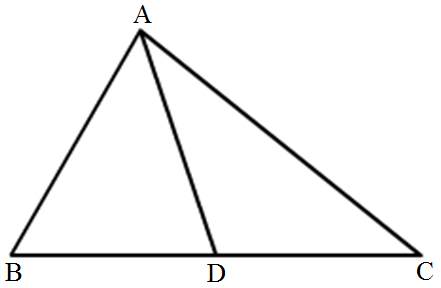
It is known that in any triangle, the sum of the squares of any two sides is equal to twice the square of half of the third side together with twice the square of the median which bisects the third side.
$\therefore\text{AB}^2+\text{AC}^2=2\text{AD}^2+2\Big(\frac{1}{2}\text{BC}\Big)^2$
$\text{AB}^2+\text{AC}^2=2\text{AD}^2+\frac{1}{2}\text{BC}^2$
$\text{AD}^2=\frac{2\text{AB}^2+2\text{AC}^2-\text{BC}^2}{4}$
This is the required expression. View full question & answer→Question 973 Marks
D and E are the points on the sides AB and AC respectively of a $\triangle\text{ABC}$ such that:
AD = 8cm, DB = 12cm, AE = 6cm and CE = 9cm, Prove that $\text{BC}=\frac{5}{2}$ DE.
AnswerIt is given that AD = 8cm, DB = 12cm, AE = 6cm and CE = 9cm.
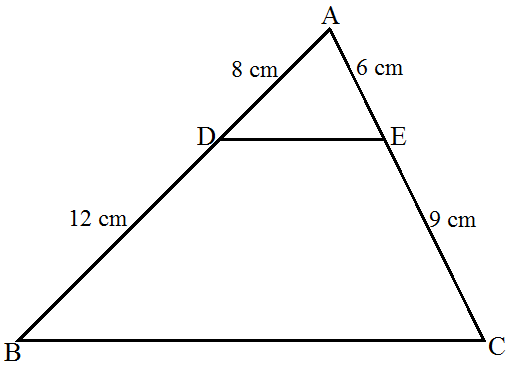
We have to prove that $\text{BC}=\frac{5}{2}\text{DE}$
Since clearly $\frac{\text{AD}}{\text{AB}}=\frac{\text{AE}}{\text{AC}}=\frac{2}{5}$
Also, $\angle\text{A}$ is common in $\triangle\text{ABC}$ and $\triangle\text{ADE}$
So $\triangle\text{ADE}\sim\triangle\text{ABC}$ (SAS Similarity)
$\Rightarrow\frac{\text{BC}}{\text{DE}}=\frac{\text{AB}}{\text{AD}}$
$\Rightarrow\frac{\text{BC}}{\text{DE}}=\frac{1}{\big(\frac{\text{AD}}{\text{AB}}\big)}$
$\Rightarrow\frac{\text{BC}}{\text{DE}}=\frac{1}{\big(\frac{2}{5}\big)}$ $\Big(\frac{\text{AD}}{\text{AB}}=\frac{2}{5}\Big)$
$\Rightarrow\frac{\text{BC}}{\text{DE}}=\frac{5}{2}$
$\Rightarrow\text{BC}=\frac{5}{2}\text{DE}$ View full question & answer→Question 983 Marks
The areas of two similar triangles are $100 cm^2$ and $49 cm^2$ respectively. If the altitude of the bigger triangle is 5 cm , find the corresponding altitude of the other.
AnswerGiven: The area of two similar triangles is $100 cm^2$ and $49 cm^2$ respectively. If the altitude of bigger triangle is 5 cm
To find: their corresponding altitude of other triangle
We know that the ratio of areas of two similar triangles is equal to the ratio of squares of their corresponding altitudes.
$\frac{\text{ar(bigger triangle1)}}{\text{ar(triangle2)}}=\Big(\frac{\text{altitude of bigger triangle1}}{\text{altitude2}}\Big)^2$
$\frac{100}{49}=\Big(\frac{5}{\text{altitude2}}\Big)^2$
Taking square root on both side
$\frac{10}{7}=\frac{5}{\text{altitude2}}$
altitude2 = 3.5cm
View full question & answer→Question 993 Marks
In a quadrilateral ABCD, $\angle\text{B}=90^\circ.$ If $AD^2 = AB^2 + BC^2 + CD^2$, then prove that $\angle\text{ACD}=90^\circ.$
AnswerGiven: In quadrilateral ABCD, $\angle\text{B}=90^\circ$ and $AD^2 = AB^2 + BC^2 + CD^2$
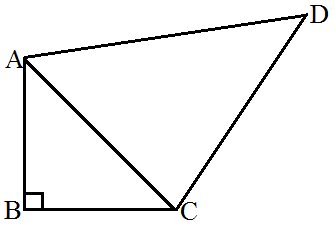
To prove: $\angle\text{ACD}=90^\circ$
Proof: In $\triangle\text{ABC},\ \angle\text{B}=90^\circ$
$AC^2 = AB^2 + BC^2 .....(i)$
$But AD^2 = AB^2 + BC^2 + CD^2$
$\Rightarrow AB^2 + BC^2 = AD^2 - CD^2 .....(ii)$
Substituting the value of $AB^2 + BC^2$ in (i)
$AC^2 = AD^2 - CD^2$
$\Rightarrow AD^2 = AC^2 + CD^2$
$\therefore\triangle\text{ACD}$ is a right triangle
Hence $\angle\text{ACD}=90^\circ$ View full question & answer→Question 1003 Marks
In the given figure, PA, QB and RC are each perpendicular to AC, Prove that $\frac{1}{\text{x}}+\frac{1}{\text{z}}=\frac{1}{\text{y}}.$
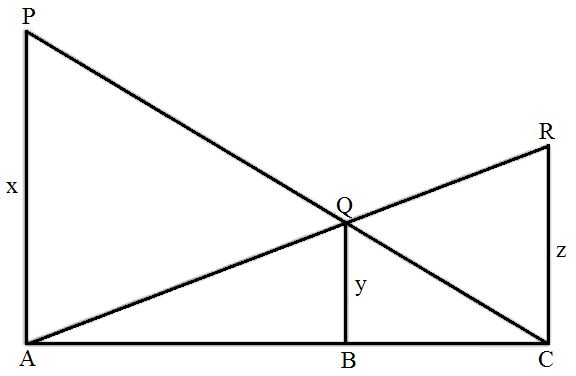
AnswerIn $\triangle\text{PAC},$ we have PA || QB
$\frac{\text{PA}}{\text{CA}}=\frac{\text{BQ}}{\text{BC}}$
$\Rightarrow\frac{\text{x}}{\text{CA}}=\frac{\text{y}}{\text{BC}}$
$\Rightarrow\frac{\text{y}}{\text{x}}=\frac{\text{BC}}{\text{CA}}\ \ ....(\text{i})$
In $\triangle\text{ACR},$ we have RC || QB
$\frac{\text{QB}}{\text{AB}}=\frac{\text{RC}}{\text{AC}}$
$\Rightarrow\frac{\text{y}}{\text{z}}=\frac{\text{AB}}{\text{AC}}\ \ ....(\text{ii})$
Adding (i) and (ii), we get,
$\Rightarrow\frac{\text{BC}}{\text{AC}}+\frac{\text{AB}}{\text{AC}}=\frac{\text{y}}{\text{x}}+\frac{\text{y}}{\text{z}}$
$\Rightarrow\frac{\text{BC}+\text{AB}}{\text{AC}}=\frac{\text{y}}{\text{x}}+\frac{\text{y}}{\text{z}}$
$\Rightarrow\frac{\text{AC}}{\text{AC}}=\frac{\text{y}}{\text{x}}+\frac{\text{y}}{\text{z}}$
$\Rightarrow1=\frac{\text{y}}{\text{x}}+\frac{\text{y}}{\text{z}}$
on dividing above eq. by y, we get
$\Rightarrow\frac{1}{\text{y}}=\frac{1}{\text{x}}+\frac{1}{\text{z}}$ "Proved"
View full question & answer→