Questions · Page 2 of 4

M.C.Q-[Phy-1M]

MCQ 511 Mark
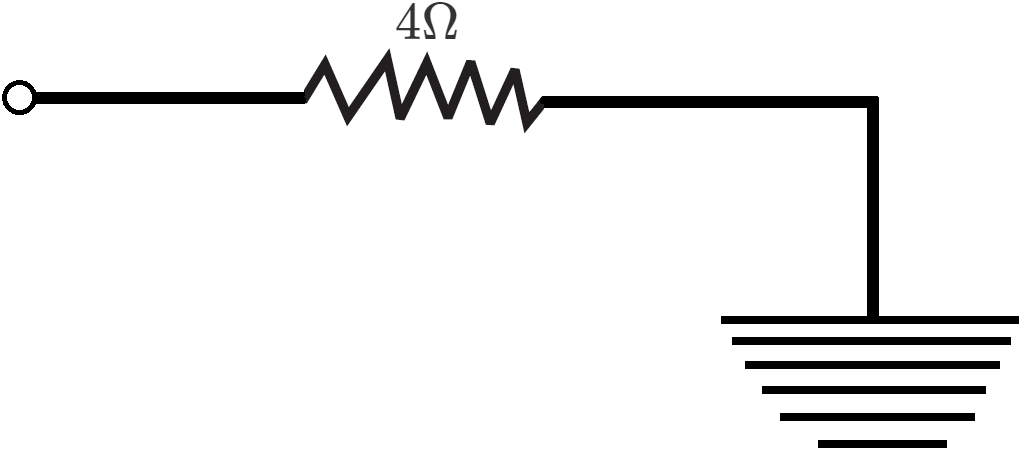
The work done in moving a unit charge across two points in an electric circuit is a measure of:
  • A
    Current.
  • B
    Potential difference.
  • C
    Resistance.
  • D
    Power.
Answer
  1. Potential difference.

Explanation:

The difference in potential between two points that represents the work involved or the energy released in the transfer of a unit quantity of electricity from one point to the other.
View full question & answer
MCQ 521 Mark
The unit of electrical resistance is:
  • A
    Ampere.
  • B
    Volt.
  • C
    Coulomb.
  • D
    Ohm.
Answer
  1. Ohm.

Explanation:

The unit of electrical resistance is ohm.

View full question & answer
MCQ 531 Mark
The unit of current is:
  • A
    Ampere
  • B
    Volt
  • C
    Ohm
  • D
    Coulomb
Answer
  1. Ampere

Explanation:

Current is measured in Coulomb/ sec or Ampere.

View full question & answer
MCQ 541 Mark
The unit for measuring potential difference is:
  • A
    Watt.
  • B
    Ohm.
  • C
    Volt.
  • D
    KWh.
Answer
  1. Volt.

Explanation:

It is the SI unit of potential difference.

View full question & answer
MCQ 551 Mark
The unit for expressing electric power is:
  • A
    Volt.
  • B
    Joule.
  • C
    Coulomb.
  • D
    Watt.
Answer
  1. Watt.

Explanation:

Watt is the unit of electric power.

View full question & answer
MCQ 561 Mark
The substance having infinitely high electrical resistance is called:
  • A
    Conductor.
  • B
    Resistor.
  • C
    Superconductor.
  • D
    Insulator.
Answer
  1. Insulator.

Explanation:

A substance having infinitely high electrical resistance is called an insulator.

View full question & answer
MCQ 571 Mark
The SI unit of energy is:
  • A
    Joule.
  • B
    Coulomb.
  • C
    Watt.
  • D
    Ohm-metre.
Answer
  1. Joule.

Explanation:

Joule is the SI unit of energy.

View full question & answer
MCQ 581 Mark
The resistivity of copper metal depends on only one of the following factors. This factor is:
  • A
    Length.
  • B
    Thickness.
  • C
    Temperature.
  • D
    Area of cross-section.
Answer
  1. Temperature.

Explanation:

The resistivity of copper depends only on temperature.

View full question & answer
MCQ 591 Mark
The resistivity of a certain material is $0.6 Ω\ \text{m}. $ The material is most likely to be:
  • A
    An insulator.
  • B
    A superconductor.
  • C
    A conductor.
  • D
    A semiconductor.
Answer
  1. A semiconductor.

Explanation:

The resistivity of a certain material is $0.6 Ω\ \text{m}. $The material is most likely to be a semiconductor because it has moderate resistivity.

View full question & answer
MCQ 601 Mark
The resistivity does not change if:
  • A
    The material is changed.
  • B
    The temperature is changed.
  • C
    The shape of the resistor is changed.
  • D
    Both material and temperature are changed.
Answer
  1. The shape of the resistor is changed.

Explanation: Resistivity of material does not depend on its dimensions and shape. However, resistivity depends upon the temperature and the nature of material.

View full question & answer
MCQ 611 Mark
The resistance of hot filament of the bulb is about 10 times the cold resistance. What will be the resistance of 100W - 220V lamp, when not in use?
  • A
    48Ω
  • B
    400Ω
  • C
    484Ω
  • D
    48.4Ω
Answer
  1. 484Ω
View full question & answer
MCQ 621 Mark
The resistance of a wire of length 300m and cross-section area 1.0mm2 made of material of resistivity $1.0\times10−7 Ω\ \text{m}$ is:
  • A
    $2 Ω$
  • B
    $3 Ω$
  • C
    $20 Ω$
  • D
    $30 Ω$
Answer
  1. $30 Ω$

Explanation:

Resistance, $\text{R}=\frac{\rho\text{I}}{\text{A}}$

Length, I = 300m

Cross section area, A = 1.0mm2 = 10-6 m2

Resistivity, $\rho=1.0\times10^{-7}\Omega\ \text{m}$

Resistance, $\text{R}=\frac{10^{-7}\times300}{10^{-6}}$

$\text{R}=30\Omega$

View full question & answer
MCQ 631 Mark
The p.d. across a $ 3Ω$ resistor is 6V. The current flowing in the resistor will be:
  • A
    $\frac{1}{2}\text{A}$
  • B
    1A.
  • C
    2A.
  • D
    6A.
Answer
  1. 2A.

Explanation:

If the p.d. across a $3\Omega$ resistor is 6V, the current flowing in the resistor will be 2A as current (I) is given by the equation, $\text{I}=\frac{\text{V} (\text{Voltage})}{\text{R}(\text{Resistance})}.$

or $\text{I}=\frac{\text{V}}{\text{R}}$

$\text{I}=6\ \frac{\text{V}}{3}\ Ω$

$\text{I} = 2\text{A.}$

View full question & answer
MCQ 641 Mark
The other name of potential difference is:
  • A
    Ampereage.
  • B
    Wattage.
  • C
    Voltage.
  • D
    Potential energy.
Answer
  1. Voltage.

Explanation:

The term voltage came from volt, which is the SI unit of potential difference.

View full question & answer
MCQ 651 Mark
The nature of the graph between potential difference and the electric current flowing through a conductor is:
  • A
    parabolic
  • B
    circle
  • C
    straight line
  • D
    hyperbolic
Answer
  1. straight line
View full question & answer
MCQ 661 Mark
The lamps in a house hold circuit are connected in parallel because:
  • A
    This way they required less current.
  • B
    If one lamp fails the others remain lit.
  • C
    This way they require less power.
  • D
    If one lamp fails the other also fail.
Answer
  1. If one lamp fails the others remain lit.

Explanation:

This is so because in a parallel circuit, if one device fails, it does not affect the working of the other devices.

View full question & answer
MCQ 671 Mark
The heat produced in a wire of resistance 'x' when a current 'y' flows through it in time 'z' is given by:
  • A
    x2 × y × z.
  • B
    x × z × y2.
  • C
    y × z2 × x.
  • D
    y × z × x.
Answer
  1. x × z × y2.

Explanation:

This is so because heat, H = I2Rt.

View full question & answer
MCQ 681 Mark
The heat produced by passing an electric current through a fixed resistor is proportional to the square of:
  • A
    Magnitude of resistance of the resistor.
  • B
    Temperature of the resistor.
  • C
    Magnitude of current.
  • D
    Time for which current is passed.
Answer
  1. Magnitude of current.

Explanation:

We know that:

H = I2Rt

It shows that the heat produced is proportional to the square of the current.

View full question & answer
MCQ 691 Mark
The flow of the electric current through a metallic conductor is:
  • A
    Only due to electrons
  • B
    Only due to + ve charges
  • C
    Due to both nuclei and electrons.
  • D
    Can not be predicted.
Answer
  1. Only due to electrons

Explanation:

Protons and neutrons are strongly bound to the atoms (in the nucleus).

Only electrons can be free from atoms.

The systematic flow of these free electrons constitutes a current.

Therefore, the electric current is only due to the flow of electrons.

View full question & answer
MCQ 701 Mark
The figure given below shows three resistors?


Their combined resistance is:

  • A
    $1\frac{5}{7}\Omega$
  • B
    $14\Omega$
  • C
    $6\frac{2}{3}\Omega$
  • D
    $7\frac{1}{2}\Omega$
Answer
  1. $7\frac{1}{2}\Omega$

Explanation:

The resistors of 6I and 2I are connected in parallel.

$\therefore\frac{1}{\text{R}}=\frac{1}{\text{R}_1}+\frac{1}{\text{R}_2}$ Here,

$\text{R}_1=6\Omega$

$\text{R}_2=2\Omega\ \frac{1}{\ \text{R}}=\frac{1}{6}+\frac{1}{2}\frac{1}{\text{R}}=\frac{4}{6}\ \text{R}=\frac{6}{4}$

This arrangement is further connected in series with the 6I resistor.

$\therefore$ Net resistance $=\frac{6}{4}+6=7\frac{1}{2}\Omega$

View full question & answer
MCQ 711 Mark
The elements of electrical heating devices are usually made of:
  • A
    Tungsten.
  • B
    Bronze.
  • C
    Nichrome.
  • D
    Argon.
Answer
  1. Nichrome.

Explanation:

Nichrome has a high resistance.

View full question & answer
MCQ 731 Mark
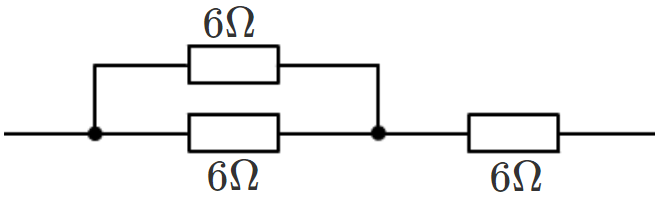
The diagram below shows part of a circuit:

If this arrangement of three resistors was to be replaced by a single resistor, its resistance should be:
  • A
    $9\Omega$
  • B
    $4\Omega$
  • C
    $6\Omega$
  • D
    $18\Omega$
Answer
  1. $9\Omega$

Explanation:

The two resistors of 6I are connected in parallel with each other. So, their net resistance 3I is connected in series with a resistance of 6I. So, the net resistance of the complete arrangement is $9 Ω.$

View full question & answer
MCQ 741 Mark
The device used for measuring potential difference is known as:
  • A
    Potentiometer.
  • B
    Ammeter.
  • C
    Galvanometer.
  • D
    Voltmeter.
Answer
  1. Voltmeter.

Explanation:

A voltage meter is an instrument used for measuring the potential difference, or voltage, between two points in an electrical or electronic circuit.

View full question & answer
MCQ 751 Mark
The current which is assumed to be flowing in a circuit from positive terminal to negative, is called:
  • A
    Direct current
  • B
    Pulsating current
  • C
    Conventional current
  • D
    Alternating current
Answer
  1. Conventional current

Explanation:

The current flowing from positive terminal to negative terminal is due to flow of positive charge, which is the conventional current.

View full question & answer
MCQ 761 Mark
The current through the $4\Omega$ resistor in the portion of the circuit given is.
  • A
    40 A.
  • B
    2 A.
  • C
    0.4 A.
  • D
    2.5 A.
Answer
  1. 2.5 A.

Explanation:

$\text{R} = 4\Omega$

$\text{V} = 10\text{V}$

$\text{I} = ?$

We know that

$\text{I} = \frac{\text{V}}{\text{R}}$

$\text{I} = \frac{10}{4}$

$\text{I} = 2.5 \text{A}$

View full question & answer
MCQ 771 Mark
The current passing through an electric kettle has been doubled. The heat produced will become:
  • A
  • B
    Double.
  • C
    Four time.
  • D
    One-fourth.
Answer
  1. One-fourth.

Explanation:

Heat produced is directly proportional to the square of the current.

View full question & answer
MCQ 781 Mark
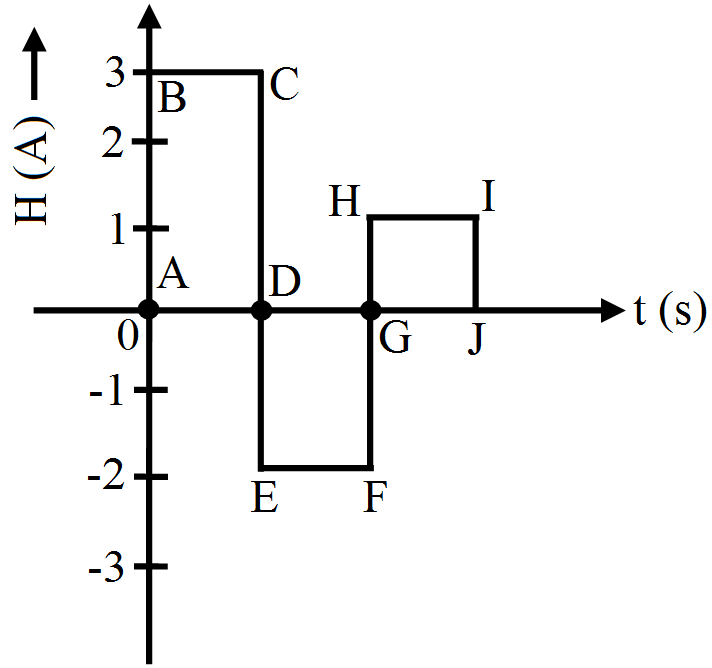
The current flowing through a wire of resistance $2\Omega$ varies with time as shown in figure alongside. The amount of heat produced (in J) in 3 would be.
  • A
    2J
  • B
    18J
  • C
    28J
  • D
    10J
Answer
  1. 28J

Explanation:

Assuming that each interval is of 1seconds, we can calculate the heat for each interval and just sum it up to find the net heat produced,

Heat, H = I2RT

Where,

I is the current,

R is the resistance,

T is the time taken

For AD,

$\text{I}=3, \text{R}=2\Omega,\text{T}=1\text{sec}$

Putting the values in the above formula, we get

$\text{H}_{\text{AD}}=3^{2}.2.1=18\text{J}$

For DG,

$\text{I}=-2\text{A},\text{R}=2\Omega,\text{T}=1\text{sec}$

Putting the values in the above formula, we get

$\text{H}_{\text{DG}}=3^{2}.2.1=18\text{J}$

For GJ,

$\text{I}=-2\text{A},\text{R}=2\Omega,\text{T}=1\text{sec}$

Putting the values in the above equation, we get

$\text{H}_{\text{GJ}}=1^{2}.2.1=2\text{J}$

So Total amount of heat generated in 3sec

$\text{H}_{\text{NET}}=18+8+2=28\text{J}$

View full question & answer
MCQ 791 Mark
The commercial unit of energy is:
  • A
    Watt.
  • B
    Watt-hour.
  • C
    Kilowatt-hour.
  • D
    Kilo-joule.
Answer
  1. Kilowatt-hour.

Explanation:

Kilowatt-hour is the commercial unit of electrical energy.

View full question & answer
MCQ 801 Mark
The amount of heat produced in a wire depends on its material-
  • A
    Length
  • B
    Thickness
  • C
    Length and thickness
  • D
    None of these
Answer
  1. Length and thickness
View full question & answer
MCQ 811 Mark
The amount of charges that pass any section of the conductors in one second is called:
  • A
    Current
  • B
    Power dissipation
  • C
    Electromotive force
  • D
    Internal resistance
Answer
  1. Current
View full question & answer
MCQ 821 Mark
Which statement/statement is/ are correct?
  1. An ammeter is connected in series in a circuit and a voltmeter is connected in parallel.
  2. An ammeter has a high resistance.
  3. A voltmeter has a low resistance.
Answer
  1. 1.

Explanation:

An ammeter is connected in series in a circuit and voltmeter is connected in parallel.

View full question & answer
MCQ 831 Mark
Find odd one out:Copper, Salt water, Cotton, Human body.
  • A
    Human body
  • B
    Cotton
  • C
    Salt water
  • D
    Copper
Answer
  1. Cotton

Explanation:

Cotton is an insulator, rest are good conductors.

View full question & answer
MCQ 841 Mark
SI unit of electrical energy is:
  • A
    Joule
  • B
    Kilowatt hour
  • C
    KiloJoule
  • D
    Watt hour
Answer
  1. Joule

Explanation:

SI unit of electrical energy is Joule.

1 Joule = 1 Volt × 1 ampere × 1 second.

View full question & answer
MCQ 851 Mark
Resistivity of a metallic wise depends on:
  • A
    its length
  • B
    its shape
  • C
    its thickness
  • D
    nature of material
Answer
  1. nature of material
View full question & answer
MCQ 861 Mark
Presence of charge can be correctly identified by.
  • A
    Repulsion between like charges.
  • B
    Attraction between neutral and positive charge.
  • C
    Attraction between neutral and negative charge.
  • D
    Repulsion between unlike charges.
Answer
  1. Repulsion between like charges.

Explanation:

The interaction between two like-charged objects isrepulsive. The interaction between two oppositely charged objects is attractive.

View full question & answer
MCQ 871 Mark
One kilowatt hour is equal to.
  • A
    36 × 106J
  • B
    36 × 10-5J
  • C
    3.6 × 106J
  • D
    0.36 × 106J
Answer
  1. 3.6 × 106J

Explanation:

One kilowatt-hour is equal to 3.6·106 joules:

View full question & answer
MCQ 881 Mark
One coulomb charge is equivalent to the charge contained in:
  • A
    2.6 × 10¹⁹ electrons.
  • B
    6.2 × 10¹⁹ electrons.
  • C
    2.65 × 10¹⁸ electrons.
  • D
    6.25 × 10¹⁸ electrons.
Answer
  1. 6.25 × 10¹⁸ electrons.

Explanation:

The coulomb is the SI unit of electric charge. It is the charge transported by a constant current of one ampere in one second. It is equivalent to the charge of approximately 6.25 × 10¹⁸ protons or electrons.

View full question & answer
MCQ 891 Mark
Ohm's law gives a relationship between:
  • A
    Current and resistance.
  • B
    Resistance and potential difference.
  • C
    Potential difference and electric charge.
  • D
    Current and potential difference.
Answer
  1. Current and potential difference.

Explanation:

Ohm's law gives the relationship between current and potential difference.

View full question & answer
MCQ 901 Mark
 A cooler of 1500W, 200 volt and a fan of 500W, 200 volt are to be used from a household supply. The rating of fuse to be used is:
  • A
    2.5A
  • B
    5.0A
  • C
    7.5A
  • D
    10A
Answer
  1. 10A
View full question & answer
MCQ 911 Mark
Name the material used for making the connection wires:
  • A
    Tin
  • B
    Copper
  • C
    Lead
  • D
    Tungsten
Answer
  1. Copper

Explanation:

Copper is a good conductor of electricity as it allows the electricity to flow through it easily.

Copper as a connecting wire has very low electrical  resistance.

Copper combines several properties that have traditionally made it preferred for most electrical wiring.

It provides good contact surface, is ductile (is easily bent repeatedly without breaking) and it is not very expensive and is easy to manufacture.

View full question & answer
MCQ 921 Mark
Motion of charges is nothing but:
  • A
    Electric current
  • B
    Magnetic effect of current
  • C
    Heating effect of current
  • D
    All of the above
Answer
  1. Electric current
View full question & answer
MCQ 931 Mark
Metals are good conductors because:
  • A
    outer electrons are strongly bound to the atom
  • B
    outer electrons are loosely bound to the atom
  • C
    inner electrons are loosely bound to the atom
  • D
    protons can detach from the nucleus and conduct electricity
Answer
  1. outer electrons are loosely bound to the atom
View full question & answer
MCQ 941 Mark
Materials that allow electrons to flow through them are known as:
  • A
    Insulator
  • B
    Conductors
  • C
    Electrolytes
  • D
    Bases
Answer
  1. Conductors
View full question & answer
MCQ 951 Mark
Keeping the potential difference constant, the resistance of a circuit is doubled. The current will become:
  • A
    Double.
  • B
    Half.
  • C
    One-fourth.
  • D
    Four times.
Answer
  1. Half.

Explanation:

As we know from Ohm’s law:

Voltage = Current × Resistance

V = IR

If the voltage is constant, the resistance is doubled and the current becomes half.

View full question & answer
MCQ 961 Mark
Keeping the p.d. constant, the resistance of a circuit is halved. The current will become:
  • A
    One-fourth.
  • B
    Four time.
  • C
    Half.
  • D
    Double.
Answer
  1. Double.

Explanation:

As we know from Ohm’s law:

Voltage = Current × Resistance

V = IR

If the voltage is constant, the resistance of the circuit is halved. That is, it becomes $\frac{\text{R}}{2}$

Current, $\text{I}=\frac{\text{V}}{\text{R}}$

$\text{I}=\frac{\text{V}}{\text{R}}$

$\text{I}=\frac{\frac{\text{V}}{\text{R}}}{2}=2\text{I}$

Thus by keeping the p.d. constant, the resistance of a circuit is halved and the current is doubled.

View full question & answer
MCQ 971 Mark
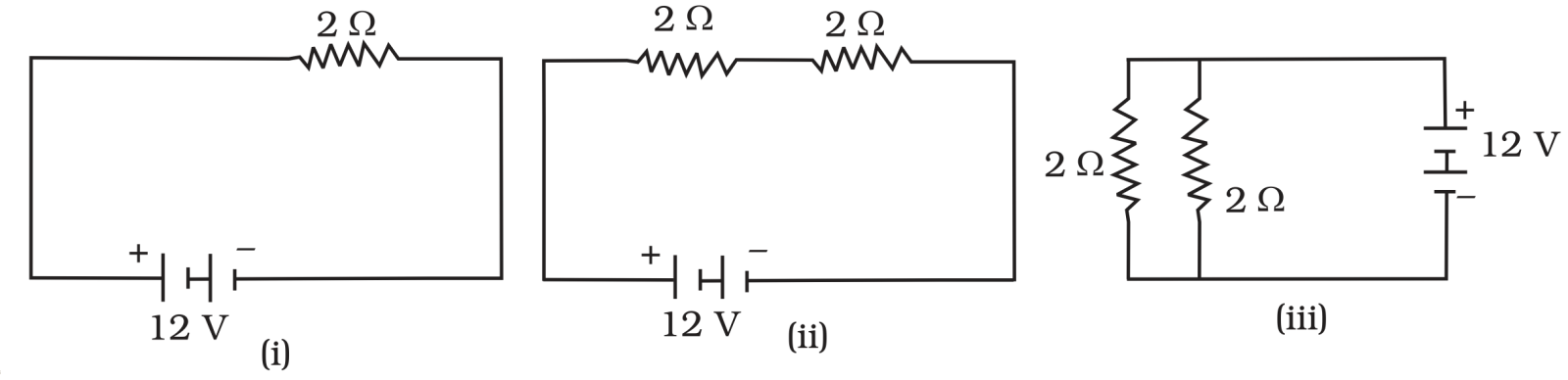
In the following circuits (Figure), heat produced in the resistor or combination of resistors connected to a 12V battery will be:
  • A
    Same in all the cases.
  • B
    Minimum in case (i).
  • C
    Maximum in case (ii).
  • D
    Maximum in case (iii).
Answer
  1. Maximum in case (ii).

Explanation: In this case, two resistors are in series. Hence, their sum will be equal to their arithmetic sum. In figure (iii) the total resistance will be less than individual resistances because they are connected in parallel. A higher resistance produces more heat so option (c) is correct.

View full question & answer
MCQ 981 Mark
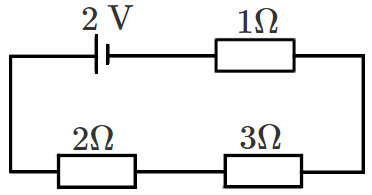
In the circuit shown below:

The potential difference across the $3 Ω$ resistor is:
  • A
    $\frac{1}{9}\text{V}$
  • B
    $\frac{1}{2}\text{V}$
  • C
    1V
  • D
    2V
Answer
  1. 1V

Explanation:

The resistors of $1 Ω, 2 Ω$ and $3 Ω$ are connected in series. Therefore, the net resistance,

$\text{R} = \text{R}_1 + \text{R}_2 +\text{R}_3$

$\text{R}=1\Omega+2\Omega+3\Omega=6\Omega$

Current in the circuit will be,

$\text{I}=\frac{\text{V}}{\text{R}}$

or $\text{I}=\frac{2}{6}=\frac{1}{3}\text{A}$

Current $=\frac{1}{3}\text{A}$

Therefore, the voltage across the 3I resistor,

V = IR

or $\text{V}=\frac{1}{3}\times3=1\text{V}$

View full question & answer
MCQ 991 Mark
Insulators:
  • A
    Conduct electricity
  • B
    Do not conduct electricity
  • C
    Conduct electricity only at low temperatures
  • D
    Conduct electricity at room temperature
Answer
  1. Do not conduct electricity

Explanation:

Insulators have tightly bound electrons which cannot move freely and hence cannot conduct electricity.

View full question & answer
MCQ 1001 Mark
In an electrical circuit two resistors of 2Ω and 4Ω respectively are connected in series to a 6V battery. The heat dissipated by the 4Ω resistor in 5s will be:
  • A
    5J.
  • B
    10J.
  • C
    20J.
  • D
    30J.
Answer
  1. 20J.

Explanation: Total resistance of combination $2\Omega+4\Omega=6\Omega$

Current through the circuit can be calculated as $\text{I}=\frac{\text{V}}{\text{R}}=\frac{6\text{V}}{6\Omega}=1\text{A}$

Heat dissipation by can be calculated as follows: $\text{H}=\text{I}^2\text{Rt}=(1\text{A})^2\times4\Omega\times5\text{s}=20\text{J}$

View full question & answer
M.C.Q-[Phy-1M] - Page 2 - Science STD 10 Questions - Vidyadip