Question
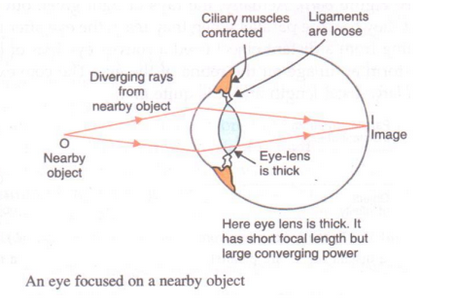
What change is made in the eye to enable it to focus on objects situated at different distances? Illustrate your answer with the help of diagrams.
Answer

To focus on distant objects, the ciliary muscles of the eye get fully relaxed and pull the suspensory ligaments attached to the eye-lens tightly. This, in turn, stretches the eye-lens and the eye-lens becomes thin.

To focus on nearby objects, the ciliary muscles of the eyes contract and make the suspensory ligaments loose. The ligaments then stop pulling the eye-lens. The eye-lens bulges under itsown elasticity and becomes thick.

Need a full question paper?

Generate a complete, print-ready paper with questions like this in minutes — across 16+ boards, with answer keys.

Start Generating Free

Similar questions

The electrical resistivities of three materials P, Q and R are given below:

 $\begin{matrix}\text{P}&2.3\times10^{3}\Omega\text{ m}\\\text{Q}&2.63\times10^{-8}\Omega\text{ m}\\\text{R}&1.0\times10^{15}\Omega\text{ m}\end{matrix}$

Which material will you use for making:

  1. Electric wires.
  2. Handle for soldering iron, and
  3. Solar cells?
Give reasons for your choices.

An electric iron is connected to the mains power supply of 220V. When the electric iron is adjusted at ‘minimum heating’ it consumes a power of 360W but at ‘maximum heating’ it takes a power of 840W. Calculate the current and resistance in each case.
With the help of a labelled circuit diagram illustrate the pattern of field lines of the magnetic field around a long current carrying straight conducting wire. How is the right hand thumb rule useful to find direction of magnetic field associated with a current carrying conductor?
You are given three resistors each of $3\Omega$ and you are asked to get all possible values of resistance when you connect them in different combinations. How many values of resistance can you get?
Distinguish between a convex and a concave mirror.
A man stands 10m in front of a large plane mirror. How far must the walk before he is 5m away from his image?
  1. Define the term ‘volt’.
  2. State the relation between work, charge and potential difference for an electric circuit.

Calculate the potential difference between the two terminals of a battery if 100 joules of work is required to transfer 20 coulombs of charge from one terminal of the battery to the other.

There are two types of light-sensitive cells in the human eye: 
  1. Where are they found?
  2. What is each type called?
  3. To what is each type of cell sensitive?
An object is placed at a distance of 4cm from a concave lens of focal length 12cm. Find the position and nature of the image.
Two lamps, one rated 60 W at 220 V and the other 40 W at 220 V, are connected in parallel to the electric supply at 220 V.
  1. Draw a circuit diagram to show the connections.
  2. Calculate the current drawn from the electric supply.
  3. Calculate the total energy consumed by the two lamps together when they operate for one hour.