Questions · Page 2 of 3

M.C.Q (1 Marks)

MCQ 511 Mark
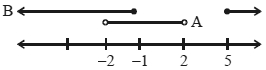
If $\mathrm{A}=\{\mathrm{x} \in {R}:|\mathrm{x}-2|>1\}, \mathrm{B}=\left\{\mathrm{x} \in {R}: \sqrt{\mathrm{x}^{2}-3}>1\right\}$, $\mathrm{C}=\{\mathrm{x} \in {R}:|\mathrm{x}-4| \geq 2\}$ and ${Z}$ is the set of all integers, then the number of subsets of the set $(A \cap B \cap C)^{c} \cap {Z}$ is .... .
  • $256$
  • B
    $64$
  • C
    $8$
  • D
    $16$
Answer
Correct option: A.
$256$
a
$\mathrm{A}=(-\infty, 1) \cup(3, \infty)$

$\mathrm{B}=(-\infty,-2) \cup(2, \infty)$

$\mathrm{C}=(-\infty, 2] \cup[6, \infty)$

So, $\mathrm{A} \cap \mathrm{B} \cap \mathrm{C}=(-\infty,-2) \cup[6, \infty)$

$\mathrm{z} \cap(\mathrm{A} \cap \mathrm{B} \cap \mathrm{C})^{\prime}=\{-2,-1,0,-1,2,3,4,5\}$

Hence no. of its subsets $=2^{8}=256$.
View full question & answer
MCQ 521 Mark
Set $A$ has $m$ elements and Set $B$ has $n$ elements. If the total number of subsets of $A$ is $112$ more than the total number of subsets of $B$, then the value of $m \times n$ is
  • A
    $7$
  • B
    $4$
  • $28$
  • D
    $24$
Answer
Correct option: C.
$28$
c
$2^m -2^{ n }=112$

$m =7, n =4$

$\left(2^{7}-2^{4}=112\right)$

$m \times n =7 \times 4=28$

View full question & answer
MCQ 531 Mark
Let $\mathrm{X}=\{\mathrm{n} \in \mathrm{N}: 1 \leq \mathrm{n} \leq 50\} .$ If $A=\{n \in X: n \text { is a multiple of } 2\}$ and $\mathrm{B}=\{\mathrm{n} \in \mathrm{X}: \mathrm{n} \text { is a multiple of } 7\},$ then the number of elements in the smallest subset of $X$ containing both $\mathrm{A}$ and $\mathrm{B}$ is
  • $29$
  • B
    $26$
  • C
    $31$
  • D
    $34$
Answer
Correct option: A.
$29$
a
$\mathrm{n}(\mathrm{A})=25$

$\mathrm{n}(\mathrm{B})=7$

$\mathrm{n}(\mathrm{A} \cap \mathrm{B})=3$

$n(A \cup B)=25+7-3=29$

View full question & answer
MCQ 541 Mark
If $A=\{x \in R:|x|<2\}$ and $B=\{x \in R:|x-2| \geq 3\}$ then
  • A
    $A \cup B=R-(2,5)$
  • B
    $A \cap B=(-2,-1)$
  • $B-A=R-(-2,5)$
  • D
    $A-B=[-1,2)$
Answer
Correct option: C.
$B-A=R-(-2,5)$
c
$A: x \in(-2,2) ; B: x \in(-\infty,-1] \cup[5, \infty)$

$\Rightarrow B-A=R-(-2,5)$

View full question & answer
MCQ 551 Mark
Let $\bigcup \limits_{i=1}^{50} X_{i}=\bigcup \limits_{i=1}^{n} Y_{i}=T$ where each $X_{i}$ contains $10$ elements and each $Y_{i}$ contains $5$ elements. If each element of the set $T$ is an element of exactly $20$ of sets $X_{i}$ 's and exactly $6$ of sets $Y_{i}$ 's, then $n$ is equal to
  • A
    $45$
  • B
    $15$
  • C
    $50$
  • $30$
Answer
Correct option: D.
$30$
d
$n \left( X _{ i }\right)=10 . \underset{ i =1}{ U } X _{ i }= T , \Rightarrow n ( T )=500$

each element of $T$ belongs to exactly 20

elements of $X _{ i } \Rightarrow \frac{500}{20}=25$ distinct elements

so $\frac{5 n}{6}=25 \Rightarrow n=30$

View full question & answer
MCQ 561 Mark
A survey shows that $63 \%$ of the people in a city read newspaper $A$ whereas $76 \%$ read newspaper $B$. If $x \%$ of the people read both the newspapers, then a possible value of $x$ can be
  • A
    $65$
  • B
    $37$
  • C
    $29$
  • $55$
Answer
Correct option: D.
$55$
d
$n(B) \leq n(A \cup B) \leq n(U)$

$\Rightarrow 76 \leq 76+63-x \leq 100$

$\Rightarrow-63 \leq-x \leq-39$

$\Rightarrow 63 \geq x \geq 39$

View full question & answer
MCQ 571 Mark
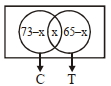
A survey shows that $73 \%$ of the persons working in an office like coffee, whereas $65 \%$ like tea. If $x$ denotes the percentage of them, who like both coffee and tea, then $x$ cannot be
  • A
    $63$
  • B
    $38$
  • C
    $54$
  • $36$
Answer
Correct option: D.
$36$
d
$C \rightarrow$ person like coffee

$T \rightarrow$ person like Tea

$n(C)=73$

$n(T)=65$

$n(C \cup T) \leq 100$

$n(C)+n(T)-n(C \cap T) \leq 100$

$73+65-x \leq 100$

$x \geq 38$

$73-x \geq 0 \Rightarrow x \leq 73$

$65-x \geq 0 \Rightarrow x \leq 65$

$38 \leq x \leq 65$

View full question & answer
MCQ 581 Mark
Consider the two sets :

$A=\{m \in R:$ both the roots of $x^{2}-(m+1) x+m+4=0$ are real $\}$ and $B=[-3,5)$

Which of the following is not true?

  • $A-B=(-\infty,-3) \cup(5, \infty)$
  • B
    $A \cap B=\{-3\}$
  • C
    $B-A=(-3,5)$
  • D
    $A \cup B=R$
Answer
Correct option: A.
$A-B=(-\infty,-3) \cup(5, \infty)$
a
$A: D \geq 0$

$\Rightarrow \quad(m+1)^{2}-4(m+4) \geq 0$

$\Rightarrow \quad m^{2}+2 m+1-4 m-16 \geq 0$

$\Rightarrow \quad m^{2}-2 m-15 \geq 0$

$\Rightarrow \quad(m-5)(m+3) \geq 0$

$\Rightarrow \quad m \in(-\infty,-3] \cup[5, \infty)$

$\therefore \quad A=(-\infty,-3] \cup[5, \infty)$

$B=[-3,5)$

$A-B=(-\infty,-3) \cup[5, \infty)$

$A \cap B=\{-3\}$

$B-A=(-3,5)$

$A \cup B=R$

View full question & answer
MCQ 591 Mark
Let $A, B$ and $C$ be sets such that $\phi  \ne A \cap B \subseteq C$. Then which of the following statements is not true ?
  • If $\left( {A - C} \right) \subseteq B$ then $A \subseteq B$
  • B
    If $\left( {A - B} \right) \subseteq C$ then $A \subseteq C$
  • C
    $\left( {C \cup A} \right) \cap \left( {C \cup B} \right) = C$
  • D
    $B \cap C \ne \phi $
Answer
Correct option: A.
If $\left( {A - C} \right) \subseteq B$ then $A \subseteq B$
a
For $A\, = \,C,\,A - C\, = \,\phi $

$ \Rightarrow \phi \, \subseteq \,B$

But $A\, \subseteq \,B$

$ \Rightarrow \,$ option $A$ is NOT true

Let $x\, \in \,\,(C\,x\, \in \,(C\, \cup \,A)\,\, \cap (C\, \cup \,B)\,)$

$ \Rightarrow \,x\,(C\, \cup \,A)$ and $x\, \in \,\,(C\, \cup \,B)$

$ \Rightarrow \,(x\, \in \,C$ or $x\, \in \,A)$ and  $(x\, \in \,C$ or $x\, \in \,B)$

$ \Rightarrow \,(x\, \in \,C$ or $x\, \in \,\,(A\, \cap \,B)$

$ \Rightarrow \,(x\, \in \,C$   or  $x\, \in \,C$  (as $A\, \cup \,B \subseteq \,C\,$ )

$ \Rightarrow \,x\, \in \,C$

$ \Rightarrow (C\, \cup \,A)\,\, \cap (C\, \cup \,B)\, \subseteq \,C\,\,\,(1)$

Now $x\, \in \,C\, \Rightarrow \,x\, \in \,(C\, \cup \,A)$ and $x\, \in \,\,(C\, \cup \,B\,)$

$ \Rightarrow x\, \in (C\, \cup \,A)\,\, \cap (C\, \cup \,B)$

$ \Rightarrow C\, \subseteq \,(C\, \cup \,A)\,\, \cap (C\, \cup \,B)\, \subseteq \,C\,\,\,(2)$

$ \Rightarrow $ from $(1)$ and $(2)$

$C\, = \,(C\, \cup \,A)\,\, \cap (C\, \cup \,B)$

$ \Rightarrow $ option $B$ is true

Let $x\, \in \,A$ and $x\, \notin \,B$

$\Rightarrow \,x\, \in \,(A - B)$

$ \Rightarrow \,x\, \in \,C$ (as $A - B \subseteq \,C$ )

Let $x\, \in \,A$ and $x\, \in \,B$

$ \Rightarrow \,x\, \in \,(A \cap B)$

$ \Rightarrow \,x\, \in \,C$ (as $A \cap B \subseteq \,C$ )

Hence $x\, \in \,A\,\, \Rightarrow \,x\, \in \,C$

$ \Rightarrow A\, \subseteq \,C$

$ \Rightarrow $ option $C$ is true

As $C \supseteq \,(A \cap B)$

$ \Rightarrow B \cap C \supseteq \,(A \cap B)$

As $A \cap B \ne \phi $

$ \Rightarrow B \cap C \ne \phi $

Hence the correct answer is option $(A)$

View full question & answer
MCQ 601 Mark
Let $S = \{1, 2, 3, ….., 100\}$. The number of non-empty subsets $A$ of $S$ such that the product of elements in $A$ is even is
  • A
    $2^{100} -1$
  • $2^{50} (2^{50} -1)$
  • C
    $2^{50} -1$
  • D
    $2^{50} + 1$
Answer
Correct option: B.
$2^{50} (2^{50} -1)$
b
Product is even when atleast one element of subset is even Hence required number of subsets = total subsets -number of subsets all whose elements are odd $= 2^{100} - 2^{50}$
View full question & answer
MCQ 611 Mark
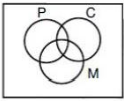
In a class of $140$ students numbered $1$ to $140$, all even numbered students opted Mathematics course, those whose number is divisible by $3$ opted Physics course and those whose number is divisible by $5$ opted Chemistry course. Then the number of students who did not opt for any of the three courses is
  • A
    $102$
  • B
    $42$
  • C
    $1$
  • $38$
Answer
Correct option: D.
$38$
d
$n(p)\, = \,\left[ {\frac{{140}}{3}} \right]\, = \,46$

$n(C)\, = \,\left[ {\frac{{140}}{5}} \right]\, = \,28$

$n(M)\, = \,\left[ {\frac{{140}}{2}} \right]\, = \,70$

$n(p\, \cup \,C\, \cup \,M)\, = \,n(P)\, + \,n(C)\, + \,n(M)$ $ - \,n(P \cap C) - \,n(C \cap M) - $ $n(M\, \cap \,P)\, + \,n(P \cap M \cap C)$

$ = \,46\, + \,28\, + 70\, - \,\left[ {\frac{{140}}{{15}}} \right]\, - \,\left[ {\frac{{140}}{{10}}} \right]\, - \,\left[ {\frac{{140}}{6}} \right]\, + \,\left[ {\frac{{140}}{{30}}} \right]\,$

$=\,144\,-\,9\,-14\,-\,23+4\,=\,102$

So required number of student $=\,140\,-\,102\,=\,38$ 

View full question & answer
MCQ 621 Mark
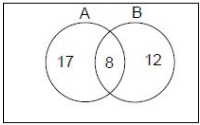
Two newspaper $A$ and $B$ are published in a city. It is known that $25\%$ of the city populations reads $A$ and $20\%$ reads $B$ while $8\%$ reads both $A$ and $B$. Further, $30\%$ of those who read $A$ but not $B$ look into advertisements and $40\%$ of those who read $B$ but not $A$ also look into advertisements, while $50\%$ of those who read both $A$and $B$ look into advertisements. Then the percentage of the population who look into advertisement is
  • A
    $12.8$
  • B
    $13.5$
  • $13.9$
  • D
    $13$
Answer
Correct option: C.
$13.9$
c
Let population $=\,100$

$n(A)\, = \,25$

$n(B)\, = \,20$

$n(A \cap B)\, = \,8$

$n(A \cap \bar B)\, = \,17$

$n(\bar A \cap B)\, = \,12$

Now $\%$ of th population who look advertisement

$=\,\frac {30}{100}\times 17\,+$ $\frac {40}{100}\times 12\,+$ $\frac {50}{100}\times 8$

$=\,13.9$

View full question & answer
MCQ 631 Mark
Let $S = \{ x \in R:x \ge 0$ and $2\left| {\sqrt x - 3} \right| + \sqrt x \left( {\sqrt x - 6} \right) + 6 = 0\} $ then $S:$ . . .
  • A
    contains exactly one element.
  • contains exactly two elements
  • C
    contains exactly four element.
  • D
    is an empty set
Answer
Correct option: B.
contains exactly two elements
b
Case - $I$ : $x\,\in \,[0,\,9]$

$2(3 - \sqrt x )\, + \,x\, - \,6\sqrt x \, + \,6\, = \,0$

$ \Rightarrow \,x\, - \,8\sqrt x \, + \,12\, = \,0\, \Rightarrow \,\sqrt x \, = \,4,2\, \Rightarrow \,x\, = \,16,4$

Since $x\, \in \,[0,\,9]$

$\therefore \,\,x\,=\,4$

Case - $II$ : $x\, \in \,[9,\,\infty ]$

$2(\sqrt x  - 3)\, + \,x\, - \,6\sqrt x \, + \,6\, = \,0$

$ \Rightarrow \,x\, - \,4\sqrt x \,\, = \,0\, \Rightarrow \,x\, = \,16,0$

Since $x\, \in \,[9,\,\infty ]$

$\therefore \,\,x\,=\,16$

Hence , $x\,=\,4$ and $16$

View full question & answer
MCQ 641 Mark
In a certain town, $25\%$ of the families own a phone and $15\%$ own a car; $65\%$ families own neither a phone nor a car and $2,000$ families own both a car and a phone. Consider the following three statements

$(A)\,\,\,5\%$ families own both a car and a phone
$(B)\,\,\,35\%$ families own either a car or a phone
$(C)\,\,\,40,000$ families live in the town
Then,

  • A
    Only $(A)$ and $(C)$ are correct.
  • B
    Only $(B)$ and $(C)$ are correct
  • All $(A),$ $(B)$ and $(C)$ are correct.
  • D
    Only $(A)$ and $(B)$ are correct
Answer
Correct option: C.
All $(A),$ $(B)$ and $(C)$ are correct.
c
$n(P)\, = \,25\,\% $

$n(C)\, = \,15\,\% $

$n(P'\, \cup \,C')\, = \,65\,\% $

$ \Rightarrow n(P \cup \,C')\, = \,65\,\% $

$n(P \cup \,C)\, = \,35\,\% $

$n(P \cap \,C)\, = \,n(P)\, + n(C)\, - \,n(P \cup \,C)$

$25\, + \,15\, - 35\, = \,5\% $

$x\, \times \,5\,\% \, = \,2000$

$x\, = \,40,000$

View full question & answer
MCQ 651 Mark
If $X = \{ {4^n} - 3n - 1:n \in N\} $ and $Y = \{ 9(n - 1):n \in N\} ,$ then $X \cup Y$ = . . . . .
  • A
    $X$
  • $Y$
  • C
    $N$
  • D
    None of these
Answer
Correct option: B.
$Y$
b
$ x=\left\{4^{n}-3 n-1\right\} $

$=\{0,9,54, \ldots\} $

$ Y =\{9(n-1)\} $

$=\{0,9,18,27, \ldots\} $

$ \therefore X U Y=Y $

View full question & answer
MCQ 661 Mark
Let $P=\{\theta: \sin \theta-\cos \theta=\sqrt{2} \cos \theta\}$ and $Q=\{\theta: \sin \theta+\cos \theta=\sqrt{2} \sin \theta\}$ be two sets. Then
  • A
    $P \subset Q$ and $Q-P \neq \varnothing$
  • B
    $Q \not \subset P$
  • C
    $P \not \subset Q$
  • $P=Q$
Answer
Correct option: D.
$P=Q$
d
$P=\{\theta: \sin \theta-\cos \theta=\sqrt{2} \cos \theta\}$

$Q=\{\theta: \sin \theta+\cos \theta=\sqrt{2} \sin \theta\}$

From P

$\sin \theta-\cos \theta=\sqrt{2} \cos \theta$

$\sin \theta=(\sqrt{2}+1) \cos \theta$

$\frac{\sin \theta}{\cos \theta}=(\sqrt{2}+1)$

$\tan \theta=(\sqrt{2}+1)$

$\text { from } Q$

$\sin \theta+\cos \theta=\sqrt{2} \sin \theta$

$\sin \theta(\sqrt{2}-1)=\cos \theta$

$\frac{\sin \theta}{\cos \theta}=(\sqrt{2}-1)$

$\tan \theta=(\sqrt{2}-1)$

$\tan \theta=\frac{1}{\sqrt{2}-1} \times \frac{\sqrt{2}+1}{\sqrt{2}+1}=\sqrt{2}+1$

$\therefore P=Q$

Hence, option $(D)$ is correct answer.

View full question & answer
MCQ 671 Mark
Let $S=\{1,2,3,4\}$. The total number of unordered pairs of disjoint subsets of $S$ is equal to
  • A
    $25$
  • B
    $34$
  • C
    $42$
  • $41$
Answer
Correct option: D.
$41$
d
Total number of unordered pairs of disjoint subsets

$=\frac{3^4+1}{2}=41 \text {. }$

View full question & answer
MCQ 681 Mark
In a college of $300$ students, every student reads $5$ newspaper and every newspaper is read by $60$ students. The no. of newspaper is 
  • A
    At least $30$
  • B
    At most $20$
  • Exactly $25$
  • D
    None of these
Answer
Correct option: C.
Exactly $25$
c
(c) Let number of newspapers be $x$. If every students reads one newspaper, the number of students would be $x(60) = 60x$

Since, every students reads $5$ newspapers

 $\therefore$ Numbers of students $ = {{x \times 60} \over 5} = 300$, $x = 25$.

View full question & answer
MCQ 691 Mark
Which of the following is the empty set
  • A
    $\{ x:x$ is a real number and ${x^2} - 1 = 0\} $
  • $\{ x:x$ is a real number and ${x^2} + 1 = 0\} $
  • C
    $\{ x:x$ is a real number and ${x^2} - 9 = 0\} $
  • D
    $\{ x:x$ is a real number and ${x^2} = x + 2\} $
Answer
Correct option: B.
$\{ x:x$ is a real number and ${x^2} + 1 = 0\} $
b
(b) Since ${x^2} + 1 = 0,$ gives ${x^2} = - 1$

$ \Rightarrow $ $x = \pm$ $ i x$ is not real but $x$ is real (given) No value of $x$ is possible.

View full question & answer
MCQ 701 Mark
The set $A = \{ x:x \in R,\,{x^2} = 16$ and $2x = 6\} $ equals
  • $\phi $
  • B
    $\{14, 3, 4\}$
  • C
    $\{3\}$
  • D
    $\{4\}$
Answer
Correct option: A.
$\phi $
a
(a) ${x^2} = 16$ ==> $x = \pm 4$

$2x = 6$ ==> $x = 3$

There is no value of $x$ which satisfies both the above equations. Thus, $A = \phi $.

View full question & answer
MCQ 711 Mark
If a set $A$ has $n$ elements, then the total number of subsets of $A$ is
  • A
    $n$
  • B
    ${n^2}$
  • ${2^n}$
  • D
    $2n$
Answer
Correct option: C.
${2^n}$
c
(c) Number of subsets of $A{ = ^n}{C_0}{ + ^n}{C_1} + .........{ + ^n}{C_n} = {2^n}$.
View full question & answer
MCQ 721 Mark
The number of proper subsets of the set $\{1, 2, 3\}$ is
  • A
    $8$
  • B
    $6$
  • $7$
  • D
    $5$
Answer
Correct option: C.
$7$
c
(c) Number of proper subsets of the set $(1, 2, 3) =$${2^3} - 1 =7$.
View full question & answer
MCQ 731 Mark
In rule method the null set is represented by
  • A
    $\{\}$
  • B
    $\phi $
  • C
    $\{ x:x = x\} $
  • $\{ x:x \ne x\} $
Answer
Correct option: D.
$\{ x:x \ne x\} $
d
(d) It is fundamental concept.
View full question & answer
MCQ 741 Mark
$A = \{ x:x \ne x\} $ represents
  • A
    $\{0\}$
  • $\{\}$
  • C
    $\{1\}$
  • D
    $\{x\}$
Answer
Correct option: B.
$\{\}$
b
(d) It is fundamental concept.
View full question & answer
MCQ 751 Mark
If $Q = \left\{ {x:x = {1 \over y},\,{\rm{where \,\,}}y \in N} \right\}$, then
  • A
    $0 \in Q$
  • $1 \in Q$
  • C
    $2 \in Q$
  • D
    ${2 \over 3} \in Q$
Answer
Correct option: B.
$1 \in Q$
b
(b) ${1 \over y} \neq 0,{1 \over y} \neq 2,{1 \over y} \neq {-2 \over 3}, [y \in N]$

${1 \over y}$ can be   $1, [ y\ can\ be\ 1].$

View full question & answer
MCQ 761 Mark
Which set is the subset of all given sets
  • A
    $\{1, 2, 3, 4,......\}$
  • B
    $\{1\}$
  • C
    $\{0\}$
  • $\{\}$
Answer
Correct option: D.
$\{\}$
d
(d) Null set is the subset of all given sets.
View full question & answer
MCQ 771 Mark
Let $S = \{ 0,\,1,\,5,\,4,\,7\} $. Then the total number of subsets of $S$ is
  • A
    $64$
  • $32$
  • C
    $40$
  • D
    $20$
Answer
Correct option: B.
$32$
b
(b) $S = \,\,\,\,\{ 0,\,1,\,5,\,4,\,7\} $,

then, total number of subsets of $S$ is ${2^n}$.

Hence, ${2^5} = 32$.

View full question & answer
MCQ 781 Mark
The number of non-empty subsets of the set $\{1, 2, 3, 4\}$ is
  • $15$
  • B
    $14$
  • C
    $16$
  • D
    $17$
Answer
Correct option: A.
$15$
a
(a) The number of non- empty subsets = ${2^n} - 1$

${2^4} - 1 = 16 - 1 = 15$.

View full question & answer
MCQ 791 Mark
The smallest set $A$ such that $A  \cup  \{1, 2\} = \{1, 2, 3, 5, 9\}$ is
  • A
    $\{2, 3, 5\}$
  • $\{3, 5, 9\}$
  • C
    $\{1, 2, 5, 9\}$
  • D
    None of these
Answer
Correct option: B.
$\{3, 5, 9\}$
b
(b) Given $A \cup \,\{ 1,\,2\} = \{ 1,\,2,\,3,\,5,\,9\} $. Hence, $A = \{ 3,\,5,9\} $.
View full question & answer
MCQ 801 Mark
If $A = \{ 1,\,2,\,3,\,4,\,5\} ,$ then the number of proper subsets of $A$ is
  • A
    $120$
  • B
    $30$
  • $31$
  • D
    $32$
Answer
Correct option: C.
$31$
c
(c) The number of proper subset $ = {2^n} - 1$
$ = {2^5} - 1$ $ = 32 - 1 = 31$.
View full question & answer
MCQ 811 Mark
Let $A$ and $B$ be two non-empty subsets of a set $X$ such that $A$ is not a subset of $B$, then
  • A
    $A$ is always a subset of the complement of $B$
  • B
    $B$ is always a subset of $A$
  • C
    $A$ and $B$ are always disjoint
  • $A$ and the complement of $B$ are always non-disjoint
Answer
Correct option: D.
$A$ and the complement of $B$ are always non-disjoint
d
(d) $A$ is not a subset of $B$
$\therefore $ Some point of $A$ will not be a point of $B$, So that point will being to ${B^c}$.

Hence $A$ and complement of $B$ are always non-disjoint.

View full question & answer
MCQ 821 Mark
Given the sets $A = \{ 1,\,2,\,3\} ,\,B = \{ 3,4\} , C = \{4, 5, 6\}$, then $A \cup (B \cap C)$ is
  • A
    $\{3\}$
  • $\{1, 2, 3, 4\}$
  • C
    $\{1, 2, 4, 5\}$
  • D
    $\{1, 2, 3, 4, 5, 6\}$
Answer
Correct option: B.
$\{1, 2, 3, 4\}$
b
(b) $B \cap C = \{ 4\} $, $A \cup (B \cap C) =$ $\{1, 2, 3, 4\}.$
View full question & answer
MCQ 831 Mark
If $A$ and $B$ are any two sets, then $A \cup (A \cap B) $ is equal to
  • $A$
  • B
    $B$
  • C
    ${A^c}$
  • D
    ${B^c}$
Answer
Correct option: A.
$A$
a
(a) $A \cap B \subseteq A$. Hence $A \cup (A \cap B) = A$.
View full question & answer
MCQ 841 Mark
If the sets $A$ and $B$ are defined as $A = \{ (x,\,y):y = {e^x},\,x \in R\} $; $B = \{ (x,\,y):y = x,\,x \in R\} ,$ then
  • A
    $B \subseteq A$
  • B
    $A \subseteq B$
  • $A \cap B = \phi $
  • D
    $A \cup B = A$
Answer
Correct option: C.
$A \cap B = \phi $
c
(c) Since, $y = {e^x}$ and $y = x$ do not meet for any $x \in R$

$\therefore A \cap B = \phi $.

View full question & answer
MCQ 851 Mark
If $A, B$ and $C$ are any three sets, then $A -(B  \cup C)$  is equal to
  • A
    $(A -B)  \cup (A -C)$
  • $(A -B)  \cap (A -C)$
  • C
    $(A -B)  \cup C$
  • D
    $(A -B)  \cap C$
Answer
Correct option: B.
$(A -B)  \cap (A -C)$
b
(b) It is De' Morgan law.
View full question & answer
MCQ 861 Mark
If $A, B$ and $C$ are non-empty sets, then $(A -B)  \cup (B -A)$ equals 
  • A
    $(A  \cup B) -B$
  • B
    $A -(A  \cap B)$
  • $(A  \cup B) -(A  \cap B)$
  • D
    $(A \cap B)  \cup (A  \cup B)$
Answer
Correct option: C.
$(A  \cup B) -(A  \cap B)$
c
(c) $(A -B)  \cup (B -A) = (A  \cup B) -(A  \cap B).$
View full question & answer
MCQ 871 Mark
If $A  \cap B = B$, then
  • A
    $A \subset B$
  • $B \subset A$
  • C
    $A = \phi $
  • D
    $B = \phi $
Answer
Correct option: B.
$B \subset A$
b
(b) Since $A \cap B = B,\,\,\,\,\therefore B \subset A$
View full question & answer
MCQ 881 Mark
If $A$ and $B$ are two sets, then $A \cup B = A \cap B$ iff
  • A
    $A \subseteq B$
  • B
    $B \subseteq A$
  • $A = B$
  • D
    None of these
Answer
Correct option: C.
$A = B$
c
(c) Let $x \in A \Rightarrow x \in A \cup B$,$[\because A \subseteq A \cup B]$

==> $x \in A \cap B$,$[\because A \cup B = A \cap B]$

==> $x \in A$ and $x \in B$ ==> $x \in B$, $\therefore A \subseteq B$

Similarly, $x \in B$ ==> $x \in A$, $\therefore B \subseteq A$

Now $A \subseteq B,\,\,B \subseteq A$ ==> $A = B$.

View full question & answer
MCQ 891 Mark
Let $A$ and $B$ be two sets. Then
  • A
    $A  \cup B  \subseteq  A  \cap B$
  • $A  \cap B  \subseteq  A  \cup B$
  • C
    $A  \cap B = A  \cup B$
  • D
    None of these
Answer
Correct option: B.
$A  \cap B  \subseteq  A  \cup B$
b
(b) $A \cap B \subseteq A \subseteq A \cup B$, $\therefore  A \cap B \subseteq A \cup B$.
View full question & answer
MCQ 901 Mark
If $A = \{2, 3, 4, 8, 10\}, B = \{3, 4, 5, 10, 12\}, C = \{4, 5, 6, 12, 14\}$ then $(A \cap B) \cup (A \cap C)$ is equal to
  • $\{3, 4, 10\}$
  • B
    $\{2, 8, 10\}$
  • C
    $\{4, 5, 6\}$
  • D
    $\{3, 5, 14\}$
Answer
Correct option: A.
$\{3, 4, 10\}$
a
(a) $A \cap B = \{ 2,\,3,\,4,\,8,\,10\} \cap \{ 3,\,4,\,5,\,10,\,12\} $

$ = \{ 3,\,4,\,10\} $, $A \cap C = \{ 4\} $.

$\therefore (A \cap B) \cup (A \cap C) = \{ 3,\,4,\,10\} $.

View full question & answer
MCQ 911 Mark
If $A$ and $B$ are any two sets, then $A \cap (A \cup B)$ is equal to
  • $A$
  • B
    $B$
  • C
    ${A^c}$
  • D
    ${B^c}$
Answer
Correct option: A.
$A$
a
(a) $A \cap (A \cup B) = A$, $[\because A \subseteq B \cup A]$.
View full question & answer
MCQ 921 Mark
If $A, B, C$ be three sets such that $A \cup B = A \cup C$ and $A \cap B = A \cap C$, then
  • A
    $A = B$
  • $B = C$
  • C
    $A = C$
  • D
    $A = B = C$
Answer
Correct option: B.
$B = C$
b
(b) It is obvious.
View full question & answer
MCQ 931 Mark
Let $A = \{a, b, c\}, B = \{b, c, d\}, C = \{a, b, d, e\},$ then $A \cap (B \cup C)$ is
  • $\{a, b, c\}$
  • B
    $\{b, c, d\}$
  • C
    $\{a, b, d, e\}$
  • D
    $\{e\}$
Answer
Correct option: A.
$\{a, b, c\}$
a
(a) $B \cup C = \{ a,\,b,\,c,\,d,\,e\} $

$\therefore A \cap (B \cup C) = \{ a,\,b,\,c\} \cap \{ a,\,b,\,c,\,d,e\,\} $$ = \{ a,\,b,c\} $.

View full question & answer
MCQ 941 Mark
If $A$ and $B$ are sets, then $A \cap (B -A)$ is
  • $\phi $
  • B
    $A$
  • C
    $B$
  • D
    None of these
Answer
Correct option: A.
$\phi $
a
(a) $A \cap (B - A) = \phi $, $[\because x \in B - A \Rightarrow x\not  \in A]$.
View full question & answer
MCQ 951 Mark
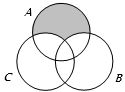
The shaded region in the given figure is
  • A
    $A \cap (B \cup C)$
  • B
    $A \cup (B \cap C)$
  • C
    $A \cap (B -C)$
  • $A -(B \cup C)$
Answer
Correct option: D.
$A -(B \cup C)$
d
(d) It is obvious.
View full question & answer
MCQ 961 Mark
If $A$ and $B$ are two sets then $(A -B) \cup (B -A) \cup (A \cap B)$ is equal to
  • $A \cup B$
  • B
    $A \cap B$
  • C
    $A$
  • D
    $B'$
Answer
Correct option: A.
$A \cup B$
a
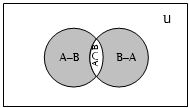
(a) From Venn-Euler's diagram,

$\therefore (A - B)\, \cup (B - A) \cup (A \cap B) = A \cup B$.

View full question & answer
MCQ 971 Mark
If $n(A) = 3$, $n(B) = 6$ and $A \subseteq B$. Then the number of elements in $A \cup B$ is equal to
  • A
    $3$
  • B
    $9$
  • $6$
  • D
    None of these
Answer
Correct option: C.
$6$
c
(c) Since $A \subseteq B,\,\,\,\therefore A \cup B = B$

So, $n(A \cup B) = n(B) = 6$.

View full question & answer
MCQ 981 Mark
Let $A$ and $B$ be two sets such that $n(A) = 0.16,\,n(B) = 0.14,\,n(A \cup B) = 0.25$. Then $n(A \cap B)$ is equal to
  • A
    $0.3$
  • B
    $0.5$
  • $0.05$
  • D
    None of these
Answer
Correct option: C.
$0.05$
c
(c) $n(A \cup B) = n(A) + n(B) - n(A \cap B)$

$0.25 = 0.16 + 0.14 - n(A \cap B)$

==> $n(A \cap B) = 0.30 - 0.25 = 0.05$.

View full question & answer
MCQ 991 Mark
If $A$ and $B$ are disjoint, then $n(A \cup B)$ is equal to
  • A
    $n(A)$
  • B
    $n(B)$
  • $n(A) + n(B)$
  • D
    $n(A)\,.\,n(B)$
Answer
Correct option: C.
$n(A) + n(B)$
c
(c) Since $A$ and $B$ are disjoint, $\therefore A \cap B = \phi $

$n(A \cap B) = 0$

Now $n\,(A \cup B) = n(A) + n(B) - n(A \cap B)$

$ = n(A) + n(B) - 0$$ = n(A) + n(B)$.

View full question & answer
MCQ 1001 Mark
If $A$ and $B$ are not disjoint sets, then $n(A \cup B)$ is equal to
  • A
    $n(A) + n(B)$
  • $n(A) + n(B) - n(A \cap B)$
  • C
    $n(A) + n(B) + n(A \cap B)$
  • D
    $n(A)\,n(B)$
Answer
Correct option: B.
$n(A) + n(B) - n(A \cap B)$
b
(b) $n(A \cup B) = n(A) + n\,(B) - n(A \cap B)$.
View full question & answer
M.C.Q (1 Marks) - Page 2 - Maths STD 11 Science Questions - Vidyadip