MCQ 11 Mark
A book is lying on the table. What is the angle between the action of the book on the table and reaction of the table on the book?
- A
$0^\circ$
- B
$30^\circ$
- C
$45^\circ$
- ✓
$180^\circ$
AnswerCorrect option: D. $180^\circ$
View full question & answer→MCQ 21 Mark
If $3$ forces $F_1, F_2$ and $F_3$ act on a particle, then in equilibrium $............$
AnswerCorrect option: B. $F_1 + F_2 + F_3 = 0$.
View full question & answer→MCQ 31 Mark
Two billiard balls $A$ and $B$, each of mass $50 g$ and moving in opposite directions with speed of $5\ m s ^{-1}$ each, collide and rebound with the same speed. If the collision lasts for $10^{-3} s,$ which of the following statements are true?
- A
The impulse imparted to each ball is $0.25\ kg\ m s ^{-1}$ and the force on each ball is $250 N .$
- B
The impulse imparted to each ball is $0.25\ kg\ m s ^{-1}$ and the force exerted on each ball is $25 \times 10^{-5} N$.
- ✓
The impulse imparted to each ball is $0.5 Ns$ and The impulse and the force on each ball are equal in magnitude and opposite in direction.
- D
AnswerCorrect option: C. The impulse imparted to each ball is $0.5 Ns$ and The impulse and the force on each ball are equal in magnitude and opposite in direction.
Mass of each ball, $m = 0.005\ kg$
speed fo each ball $v= 5\ m/ s$
$\vec{\text{p}}_\text{t}= (0.005)(5)=0.25\text{kg}\ \text{ms}^{-1}$
$= 0.25N-s (1)$
As after collision, the direction of the velocity of each ball is reversed on rebounding.
$\therefore$ Final momentum of each ball $\vec{\text{p}}=\text{m}(-\vec{\text{v}})$
$\vec{\text{p}}_\text{f}=0.005\times(-5)$
$=0.25\text{kg}\ \text{ms}^{-1}$
$=-0.25\ \text{N}-\text{s}$
Eqns $(1)$ and $(2)$
$\therefore$ Impulse imparted to each ball $=$ change in momentam of each ball
$= \text{p}_\text{f}-\text{p}_\text{t}$
$=-0.25-(0.25)$
$=-0.50\text{kg}\ \text{ms}^{-1}$
$=-0.50\ \text{N-s}$
Euation $(3)$ verifies option $(c).$
i.e., the magnitude of impulse imparted by one ball due to collsion with the other ball $=0.50 \ kg ms ^{-5}$.
these two impulse are opposite to each other.
View full question & answer→MCQ 41 Mark
When a car is taking a circular turn on a horizontal road, the centripetal force is the force of:
MCQ 51 Mark
If the tension in the cable supporting an elevator is equal to the weight of the elevator, the elevator may:
AnswerCorrect option: A. Going up with uniform speed.
View full question & answer→MCQ 61 Mark
A particle of mass $5 \ kg$ is pulled along a smooth horizontal surface by a horizontal string. The acceleration of the particle is $10\ ms ^{-2}$. The tension in the string is
- A
$25N$
- ✓
$50N$
- C
$75N$
- D
$100N$
View full question & answer→MCQ 71 Mark
The coefficient of friction between tyres and the road is $0.1.$ Find the maximum speed allowed by traffic police for cars to cross a circular turn of radius $10m$ to prevent accident.
AnswerCorrect option: A. $\sqrt{10}\text{ms}^{-1}$
View full question & answer→MCQ 81 Mark
A rectangular body is held at rest by pressing it against a vertical wall. Which of the following is generally true?
AnswerCorrect option: C. Pressing force required is greater than weight $mg$ of the body.
View full question & answer→MCQ 91 Mark
A $7\ kg$ object is subjected to two forces $($in Newton$) \vec{\text{F}}_1=20\hat{\text{i}}+30\hat{\text{j}}$ and $\vec{\text{F}}_2=8\hat{\text{i}}-5\hat{\text{j}}$ The magnitude of resulting acceleration in $ms^{-2}$ will be:
AnswerResultant force, $\vec{\text{F}}=\vec{\text{F}}_1+\vec{\text{F}}_2$
$=(20\hat{\text{i}}+30\hat{\text{j}})+(8\hat{\text{i}}-5\hat{\text{j}})$
$\vec{\text{F}}=28\hat{\text{i}}+25\hat{\text{j}}$
$\therefore\ \text{F}=\sqrt{28^2+25^2}$
$=\sqrt{784+625}$
$=\sqrt{1409}$
$=37.5\text{N}$
$\text{a}=\frac{\text{F}}{\text{m}}=\frac{37.5}{7}$
$=5.3\text{ ms}^{-2}$
View full question & answer→MCQ 101 Mark
Three forces start acting simultaneously on a particle moving with velocity $\vec{\text{v}.}$ These forces are represented in magnitude and direction by three sides of a triangle taken in the same order. The particle will now move with a velocity.
AnswerCorrect option: C. $\vec{\text{v}}$ only
Resultant of three forces represented completely by three sides of a triangle taken in the same order is zero. Therefore, velocity of particle remains unaffected.
View full question & answer→MCQ 111 Mark
A block of mass m is placed on a smooth inclined plane of inclination $\theta$ with the horizontal. The force exerted by the plane on the block has a magnitude:
- A
$\text{mg}\cos\theta$
- B
$\text{mg}\tan\theta$
- ✓
$\text{mg}/\cos\theta$
- D
$\text{mg}/\sec\theta$
AnswerCorrect option: C. $\text{mg}/\cos\theta$
View full question & answer→MCQ 121 Mark
If, in Exercise $5.21,$ the speed of the stone is increased beyond the maximum permissible value, and the string breaks suddenly, which of the following correctly describes the trajectory of the stone after the string breaks:
- A
The stone moves radially outwards.
- ✓
The stone flies off tangentially from the instant the string breaks.
- C
The stone flies off at an angle with the tangent whose magnitude depends on the speed of the particle?
- D
AnswerCorrect option: B. The stone flies off tangentially from the instant the string breaks.
When the string breaks, the stone will move in the direction of the velocity at that instant. According to the first law of motion, the direction of velocity vector is tangential to the path of the stone at that instant. Hence, the stone will fly off tangentially from the instant the string breaks.
View full question & answer→MCQ 131 Mark
A particle stays at rest as seen in a frame. We can conclude that,
AnswerCorrect option: D. $B$ and $C$
Particle will be seen at rest only when frame is inertial and resultant force on particle is zero.
Also, if frame is non inertial $($i.e., accelerated$),$ the particle must also possess the same acceleration in magnitude and direction
i.e., resultant force on the particle must be non zero.
View full question & answer→MCQ 141 Mark
A body of mass $10\ kg$ is acted upon by two perpendicular forces, $6N$ and $8N.$ The resultant acceleration of the body is:
- A
$1\ ms^{-2}$ at an angle of $14 \tan^{-1}\Big(\frac{4}{3}\Big)$ w.r.t. $6N$ force.
- B
$0.2\ ms^{-2}$ at an angle of $\tan^{-1}\Big(\frac{4}{3}\Big)$ w.r.t. $6N$ force.
- ✓
$1\ m s^{-2}$ at an angle of $\tan^{-1}\Big(\frac{4}{3}\Big)$ w.r.t.$8N$ force.
- D
$0.2\ ms^{-2}$at an angle of $\tan^{-1}\Big(\frac{4}{3}\Big)$ w.r.t.$8N$ force.
AnswerCorrect option: C. $1\ m s^{-2}$ at an angle of $\tan^{-1}\Big(\frac{4}{3}\Big)$ w.r.t.$8N$ force.
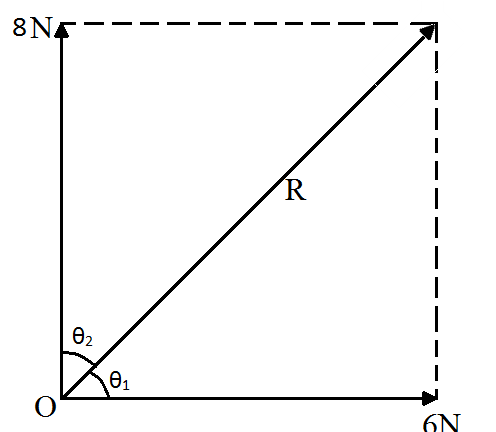
$\text{R}=\sqrt{8^2+6^2}=\sqrt{64+36}=\sqrt{100}$
$\text{R}=10\ \text{N}$
$\text{F}=\text{ma}$
$\Rightarrow\alpha=\frac{\text{F}}{\text{m}}=\frac{\text{R}}{\text{m}}=\frac{10}{10}=1\text{ms}-2\ ...(\text{i})$
$\tan\theta_1=\frac{8}{6}=\frac{4}{3}$
$\Rightarrow\theta_1=\tan^{-1}\Big(\frac{4}{3}\Big)\ ...(\text{ii})$
$\tan\theta_2=\frac{6}{8}=\frac{3}{4}$
$\Rightarrow\theta_2=\tan^{-1}\Big(\frac{3}{4}\Big)\ ...(\text{iii})$
$(i),(ii)$ verifies option $(a)$ and $(i),(iii)$ verifies option $(c).$
Acceleration $\alpha \not=0.2\ \text{ms}^{-2}.$ View full question & answer→MCQ 151 Mark
A metre scale is moving with uniform velocity. This implies:
- A
The force acting on the scale is zero, but a torque about the centre of mass can act on the scale.
- ✓
The force acting on the scale is zero and the torque acting about centre of mass of the scale is also zero.
- C
The total force acting on it need not be zero but the torque on it is zero.
- D
Neither the force nor the torque need to be zero.
AnswerCorrect option: B. The force acting on the scale is zero and the torque acting about centre of mass of the scale is also zero.
Key concept: To solve these types of problem we have to apply Newton’s second law of motion! Newton’s Second Law of Motion
According to this law: The rate of change of linear momentum of a body is directly proportional to the external force applied on the body and this change takes place always in the direction of the force applied.
View full question & answer→MCQ 161 Mark
A ball is travelling with uniform translatory motion. This means that:
AnswerCorrect option: C. All parts of the ball have the same velocity $($magnitude and direction$)$ and the velocity is constant.
If all the particles of the body move with the same velocity in same straight line, then the motion is called uniform motion or uniform translatory motion.
View full question & answer→MCQ 171 Mark
Physical independence of force is a consequence of:
AnswerPhysical independence of force is a consequence of first law of motion.
View full question & answer→MCQ 181 Mark
Who gave the idea that when a particle is moving with uniform velocity, there is no need of any force, if frictional force is zero?
MCQ 191 Mark
If the running bus stop suddenly our feet stop due to friction which does not allow relative motion between the feet and floor of the bus. But the rest of the body continues to move forward due to:
MCQ 201 Mark
Suppose the earth suddenly stops attracting objects placed near surface. A person standing on the surface of the earth will:
- ✓
- B
- C
- D
Either $(b)$ or $(c).$
AnswerIf downward force on the earth stops,
so upward self adjusting force also stop.
In vertical direction, there is no force. Due to inertia person resists any change to its state of rest.
Person will remain standing.
View full question & answer→MCQ 211 Mark
A shell is fired from a cannon, it explodes in mid air, its total:
- A
- B
- ✓
$K.E.$ increases.
- D
$K.E.$ decreases.
AnswerCorrect option: C. $K.E.$ increases.
On explosion, $K.E.$ increases, as chemical energy of explosives is converted into $K.E.$
View full question & answer→MCQ 221 Mark
Physical independence of force is a consequence of:
MCQ 231 Mark
When forces $F_1, F_2, F_3$ are acting on a particle of mass $m$ such that $F_2$ and $F_2$ are mutually perpendicular, then the particle remain stationary. If the force $F_1$ is now removed, then the acceleration of the particle is:
- ✓
$\frac{\text{F}_1}{\text{m}}$
- B
$\frac{\text{F}_2}{\text{m}}$
- C
$\frac{\text{F}_3}{\text{m}}$
- D
$\text{None of these}$
AnswerCorrect option: A. $\frac{\text{F}_1}{\text{m}}$
As $F_3$ and $F_3$ are mutually perpendicular, their resultant $=\sqrt{\text{F}_2^2+\text{F}_3^2}$
As particle is stationary under $F_1, F_2, F_3$,
therefore, $\sqrt{\text{F}_2^2+\text{F}_3^2}$ must be equal and opposite of $F_1$.
When $F_1$ is removed, resultant force is $\sqrt{\text{F}_2^2+\text{F}_3^2}$
Therefore, acceleration of particle $=\frac{\sqrt{\text{F}^2_2+\text{F}_3^2}}{\text{m}}=\frac{\text{F}_1}{\text{m}}$
View full question & answer→MCQ 241 Mark
A block of mass $M$ is pulled along a horizontal frictionless surface by a rope of mass $m$. Force $P$ is applied at one end of the rope. The force which the rope exerts on the block is:
- A
$\frac{\text{P}}{\text{M - m}}$
- ✓
$\frac{\text{PM}}{\text{m + M}}$
- C
$\frac{\text{P}}{\text{M(m + M)}}$
- D
$\frac{\text{Pm}}{\text{M - m}}$
AnswerCorrect option: B. $\frac{\text{PM}}{\text{m + M}}$
View full question & answer→MCQ 251 Mark
$25N$ force is required to raise $75\ kg$ mass from a pulley. If rope is pulled $12m,$ then the load is lifted to $3m,$ the efficiency of pulley system will be,
- A
$25\%$
- B
$33.3\%$
- ✓
$75\%$
- D
$90\%$
AnswerCorrect option: C. $75\%$
$\eta=\frac{\text{Output}}{\text{Input}}=\frac{75\times3}{25\times12}$
$=\frac{75\times3}{25\times12}$
$=\frac{75}{100}$
$=\frac{75}{100}\times100\%$
$=75\%$
View full question & answer→MCQ 261 Mark
A force of $200N$ is required to push a car of mass $500\ kg$ slowly at constant speed on a level road. If a force of $500N$ is applied, the acceleration of the car $($in $ms^{-2})$ will be:
View full question & answer→MCQ 271 Mark
Two forces $\text{F}_1=3\hat{\text{i}}-4\hat{\text{j}}$ and $\text{F}_2=2\hat{\text{i}}-3\hat{\text{j}}$ are acting upon a body of mass 2kg. Find the force F, which when acting on the body will make it stable.
- ✓
$5\hat{\text{i}}+7\hat{\text{j}}$
- B
$-5\hat{\text{i}}-7\hat{\text{j}}$
- C
$-5\hat{\text{i}}+7\hat{\text{j}}$
- D
$5\hat{\text{i}}-7\hat{\text{j}}$
AnswerCorrect option: A. $5\hat{\text{i}}+7\hat{\text{j}}$
View full question & answer→MCQ 281 Mark
For a body moving with constant speed in a horizontal circle, which of the following remains constant?
Answer$\text{K.E.}=\frac{1}{2}\text{mv}^2=$ constant, while moving uniformly in a horizontal circle.
View full question & answer→MCQ 291 Mark
An insect is crawling up on the concave surface of a fixed hemispherical bowl of radius $R.$ If the coefficient of friction is $\frac13$ then the height up to which the insect can crawl is nearly:
- ✓
$5\%$ of $R.$
- B
$6\%$ of $R.$
- C
$6.5\%$ of $R.$
- D
$7.5\%$ of $R.$
AnswerCorrect option: A. $5\%$ of $R.$
View full question & answer→MCQ 301 Mark
If all matter were made of electrically neutral particles such as neutrons,
- A
There would be no force of friction.
- B
There would be no tension in the string.
- C
It would not be possible to sit on a chair.
- ✓
AnswerThe main cause of friction is adhesive force which is electrical in nature. Tension in a string is sort of restoring force which is again electrical in nature. Without friction, it would not be possible to sit on a chair.
View full question & answer→MCQ 311 Mark
A machine gun fires a bullet of mass $40\ gm$ with a velocity $1200\ m/ s.$ The man holding it can exert a maximum force of $144N$ on the gun. How many bullets can he fire per second at the most?
- A
- ✓
- C
He can fire any number of bullets.
- D
$144 \times 48$
View full question & answer→MCQ 321 Mark
In the previous problem $(5.3),$ the magnitude of the momentum transferred during the hit is:
- A
- B
$0.75\ kg\ ms^{-1}$
- ✓
$1.5\ kg\ ms^{-1}$
- D
$14\ kg\ m s^{-1}$
AnswerCorrect option: C. $1.5\ kg\ ms^{-1}$
$\Delta\overrightarrow{\text{p}}=-(0.9\hat{\text{i}}+1.2\hat{\text{j}})$
Magnitude $\Big|\Delta\overrightarrow{\text{p}}\Big|$
$=\sqrt{(0.9)^2+(1.2)^2}$
$=\sqrt{0.81+1.44}$
$=\sqrt{2.25}$
$=1.5\text{kg}\ \text{m s}^{-1}$
View full question & answer→MCQ 331 Mark
The motion of a particle of mass m is given by $\text{x}=0$ for $\text{t} < 0\ \text{s},$ $\text{x}(\text{t})=\text{A}\sin4\text{p}\ \text{t}$ for $0<\text{t}<(1/ 4)\ \text{s}(\text{A}>\text{o}),$ and $\text{x}=0$ for $\text{t}>(1/4)\ \text{s}.$ Which of the following statements is true?
AnswerCorrect option: C. The particle is not acted upon by a constant force.
For different time intervals position of the particle is given.
Hence, we have to find velocity and acceleration corresponding to the intervals.
Givan, $x = 0$ ; for $t < 0 s.$
$\text{x}\text({t})=\text{A}\sin4\pi\text{t};$ For $0<\text{t}<\frac{1}{4}\text{s}$
By differentiating this equation $\text{W.R.T}.$ time, we get velocity of the particle as function of time.
For, $0<\text{t}<\frac{1}{4}\text{s},$ $\text{v}(\text{t})=\frac{\text{dx}}{\text{dt}}=4\pi\text{A}\cos4\pi\text{t}$
If we again Differntiate this eqation w.r.t. time we well get acceleration the particle as a function of time $($at a particular time$).$
$\text{a(t)}=\frac{\text{dv(t)}}{\text{dt}}=-16\pi^2\text{A}\sin4\pi\text{t}$
At $\text{t}=\frac{1}{8}\text{s}.\text{a(t)}=-16\pi^2\text{A}\sin4\pi\times\frac{1}{8}=-16\pi^2\text{A}$
$\text{F}=\text{m}[\text{a(t)}]=-16\pi^2\text{A}\times\text{m}=-16\pi^2\text{mA}$
Hence option $(a)$ is correct.
Impulse $=$ change in linear momentum
$=\text{F}\times\text{t}=(-16\pi^2\text{Am})\times\frac{1}{4}=-4\pi^2\text{Am}$
The impulse $($Change in linear momentum$)$ at $t = 0$ is same as $\text{t}=\frac{1}{4}\text{s}.$
Hence, option $(b)$ is correct.
We know that, force depends upon acceleration and which is not constant here.
Hence, force is also not constant.
Hence, option $(c)$ is correct.
Important point: We have to keep in mind that the force is varying for different time intervals.
Hence, we should apply differential formulae for each interval separately.
View full question & answer→MCQ 341 Mark
The two ends of a spring are displaced along the length of the spring. All displacements have equal magnitudes. In which case or cases the tension of compression in the spring will have a maximum magnitude?
- ✓
The right end is displaced towards right and the left end towards left.
- B
The right end is displaced towards left and the left end towards right.
- C
Both ends are displaced towards right.
- D
Both ends are displaced towards left.
AnswerCorrect option: A. The right end is displaced towards right and the left end towards left.
The right end is displaced towards right and the left end towards left.
View full question & answer→MCQ 351 Mark
Conservation of momentum in a collision between particles can be understood from:
- A
- B
- C
Newton’s second law only.
- ✓
Both Newton’s second and third law.
AnswerCorrect option: D. Both Newton’s second and third law.
- By newton's second law $\frac{\vec{\text{dp}}}{\text{dt}}=\vec{\text{f}}_\text{ext}$
As $\vec{\text{F}}_\text{ext}$ on law of conservation of momentam is zero.
$\text{i.e},\vec{\text{f}}_\text{ext}=0$
$\frac{\vec{\text{dp}}}{\text{dt}}=0$
$\Rightarrow\vec{\text{p}}$ is constant.
- By netton's third law action force is equal to reaction force in magnitude but in opposite direction.
$\therefore\vec{\text{F}}_12=-\vec{\text{F}}_21(\vec{\text{F}_\text{ext}}=0)$
$\frac{\vec{\text{dp}_{12}}}{\text{dt}}=\frac{\vec{\text{- dp}_{21}}}{\text{dt}}$ or $\vec{\text{dp}_{12}}=-\vec{\text{dp}_{21}}$
$\vec{\text{dp}}_{12}+\vec{\text{dp}_{21}}=0.$ View full question & answer→MCQ 361 Mark
A particle is moving on a circular path of $10m$ radius. At any instant of time, its speed is $5\ ms^{-1}$ and the speed is increasing at a rate of $2\ ms^{-2}$. The magnitude of net acceleration at this instant is:
- A
$5\ ms^{-2}$
- B
$2\ ms^{-2}$
- ✓
$3.2\ ms^{-2}$
- D
$4.3\ ms^{-2}$
AnswerCorrect option: C. $3.2\ ms^{-2}$
View full question & answer→MCQ 371 Mark
A particle of mass $10\ kg$ is moving in a straight line. If its displacement, $x$ with time $t$ is given by $x = (t^3 - 2t - 10)m,$ then the force acting on it at the end of $4$ seconds is:
- A
$24N$
- ✓
$240N$
- C
$300N$
- D
$1200N$
AnswerCorrect option: B. $240N$
$\text{m}=10\text{kg}$
$\text{x}=(\text{t}^3-2\text{t}-10)\text{m}$
$\frac{\text{dx}}{\text{dt}}=\text{v}=3\text{t}^2-2$
$\frac{\text{d}^2\text{x}}{\text{dt}^2}=\text{a}=6\text{t}$
At the end of $4 \sec,$
$\text{a}=6\times4=24\text{ m/s}^2$
$\text{F}=\text{ma}$
$=10\times24$
$=240\text{N}$
View full question & answer→MCQ 381 Mark
- A
Act on two different objects.
- B
- C
Have opposite directions.
- ✓
View full question & answer→MCQ 391 Mark
If the tension in the cable supporting an elevator is equal to the weight of the elevator, the elevator may be:
- A
Going up with uniform speed.
- B
Going down with uniform speed.
- ✓
$A$ and $B$
- D
Going down with increasing speed.
AnswerCorrect option: C. $A$ and $B$
Tension $=\text{R}=\text{m}(\text{g}\pm\text{a}).$
When $R = mg, a = 0$
i.e., speed must be uniform.
It may be upwards or downwards.
View full question & answer→MCQ 401 Mark
If a box is lying in the compartment of an accelerating train and box is stationary relative to the train. What force cause the acceleration of the box?
- ✓
Frictional force in the direction of train.
- B
Frictional force in the opposite direction of train.
- C
- D
AnswerCorrect option: A. Frictional force in the direction of train.
Frictional force in the direction of train causes the acceleration of the box lying in the compartment of an accelerating train.
View full question & answer→MCQ 411 Mark
During the motion of a lift, apparent weight of a body becomes twice its actual weight when,
- A
Lift is moving down with acc. $= g.$
- ✓
Lift is moving up with acc. $= g.$
- C
Lift is moving down with uniform velocity $= 9.8\ ms^{-1}$.
- D
Lift is moving up with uniform velocity $= ms^{-1}$.
AnswerCorrect option: B. Lift is moving up with acc. $= g.$
Apparent weight $=\text{m}(\text{g}\pm\text{a})$
Apparent weight $= m(g + g) = 2mg$
View full question & answer→MCQ 421 Mark
A body with mass $5\ kg$ is acted upon by a force $\text{F}=(-3\hat{\text{i}}+4\hat{\text{j}})\text{N.}$ If its initial velocity at $t = 0$ is $\text{v}=(6\hat{\text{i}}-12\hat{\text{j}})\text{m s}^{-1},$ the time at which it will just have a velocity along the $y-$axis is:
AnswerAccording to the problam, mass $m = 5\ kg$
Force which is acting uppon the block $\vec{\text{F}}=(-3\hat{\text{i}}+4\hat{\text{j}})\text{N}$
Inital velocity at $\text{t}=0,\ \vec{\text{u}}=(6\vec{\text{i}}-12\vec{\text{j}})\text{m/s}$
Retardation, $\vec{\text{a}}=\frac{\vec{\text{F}}}{\text{m}}=\Big(-\frac{3\vec{\text{i}}}{5}+\frac{4\vec{\text{j}}}{5}\Big)\text{m/s}^2$
And when final veocity is along $y-$axis only, its $x-$componet must be zero.
We have to apply kinematic wquations seprately for $x-$component only. then we get $\text{v}_\text{x}=\text{u}_\text{x}+\text{a}_\text{x}\text{t}$
$0= 6\vec{\text{i}}-\frac{3\vec{\text{i}}}{5}\text{t}$
$\text{t}=\frac{5\times6}{3}=10\ \text{s}$
View full question & answer→MCQ 431 Mark
The dimension of Impulse is:
- A
$\ce{MLT^{-2}}$
- ✓
$\ce{MLT^{-1}}$
- C
$\ce{MLT^{-3}}$
- D
$\text{MLT}$
AnswerCorrect option: B. $\ce{MLT^{-1}}$
View full question & answer→MCQ 441 Mark
A body of mass $m$ collides against a wall with the velocity $v$ and rebounds with the same speed. Its change of momentum is:
AnswerChange in momentum $= m(v - u) = m(-v - v) = 2mv$
View full question & answer→MCQ 451 Mark
A hockey player is moving northward and suddenly turns westward with the same speed to avoid an opponent. The force that acts on the player is:
AnswerCorrect option: C. Frictional force along south$-$west.
The force on the player will be due to the rate of change of momentum. The direction of force acting on player will be the same as the direction of change in momentum $\vec{\text{p}}_2-\vec{\text{p}}_1.$
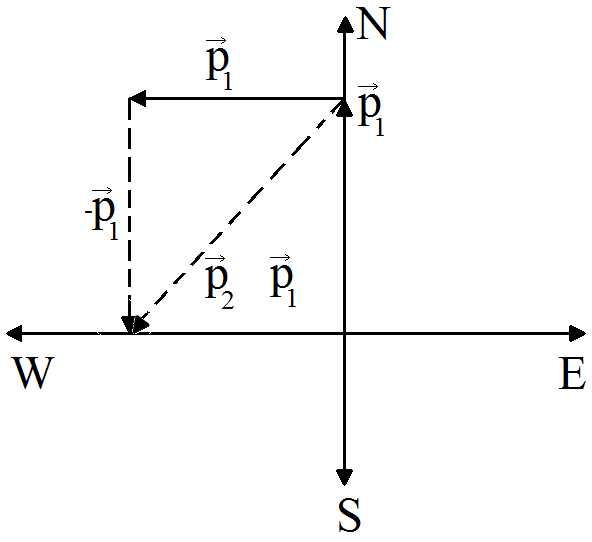
It is clear from the figure. The direction $\vec{\text{p}}_2-\vec{\text{p}}_1$ of is towards the south$-$west. It will be the direction of the force on the player. View full question & answer→MCQ 461 Mark
- A
Act on two different objects.
- B
Have opposite directions.
- C
- ✓
AnswerForces of action and reaction are equal and opposite, acting on different objects and having zero resultant.
View full question & answer→MCQ 471 Mark
A sparrow flying in air sits on a stretched telegraph wire. If weight of the sparrow is $W,$ which of the following is true about the tension $T$ produced in the wire?
- A
$T = W$
- B
$T < W$
- C
$T = 0$
- ✓
$T > W$
AnswerCorrect option: D. $T > W$
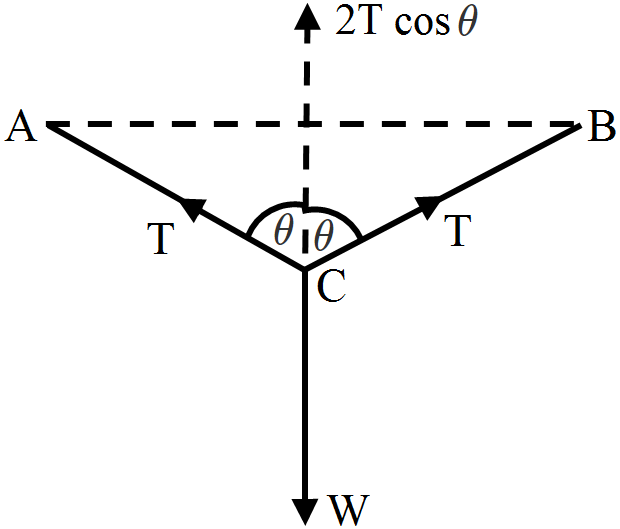
$2\text{T}\cos\theta=\text{W},$
$\text{T}=\frac{\text{W}}{2\cos\theta}$
As, $\theta=90^\circ$
$\therefore\ \text{T}>>\text{W}$ View full question & answer→MCQ 481 Mark
A ball with an initial momentum $p$ collides normally with a rigid wall. If $p'$ is its linear momentum after the perfectly elastic collision, then:
- A
$p' = p$
- ✓
$p' = -p$
- C
$p' = 2p$
- D
$p' = -2p$
AnswerCorrect option: B. $p' = -p$
As collision is perfectly elastic, the ball rebounces with the same velocity.
$\therefore\ \text{p}'=-\text{p}$
View full question & answer→MCQ 491 Mark
A car of mass $m$ is driven with an acceleration a along a straight level road against a constant externally resistive force $R$. When the velocity of the car is $V$, the rate at which the engine of the car is doing work is:
- A
$\ce{RV}$
- B
$\ce{maV}$
- ✓
$\ce{(R + ma)V}$
- D
$\ce{(ma + V)R}$
AnswerCorrect option: C. $\ce{(R + ma)V}$
$\ce{P = (f_1 + f_2)V = (R + ma)V}$
View full question & answer→MCQ 501 Mark
In an elevator moving vertically up with an acceleration $'g\ ',$ the force exerted on the floor by a passenger of mass $M$ is:
- A
$Mg$
- B
$\frac{1}{2}\text{Mg}$
- C
- ✓
$2Mg$
AnswerForce exerted by the passenger on floor
$= R = M(g + a)$
$= M(g + g)$
$= 2Mg$
View full question & answer→