Questions · Page 3 of 3

5 Marks Questions

Question 1015 Marks
A wave travelling along a string is described by equation y (x, t) = 0.05 sin(40x - 5t) in which the numerical constants are in SI units ($0.05m, 40 radm^{-1}$ and $5 rad s^{-1}$).
Calculate the (a) amplitude (b) wavelength (c) time period (d) frequency of wave. Also calculate the displacement at distance $35cm$ and time $10 sec$.
Answer
$\text{y}(\text{x, t})=0.05\ \sin(40\text{x}-5\text{t})$
Comparing with standard equation,
$\text{y}(\text{x, t})=\text{A}\sin\Big(\frac{2\pi\text{x}}{\lambda}-\frac{2\pi\text{t}}{\text{T}}\Big)$
  1. Amplitude = 0.05m
  2. $\frac{2\pi}{\lambda}=40$
wavelength $\lambda=+\frac{\pi}{20}\text{m}$
  1. Time period $=-\frac{2\pi\text{t}}{\text{T}}=-5\text{t}$
$\text{T}=\frac{2\pi}{5}\text{seconds}$
  1. Frequency of wave $\text{v}=\frac{1}{\text{T}}=\frac{5}{2\pi}=0.8\text{Hz}$
$\text{y}=0.05\sin(+40\times0.35-5\times10)\$\because \text{x}=0.35\text{m},\text{t}=10\text{s})$

$=0.05\sin(-36^\circ)$

$=-0.05\sin36^\circ$
View full question & answer
Question 1025 Marks
Explain Doppler effect in sound. Obtain an expression for apparent frequency of sound when source and listener are approaching each other.
Answer
Whenever there is a relative motion between a source of sound and listener, the apparent frequency of sound heard by listener is different from actual frequency of sound emitted by the source.
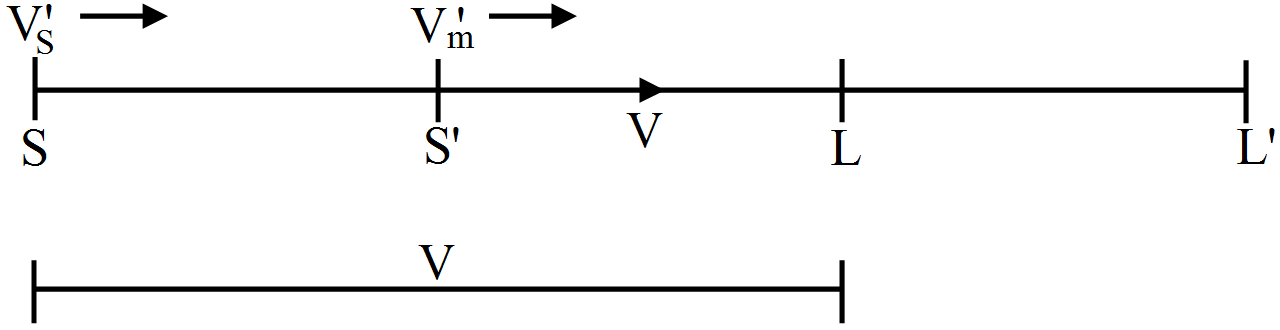
Let S be a source of sound and L, the listener of sound, both initially at rest. Let v be the actual frequency of sound emitted by the source and $\lambda$ be the actual wavelength of sound emitted. If v is velocity of sound in still medium, then
$\lambda=\frac{v}{\text{v}}$
Let the distance between source and listener be V, so that v waves from the source reach listener in 1 second.
$V_m$ = Velocity of medium, $V_s$ = Velocity of source,
$V_L​​​​​​​$ = Velocity of listener

Resultant velocity of sound along SL = (V + Vm)
SS' = Distance moved by source in 1 sec. = $V_s​​​​​​​$ along SL
$\therefore$ Relative velocity of sound w.r.t. source SS' = $V_s' = [(V + V_m) - V_s]$
As the frequency remains unchanged.
$\therefore$ V waves emitted in one second occupy the distance $[(V + V_m) - V_s]$ apparent wavelength $\lambda'=\frac{[(\text{V}+\text{V}_\text{m})-\text{V}_\text{s}]}{\text{V}}$
Assuming both listener and source are moving in same direction, i.e. toward right.
$LL' = V_L’$ relative velocity of sound wave w.r.t. listener $(V + V_m) - V_L$
Apparent frequency of sound waves heard by listener is
$\text{v}'=\frac{(\text{V}+\text{V}_\text{m})-\text{V}_\text{L}}{\lambda'}$
$\text{v}'=\frac{[(\text{V}+\text{V}_\text{m})-\text{V}_\text{L}]\text{v}}{(\text{V}+\text{V}_\text{m})-\text{V}_\text{s}}$
When both approach each other, i.e. listener move towards the source:
$V_s$ = Positive, $V_L$ = Negative.
$\text{v}'=\frac{\text{V}-(-\text{V}_\text{L})}{\text{V}-\text{v}_\text{s}}\text{v}=\Big(\frac{\text{V}+\text{V}_\text{L}}{\text{V}-\text{V}_\text{s}}\Big)\text{v}$
Apparent frequency (v') is greater than actual frequency (v).
View full question & answer
Question 1035 Marks
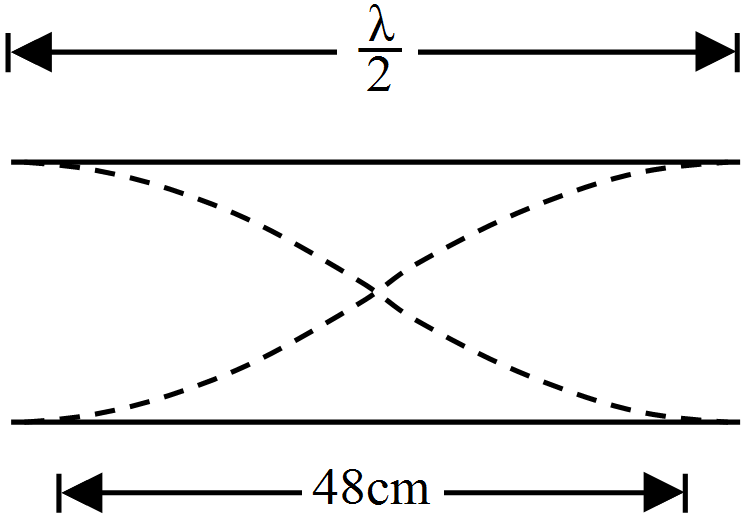
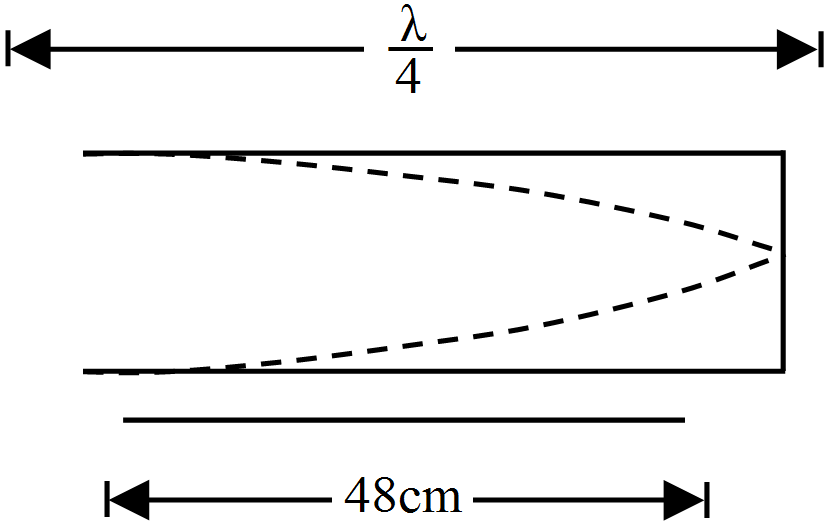
A tube of certain diameter and of length 48cm is open at both ends. Its fundamental frequency of resonance is found to be 320Hz. The velocity of sound in air is 320m/s. Estimate the diameter of the tube. One end of the tube is now closed, calculate the lowest frequency of resonance for the tube.
Answer
For the open tube (i)
$\frac{\lambda}{2}=48+2\times0.3\text{D}$
But $\lambda=\frac{\nu}{\text{V}}=\frac{32000}{320}=100\text{cm}$
$\therefore \frac{100}{2}=48+2.3\times\text{D or D}$
$=\frac{20}{6}=3.33\text{cm}$

When one end of the tube is closed (ii)

$\frac{\lambda}{4}=48+0.3\text{D}$
$\lambda=[48+0.3\times3.33]\times4$
$=196\text{cm}$
$\therefore$ Lowest frequency,
$\text{V}=\frac{\nu}{\lambda}=\frac{32000}{196}=163.3\text{Hz}$
View full question & answer
Question 1045 Marks
An incident wave and a reflected wave are represented by
$\xi_1=\text{a}\sin\frac{2\pi}{\lambda}(\nu\text{t}-\text{x})$
$\xi_2=\text{a}\sin\frac{2\pi}{\lambda}(\nu\text{t}+\text{x})$
Derive the equation of the stationary wave, and calculate the position of the nodes and antinodes.
Answer
Applying superposition principle,
$\xi=\xi_1+\xi_2$
$=\text{a}\Big[.\sin\frac{2\pi}{\lambda}\nu\text{t}\cos\frac{2\pi}{\lambda}\text{x}-\cos\frac{2\pi}{\lambda}\nu\text{t}\\ \sin\frac{2\pi}{\lambda}\text{x}\sin\frac{2\pi}{\lambda}(\nu\text{t}+\text{x}+\pi)\Big]$
$\xi=2\text{a}\sin\frac{2\pi}{\lambda}\text{x}\cos\frac{2\pi}{\lambda}\nu\text{t}$ as the reflected waYe will be out of phase by $\pi$ radians besides oppositely directed.
Amplitude $=2\text{a}\sin\frac{\pi}{\lambda}\text{x}.$
Amplitude is minimum at nodes. Therefore at
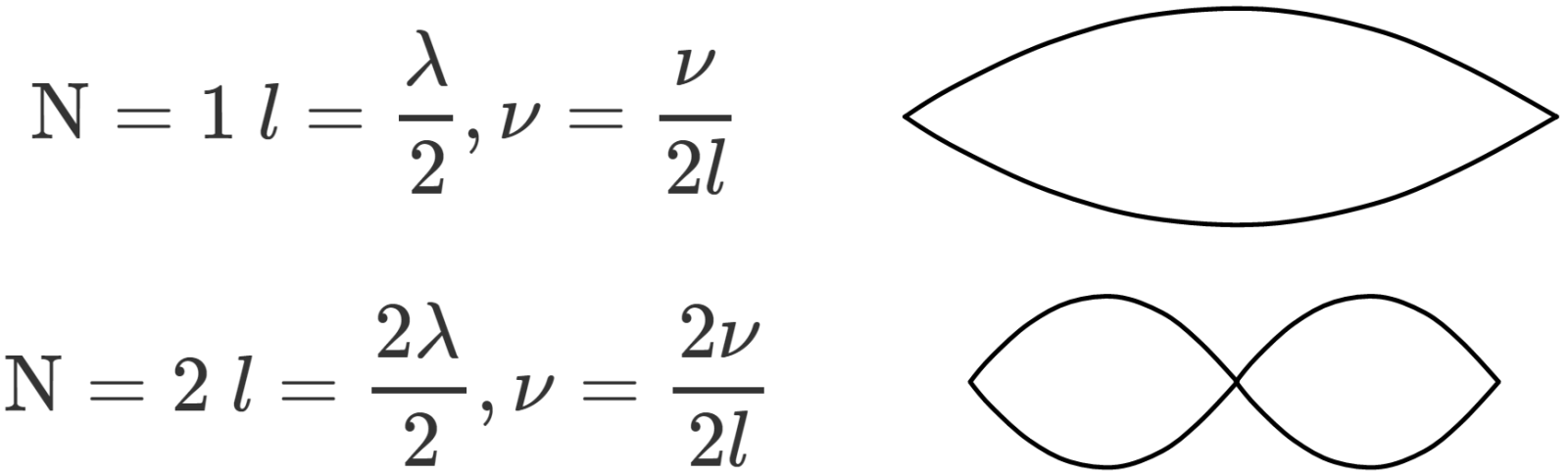
x = 0 and x = l, for nodes, $\frac{2\pi}{\lambda}\text{x}=0,\pi,2\pi...\text{N}\pi$
$\text{x}=\frac{\text{N}\lambda}{2}$ or $\text{l}=\frac{\text{N}\lambda}{2}.$
So at all points separated by $\frac{\lambda}{2}$ from one end nodes are formed. The pattern at the fundamental mode and II harmonic can be shown as below.
View full question & answer
Question 1055 Marks
One end of a long string of linear mass density $8.0 \times 10^{–3}kg m^{–1}$ is connected to an electrically driven tuning fork of frequency $256Hz$. The other end passes over a pulley and is tied to a pan containing a mass of $90kg$. The pulley end absorbs all the incoming energy so that reflected waves at this end have negligible amplitude. At $t = 0$, the left end (fork end) of the string $x = 0$ has zero transverse displacement $(y = 0)$ and is moving along positive y-direction. The amplitude of the wave is $5.0cm$. Write down the transverse displacement y as function of x and t that describes the wave on the string.
Answer
The equation of a travelling wave propagating along the positive y-direction is given by the displacement equation: $\text{y}(\text{x, t})=\text{a}\sin(\text{wt}-\text{kx})\ \dots(\text{i})$ Linear mass density, $\mu=8.0\times10^{-3}\text{kg m}^{-1}$ Frequency of the tuning fork, ν = 256Hz Amplitude of the wave, a = 5.0cm = 0.05m …(ii) Mass of the pan, m = 90kg Tension in the string, $T = mg = 90 \times 9.8 = 882N$ The velocity of the transverse wave v, is given by the relation: $\text{v}=\sqrt{\frac{\text{t}}{\mu}}$
$=\frac{882}{8.0\times10^{-3}}=332\text{m/s}$ Angular Frequency, $\omega=2\pi\text{v}$
$=2\times3.14\times256$
$=1608.5=1.6\times10^3\text{ rad/s}\ \dots(\text{iii})$ Wanelength, $\lambda=\frac{\text{v}}{\text{v}}=\frac{332}{256}\text{m}$
$\therefore$ Propagation constant, $\text{k}=\frac{2\pi}{\lambda}$
$=\frac{2\times3.14}{\frac{332}{256}}=4.84\text{m}^{-1}\ \dots(\text{iv})$Substituting the values from equations (ii), (iii) and (iv) in equatio (i) we get the displacement equation:
$\text{y}(\text{x, t})=0.05\sin(1.6\times10^3\text{t}-4.84\text{x})\text{m}.$
View full question & answer
Question 1065 Marks
A man standing in front of a mountain at a certain distance beats a drum at regular intervals. The drumming rate is gradually increased, and he finds that the echo is not heard distinctly, when the rate becomes 40 per minute. He then moves nearer to the mountain by 90 metres, and finds what the echo is again not heard when the drumming rates becomes 60 per minute. Calculate
  1. The distance between the mountain and the initial position of the man.
  2. The velocity of sound.
Answer
Let d be the distance between the man and the mountain and v be the velocity of sound.
$\therefore$ Distance covered by the echo = 2d
$\text{Time}=\frac{2\text{d}}{\nu}$
Interval between the successive beats $=\frac{60}{40}=1.5/\text{sec}$
[$\because$ Drumming rate = 40 per minute]
According to the conditions given,
$\frac{2\text{d}}{\nu}=1.5\dots{\text{(i})}$
Again, 2(d - 90) = Distance covered by the echo
Or $\frac{2\text{d}-180}{\nu}=1$
[$\because$ Drumming rate = 60 per minute] ...(ii)
From (i) and (ii), we have
$1.5-\frac{180}{\nu}=1$
$\nu=\frac{180}{0.5}=360\text{m/s}$
$\therefore \text{d}=170\text{m}$
So,
  1. Distance = 270m
  2. Velocity = 360m/s
View full question & answer
Question 1075 Marks
A source of frequency $250Hz$ produces sound waves of wavelength $1.32m$ in a gas at STP. Calculate the change in the wavelength, when temperature of the gas is $40°C$.
Answer
We have, $v_0 = 250Hz$, T0 $= 273K$
$T_1 = 273 + 40 = 313K; \lambda_0=132\text{m}$
$\therefore$ Speed of sound, $\text{v}_0=\text{v}_0.\lambda_0=250\times1.32$
$=330\text{m/s}$
As we know that,
Speed of sound, $\text{v}\propto\sqrt{\text{T}}$
Thus, $\frac{\text{v}_1}{\text{v}_0}=\sqrt{\frac{\text{T}_1}{\text{T}_0}}$
$\text{v}_1=\text{v}_0\sqrt{\frac{\text{T}_1}{\text{T}_0}}$
$=330\sqrt{\frac{313}{273}}=353.34\text{m/s}$
$\because \text{v}_1=\text{v}_0\lambda_1$
$\lambda_1=\frac{353.34}{250}=1.14\text{m}$
$\therefore$ Change in the wavelenth,
$\Delta \lambda=\lambda-\lambda_0$
$=1.14-1.32=0.09\text{m}$
View full question & answer
Question 1085 Marks
A progressive wave is given by $\text{y}(\text{x, t})=8\cos(300\text{t}-0.15\text{x})$ where x in m, y in cm and t in second. What is the-
  1. Direction of propagation?
  2. Wavelength?
  3. Frequency?
  4. Wave speed?
  5. Phase difference between two points 0.2m apart?
Answer
$\text{y}(\text{x, t})=8\cos(300\text{t}-0.15\text{x})$
On comparing it with $\text{y}=\text{a}\cos2\pi\Big(\frac{\text{t}}{\text{T}}-\frac{\text{x}}{\lambda}\Big)$
  1. Direction of propogation is + x-axis.
  2. $\frac{2\pi}{\lambda}=0.15$
$\Rightarrow \lambda=\frac{2\pi}{0.15}$

$=41.87\text{m}$
  1. $\frac{2\pi}{\text{T}}=300$
$2\pi\text{v}=300$

$\text{v}=\frac{300}{2\pi}$

$=47.78\text{Hz}$
  1. $\nu=\lambda\text{v}$
$=\frac{2\pi}{0.15}\times\frac{300}{2\pi}$

$=2000\text{m/s}$
  1. $\Delta\phi=\frac{2\pi}{\lambda}\Delta\text{x}=\frac{2\pi}{\lambda}\times0.2$
$=\frac{2\pi\times0.2\times0.15}{2\pi}=0.03\text{ radian}$
View full question & answer
Question 1095 Marks
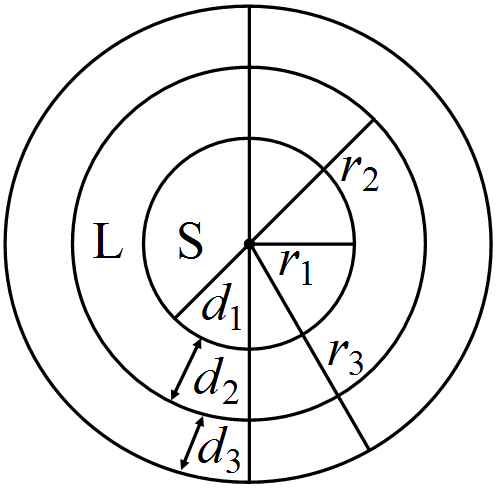
The earth has a radius of $6400km$. The inner core of $1000km$ radius is solid. Outside it, there is a region from $1000km$ to a radius of $3500km$ which is in molten state. Then again from $3500km$ to $6400km$ the earth is solid. Only longitudinal (P) waves can travel inside a liquid. Assume that the P wave has a speed of $8km s^{–1}$ in solid parts and of $5km s^{–1}$ in liquid parts of the earth. An earthquake occurs at some place close to the surface of the earth. Calculate the time after which it will be recorded in a seismometer at a diametrically opposite point on the earth if wave travels along diameter?
Answer
$\text{r}_1=1000\text{km}$
$\text{r}_2=3500\text{km}$
$\text{r}_3=6400\text{km}$
$\text{d}_1=1000\text{km}$
$\text{d}_2=3500-1000=2500\text{km}$
$\text{d}_3=6400-3500=2900\text{km}$


Solid distance diametrically $=2(\text{d}_1+\text{d}_3)=(1000+2900)$
$2\times3900\text{km}$ Time taken by wave produced by earthquake in solid part $=\frac{3900\times2}{8}\sec$ Liquid part along diametrically $2\text{d}_2=2\times2500$
$\therefore$ Time taken by seismic wave in liquid part $=\frac{2\times2500}{5}$ Total time $\frac{2\times3900}{8}+\frac{2\times2500}{5}=2\Big[\frac{3900}{8}+\frac{2500}{5}\Big]$
$=2[487.5+500]=2\times987.5=1975\sec.$
$=32\ \text{min}\ 55\sec.$
View full question & answer
Question 1105 Marks
What do you understand by beat? Explain beats analytically.
Answer
For definition, see text:
Consider two simple harmonic progressive waves travelling simultaneously in the same direction and in the same medium. Let
'A' be the amplitude of each wave.
There is no initial phase difference between them.
$v_1$ and $v_2$ be their frequencies.
If $y_1$ and $y_2$ be displacements of the two waves, then
$\text{y}_1=\text{A}\sin2\pi\text{v}_1\text{t}$ and $\text{y}_2=\text{A}\sin2\pi\text{v}_2\text{t}$
If y be the result and displacement at any instant, then
$\text{y}=\text{y}_1+\text{y}_2=\text{A}\sin(2\pi\text{v}_1\text{t})+\sin(2\pi\text{v}_2\text{t})$
$=\text{A}\Bigg[2\sin\Big(\frac{2\pi(\text{v}_1+\text{v}_2)\text{t}}{2}\Big)\cos\Big(\frac{2\pi(\text{v}_1-\text{v}_2)\text{t}}{2}\Big)\Bigg]$
$=2\text{A}\cos\pi(\text{v}_1\text{v}_2)\text{t}\sin \pi(\text{v}_1+\text{v}_2)\text{t}$
$=\text{R}\sin\pi(\text{v}_1+\text{v}_2)\text{t}\ \dots(1)$
where $\text{R}=2\text{A}\cos\pi(\text{v}_1-\text{v}_2)\text{t}\ \dots(2)$
is the amplitude of the resultant displacement and depends upont. The following cases arise.
  1. If R is maximum, then
$\cos\pi(\text{v}_1-\text{v}_2)\text{t}=\text{max}.=\pm1=\cos\text{n}\pi$
$\therefore \pi(\text{v}_1-\text{v}_2)\text{t}=\text{n}\pi$
$\text{t}=\frac{\text{n}}{\text{v}_1-\text{v}_2}\ \dots(3)$
where n = 0, 1, 2...
$\therefore$ Amplitude becomes maximum at times given by
$\text{t}=0,\frac{1}{\text{v}_1-\text{v}_2},\frac{2}{\text{v}_1-\text{v}_2}=\frac{3}{\text{v}_1-\text{v}_2},...$
$\therefore$ Time interval between two consecutive maxima is
$=\frac{1}{\text{v}_1-\text{v}_2}$
$\therefore$ Beat period $=\frac{1}{\text{v}_1-\text{v}_2}$
$\therefore$ Beat frequency $=\text{v}_1-​​\text{v}_2$
$\therefore$ no. of beats formed per sec. $=\text{v}_1-​​\text{v}_2$
  1. If R is minimum, then
$\cos\pi(\text{v}_1-\text{v}_2)\text{t}=\text{min}=0=\cos(2\text{n}+1)\frac{\pi}{2}$
$\therefore \pi(\text{v}_1-\text{v}_2)\text{t}=(2\text{n}+1)\frac{\pi}{2}$
$\text{t}=\frac{(2\text{n}+1)}{2(\text{v}_1-\text{v}_2)},$ where n = 0, 1, 2,...
$\therefore$ Amplitude becomes minimum at times grven by
$\text{t}=\frac{1}{2(\text{v}_1-\text{v}_2)},\frac{3}{2(\text{v}_1-\text{v}_2)},\frac{5}{2(\text{v}_1-\text{v}_2)},...$
$\therefore$ Time interval between two consecutive minima is $=\frac{1}{\text{v}_1-\text{v}_2}.$
$\therefore$ Beat period $=\frac{1}{\text{v}_1-\text{v}_2}.$
$\therefore$ Beat requency = $v_1 - v_2$.
$\therefore$ No. of beats formed per sec = $v_1 - v_2$.
Hence the number of beats formed per second is equal to the difference between the frequencies of two component waves.
View full question & answer
Question 1115 Marks
Show that in the case of a closed organ pipe, the ratio of the frequencies of the harmonics is 1 : 3 : 5 : 7.
Answer
Displacement at position x and time t in incident wave,
$\text{y}_1=\text{r}\sin\frac{2\pi}{\lambda}(\nu\text{t}+\text{x})$
Wave reflected at closed end of pipe suffers a phase reversal of $\pi.$
$\therefore$ For reflected wave
$\text{y}_2=\text{r}\sin\Big[\frac{2\pi}{\lambda}(\nu\text{t}-\text{x})+\pi\Big]$
$=-\text{r}\sin\frac{2\pi}{\lambda}(\nu\text{t}-\text{x})$
According to superposition principle,
$\text{y}=\text{y}_1+\text{y}_2$
$\text{y}=\text{r}\Big[\sin\frac{2\pi}{\lambda}(\nu\text{t}+\text{x})-\sin\frac{12\pi}{\lambda}(\nu\text{t}-\text{x})\Big]$
$\text{y}=2\text{r}\cos\frac{2\pi}{\lambda}\nu\text{t}.\sin\frac{2\pi}{\lambda}\text{x}.$
At closed end of pipe x = 0
$\therefore \sin \frac{2\pi}{\lambda}\text{x}=\sin\theta=0$
y = 0, i. e., a node is formed.
At the open end of the pipe of length, Lx = L an antinode is to formed, i. e., y = max
$\text{y}=2\text{r}\cos\frac{2\pi}{\lambda}\nu\text{t}.\sin\frac{2\pi}{\lambda}\text{L}$
y will be max, when
$\sin \frac{2\pi\text{L}}{\lambda}=\text{max}=\pm1$
$=\sin (2\text{n}-1)\frac{\pi}{2}$
where n = 1, 2, 3.......
$\frac{2\pi\text{L}}{\lambda}=(2\text{n}-1)\frac{\pi}{2}$
$\lambda=\frac{4\text{L}}{(2\text{n}-1)}$
For first normal mode of vibration,
Let $\lambda_1=$ wavelength corresponding to n = 1
$\lambda_1=\frac{4\text{L}}{(2\times1-1)}=4\text{L}$
$\text{L}=\frac{\lambda_1}{4}$
Frequency
$\text{V}_1=\frac{\nu}{\lambda_1}=\frac{\nu}{4\text{L}}$
$\text{V}_1=\frac{\nu}{4\text{L}}$ fundamental frequency
For second normal mode of vibration,
$\lambda_2=$ wavelength of standing waves correspondig to n = 2
$\lambda_2=\frac{4\text{L}}{2\times2-1}=\frac{4\text{L}}{3}$
$\text{V}_2=\frac{\nu}{\lambda_2}=\frac{\nu}{\frac{4\text{L}}{3}}$
$=\frac{3\nu}{4\text{L}}=3\text{V}_1$
$\text{V}_2=3\text{V}_1$ third harmonic.
$\lambda_3=$ wavelength of standing waves corresponding to n = 3
$\lambda_3=\frac{4\text{L}}{2\times3-1}=\frac{4\text{L}}{5}$
$\text{V}_3=\frac{\nu}{\lambda_3}=\frac{\nu}{\frac{4\text{L}}{5}}=5\frac{\nu}{4\text{L}}$
$\text{V}_3=5\text{V}_1$ fifth harmonic
In general
$\text{V}_\text{n}=\frac{(2\text{n}-1)\nu}{4\text{L}}=(2\text{n}-1)\text{V}_1$
$\therefore$ Ratio of frequencies of harmonics is 1 : 3 : 5 : 7
View full question & answer
Question 1125 Marks
A train, standing at the outer signal of a railway station blows a whistle of frequency $400Hz$ in still air.
  1. What is the frequency of the whistle for a platform observer when the train (a) approaches the platform with a speed of $10m s^{–1}$, (b) recedes from the platform with a speed of $10m s^{–1}$?
  2. What is the speed of sound in each case? The speed of sound in still air can be taken as $340m s^{–1}$.
Answer
  1. (a) Frequency of the whistle, $ν = 400Hz$
Speed of the train, $v_T= 10m/ s$
Speed of sound, v = 340m/ s
The apparent frequency (v') of the whistle as the train approaches the platform is given by the
relation:
$\text{v}'=\Big(\frac{\text{v}}{\text{v}-\text{v}_\text{r}}\Big)\text{v}$
$=\Big(\frac{340}{340-10}\Big)\times400=412.12\text{Hz}$
(b) The apparent frequency (v') of the whistle as the train recedes from the platform is given by the relation:
$\text{v}''=\Big(\frac{\text{v}}{\text{v}-\text{v}_\text{r}}\Big)\text{v}$
$=\Big(\frac{340}{340+10}\Big)\times400=388.57\text{Hz}$
  1. The apparent change in the frequency of sound is caused by the relative motions of the source and the observer. These relative motions produce no effect on the speed of sound. Therefore, the speed of sound in air in both the cases remains the same, i.e., 340m/ s.
View full question & answer
Question 1135 Marks
Earthquakes generate sound waves inside the earth. Unlike a gas, the earth can experience both transverse $(S)$ and longitudinal ( $P$ ) sound waves. Typically the speed of $S$ wave is about $4.0 km s ^{-1}$, and that of $P$ wave is $8.0 km s ^{-1}$. A seismograph records $P$ and $S$ waves from an earthquake. The first $P$ wave arrives $4$ min before the first S wave. Assuming the waves travel in straight line, at what distance does the earthquake occur?
Answer
Let $v_S$ and $v_P$ be the velocities of S and P waves respectively.
Let L be the distance between the epicentre and the seismograph.
We have:
$L = v_St_S …(i)$
$L = v_Pt_P …(ii)$
Where,
$t_S $and $t_P $are the respective times taken by the S and P waves to reach the seismograph from the epicentre
It is given that:
$v_P = 8km/ s$
$v_S = 4km/ s$
From equations (i) and (ii), we have:
$v_S t_S = v_P t_P$
$4t_S = 8t_P​​​​​​​$​​​​​​​
$t_S = 2 t_P …(iii)$
It is also given that:
$t_S – t_P = 4 min = 240s$
$2t_P – t_P = 240$
$t_P = 240$
And $t_S = 2 \times 240 = 480s$
From equation (ii), we get:
$L = 8 \times 240$
$= 1920km$
Hence, the earthquake occurs at a distance of $1920\ km$ from the seismograph.
View full question & answer
Question 1145 Marks
What are the characteristics of stationary waves? Distinguish between stationary waves and progressive waves.
Answer
Characteristics of Stationary waves:
  1. Stationary waves are produced in a bounded medium. A medium whose boundaries are separated from other media by distinct surfaces is called bounded medium. The boundaries of a bounded medium may be rigid or free. For example, string fixed at both the ends (i.e., string of a guitar), closed and open organ pipes.
  2. There are certain points in the bounded medium (in which stationary waves are formed) which are always in the state of rest. These points are called nodes. If the stationary waves are longitudinal, then the change in pressure and density is maximum at nodes as compared to the other points.
  3. There are points in between the nodes whose displacement is maximum as compared to other points. These points are called anti-nodes. In the longitudinal stationary waves, there is no change in pressure and density of the medium at anti-nodes.
  4. The distance between any two successive nodes or antinodes is $\frac{\lambda}{2}.$ The distance between a node and the neighbouring anti-node is $\frac{\lambda}{4}.$
  5. All particles of the medium lying between two successive nodes vibrate but the amplitude of vibration is different for different particles. The amplitude of vibration is zero at nodes and maximum at anti-nodes.
  6. All particles between two successives nodes vibrate in the same phase. They pass simultaneously through their mean positions and also pass simultaneously through their positions of maximum displacement.
  7. At any instant, the phase of vibration of the particles on one side of a node is opposite from the phase of vibration of the particles on the other side.
  8. All particles of the medium pass through their equilibrium positions (i.e., mean positions) simultaneously twice in each period. That is, the stationary wave takes the form of a straight line twice.
  9. In a stationary wave, the medium splits up into a number of segments. Each segment vibrates up and down as a whole.
  10. All the particles except those at nodes, execute simple harmonic motion about their mean positions with the same time period.
  11. In a stationary wave, there is no onward motion of the disturbance from one particle to the other particle.
  12. Stationary wave does not advance in the medium, but remains steady at its place. In other words, stationary wave does not transmit energy in the medium.
For distinction between progressive and stationary waves, see text.
View full question & answer
Question 1155 Marks
A train, standing in a station-yard, blows a whistle of frequency $400Hz$ in still air. The wind starts blowing in the direction from the yard to the station with a speed of $10m s^{–1}$. What are the frequency, wavelength, and speed of sound for an observer standing on the station’s platform? Is the situation exactly identical to the case when the air is still and the observer runs towards the yard at a speed of $10m s^{–1}$? The speed of sound in still air can be taken as $340m s^{–1}$.
Answer
For the stationary observer: 400Hz; 0.875m; 350m/ s
For the running observer: Not exactly identical
For the stationary observer:
Frequency of the sound produced by the whistle, ν = 400Hz
Speed of sound = 340m/ s
Velocity of the wind, v = 10m/ s
As there is no relative motion between the source and the observer, the frequency of the sound heard by the observer will be the same as that produced by the source, i.e., 400Hz.
The wind is blowing toward the observer. Hence, the effective speed of the sound increases by 10 units, i.e.,
Effective speed of the sound, $v_e = 340 + 10 = 350m/ s$
The wavelength $(\lambda)$ of the sound heard by the observer is given by the relation:
$\lambda=\Big(\frac{\text{v}_\text{e}}{\text{V}}\Big)-=\frac{350}{400}=0.875\text{m}$
For the running observer:
Velocity of the observer, $v_0 = 10m/ s$
The observer is moving toward the source. As a result of the relative motions of the source and the observer, there is a change in frequency (V').
This is given by the relation:
$\text{v}'=\Big(\frac{\text{v}+\text{v}_0}{\text{v}}\Big)\text{v}$
$=\Big(\frac{340+10}{340}\Big)\times400=411.76\text{Hz}$
Since the air is still, the effective speed of sound = 340 + 0 = 340m/s
The source is at rest. Hence, the wavelength of the sound will not change, i.e., λ remains 0.875m.
Hence, the given two situations are not exactly identical.
View full question & answer
Question 1165 Marks
A travelling harmonic wave on a string is described by
$\text{y}(\text{x, t})=7.5\sin\Big(0.0050\text{x}+12\text{t}+\frac{\pi}{4}\Big)$
What are the displacement and velocity of oscillation of a point at x = 1cm, and t = 1s? Is this velocity equal to the velocity of wave propagation?
Answer
The given harmonic wave is:
$\text{y}(\text{x, t})=7.5\sin\Big(0.0050\text{x}+12\text{t}+\frac{\pi}{4}\Big)$
For x = 1cm and t = 1s,
$\text{y}=(1,1)=7.5\sin\Big[0.0050+12+\frac{\pi}{4}\Big]$
$=7.5\sin\Big[12.0050+\frac{\pi}{4}\Big]$
$=7.5\sin\theta$
Where, $\theta=12.0050+\frac{\pi}{4}=12.0050+\frac{3.14}{4}=12.79\text{ rad}$
$=\frac{180}{3.14\times12.79}=732.81^\circ$
$\therefore\ \text{y}=(1,1)=7.5\sin[732.81^\circ]$
$=7.5\sin(90\times8+12.81^\circ)$
$=7.5\sin(12.81^\circ)$
$=7.5\times0.2217$
$=1.6629\approx1.663\text {cm}$
The velocity of the oscillation at a given point and time is given as:
$\text{v}=\frac{\text{d}}{\text{dt}}\text{y}(\text{x, t})=\frac{\text{d}}{\text{dt}}\Big[7.5\sin\big(0.0050\text{x}+12\text{t}+\frac{\pi}{4}\big)\Big]$
$=7.5\times12\cos\Big(0.0050\text{x}+12\text{t}+\frac{\pi}{4}\Big)$
At x = 1cm and t = 1s:
$\text{v}=\text{y}(1, 1)=90\cos\Big(12.005+\frac{\pi}{4}\Big)$
$=90\cos(732.81^\circ)=90\cos(90\times8+12.81^\circ)$
$=90\cos(12.81^\circ)$
$=90\times0.975=87.75\text{cm/s}$
Now, the equation of a propagating wave is given by:
$\text{y}(\text{x, t})=\text{a}\sin(\text{kx}+\text{wt}+\phi)$
Where,
$\text{k}=\frac{2\pi}{\lambda}$
$\therefore\ \lambda=\frac{2\pi}{\text{k}}$
And $\omega=2\pi\text{ v}$
$\therefore\ \text{v}=\frac{\omega}{2\pi}$
Speed $=\text{v}=\text{v}\lambda=\frac{\omega}{\text{k}}$
Where
$\omega=12\text{ rad/s}$
$\text{k}=0.0050\text{m} ^{-1}$
$\therefore\ \text{v}=\frac{12}{0.0050}=2400\text{cm/s}$
$\therefore$ Hence, the velocity of the wave oscillation at x = 1cm and t = 1s is not equal to the velocity of the wave propagation.
View full question & answer
Question 1175 Marks
A pipe, $30.0 cm$ long, is open at both ends. Which harmonic mode of the pipe resonates a $1.1 kHz$ source? Will resonance with the same source be observed if one end of the pipe is closed? Take the speed of sound in air as $330 m s ^{-1}$.
Answer
The first harmonic frequency is given by
$
v_1=\frac{v}{\lambda_1}=\frac{v}{2 L}
$
(open pipe)
where $L$ is the length of the pipe. The frequency of its $n$th harmonic is:
$
v_{ n }=\frac{n v}{2 L}, \text { for } n=1,2,3, \ldots \text { (open pipe) }
$

First few modes of an open pipe are shown in Fig. 14.15.
For $L=30.0 cm , V=330 m s ^{-1}$,
$
v_{ n }=\frac{n 330\left( m s ^{-1}\right)}{0.6( m )}=550 n s ^{-1}
$
Clearly, a source of frequency $1.1 kHz$ will resonate at $v_2$, i.e. the second harmonic.
Image
Image
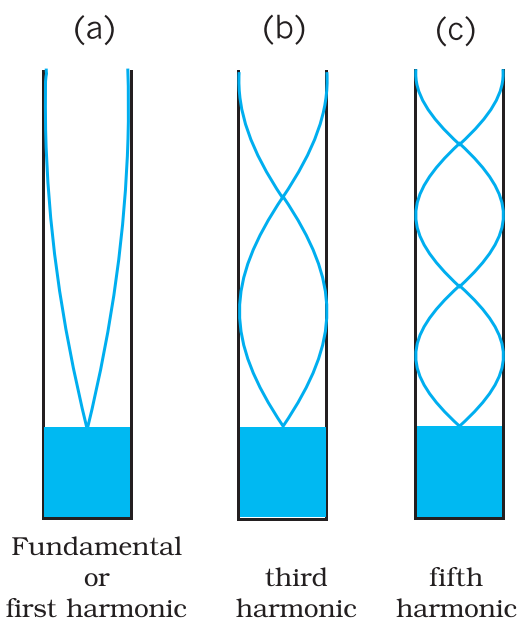
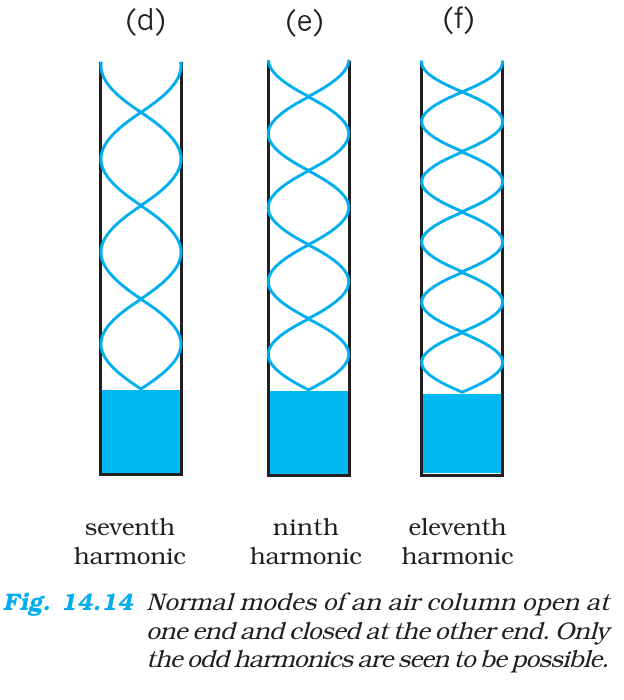
Now if one end of the pipe is closed (Fig. 14.15), it follows from Eq. (14.15) that the fundamental frequency is
$
v_I=\frac{v}{\lambda_1}=\frac{v}{4 L} \text { (pipe closed at one end) }
$
and only the odd numbered harmonics are present :
$
v_3=\frac{3 v}{4 L}, v_5=\frac{5 v}{4 L} \text {, and so on. }
$
For $L=30 cm$ and $v=330 m s ^{-1}$, the fundamental frequency of the pipe closed at one end is $275 Hz$ and the source frequency corresponds to its fourth harmonic. Since this harmonic is not a possible mode, no resonance will be observed with the source, the moment one end is closed.
View full question & answer
5 Marks Questions - Page 3 - Physics STD 11 Science Questions - Vidyadip