Question 515 Marks
A steel rod $100cm$ long is clamped at its middle. The fundamental frequency of longitudinal vibrations of the rod are given to be $2.53$ kHz. What is the speed of sound in steel?
AnswerLength of the steel rod, $l = 100cm = 1m$ Fundamental frequency of vibration, $ν = 2.53 kHz = 2.53 \times 10^3Hz$ When the rod is plucked at its middle, an antinode (A) is formed at its centre, and nodes (N) are formed at its two ends, as shown in the given figure.
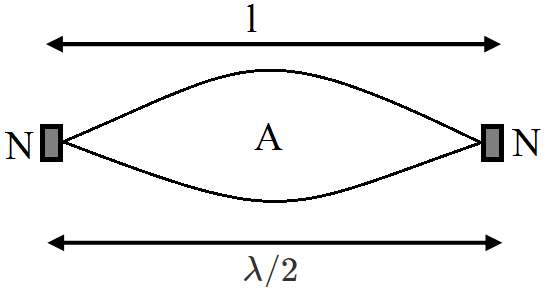
The distance between two successive nodes is $\frac{\lambda}{2} .$
$\therefore\ \text{I}=\frac{\lambda}{2}$ $\lambda=2\text{l}=2\times1=2\text{m}$
The speed of sound in steel is given by the relation: $\text{v}=\text{v}\lambda$
$=5.06\times10^3\text{m/s}$ $=2.53\times10^3\times2$ $=5.06\text{km/s}$ View full question & answer→Question 525 Marks
Write Newton's formula for the speed of sound in air. What was wrong with this formula? What correction was made by Laplace in this formula?
AnswerAccording to Newton, as wave propagates through a medium, temperature remain constant thus wave propagation is an isothermal process, satisfying PV = Constant. Differentiating, we get
PDV + VAP = 0
$\Rightarrow \text{P}=-\frac{(\text{dP})}{\Big(\frac{\text{dV}}{\text{V}}\Big)}=\beta$ (Bulk modulas)
Since velocity of sound waves is $\text{v}=\sqrt{\frac{\beta}{\rho}}$
We have, $\text{v}=\sqrt{\frac{\text{P}}{\rho}}$
According to Laplace, temperature can change, but heat energy change should be zero and so wave propagation is adiabatic. Hence Laplace corrected it as,
$\text{v}=\sqrt{\frac{\gamma\text{P}}{\rho}},$ where $\gamma$ is the ratio of molar specific heat capacities at constant pressure and volume, i.e. $\gamma =\frac{\text{C}_\text{p}}{\text{C}_\text{v}}.$
View full question & answer→Question 535 Marks
In a laboratory experiment (room temperature being $15°C$), the wavelength of a note of sound of frequency $500Hz$ is found to be $0.68m$. If the density of air at STP is $1.29kg m^{-3}$ calculate the ratio of the specific heat of air.
Answer$\nu_1 \text{ at }15^\circ\text{C}=\text{v}\lambda=500\times0.68=340\text{ms}^{-1}$
Velocity $(\nu'_\text{S})$ at $0^\circ\text{C}$
$=340\times\sqrt{\frac{273}{273+15}}=331\text{ms}^{-1}$
As STP, $\rho_0=1.27\text{kg m}^{-3}$
and $\text{P}_0=0.76\times136\times10^3\times9.8\text{Nm}^{-2}$
Since $\nu_0\sqrt{\frac{\gamma\text{P}_0}{\rho_0}},\gamma=\frac{\text{C}_\text{p}}{\text{C}_\text{v}}$
$\gamma=\nu^2_0\frac{\rho_0}{\text{P}_0}$
$=\frac{331\times331\times1.27}{0.76\times13.6\times10^3\times9.8}=1.37$
View full question & answer→Question 545 Marks
Calculate the velocity of transverse waves in a copper wire $1mm^2$ in cross section, under the tension produced by $1kg$ wt. The relative density of copper = $8.93$.
Answer$\nu=?, \text{a}=1\text{mm}^2=10^{-2}\text{cm}^2,$
$\rho=8.93\text{g/cm}^3$
$\text{T}=1\text{kg wt.}=9.8\text{N}$
$=9.8\times10^5\text{dyne}$
Mass of unit length of wire,
$\mu=\text{a}\times1\times\rho=10^{-22}\times8.93\text{g/cm}$
As $\nu=\sqrt{\frac{\text{T}}{\mu}}$
$\therefore \nu=\sqrt{\frac{9.8\times10^5}{8.93\times10^{-2}}}$
$=3.312\times10^3\text{cm/s}$
$=33.12\text{m/s}$
View full question & answer→Question 555 Marks
A sitar wire is replaced by another wire of same length and material but of three times the earlier radius. If the tension in the wire remains the same, by what factor will the frequency change?
AnswerThewire is stretched both and so frequency of stretched wure is $\text{v}=\frac{\text{n}}{2\text{L}}\sqrt{\frac{\text{T}}{\text{m}}}$
As number of harmonic n, lengthL and tensuin (T) are kept same in both cases.
$\therefore\text{v}\propto\frac{1}{\sqrt{\text{m}}}$
$\frac{\text{v}_1}{\text{v}_2}=\frac{\sqrt{\text{m}_2}}{\sqrt{\text{m}_1}}\ ...(\text{i})$
Mass per unit length $=\frac{\text{mass of wire}}{\text{length}}=\frac{(\pi\text{r}^2\text{l})\rho}{\text{l}}$
$\text{m}=\pi\text{r}^2\rho$
As matterial of wire is same.
$\frac{\text{m}_2}{\text{m}_1}=\frac{\pi\text{r}_2^2\rho}{\pi\text{r}^2_1\rho}=\frac{(3\text{r})^2}{\text{r}^2}=\frac{9}{1}$
$\therefore\frac{\text{v}_1}{\text{v}_2}==\sqrt{\frac{9}{1}}=\frac{3}{1}$
$\therefore\text{v}_2=\frac{1}{3}\text{v}_1$
So the frequency of sitar reduced by $\frac{1}{2}$ of previous value.
View full question & answer→Question 565 Marks
A sonometer wire is vibrating in resonance with a tuning fork. Keeping the tension applied same, the length of the wire is doubled. Under what conditions would the tuning fork still be is resonance with the wire?
AnswerWire of sonometer is twice the length which it vibrates in its second harmonic. Thus, if the tuning fork resonates at L, it will resonate at 2L. This can be explained as below:
The frequency of sonometer is given by
$\text{f}=\frac{\text{n}}{2\text{L}}\sqrt{\frac{\text{T}}{\mu}}=\frac{\text{nv}}{2\text{L}}$ (n = number of loops)
For a given sonometer velocity of wave will be constant. if after chaning the leggth of wire the tuing fork still be in resonance witrh the wire. then, $\frac{\text{n}}{\text{L}}=\text{constant}\Rightarrow\frac{\text{n}^2}{\text{L}^2}$
$\frac{\text{n}^1}{\text{L}^1}=\frac{\text{n}^2}{2\text{L}^2}\Rightarrow\text{n}_2=2\text{n}_1$
Hence, when the wire is doubled the number of loops also get doubled to produce the resonance. That is it resonates in second harmonic.
View full question & answer→Question 575 Marks
A tuning fork is in unison with a sonometer wire $73cm$ long. If $4$ beats are heard on shortening the wire by $5mm$, find the frequency of the fork.
Answer$l_1 = 73cm, n = 4,$
$l_2 = 73 - 0.5 = 72.5cm$
$\frac{\text{V}_2}{\text{V}_1}=\frac{\text{l}_1}{\text{l}_2}=\frac{73}{72.5},$
$\text{V}_=\frac{73\text{V}_1}{72.5}$
Alsio, $\text{n}=\text{V}_2-\text{V} _1$
$4=\frac{73}{72.5}\text{V}_1-\text{V}_1=\frac{0.5\text{V}_1}{72.5}$
$\text{V}_1=\frac{4\times72.5}{0.5}=580\text{Hz}$
View full question & answer→Question 585 Marks
Calculate the number of beats heard per second is there are three sources of sound of frequencies 400, 401 and 402 of equal intensity sounded together.
AnswerLet us consider the case of three disturbances each of amplitude a and frequencies (n - 1), and (n + 1) respectively. The resultant displacement is given by
$\text{y}=\text{a}\sin2\pi(\text{n}-1)\text{t}+\text{a}\sin2\pi\text{nt}\\+\text{a}\sin2\pi(\text{n}+1)\text{t}$
$=2\text{a}\sin2\pi\text{nt}\cos2\pi\text{t}+\text{a}\sin2\pi\text{nt}$
$=\text{a}(1+2\cos2\pi\text{t})\sin2\pi\text{nt}$
So the resultant amplitude is a $(1+2\cos2\pi\text{t})$
which is maximum when $\cos2\pi\text{t}=+1$
$\therefore 2\pi\text{t}=2\text{k}$ where $\text{k}=0,1,2,3....$
$\text{t}=0, 1, 2, 3....$
Thus the time interval between two consecutive maxima is one. This shows that the frequency of maxima is one.
Similarly, the amplitude is minimum when
$1+2\cos2\pi\text{t}=0$ or $\cos2\pi\text{t}=-\frac{1}{2}$
$2\pi\text{t}=2\text{k}\pi+\frac{2\pi}{3}$ (where k = 0, 1, 2, ....)
$\text{t}=\Big(\text{k}+\frac{1}{3}\Big)=\frac{1}{3},\frac{4}{3},\frac{7}{3},\frac{10}{3}$
Thus the minima occur after an interval of one second, i.e., the frequency of minima is also one. Hence, the frequency of beats is also one.
Thus, one beat is heard per second.
View full question & answer→Question 595 Marks
Find the velocity of source of sound, when the frequency appears to be:
- Double.
- Half, the original frequency to a stationary listener.
Answer
- v' = 2v.
It is possible is source is approaching the stationary listener i.e., $v_s$ is +
As $\text{v}'=\frac{v-v_\text{L}}{u-u_\text{s}}\text{v}$
$\therefore 2\text{v}=\frac{v}{v-v_\text{s}}\text{v}$
$2=\frac{v}{v-v_\text{s}}$
$2v-2v_\text{s}=v$
$2v_\text{s}=v$
$v_\text{s}=\frac{v}{2}$
Therefore, source should approach the listener with half the velocity of sound propagation.
- $\text{v}'=\frac{v}{2}$
It is possible if source is receding away from the stationary listener i.e., $v_\text{s}$ is negative and $v_\text{L}=0$
$\therefore \text{v}'=\frac{v}{v+v_\text{s}}\text{v}$
$\frac{v}{2}=\frac{v}{v+v_\text{s}}\text{v}$
$\frac{1}{2}=\frac{v}{v+v_\text{s}}$
$v+v_\text{s}=2v$
$v_\text{s}=v$
Therefore, source should recede away from the listener with the velocity of sound propagation. View full question & answer→Question 605 Marks
In the given progressive wave $\text{y}=5\sin(100\pi\text{t+0.4x})$ where y and x are in m, t is in s. What is the:
Particle velocity amplitude.
AnswerStandard form of progressive wave travelling in $+\text{x}$ direction (kx and $\omega\text{}t$ have opposite sign is given) Eqn. is $\text{y}=\text{a}\sin(\omega\text{t}-\text{kx}+\phi)$ $\text{y}=5\sin(100\pi\text{t}-0.4\pi\text{t}+0)$Particle (medium) velocity in the direction of amplitude at a distance $\text{x}$ from source.
$\text{y}=5\sin(100\pi\text{t}-0.4\pi\text{x})$ $\frac{\text{dy}}{\text{dt}}=5\times100\pi\cos(100\pi\text{t}-0.4\pi\text{x})$For maximum velocity of particle is at its mean position
$\cos(100\pi\text{t}-0.4\pi\text{x})=1$ $\Rightarrow100\pi\text{t}-0.4\pi\text{t=0}$ $\therefore\Big(\frac{\text{dy}}{\text{dt}}\Big)_\text{max}=5\times100\pi\times1$$\text{v}_\text{max}$ of medium particle $=500\pi\text{m/ s}$
View full question & answer→Question 615 Marks
Find at what temperature the velocity of sound is air will be $1\frac{1}{2}$ times the velocity at 11°C.
AnswerSuppose velocity of sound in air at t°C $1\frac{1}{2}$ times the velocity at 11°C.
i.e., $v_\text{t}=\frac{3}{2}v_{11}$
As $v_\text{t}=v_0\sqrt{\frac{273+\text{t}}{273}}$
$\therefore$ from (i), $v_0=\sqrt{\frac{273+\text{t}}{273}}=\frac{3}{2}v_{11}$
$v_0=\sqrt{\frac{273+\text{t}}{273}}=\frac{3}{2}v_0\frac{284}{273}$
Squaring both sides, we get
$\sqrt{\frac{273+\text{t}}{273}}=\frac{9}{4}\times\frac{284}{273}$
$1092+4\text{t}=2556$
$4\text{t}=2556-1092=1464$
$\text{t}=\frac{1464}{4}=366^\circ\text{C}$
View full question & answer→Question 625 Marks
Two sitar strings A and B playing the note ‘Ga’ are slightly out of tune and produce beats of frequency $6Hz$. The tension in the string A is slightly reduced and the beat frequency is found to reduce to $3Hz$. If the original frequency of A is $324Hz$, what is the frequency of B?
AnswerFrequency of string $A, f_A=324 \mathrm{~Hz}$
Frequency of string $B=f_B$
Beat's frequency, $n=6 \mathrm{~Hz}$
Beat's frequency is given as:
$=\left|f_A+-f_B\right|$
$6=324+-f_B$
$f_B=330 H z \text { or } 318 H z$
Frequency decreases with a decrease in the tension in a string. This is because frequency is irectly proportional to the square root of tension. It is given as:
$\mathrm{v} \propto \text { Underroot } T$
Hence, the beat frequency cannot be 330 Hz
$\therefore \mathrm{f}_{\mathrm{B}}=318 \mathrm{~Hz}$
View full question & answer→Question 635 Marks
A wave $\text{Y} = \text{A}\sin(\omega\text{t} - \text{kx})$ allowed through a string gets reflected from a rigid support and forms stationary wave. Derive the expression for the standing wave.
AnswerGiven wave: $\text{Y}_\text{i}=\text{A}\sin(\omega\text{t}-\text{Kx})$
Reflected wave:
$\text{Y}_\text{r}=\text{A}\sin (\omega\text{t}+\text{Kx}+\pi)$
$=-\text{A}\sin(\omega\text{t}+\text{Kx})$

Applying superposition principle,
$\text{y}=\text{Y}_\text{i}+\text{Y}_\text{r}$
$=\text{A}\sin(\omega\text{t}-\text{Kx})-\text{A}\sin(\omega\text{t}+\text{Kx})$
$\text{y}=2\text{A}\sin\text{Kx}\cos\omega\text{t}$
Since amplitude $2\text{A}\sin\text{Kx}$ varies with position, it represents a standing wave. View full question & answer→Question 645 Marks
A metre-long tube open at one end, with a movable piston at the other end, shows resonance with a fixed frequency source (a tuning fork of frequency 340Hz) when the tube length is 25.5cm or 79.3cm. Estimate the speed of sound in air at the temperature of the experiment. The edge effects may be neglected.
AnswerFrequency of the turning fork, ν = 340Hz Since the given pipe is attached with a piston at one end, it will behave as a pipe with one end closed and the other end open, as shown in the given figure.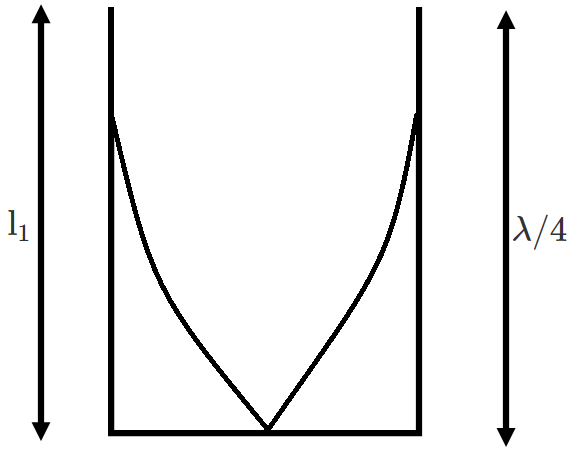
Such a system produces odd harmonics. The fundamental note in a closed pipe is given by the relation: $\text{l}_1=\frac{\pi}{4}$ where, length of pipe, $\text{l}_1=25.5\text{cm}=0.255\text{m}$ $\therefore\ \lambda=4\text{l}_1=4\times0.255=1.02\text{m}$ The speed of the sound is given by the relation: $\text{v}=\text{v}\lambda=340\times1.02=346.8\text{m/s}$ View full question & answer→Question 655 Marks
A narrow sound pulse (for example, a short pip by a whistle) is sent across a medium.
(a) Does the pulse have a definite,
- frequency,
- wavelength,
- speed of propagation?
(b) If the pulse rate is 1 after every 20s, (that is the whistle is blown for a split of second after every 20s), is the frequency of the note produced by the whistle equal to 1/20 or 0.05Hz?
Answer(a)
- No
- No
- Yes
(b) No
Explanation:
- The narrow sound pulse does not have a fixed wavelength or frequency. However, the speed of the sound pulse remains the same, which is equal to the speed of sound in that medium.
- The short pip produced after every 20s does not mean that the frequency of the whistle is 1/20 or 0.05Hz. It means that 0.05Hz is the frequency of the repetition of the pip of the whistle.
View full question & answer→Question 665 Marks
What are beats? Prove that the number of beats produced per second by the two sound sources is equal to the difference between their frequencies.
AnswerBeats: The phenomenon of alternate variation in the intensity of sound with time at a particular position, when two sound waves of nearly same frequencies and amplitudes superimpose on each other is called beats. If $v_1$ and $v_2$ are the two frequencies, $n = |v_1 - v_2|$, Beats are heard only when $|v_1 - v_2| < 10$, since the sound persist in our ear for $\frac{1}{10}\text{th}$ of a second.
Let us consider two wave trains of equal amplitude ‘A’ and slightly different frequencies $v_1$ and $v_2$ travelling in a medium in the same direction. Displacement of waves are $\text{y}_1=\text{A}\sin2\pi\text{v}_1\text{t}$ and $\text{y}_2=\text{A}\sin2\pi\text{v}_2\text{t},$ on superposition, resultant displacement of waves are:
$\text{y}=\text{y}_1+\text{y}_2=\text{A}\sin2\pi\text{v}_1\text{t}+\text{A}\sin2\pi\text{v}_2\text{t}$
$=\text{A}[\sin2\pi\text{v}_1\text{t}+\sin2\pi\text{v}_2\text{t}]$
$=2\text{A}\cos2\pi\Big(\frac{\text{v}_1-\text{v}_2}{2}\Big)\text{t}\sin2\pi\Big(\frac{\text{v}_1+\text{v}_2}{2}\Big)$
$\Big[\text{Using}\sin\text{A}+\sin\text{B}=2 \cos\frac{\text{A}-\text{B}}{2}\sin\frac{\text{A}+\text{B}}{2}\Big]$
Amplitude $=2\text{A}\cos2\pi\Big(\frac{\text{v}_1\text{v}_2}{2}\Big)\text{t}$ becomes maximum,
when $2\pi\text{t}\Big(\frac{\text{v}_1-\text{v}_2}{2}\Big)=0,\pi,2\pi,...=\text{N}\pi$
i.e. $\text{v}_1\text{v}_2=\frac{2\text{N}\pi}{2\pi\text{t}}=\frac{\text{N}}{\text{t}}=\text{n}$
Where n is the beat frequency – the number of times the maxima and minima is repeated in one second. Thus number of beats produced by two superimposing waves is equal to difference of their frequency.
View full question & answer→Question 675 Marks
For the harmonic travelling wave $\text{y}=2\cos2\pi(10\text{t}-0.0080\text{x}+3.5)$ where x and y are in cm and t is second. What is the phase difference between the oscillatory motion at two points separated by a distance of:
What is the phase difference between the oscillation of a particle located at x = 100cm at t = T and t = 5s?
Answer$\text{y}=2\cos2\pi(10\text{t}-0.0080\text{x+3.5})$ $\text{y}=2\cos(20\pi\text{t}-0.0016\pi\text{x}+7.0\pi)$ Wave is propagated in $+\text{x}$ direction because $\omega\text{t}$ and kx are in with opposite sign standard equation $\text{y}=\text{a}\cos(\omega\text{t}-\text{kx}+\phi)$ $\text{a}=2\ \omega=20\pi,\ \text{k}=0.016\pi$ and $\phi=7\pi$ $\text{T}=\frac{2\pi}{\omega}=\frac{2pi}{20\pi}=\frac{1}{10}\sec$ $\text{x}=100\text{cm}$ At $\text{x}=100,\ \text{t}=\text{T}$ $\phi_120\pi\text{T}-0.016\pi(100)+7\pi=20\pi\times\frac{1}{10}-1.6\pi+7\pi=7.4\pi$At $\text{t}=5\text{s}$
$\phi_120\pi\text{(5)}-0.016\pi(100)+7\pi=100\pi-1.6\pi+7\pi=105.4\pi$
$\phi_2-\phi_1=105.4\pi-7.4\pi=98\pi\ \text{radian}$
View full question & answer→Question 685 Marks
The transverse displacement of a string (clamped at its both ends) is given by
$\text{y}(\text{x, t})=0.06\sin\Big(\frac{2\pi}{3}\text{x}\Big)\cos(120\pi\text{ t})$
where x and y are in m and t in s. The length of the string is $1.5m$ and its mass is $3.0 \times 10^{–2}kg$.
Answer the following:
Determine the tension in the string.
AnswerThe velocity of a transverse wave travelling in a string is given by the relation:
$\text{v}=\sqrt{\frac{\text{T}}{\mu}}\ \dots(\text{i})$
Where,
Velocity of the transverse wave, v = 180m/ s
Mass of the string, m = $3.0 \times 10^{-2}kg$
Length of the string, l = 1.5m
Mass per unit length of the string, $\mu=\frac{\text{m}}{\text{l}}$
$=\frac{3.0}{1.5}\times10^{-2}$
$=2\times10^{-2}\text{kg m}^{-1}$
Tension in the string = T
From equation (i), tension can be obtained as:
$\text{T}=\text{v}^2\mu$
$=(180)^2\times2\times10^{-2}$
$=648\text{N}$
View full question & answer→Question 695 Marks
A stone hangs in air from one end of a wire which is stretched over a sonometer. The wire is in unison with a certain tuning fork when the bridges of the sonometer are 45cm apart. Now the stone hangs immersed in water at 4°C and the distance between the bridges has to be altered by 9cm to re-establish unison of the wire with the same fork. Calculate the density of the stone.
Answer$\text{T}_1=\text{mg}$
$\text{T}_2=\text{mg}-\frac{\text{m}}{\rho}\text{g}$
Since the tension has decreased, the length should also be decreased to re-establish unison. Therefore as,
1 = 45cm,
12 = 45 - 9 = 36cm
Since in both the cases, the wire resonates with the same tuning fork, the frequency of the wire in both cases should be equal, i.e.,
$\frac{1}{2\text{l}_1}\sqrt{\frac{\text{T}_1}{\mu}}=\frac{1}{2\text{l}_2}\sqrt{\frac{\text{T}_2}{\mu}}$
$\frac{\text{T}_1}{\text{T}_2}=\Big(\frac{\text{l}_1}{\text{l}_2}\Big)^2$
$\frac{\text{mg}}{\text{mg}-\frac{\text{mg}}{\rho}}=\Big(\frac{45}{36}\Big)^2=\frac{25}{16}$
$\rho=\frac{25}{9}=2.778\text{g/cc}.$
View full question & answer→Question 705 Marks
A bat is flitting about in a cave, navigating via ultrasonic beeps. Assume that the sound emission frequency of the bat is $40 kHz$. During one fast swoop directly toward a flat wall surface, the bat is moving at $0.03$ times the speed of sound in air. What frequency does the bat hear reflected off the wall?
AnswerUltrasonic beep frequency emitted by the bat, ν = 40 kHz
Velocity of the bat, $v_b = 0.03v$
where, v = velocity of sound in air
The apparent frequency of the sound striking the wall is given as:
$\text{v}'=\Big(\frac{\text{v}}{\text{v}-\text{v}_\text{b}}\Big)\text{v}$
$=\Big(\frac{\text{v}}{\text{v}-0.03\text{v}}\Big)\times40$
$=\frac{40}{0.97}\text{kHz}$
This frequency is refiected by the stationary wall (vs) toward the bat.
The frequency (v'') of the received sound is given by the relation:
$\text{v}''=\Big(\frac{\text{v}+\text{v}_0}{\text{v}}\Big)\text{v}'$
$=\Big(\frac{\text{v}+0.03\text{v}}{\text{v}}\Big)\times\frac{40}{0.97}$
$=\frac{1.03\times40}{0.97}=42.47\text{kHz}$
View full question & answer→Question 715 Marks
Write Newton's formula for the speed of sound in air. Discuss the correction made by Laplace in this formula.
AnswerAccording to Newton, as wave propagates through a medium, temperature is a constant and so propagation is an isothermal process, satisfying PV = Constant.
Differentiating, we get.
$\text{PdV}+\text{VdP}=0$
$\Rightarrow \text{P}=-\frac{(\text{dP})}{\Big(\frac{\text{dV}}{V}\Big)}=\text{B}$
Since velocity of sound waves is $\text{v}=\sqrt{\frac{\text{B}}{\rho}}$
we have, $\text{v}=\sqrt{\frac{\text{P}}{\rho}}$
According to Laplace sound wae propagation in air is an adiabatic process in which temperature can change, but heat energy change should be zero. Hence Laplace corrected it as,
$\text{v}=\sqrt{\frac{\gamma\text{P}}{\rho}},$
where $\gamma$ is the ratio of molar-specific heat capacities at constant pressure and volume (i.e.,) $\gamma =\frac{\text{C}_\text{p}}{\text{C}_\text{v}}.$
View full question & answer→Question 725 Marks
The wave pattern on a stretched string is shown in Interpret what kind of wave this is and find its wavelength.
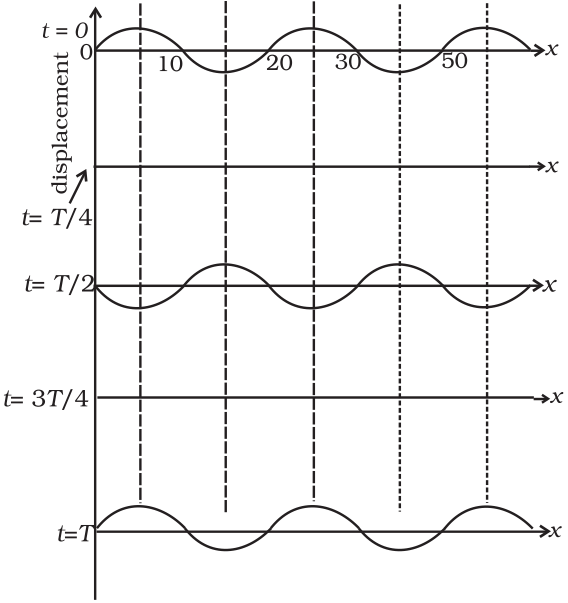
AnswerThe displacement of medium particlles at distance 10, 20, 30, 40, and 50cm are always rest which is the property of nodes in stationary wave.
$\text{AT}\ \text{t}=\frac{\text{T}}{4}$ and $\frac{\text{3T}}{4}$ all particle are at rest wgich is in stationary wave when the particle crossrs its mean position.
so thet praph of wave shos stationaty wave.
The wave at $\text{x}=10,\ 20,\ 30,\ 40\text{cm}$ there are nodes and distance between successive nodes is $\frac{\lambda}{2}$
$\therefore\frac{\lambda}{2}=(30-20)$ or $\lambda=20\text{cm.}$
View full question & answer→Question 735 Marks
For the wave on a string described in Exercise 15.11, do all the points on the string oscillate with the same,
- Frequency,
- Phase,
- Amplitude?
AnswerFor the wave on the string described in questions we have seen that l = 1.5m and $\lambda=3\text{m}.$ So, it is clear that $\lambda=\frac{\lambda}{2}$ and for a string clamped at both ends, it is possible only when both ends behave as nodes and there is only one antinode in between i.e., whole string is vibrating in one segment only.
- Yes, all the sring particles, except nodes, vibrate with the same frequency v = 60Hz.
- As all string particles lie in one segment, all of them are in same phase.
- Amplitude varies from particle to particle. At antinode, amplitude = 2A = 0.06m. It gradually falls on going towards nodes and at nodes, and at nodes, it is zero.
View full question & answer→Question 745 Marks
Prove that if a, and a, are the amplitudes of two interfering waves $\phi$ and is their phase difference, the amplitude of the resultant wave is given by,
$\text{a}^2=\text{a}^2_1+\text{a}^2_2+2\text{a}_1\text{a}_2\cos\phi$
AnswerLet $\text{y}_1=\text{a}_1\cos\ \omega\text{t},$
$\text{y}_2=\text{a}_52\cos\ (\omega\text{t}+\phi)$
be the two displacements.
On superposition,
$\text{y}=\text{y}_1+\text{y}_2$
$=\text{a}_1\cos\ \omega\text{t}+\text{a}_2\cos(\omega\text{t}+\phi)$
$=\text{a}_1\cos\omega\text{t}+\text{a}_2\cos\ \omega\text{t}\cos\phi$
$=-\text{a}_2\sin\omega\text{t}\sin\phi$
$=-(\text{a}_2\sin \phi)\sin\omega\text{t}\dots(1)$
$\text{put}\text{ a}_1+\text{a}_2\cos\phi=\text{a}\cos\theta\dots(2)$
$\text{a}_2\sin\phi=\text{a}\sin\theta\dots(3)$
Squaring and adding (2) and (3), we have
$\text{y}=\text{a}\cos\theta\cos\omega\text{t}-\text{a}\sin\theta\sin\omega\text{t}$
$=\text{a}\cos(\omega\text{t}+\theta)$
$\therefore\text{y}=\Big(\text{a}^2_1+\text{a}^2_2+2\text{a}_1\text{a}_2\cos\phi\Big)^{\frac{1}{2}}\cos(\omega\text{t}+\theta)$
where $\theta=\tan^{-1}\Big(\frac{\text{a}_2\sin\phi}{\text{a}_1+\text{a}_2\cos\phi}\Big)$
View full question & answer→Question 755 Marks
The transverse displacement of a string (clamped at its both ends) is given by
$\text{y}(\text{x, t})=0.06\sin\Big(\frac{2\pi}{3}\text{x}\Big)\cos(120\pi\text{ t})$
where x and y are in m and t in s. The length of the string is $1.5m$ and its mass is $3.0 \times 10^{–2}kg$.
Answer the following:
Interpret the wave as a superposition of two waves travelling in opposite directions. What is the wavelength, frequency, and speed of each wave?
AnswerA wave travelling along the positive x-direction is given as: $\text{y}_1=\text{a}\sin(\omega\text{t}-\text{kx})$The wave travelling along the negative x-direction is given as:
$\text{y}_2=\text{a}\sin(\omega\text{t}-\text{kx})$ The superposition of these two waves yields: $\text{y}=\text{y}_1+\text{y}_2=\text{a}\sin(\omega\text{t}-\text{kx})-\text{a}\sin(\omega\text{t}-\text{kx})$
$=\text{a}\sin(\omega\text{t})\cos(\text{kx})-\text{a}\sin(\text{kx})\cos(\omega\text{t})-\text{a}\sin(\omega\text{t})\cos(\text{kx})-\text{a}\sin(\text{kx})\cos(\omega\text{t})$
$=-2\text{a}\sin(\text{kx})\cos(\omega\text{t})$
$=-2\text{a}\sin\Big(\frac{2\pi}{\lambda}\text{x}\Big)\cos(2\pi\text{ vt})\ \dots(\text{i})$ The transverse displacement of the string is given as: $\text{y}(\text{x, t})=0.06\sin\Big(\frac{2\pi}{3}\text{x}\Big)\cos(120\pi\text{ t})\ \dots(\text{ii})$ Comparing equations (i) and (ii), we have: $\frac{2\pi}{\lambda}=\frac{2\pi}{3}$
$\therefore$ Wavelength, $\lambda=3\text{m}$ It is given that: $120\pi=2\pi\text{v}$ Frequency, $\text{v} = 60\text{Hz}$ Wave speed, $\text{v}=\text{v}\lambda$
$=60\times3=180\text{m/s}$
View full question & answer→Question 765 Marks
Give any three differences between progressive waves and stationary waves. A stationary wave is $\text{y}=12\sin300\text{t}\cos^2\text{x}.$ What is the distance between two nearest nodes?
Answer
|
S. No.
|
Progressive Wave
|
Stationary Wave
|
|
1.
|
All particles have same phase and amplitude.
|
Amplitude varies with position.
|
|
2.
|
Speed of motion is same.
|
Speed varies with position.
|
|
3.
|
Energy is transported.
|
Energy is not transported.
|
|
4.
|
Same change in pressure and density is with every point.
|
Pressure and density varies with point.
|
$\text{y}=12\sin300\text{t}\cos2\text{x}$
Comparing with equation of stationary wave
$\text{y}=2\text{A}\sin\omega\text{t}\cos\text{kx}$
$\text{k}=2$
Distance between two consecutive nodes $=\frac{\lambda}{2}$ Where $\lambda$ is wavelength
$\text{k}=\frac{2\pi}{\lambda}$
$\Rightarrow\frac{\pi}{\Big(\frac{\lambda}{2}\Big)}=2$
$\therefore \frac{\lambda}{2}=\frac{\pi}{2}$
So, the distance between two nearest nodes is $\frac{\pi}{2}.$ View full question & answer→Question 775 Marks
- What is beat phenomenon?
-
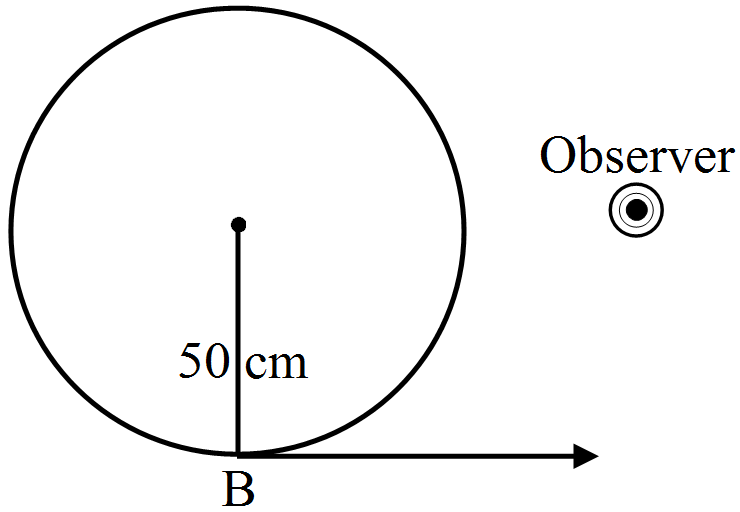
A whistle revolve in a circle with angular velocity of o =$20 rad s^{-1}$. If the frequency of the sound is $385Hz$ and speed is $340ms^{-1}$, than find the frequency heard by the observer when the whistle is at B.Answer
- Beat phenomenon: When two sound waves of nearly same frequencies and amplitudes travelling in a medium along the same direction, super impose on each other, the intensity of resultant sound at a particular position rises and falls alternatively with time.
This phenomenon of alternate variation in the intensity of sound with time at a particular position, when two sound waves of nearly same frequencies and amplitudes superimpose on each other is called beats.
-
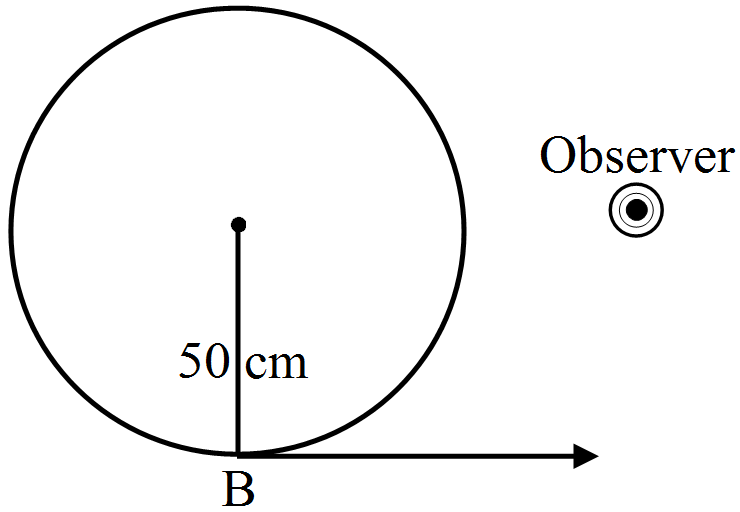
$W = 20 rad s^{-1}$
Frequency of sound $\gamma =385\text{Hz}$
$\nu=\text{Speed}=340\text{ms}^{-1}$
$\nu_\text{s}=\text{rw}=0.50\times20=10\text{m/s}$
Using formula,
$\gamma'=\frac{\text{v}}{\text{v}-\text{v}_\text{s}}\times\gamma$
$=\frac{340\times385}{340-10}=\frac{340\times285}{330}$
$=395\text{Hz}$
Hence, the frequency heard by an observer is 397Hz when the whistle is at B. View full question & answer→Question 785 Marks
What do you mean by interference of waves? Distinguish between constructive and destructive interference.
Standing waves are produced by the superposition of two waves
$\text{y}_1=0.05\sin(3\pi\text{t}-2\text{x})$ and $\text{y}_2=0.05\sin(3\pi\text{t}+2\text{x})$
where y and x are measured in metres and t in seconds. Find the amplitude of a particle at x = 0.5m.
AnswerInterference of waves is the phenomenon of redistribution of energy in space on account of superposition of two waves of same nature, same frequency and equal or comparable amplitudes and travelling in the given medium in the same direction.
Constructive interference takes place when the two superposing waves are in same phase i.e., crest of one wave (in transverse waves) coincides with crest of another wave and vice-versa. As a result, the resultant amplitude and hence intensity of the resultant wave is maximum. Thus, for constructive interference, the phase difference between the superposing waves $\Delta\phi=0$ or $2\text{n}\pi,$ where n is an integer i.e., n = 1, 2, 3.....
Destructive interference takes place when two superposing waves are in mutually opposite phase i.e., in superposing of two transverse waves crest of one wave exactly coincides with trough of another wave. As a result, the resultant amplitude and hence intensity of the resultant wave is minimum. For destructive interference, the phase difference $\Delta\phi=(2\text{n}-1)\pi,$ where n = 1, 2, 3....
Numerical:
The resultant displacement is given by
$\text{y}=\text{y}_1+\text{y}_2=0.05\{\sin(3\pi\text{t}-2\text{x})+\sin(3\pi\text{t}+2\text{x})\}$
Using trigonometric relation
$\sin(\alpha+\beta)+\sin(\alpha-\beta)=2\sin\alpha\cos\beta,$ we have
$\text{y}=0.1\cos2\text{x}\sin3\pi\text{t}$ or $\text{y}=\text{A}\sin3\pi\text{t}$
where A, the amplitude of standing waves, is
given by $\text{A}=0.1\cos2\text{x}$ with
$\text{x}=0.5\text{m}$
$\cos2\text{x}=\cos(2\times0.5\text{ rad})$
$=\cos(1\text{ rad})=\cos\Big(\frac{\pi}{3.142}\Big)=\cos57.3^\circ$
$=0.54$
Amplitude A at (x = 0.5) = 0.1 × 0.54
= 0.054m.
View full question & answer→Question 795 Marks
For the travelling harmonic wave, y = 2.0 cos 2π (10t - 0.0080x + 0.35), where x and y are in cm and t in s. What is the phase difference between oscillatory motion at two points separated by a distance of,
- $4\text{m}$
- $0.5\text{m}$
- $\frac{\lambda}{2}$
- $\frac{3\lambda}{4}$
Answer$\text{y}=2.0\cos[2\pi(10\text{t}-0.0080\text{x})+2\pi\times0.35]$ $\text{y}=2.0\cos\Big[2\pi\times0.0080\big(\frac{101\text{t}}{0.0080}-\text{x}\big)+0.7\pi\Big]$ Compare it with the standard equation of a travelling harmonic wave, $\text{y}=\text{r}\cos\Big[\frac{2\pi}{\lambda}\big(\text{V}_{\text{t}}-\text{x}\big)+\phi\Big]$we get, $\frac{2\pi}{\lambda}=2\pi\times0.0080$
phase difference$\phi=\frac{2\pi}{\lambda}\text{x}$
- When $\text{x}=4\text{m}=400\text{cm,}$
$\phi=6.4\pi\text{ rad.}$
- When $\text{x}=0.5\text{m}=50\text{cm}$
$\phi=2\pi\times0.0080\times50=0.8\pi\text{ rad.}$
- When $\text{x}=\frac{\lambda}{2}$
$\phi=\frac{2\pi}{\lambda}\times\frac{\lambda}{2}=\phi\text{ rad}$
- When $\text{x}=\frac{3\lambda}{4}$
$\phi=\frac{2\pi}{\lambda}\times\frac{3\lambda}{4}=\frac{3\pi}{52}\text{ rad}$ View full question & answer→Question 805 Marks
Given below are some functions of x and t to represent the displacement of an elastic wave.
$\text{y}=100\cos(100\pi\text{t+0.5x})$
Answer$\text{y}=4\sin\Big(5\text{x}-\frac{\text{t}}{2}\Big)+3\cos\Big(5\text{x}-\frac{\text{t}}{2}\Big)$
$\text{Let}4=\text{a}\cos\phi\ ...(\text{ii})$and $3=\text{a}\sin\phi\ ...(\text{iii})$
$\text{a}^2\cos^2\phi+\text{a}^2\sin^2\phi=4^2+3^2$ Squaring and adding (ii), (iii)
$\text{a}^2=25\text{K}\Rightarrow\text{a}=5$
Substituting (ii), (iii) in (i)
$\text{y}=\text{a}\cos\phi\sin\Big(5\text{x}-\frac{\text{t}}{2}\Big)+\text{a}\sin\phi\cos\Big(5\text{x}-\frac{\text{t}}{2}\Big)$
$\text{y}=\text{a}\sin\Big(5\text{x}-\frac{\text{t}}{2}+\phi\Big)$
$\text{y}=\text{5}\sin\Big(5\text{x}-\frac{\text{t}}{2}+\phi\Big)$
Which represents the progressive wave in $+\text{x}$ direction as the sign of Kx (or5x) and $\omega\text{t}\Big(\frac{1}{2}\text{t}\Big)$ are opposite so it travels in $+\text{x}$ direction. So (d) (ii)
View full question & answer→Question 815 Marks
Explain how stationary waves are formed in open and closed pipes. Compare the first three harmonics produced in them.
AnswerStationary or Standing Waves: Formed by two waves moving in opposite directions interacting. They may have equal or unequal amplitudes and generally equal frequencies are $\text{Y}=\pm2\text{A}\sin\text{kx}\cos\omega\text{t}$ refers to a standing wave, where nodes and antinodes are alternatively formed with a separation $\frac{\lambda}{2}.$ In closed pipes, there will be a node at the closed end and antinode at open end while both ends will be antinodes in an open pipe. The frequency in them are given by: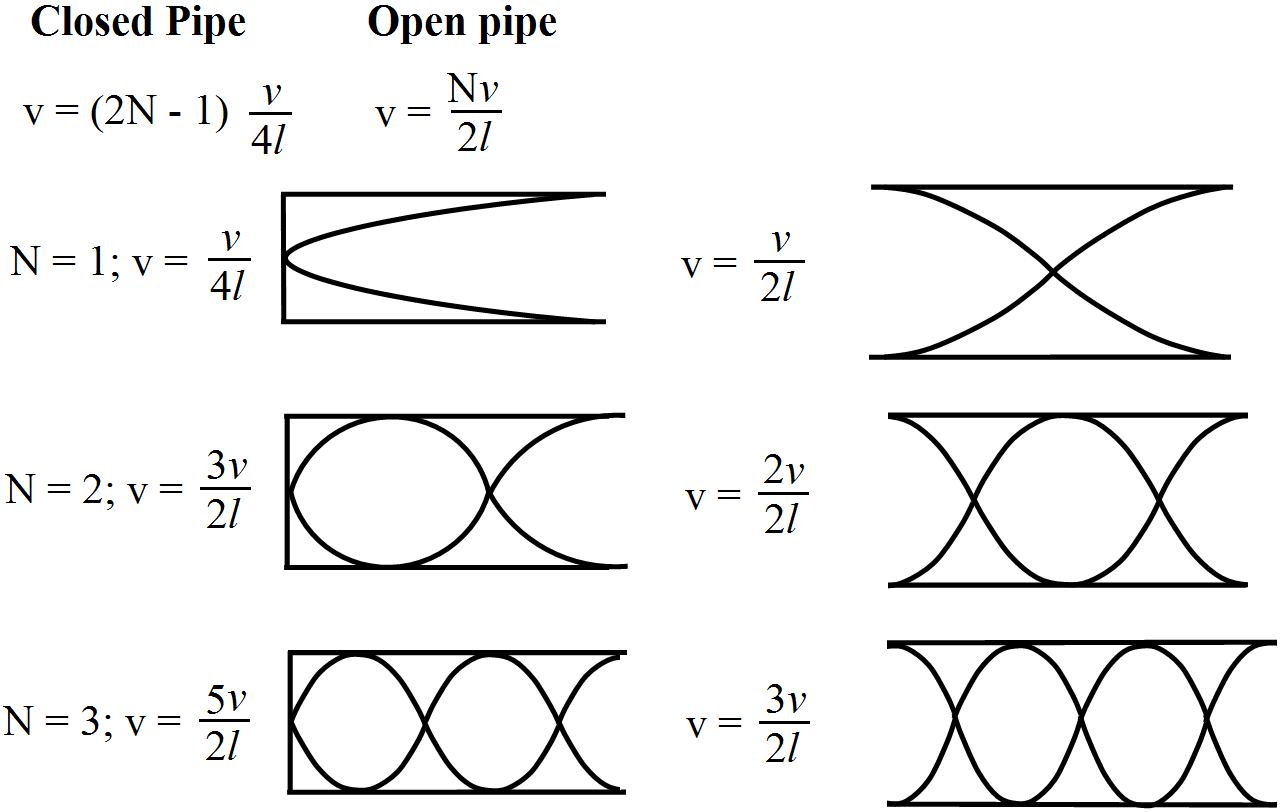
This type of pattern is being formed. On observation, one can conclude that only odd harmonics are available in a closed pipe, while all harmonics are available in an open pipe. View full question & answer→Question 825 Marks
A metallic rod of length $1m$ is rigidly clamped at its midpoint. Longitudinal stationary waves are set up in the rod in such a way that there are two nodes on either side of the midpoint. The amplitude of an antinode is $2 \times 10^{-6}m$. Write the equation of motion at a point $2cm$ from the midpoint and those of the constituent waves in the rod. (Young's modulus = $2 \times 10^{11}Nm^{-2}$ and density = $8000kg m^{-3}$)
AnswerThe equation of standing wave can be written as
$\text{y}=1\text{A}\sin\text{kx}\cos\omega\text{t}$
where $\text{k}=\frac{2\pi}{\lambda}$ and $\omega=\frac{2\pi\text{V}}{\lambda}.$
The standing wave is obtained by adding the equation of two identical progressive waves travelling in opposite directions
$\text{y}_1=\text{A}\sin(\text{kx}-\omega\text{t});$
$\text{y}_2=\text{A}\sin(\text{kx}+\omega\text{t})$
In the present problem the length L of the rod = 1 metre.
i.e., $\text{}=\frac{5\lambda}{2}$ or $\frac{2}{5}\text{ metre}.$

Velocity of longitudinal wave is given by
$\text{V}=\sqrt{\frac{\text{Y}}{\rho}}=\sqrt{\frac{2\times10^{11}}{8000}}$
$=5\times10^3\text{ms}^{-1}$
$\text{k}=\frac{2\pi}{\lambda}=\frac{2\pi}{\frac{2}{5}}=5\pi\text{ metre}^{-1}$
$\omega=\frac{2\pi\text{V}}{\lambda}$
$=\frac{2\pi\times5\times10^3}{\frac{2}{5}}=(25\times10^3\pi)\text{s}^{-1}$
Hence equation of standing wave is
$\text{y}=(2\times10^{-6})\sin5\pi\text{x}\cos25\times10^3\pi\text{t}$
Equations of component waves are
$\text{y}_1=(1\times10^{-6})\sin(5\pi\text{x}-25\times10^3\pi\text{t})$
$\text{y}_2=(1\times10^{-6})\sin(5\pi\text{x}+25\times10^3\pi\text{t})$ View full question & answer→Question 835 Marks
Derive an expression for nth mode of vibration in case of a closed end organ pipe. Hence, give the value of $V_1 : V_3: V_5$.
AnswerDisplacement at position x and time t in incident wave,
$\text{y}_1=\text{r}\sin\frac{2\pi}{\lambda}(\text{vt}+\text{x})$
Wave reflected at closed end of pipe suffers a phase reversal of $\pi.$
$\therefore$ For reflected wave $\text{y}_2=\text{r}\sin\Big[\frac{2\pi}{\lambda}(\text{vt}-\text{x})+\pi\Big]$
$=-\text{r}\sin\frac{2\pi}{\lambda}(\text{vt}-\text{x})$
According to superposition principle,
$\text{y}=\text{y}_1+\text{y}_2$
$\text{y}=\text{r}$
$\Big[\sin\frac{2\pi}{\lambda}(\text{vt}+\text{x})-\sin\frac{2\pi}{\lambda}(\text{vt}-\text{x})\Big]$
$\text{y}=2\text{r}\cos\frac{2\pi}{\lambda}\text{vt}.\sin\frac{2\pi}{\lambda}\text{x}.$
At closed end of pipe x = 0
$\therefore \sin \frac{2\pi}{\lambda}\text{x}=\sin \theta=0$
y = 0, i.e., a node is formed.
At the open end of the pipe of length L,X = L and antinode is to be formed, i.e., y = max
$\text{y}=2\text{r}\cos\frac{2\pi}{\lambda}\text{vt}.\sin\frac{2\pi}{\lambda}\text{L}$
y will be max, when
$\sin \frac{2\pi\text{L}}{\lambda}=\text{max}= \pm1$
$=\sin(2\text{n}-1)\frac{\pi}{2}$
Where n = 1, 2, 3,....
$\frac{2\pi\text{L}}{\lambda}=(2\text{n}-1)\frac{\pi}{2}$
$\lambda=\frac{4\text{L}}{(2\text{n}-1)}$
- For first normal mode of vibration,
Let $\lambda_1=$ wavelength corresponding tp n = 1
$\lambda_1=\frac{4\text{L}}{(2\times1-1)}=4\text{L}$
$\text{L}=\frac{\lambda_1}{4}$
Frequency, $\text{v}_1\frac{\text{v}}{\lambda_1}=\frac{\text{v}}{4\text{L}}$
$\text{v}_1=\frac{\text{v}}{4\text{L}}$ fundametal frequency
For second normal mode of vibration,
$\lambda_2=$ wavelength of standing waves corresponding to n = 2
$\lambda_2=\frac{4\text{L}}{2\times2-1}=\frac{4\text{L}}{3}$
$\text{v}_2=\frac{\text{v}}{\lambda_2}=\frac{\text{v}}{\frac{4\text{L}}{3}}$
$=\frac{3\text{v}}{4\text{L}}=3\text{v}_1$
For third normal mode of vibration.
$\lambda_3=$ wavelength of standing waves corresponding to n = 3
$\lambda_3=\frac{4\text{L}}{2\times3-1}=\frac{4\text{L}}{5}$
$\text{v}_3=\frac{\text{v}}{\lambda_3}=\frac{\text{v}}{\frac{4\text{L}}{5}}=5\frac{\text{v}}{4\text{L}}$
$\text{v}_3=5\text{v}_1$ fifth harmonic
In genetal, $\text{v}_\text{n}=\frac{(2\text{n}-1)\text{v}}{4\text{L}}=(2\text{n}-1)\text{v}_1$
$\therefore$ ratio of frequencies of harmonics is 1 : 3 : 5 : 7. View full question & answer→Question 845 Marks
- What are beats? Name the basic phenomenon due to which beats are produced.
- Two sources of sound are producing waves of frequency $n_1$ and $n_2$, where $(n_1 - n_2)$ is small, show mathematically that the beat frequency is $(n_1 - n_2)$.
Answer
- Beats: The waxing and waning of sound due to interaction between two slightly different frequencies. If y, and v, are the two frequencies $v_b = |v_1 - v_2|$.
Beats are heard only when $|v_1 - v_2l< 10$, since the sound persist in our ears for $\frac{1}{10}\text{th}$ of a second.
- When n, and n, are two frequencies represented by $\text{y}_1=\text{A}\sin2\pi\text{n}_1\text{t}$ and $\text{y}_2=\text{A}\sin2\pi\text{n}_2\text{t},$ we get on superposition,
$\text{y}=\text{y}_1+\text{y}_2$
$=2\text{A}\cos\pi\Big(\frac{\text{n}_1-\text{n}_2}{2}\Big)\text{t}\sin2\pi\Big(\frac{\text{n}_1\text{n}_2}+{2}\Big)\text{t}$
Amplitude $=2\text{A}\cos2\pi\Big(\frac{\text{n}_1-\text{n}_2}{2}\Big)\text{t}$ becomes maximum, when $2\pi\text{t}\Big(\frac{\text{n}_1-\text{n}_2}{2}\Big)=0,2\pi...\text{N}\pi\text{ i.e., }\text{n}_1-\text{n}_2=\frac{2\text{N}\pi}{2\pi\text{t}}=\frac{\text{N}}{\text{t}}=\text{N}.$ n where n is the beat frequency-the number of times the maxima and minima is repeated in one second. View full question & answer→Question 855 Marks
The displacement of an elastic wave is given by the function $\text{y}=3\sin\omega\text{t}+4\cos\omega\text{t}$ where y is in cm and t is in second. Calculate the resultant amplitude.
Answer$\because\text{y}=3\sin\omega\text{t}+4\cos\omega\text{t}\ ...(\text{i})$
Let $3=\text{a}\cos\phi\ ...(\text{ii})$
$4=\text{a}\sin\phi\ ...{\text{iii}}$
Then $\text{y}=\text{a}\cos\phi\sin\omega\text{t}+\text{a}\sin\phi\cos\omega\text{t}$
$\text{y}=\text{a}\sin(\omega\text{t}+\phi) $
From (ii) and(iii)
$\tan \phi=\frac{4}{3}$ or $\phi=\tan^{-1}\frac{4}{3}$
On squaring and adding (ii) and (iii) equations
$\text{a}_2\cos^2\phi+\text{a}^2\sin^2\phi=3^2+4^2$
$\text{a}^2(\cos^2\phi+\sin^2\phi)=9+16$
$\text{a}^2=25\Rightarrow\text{a}=5$
$\text{y}'=5\sin(\omega\text{t}+\phi)$ when $\phi=\tan^{-1}\frac{4}{3}$
Hence, New amplitude is 5 cm.
View full question & answer→Question 865 Marks
A pipe $20cm$ long is closed at one end. Which harmonic mode of the pipe is resonantly excited by a $430Hz$ source? Will the same source be in resonance with the pipe if both ends are open? (speed of sound in air is $340m s^{–1}$).
AnswerFirst (Fundamental); No
Length of the pipe, l = 20cm = 0.2m
Source frequency = $n^{th}$ normal mode of frequency, $ν_n= 430Hz$
Speed of sound, v = 340m/ s
In a closed pipe, the $n^{th}$ normal mode of frequency is given by the relation:
$\text{v}_\text{n}=(2\text{n}-1)\frac{\text{v}}{4\text{l}}$ n is an interger = 0, 1, 2, 3
$430=(2\text{n}-1)\frac{340}{4\times0.2}$
$2\text{n}-1=\frac{430\times4\times0.2}{340}=1.01$
$2\text{n}=2.01$
$\text{n}\sim1$
Hence, the first mode of vibration frequency is resonantly excited by the given source. In a pipe open at both ends, the $n^{th}$ mode of vibration frequency is given by the relation:
$\text{v}_\text{n}=\frac{\text{nv}}{2\text{l}}$
$\text{n}=\frac{2\text{lv} _n}{\text{v}}$
$=\frac{2\times0.2\times430}{340}=0.5$
View full question & answer→Question 875 Marks
Explain Doppler effect in sound. Obtain an expression for apparent frequency of sound when source moves and listener is at rest.
Answer
- Doppler effect: The phenomena of apparent change in pitch of sound caused due to relative motion between a source and an observer is called Doppler effect.
- Let S and O be the source and observer. If v is the frequency of sound with velocity v released by the source, then a number of waves will be received by the observer at rest.
- When the source approaches the stationary listener, the number of waves received, increases due to the apparent shortening of the wavelength.
Wavelength perceived $\lambda'=\frac{\text{velocity of sound w.r. to moving source}}{\text{frequency}}$
$\therefore \lambda'=\frac{\nu-\nu_\text{s}}{\text{V}}$
Using $\lambda'=\frac{\nu}{\text{V}'}$ we get,
and $\frac{\nu}{\text{V}'}=\frac{\nu-\nu_\text{s}}{\text{V}}$
$\text{V}'=\text{V}\Big(\frac{\nu}{\nu-\nu_\text{s}}\Big)$
- When the source is moving away from the listener who is at rest, then velocity of source is negative.
$\therefore \text{V}'=\frac{\nu}{\nu-(-\nu_\text{s})}\text{V}=\frac{\nu}{\nu+\nu_\text{s}}\text{V}$ View full question & answer→Question 885 Marks
A drop of water, $2 mm$ in diameter, falling from a height of $50 cm$ in a bucket generates sound which can be heard from the $5 m$ distance. Take all the gravitational energy difference as going into the sound form, the transformation being spread in time over $0.2 s$ . Deduce the average intensity and the amplitude of vibration at the listener's end. Given: density of air $=1.3 \mathrm{~kg} \mathrm{~m}^{-3}$, frequency of wave $=1000 \mathrm{~Hz}$ and $\mathrm{c}=350 \mathrm{~ms}^{-1}$ ?
AnswerMass of drop, $\text{m}=\frac{4}{3}\pi\text{r}^3\times\rho,$ where $\rho$ is the density of water.
Loss in gravitational energy when the drop falls through a height h,
$\text{E}=\frac{4}{3}\pi\text{r}^3\times\rho\times\text{gh}$
Ift be the time during which this energy is fully convened into sound energy, then the intensity of sound at a distance R is given by
$\text{I}=\frac{\text{E}}{4\pi\text{R}^2\times\text{t}}=\frac{\frac{4}{3}\pi\text{r}^3\times\rho\text{gh}}{4\pi\text{R}^2\text{t}}$
$\text{I}=\frac{\text{r}^3\rho\text{gh}}{3\text{R}^2\text{t}}$
Now, $d = 2mm = 2 \times 10^{-3}m,$
$r = 10^{-3}m$
$\rho = 10^3\text{kg m}^{-3},$
$\text{g}=9.8\text{m s}^{-2},$
$\text{h}=50\text{cm}=0.5\text{m},$
$\text{R}=5\text{m}$ and $\text{t}=0.2\text{s}$
$\therefore \text{I}=\frac{(10^{-3})^3\times1000\times9.8\times0.5}{3\times(5)^2\times0.2}\text{Wm}^{-2}$
$=3.267\times10^{-7}\text{Wm}^{-2}$
$\Rightarrow \text{amp}=\sqrt{\text{I}}=\sqrt{3.267\times10^{-7}}$
$=5.71\times10^{-4}\text{m}$
View full question & answer→Question 895 Marks
A simple harmonic wave of amplitude 1cm and frequency 100Hz is travelling along positive x-direction with a velocity of 15m/s. Calculate the displacement y, particle velocity and particle acceleration at x = 180 cm from the origin at t = 5s.
AnswerHere, $\text{a}=1\text{cm}$
$\text{v}=100\text{Hz}$
$\nu=15\text{m/s}$
$\text{y}=?,\frac{\text{dy}}{\text{dt}}=? \frac{\text{d}^2\text{y}}{\text{dt}^2}=?\text{x}=180\text{cm}$
$\text{t}=5\text{s}$
Now $\lambda=\frac{\nu}{\text{v}}=\frac{1500}{100}=15\text{cm}$
$\text{T}=\frac{1}{\text{v}}=\frac{1}{100}=0.01\text{sec.}$
The equation of the wave is
$\text{y}=\text{a}\sin\Big[\frac{2\pi\text{t}}{\text{T}}-\frac{2\pi\text{x}}{\lambda}\Big]$
$=1\sin\Big[\frac{2\pi\times5}{0.01}-\frac{2\pi\times180}{15}\big]$
$\text{y}=1\sin(1000\pi-24\pi)$
$=\sin976\pi=0$
As $\sin\Big[\frac{2\pi\text{t}}{\text{T}}-\frac{2\pi\text{x}}{\lambda}\Big]=0;\cos\Big[\frac{2\pi\text{t}}{\text{T}}-\frac{2\pi\text{x}}{\lambda}\Big]=1$
$\therefore \frac{\text{dy}}{\text{dt}}=\text{a}\times\frac{2\pi}{\text{T}}\cos\Big(\frac{2\pi\text{t}}{\text{T}}-\frac{2\pi\text{x}}{\lambda}\Big)$
$=1\times\frac{2\pi}{0.01}\times1=200\pi\text{cm/s}$
$\frac{\text{d}^2\text{y}}{\text{dt}^2}=-\text{a}\times\Big(\frac{2\pi}{\text{T}}\Big)^2\sin\Big[\frac{2\pi\text{t}}{\text{T}}-\frac{2\pi\text{x}}{\lambda}\Big]$
$=\text{zero}$
View full question & answer→Question 905 Marks
An incident wave and a reflected wave are represented by:
$\xi_1=\text{a}\sin\frac{2\pi}{\lambda}(\nu\text{t}-\text{x})$
$\xi_2=\text{a}\sin\frac{2\pi}{\lambda}(\nu\text{t}+\text{x})$
Derive the equation of the stationary wave and calculate the position of the nodes and antinodes.
Answer$\xi_1=\text{a}\sin\frac{2\pi}{\lambda}(\nu\text{t}-\text{x})$ [Incident wave]
$\xi_2=\text{a}\sin\frac{2\pi}{\lambda}(\nu\text{t}+\text{x})$ [Reflected wave]
As there is a phase change of a radian on reflection at the rigid boundary, then
$\xi_2=\text{a}\sin\Big[\frac{2\pi}{\lambda}(\nu\text{t}+\text{x})+\pi\Big]$
$\therefore \xi_2=-\text{a}\sin\frac{2\pi}{\lambda}(\nu\text{t}+\text{x})$
According to the superposition principle, the resultant displacement y at time t and position x is given by
$\xi=\xi_1+\xi_2$
$\xi=\text{a}\sin\frac{2\pi}{\lambda}(\nu\text{t}-\text{x})-\text{a}\sin\frac{2\pi}{\lambda}(\nu\text{t}+\text{x})$
$\therefore \xi=2\cos\frac{2\pi}{\lambda}\nu\text{t}.\sin\frac{2\pi}{\lambda}(-\text{x})$
$\xi=-2\sin\frac{2\pi}{\lambda}\text{x}\cos\frac{2\pi}{\lambda}\nu\text{t}$
Here $2\sin\frac{2\pi}{\lambda}\text{x}=\text{Amplitude}$
Posotion of Nodes:
At nodes, amplitude = 0
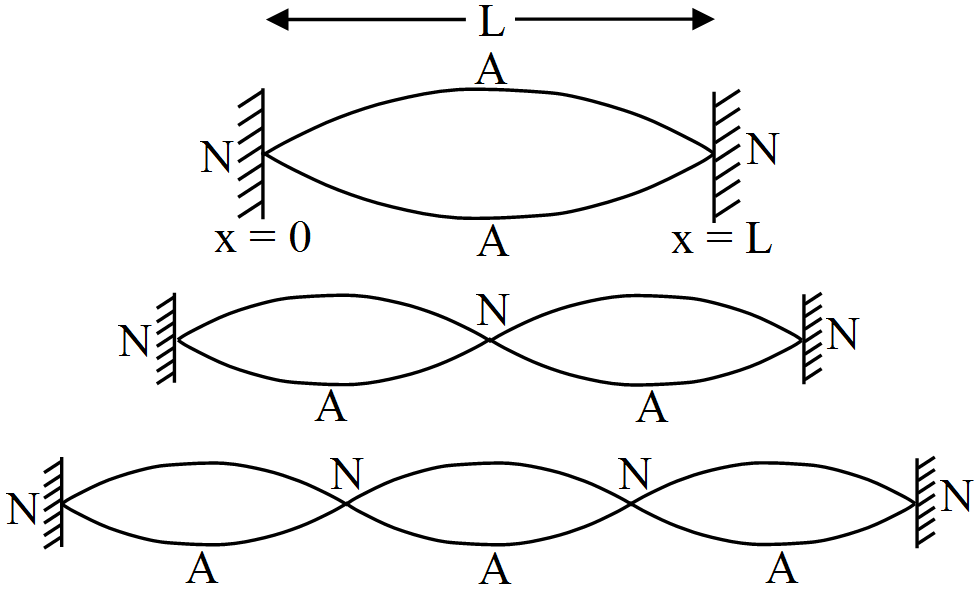
From the figures, we see that there are two nodes in the first normal mode of vibration, then three nodes in the second normal mode; and so on, therefore in the nth normal mode of vibration, there will be (n + 1) nodes.
These nodes are located at $\text{x}=0,\frac{\text{L}}{\text{n}},\frac{3\text{L}}{\text{n}},...\text{L}.$
Position of Antinodes: At antinodes, displacement is maximum. As antinodes are located in between the nodes; therefore, their position will be given by
$\text{x}=\frac{\text{L}}{2\text{n}},\frac{3\text{L}}{2\text{n}},\frac{5\text{L}}{2\text{n}},...,\frac{(2\text{n}-1)\text{L}}{2\text{n}}$
where n= 1, 2, ... View full question & answer→Question 915 Marks
Discuss Newton's formula for the velocity of longitudinal waves in air. What correction was applied by Laplace and why?
AnswerAccording to Newton, as wave propagates through a medium, temperature is a constant and so propagation is an isothermal process, satisfying PV = Constant. Differentiating, we get.PdV + VdP = 0
$\Rightarrow\text{P}=-\frac{(\text{dP})}{\Big(\frac{\text{dV}}{\text{V}}\Big)}=\text{B}$
Since velocity of sound waves is $\nu=\sqrt{\frac{\text{B}}{\rho}}$
we have, $\nu=\sqrt{\frac{\text{P}}{\rho}}$
According to Laplace, temperature can change, but heat energy change should be zero and so the process is adiabatic. Hence Laplace corrected it as,
$\nu=\sqrt{\frac{\gamma\text{P}}{\rho}},$ where $\gamma$ is the ratio of molar-specific heat capacities at constant pressure and volume (i.e.,) $\gamma =\frac{\text{C}_\text{p}}{\text{C}_\nu}.$
View full question & answer→Question 925 Marks
If c is r.m.s. speed of molecules in a gas and v is the speed of sound waves in the gas, show that c/ v is constant and independent of temperature for all diatomic gases.
AnswerWe know that $\text{c}\sqrt{\frac{3\text{p}}{\rho}}$ for molecules.
$\text{c}=\sqrt{\frac{3\text{RT}}{\text{M}}}$
$\therefore\frac{\text{p}}{\rho}=\frac{\text{PT}}{\text{M}}\because\frac{\text{P}}{\rho}=\frac{\text{RT}/\text{V}}{\text{M/V}}$
M = molar mass of gas
$\text{v}=\sqrt{\frac{\gamma\text{P}}{\rho}}=\sqrt{\frac{\gamma\text{RT}}{\text{M}}}$
$\therefore\text{RV}=\text{nRT}$
$\text{n}=1$
$\text{p}\frac{\text{PT}}{\text{V}}$
$\frac{\text{c}}{\text{v}}=\frac{\sqrt{\frac{3\text{RT}}{\text{M}}}}{\sqrt{}\frac{\gamma\text{RT}}{\text{M}}}=\sqrt{\frac{3}{\gamma}}$
$\gamma=\frac{\text{C}_\text{P}}{\text{C}_\text{v}}=$ adiabatic constant for diatomic gas
$\gamma=\frac{7}{5}$
$\therefore\frac{\text{c}}{\text{v}}=\sqrt{\frac{3}{7/5}}=\sqrt{\frac{15}{7}}=$ constant.
View full question & answer→Question 935 Marks
Explain Doppler effect in sound. Obtain an expression for apparent frequency of sound when source and listener are approaching each other.
AnswerWhenever there is a relative motion between a source of sound and listener, the apparent frequency of sound heard by listener is different from actual frequency of sound emitted by the source.
Let S be a source of sound and L, the listener of sound, both initially at rest. Let v be the actual frequency of sound emitted by the source and a be the actual wavelength of sound emitted. If v is velocity of sound in still air, then
$\lambda=\frac{\nu}{\text{V}}$
Let the distance between source and listener be V, so that v waves from the source reach listener in 1 second.
$V_m$= Velocity of medium, $V_s$ = Velocity of source, $V_L$ = Velocity of listener
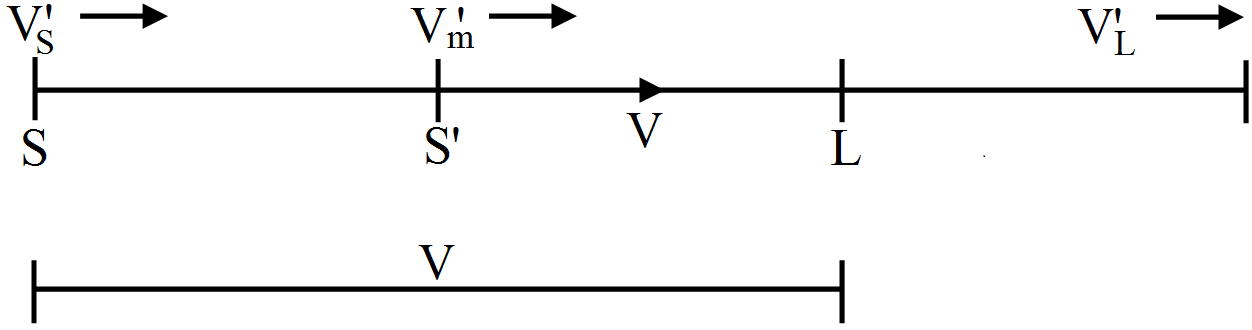
Resultant velocity of sound along
$SL = (V + V_m)$
SS; = distance proved by source in 1sec.
= $V_s$ along SL
$\therefore$ Relative velecity of sound w.r.t. source = $[(V + V_m) - V_s]$
As the frequency remains unchanged.
$\therefore$ V waves emitted in one second occupy the distance $[(V + V_m) - V_s]$
$\lambda'=\frac{[\text{V}+\text{V}_\text{m}-\text{V}_\text{s}]}{\nu}$
LL; = VL Relative vel. of sound waves w.r.t. listener $[(V + V_m)_- VL]$
Apparent frequency of sound waves heard by listener is $\text{v}'=\frac{(\text{V}+\text{V}_\text{m})-\text{V}_\text{L}}{\lambda'}$
$\text{v}'=\frac{[(\text{V}+\text{V}_\text{m})-\text{V}_\text{L}]}{(\text{V}+\text{V}_\text{m}-\text{V}_\text{S})}$
when both approach each other $\text{V}_\text{S}=(+),\text{V}_\text{L}=(-)$
$\text{v}'=\frac{\text{V}-(-\text{V}_\text{L})}{\text{V}-\text{V}_\text{S}}\text{v}=\Big(\frac{\text{V}+\text{V}_\text{L}}{\text{V}-\text{V}_\text{S}}\Big)\text{v}.$ View full question & answer→Question 945 Marks
What are stationary waves? How are they formed in strings? Draw the various modes of vibration in them.
AnswerStationary or Standing Waves:
Formed by two waves moving in opposite directions interacting. They may have equal or unequal amplitudes and generally equal frequencies. $\text{Y}=\pm2\text{A}\sin\text{kx}\cos\omega\text{t}$ refers to a standing wave, where nodes and antinodes are alternatively formed with a separation $\frac{\lambda}{2}.$

Given wave: $\text{Y}_\text{i}=\text{A}\sin(\omega\text{t}-\text{kx})$
Reflacted wave; $\text{Y}\text{r}=\text{A}\sin(\omega\text{t}+\text{kx}+\pi)$
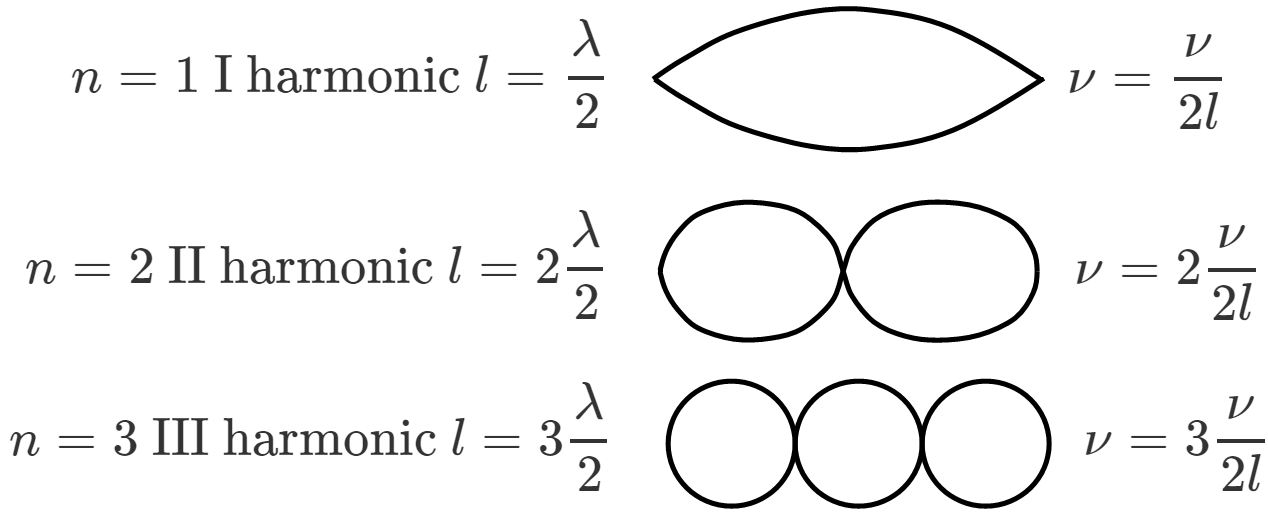
In strings, stationary waves formed profuce frequencies, multiple of $\Big(\frac{\nu}{2\text{l}}\Big)$ or harmonics of $\Big(\frac{\nu}{2\text{l}}\Big)$ .i.e., $\text{v}=\frac{\text{n}\nu}{2\text{l}}=\frac{\text{n}}{2\text{l}}\sqrt{\frac{\text{T}}{\mu}}.$
Since $\text{v}=\frac{\text{n}\nu}{2\text{l}},$ the pattern can be shown as below:
Applying superposition principle,
$\text{y}=\text{Y}_\text{i}+\text{Y}_\text{r}$
$=\text{A}\sin(\omega\text{t}-\text{kx})-\text{A}\sin(\omega\text{t}+\text{kx})$
$\text{y}=2\text{A}\sin\text{kx}\cos\omega\text{t}.$
Since amplitude $2\text{A}\sin\text{kx}$ varies with position, it represerts a standing wave. View full question & answer→Question 955 Marks
Stationary waves are set up by the superposition of two waves given by $\text{y}_1=0.05\sin(5\pi\text{t}-\text{x})$ and $\text{y}_2=0.05\sin(5\pi\text{t}),$ where x and y are in metre and t in sec. Calculate the displacement of a particle at a distance of x = 1m.
AnswerUsing superposition principle, the resultant displacement at time t is given by
$\text{y}=\text{y}_1+\text{y}_2$
$=0.05\sin(5\pi\text{t}-\text{x})+0.05\sin(5\pi\text{t}+\text{x})$
$=0.05\times2\sin\Big(\frac{5\pi\text{t}-\text{x}+5\pi\text{t}+\text{x}}{2}\Big)$
$\cos\frac{5\pi\text{t}+\text{x}-5\pi\text{t}+\text{x}}{2}$
$=0.1\sin5\pi\text{t}\cos\text{x}$
$\text{y}=[0.1\cos\text{x}]\sin5\pi\text{t}$
Amplitude $\text{r}=0.1\cos\text{x}$
At $\text{x}=1\text{m, r}=0.1\cos1=0.1\cos\frac{180}{\pi}$
$=0.1\cos57.3^\circ$
$=0.1\times0.5406$
$=0.054\text{m}.$
View full question & answer→Question 965 Marks
Show that when a string fixed at its two ends vibrates in 1 loop, 2 loops, 3 loops and 4 loops, the frequencies are in the ratio 1 : 2 : 3 : 4.
AnswerLet n be the number of loop in the string.The length of each loop is $\frac{\lambda}{2}$
$\therefore\text{L}=\frac{\text{n}\lambda}{2}$ or $\lambda=\frac{2\text{L}}{\text{n}}$
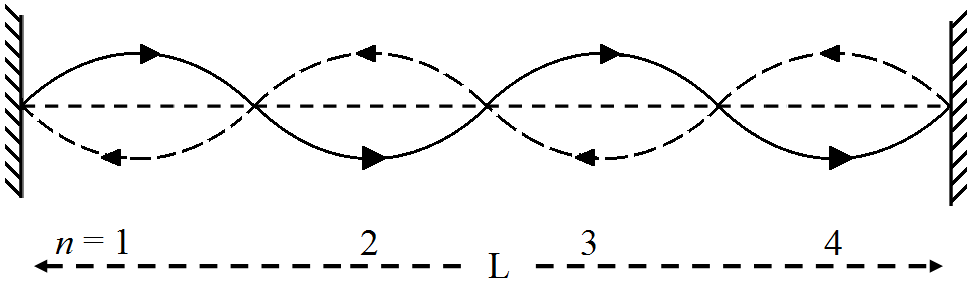
$\text{v}=\text{v}\lambda$ and $\lambda=\frac{\upsilon}{\text{v}}.$
so $\frac{\upsilon}{\text{v}}=\frac{2\text{L}}{\text{n}}$
$\text{v}=\frac{\text{n}}{2\text{L}}.\text{v}$ v is stretch string $=\sqrt{\frac{\text{T}}{\text{m}}}$
$\therefore\text{v}=\frac{\text{n}}{2\text{L}}\sqrt{\frac{\text{T}}{\text{m}}}$
For n =1, $\text{v}_1=\frac{1}{2\text{L}}\sqrt{\frac{\text{T}}{\text{m}}}=\text{v}_0$
If n = 2 then $\text{v}_2=\frac{2}{2\text{L}}\sqrt{\frac{\text{T}}{\text{m}}}=2\text{v}_0$
n = 3 then $\text{v}_3=\frac{3}{2\text{L}}\sqrt{\frac{\text{T}}{\text{m}}}=3\text{v}_0$
$\therefore\text{v}_1:\text{v}_2:\text{v}_3:\text{v}_4:=\text{n}_1:\text{n}_2:\text{n}_3:\text{n}_4:=1:2:3:4$ View full question & answer→Question 975 Marks
A simple harmonic wave is expressed by equation:
$\text{y}=7\times10^{-6}\sin\Big(800\pi\text{t}-\frac{\pi}{42.5}\text{x}\Big)$
where y and x are in cm. and t in seconds. Calculate the following:
- Amplitude.
- Frequency.
- Wavelength.
- Wave velocity.
- Phase difference between two particles separated by 17.0cm.
AnswerComparing the given equation with
$\text{Y}=\text{A}\sin(\omega\text{t}-\text{kx}),$ we get
- Amplitude $=\text{A}=7\times10^{-6}\text{cm}$
- Frequency $=\text{v}=\frac{\omega}{2\pi}=\frac{800\pi}{2\pi}=400\text{Hz}$
- Wavelength $=\lambda=\frac{2\pi}{\text{k}}=\frac{2\pi}{\Big(\frac{\pi}{42.5}\Big)}=85\text{cm}$
- Wave velocity $=\nu=\frac{\omega}{\text{k}}=\frac{800\pi}{\Big(\frac{\pi}{42.5}\Big)}$
$=3400\text{cm s}^{-1}$
$=340\text{ms}^{-1}$
- Using $=\frac{\phi}{2\pi}=\frac{\text{x}}{\lambda},$ we get
Phase difference $=\phi=\frac{2\pi}{85}\times17$
$=\frac{2\pi}{5}\text{radian}$ View full question & answer→Question 985 Marks
Discuss the various factors influencing velocity of sound. A sonometer wire of length $110cm$ is stretched with a tension T and fixed at its ends. The wire is divided into three segments by placing two bridges below it. Where should the bridges be placed so that the fundamental frequencies of the segments are in the ratio $1: 2: 3$?
AnswerFor factors influencing velocity of sound, see text.
Numerical: Let $L_1, L_2$, and $L_3$ be the lengths of the segments of wire AB (Fig.).
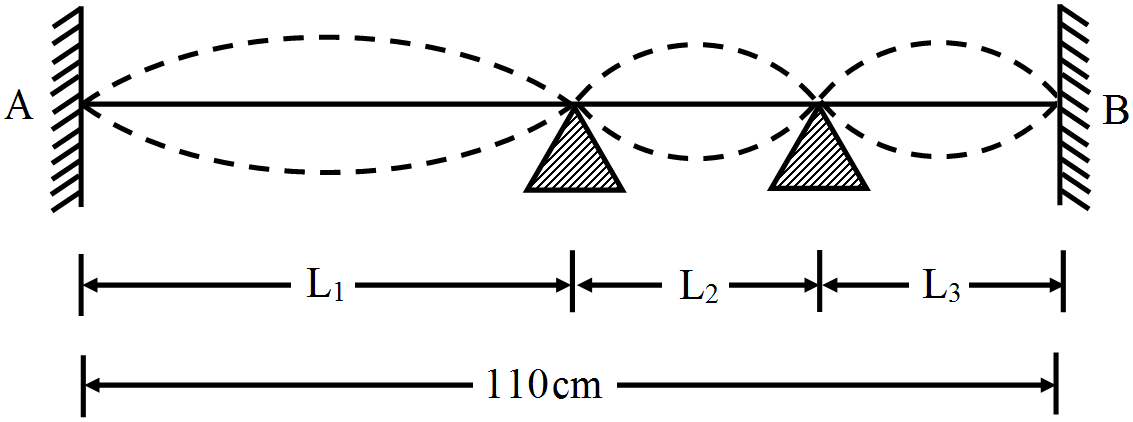
Then
$L_1 + L_2 + L_3 = 110cm$ ...(1)
Let $n_1 n_2$ and $n_3$ be their respective fundamental frequecies, Thus
$\text{n}_1=\frac{1}{2\text{L}_1}\sqrt{\frac{\text{T}}{\text{m}}}$
$\text{n}_2=\frac{1}{2\text{L}_2}\sqrt{\frac{\text{T}}{\text{m}}}$ and $\text{n}_3=\frac{1}{2\text{L}_3}\sqrt{\frac{\text{T}}{\text{m}}}$
Hence $\text{n}_1\text{L}_1=\text{n}_2\text{L}_2=\text{n}_3\text{L}_3\ \dots(2)$
But $\text{n}_1:\text{n}_2:\text{n}_3=1:2:3$
$\therefore \text{n}_2=2\text{n}_1$ and $\text{n}_3=3\text{n}_1\ \dots(3)$
From (2) and (3) we have
$\text{L}_1=2\text{L}_2=3\text{L}_3\ \dots(4)$
Substituting (4) in (1) we get
$\text{L}_1+\frac{1}{2}\text{L}_1+\frac{1}{3}\text{L}_1=110$
$\text{L}_1=60\text{cm}$
Hence $\text{L}_2=30\text{cm}$ and $\text{L}_3=20\text{cm}$
Thus, the bridges should be placed at distances of 60cm and 90cm from end A. View full question & answer→Question 995 Marks
A wire stretched between two rigid supports vibrates in its fundamental mode with a frequency of $45Hz$. The mass of the wire is $3.5 \times 10^{–2}kg$ and its linear mass density is $4.0 \times 10^{–2}kg m^{–1}$. What is
- The speed of a transverse wave on the string,
- The tension in the string?
Answer
- Mass of the wire, $m = 3.5 \times 10^{–2}kg$
Linear mass density, $\mu=\frac{\text{m}}{\text{l}}=4.0\times10^2\text{kg m}^{-1}$
Frequency of vibration, v = 45Hz
$\therefore$ length of the wire, $\text{l}=\frac{\text{m}}{\mu}=\frac{3.5\times10^{-2}}{4. 0\times10^{-2}}=0.875\text{m}$
The wavelength of the stationary wave $(\lambda)$ is related to the length of the wire by the relation:
$\lambda=\frac{2\text{l}}{\text{m}}$
where,
n = Number of nodes in the wire
For fundamental node, n = 1:
$\lambda=2\text{l}$
$\lambda=2\times0.875=1.75\text{m}$
The speed of the transverse wave in the string is given as:
$\text{v}=\text{v}\lambda=45\times1.75=78.75\text{m/s}$
- The tension produced in the string is given by the relation:
$\text{T}=\text{v}^2\mu$
$=(78.75)^2\times4.0\times10^{-2}=248.06\text{N}$ View full question & answer→Question 1005 Marks
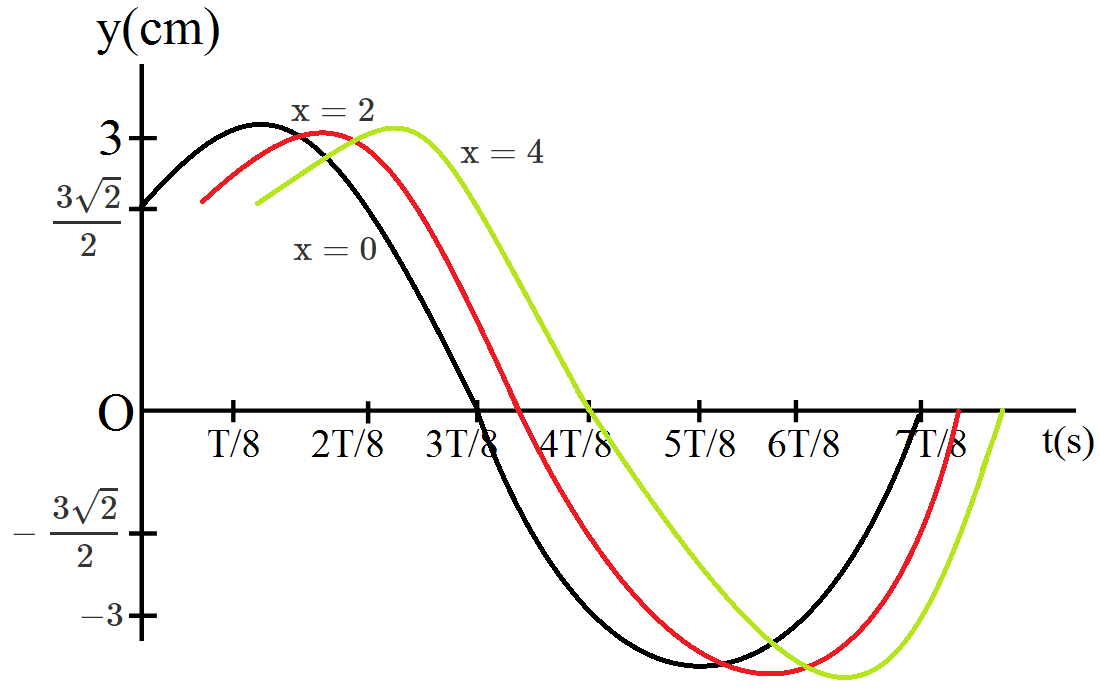
For the wave described in Exercise 15.8, plot the displacement (y) versus (t) graphs for x = 0, 2 and 4cm. What are the shapes of these graphs? In which aspects does the oscillatory motion in travelling wave differ from one point to another: amplitude, frequency or phase?
AnswerAll the waves have different phases. The given transverse harmonic wave is: $\text{y}(\text{x, t})=3.0\sin\Big(36\text{t}+0.018\text{x}+\frac{\pi}{4}\Big)\ \dots(\text{i})$ For x = 0, the equation reduces to: $\text{y}(\text{x, t})3.0\sin\Big(36\text{t}+\frac{\pi}{4}\Big)$ Also, $\omega=\frac{2\pi}{\text{t}}=36\text{ rad/s}^{-1}$ $\therefore\ \text{t}=\frac{\pi}{18}\text{s}$ Now, plotting y vs. t graphs using the different values of t, as listed in the given table
| t (s) |
0 |
T/8 |
2T/7 |
3T/8 |
4T/8 |
5T/8 |
6T/8 |
7T/8 |
| y (cm) |
$\frac{3}{\sqrt{2}}$ |
3 |
$\frac{3}{\sqrt{2}}$ |
0 |
$-\frac{3}{\sqrt{2}}$ |
–3 |
$-\frac{3}{\sqrt{2}}$ |
0 |
View full question & answer→